What Is the Second Exodus & When Does It Occur?

The children of Israel left Egypt on the first day of the Feast of Unleavened Bread, and crossed through the Red Sea on the last or seventh day of this feast. This was the first exodus. But there’s more!

The biblical prophets speak of a greater or second exodus to occur in the last days where YHVH’s people who’ve been scattered throughout the nations of the world will be set free from their spiritual, economic and political enslavement in the nations, which are under the control of Babylon the Great. There is much to learn on this subject, and it’s an important subject to study, since it affects your spiritual destiny.

The following article is a comprehensive analysis of this topic, which explores all the biblical scriptures on the subject of the second exodus. It’s a long one article, but try to stay with it and read it to the end. It will help you to understand end times Bible prophecy in a way that only a privileged and enlightened few do. You have never read anything like this before. It will help you to understand where you personally fit into end times Bible prophecy!

A Look at End-Times Bible Prophecies Relating to the Second Exodus

By Ya’acov Natan Lawrence

The Issue in People’s Hearts

The Bible clearly teaches that the ten tribes of the ancient northern kingdom of Israel (known biblically by various names such as the house of Israel, Samaria or Ephraim) were exiled among the nations of the world because of sin (1). At the same time, the biblical prophets and Jewish sages over the past 2000 years have predicted that in the end times (at the coming of the Messiah), through a series of supernatural events, these tribes will be regathered and return to the land of Israel to be reunited with their Jewish brethren who are descended from the southern kingdom of Judah (2). Furthermore, there is clear biblical and historical evidence that the ten northern tribes of Israel collectively known as Ephraim are largely to be found among the Christian peoples scattered across the earth. I have attempted to prove this point from biblical, linguistic, archeological, historical and rabbinic Jewish sources in a previous work (3)) .

In these last days before Messiah’s second coming, more and more redeemed believers in Yeshua (the Hebrew name for Jesus) are discovering a new-found love for the Jewish people and the land of Israel. At the same time, they are awakening to the need to return to the Hebrew roots of the Christian faith by adhering to a more Torah-centered lifestyle and spiritual walk. It then follows that some are coming to the fundamental truth taught Continue reading →


Exodus 34: A Prophecy About the Second Coming

Exodus 34:1–35, Moses’ second ascension of Mount Sinai is a prophetic picture of the saints’ resurrection and glorification at the second coming of Yeshua the Messiah.

According to Jewish tradition, Moses ascended Mount Sinai to receive the second set of stone tablets containing the Ten Commandments on the first day of the sixth month or 30 days before Yom Teruah, which occurs on the first day of the seventh month. Forty days later on Yom Kippur he descended from the mountain carrying with him the second set of tablets as a sign of YHVH’s forgiveness of the children of Israel after the golden calf incident. This signaled YHVH’s renewed relationship with Israel after they had repented of golden calf worship.

We know that a biblical Israelite bride, while waiting for her betrothed to arrive from his father’s house, would hear the sound of the shofar in the distance as her bridegroom approached. If she were alert and not asleep (as were the ten virgins in Matt 25), she would have had time to put on her wedding robes, trim her lamp’s wick, and have it filled with oil and ready to light as soon as he arrived.

Prophetically, the Scriptures tells us that the saints of Yeshua are to be resurrected and to meet the returning Messiah Yeshua in the air at the seventh or last shofar blast on Yom Teruah (Day of the Trumpets, Shouting or Shofar Blasts, see 1 Cor 15:52; Rev 11:15–18). From the time the saints begin hearing the shofar blasts in the distance signaling the arrival Continue reading →


The Golden Calf Incident: A Prophetic Picture of the Church

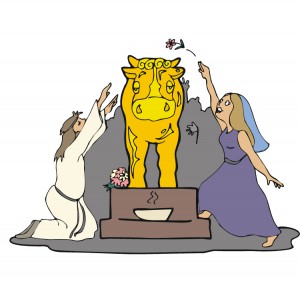
Exodus 32, On Shavuot (the Feast of Weeks or Pentecost), at Mount Sinai, YHVH entered into a marriage covenant with the children of Israel, but they were not ready to live up to the terms of that covenant. Those terms, simply stated, involved the Israelites being faithful and obedient only to YHVH, Israel’s Elohim (God) and spiritual husband, and to his instruction in righteousness, the Torah. This Israel quickly demonstrated they were not willing to do, for they had hardly said “I do” to their marriage vows (Exod 24:3, 7) when they turned their hearts away from YHVH and began worshipping the golden calf—a pagan deity from Egypt. After the golden calf incident and up until Yom Teruah (the Day of Trumpets or Shofar Blasts) when Moses received the second tablets of stone from YHVH containing the Ten Commandments, the children of Israel, the bride of YHVH, prepared herself not only to receive YHVH’s instructions again, but this time to be faithful to her marriage vows. This Israel did. She remained faithful to YHVH for approximately 38 years while trekking through the wilderness of Sinai, after which she entered the Promised Land and “stayed the course” until after the death of Joshua.

Golden Calf 6 21409020

Sadly, the cycles of history often repeat themselves. This time, it involved the descendants of the children of Israel who were at Mount Sinai. In the early first century A.D.,  the redeemed Israelite followers of Yeshua received the Torah written on the fleshly tablets of their hearts by the finger of the Spirit of Elohim on the Day of Pentecost (Shavuot) as recorded in Acts 2. But starting at about A.D. 70 with the destruction of the temple in Jerusalem and continuing up through the Second Jewish Revolt of A.D. 135 until the time of Emperor Constantine (in the fourth century), the first-century spiritual bride of Messiah had, for the most part, abandoned YHVH’s Torah-commandments and turned, to one degree or another, to a mixed form of worship (of which ancient Israel’s worship at the golden calif was a prophetic foreshadow) where some pagan practices were assimilated into the early churches’ belief system (most notably, Sunday replaced the Sabbath, and Christmas, Easter and other paganistic holidays replaced the biblical feasts).

Moses’ descent of Mount Sinai on Yom Teruah with the second set of tablets containing the Torah prophetically foreshadows Yeshua’s second coming. As Moses renewed YHVH’s Continue reading →


New Video: Yeshua’s Triumphal Entry—Prophetic Implications

This video discusses Yeshua’s triumphal entry, his cursing the fig tree and overturning the moneychangers’ tables how and these events contain a prophetic subtext that point to events that will occur at his second coming.


New Video: Joseph, Judah and the Two Messiahs

This video discusses the prophetic implications of Genesis 44:18 and Judah presenting himself to Joseph and how this is a prophetic picture of Yeshua the Messiah, the Suffering Servant as opposed to the Conquering King.


Will the Saints Go Through the Great Tribulation?

Genesis 7:9, After seven days. Noah was a preacher of righteousness for 120 years prior to the flood (Gen 6:3). He no doubt endured the mockery and persecution of those who did not believe his message about a coming flood, and the need for an ark of safety when that generation had never experienced rain or floods (Heb 11:7; 2 Pet 2:5).

Rain 20107088

In Genesis 7:4 YHVH allows Noah to experience seven more days of persecution before the rains of judgment come upon the earth after which YHVH shut Noah and his family up in the ark of safety (Gen 7:16) after which the ark “was lifted above the earth” (Gen 7:17).

Yeshua likens the end times just prior to his return to the days of Noah (Matt 24:37–39). Yeshua further teaches that his saints will not only go through tribulation on this earth (Matt 24:3–22), but that his people will even go through “great tribulation” (Greek: megathlipsis, v. 21).

After this, Yeshua teaches that the saints will be lifted up above the earth to meet him in the air after the great tribulation (Matt 24:29–31). The Scriptures reveal that Noah endured another seven days of tribulation before the wrath of Elohim was poured out upon the wicked inhabitants of the earth. This may be a prophetic picture of a seven-year tribulation period the saints will have to go through before the wrath of Elohim (which is different than the tribulation period) is poured out upon this earth (See Rev 11:15–18 [compare with 1 Cor 15:51–53] and chapters 15 and 16 where the seven last plagues are called the wrath of Elohim).

The Scriptures clearly teach that YHVH’s people will not have to endure his wrath (1 Thess 1:10; 5:9), but conversely teaches that all will go through tribulation (John 16:33; Acts 14:22; Rev 7:14). Scripturally, tribulation and wrath are two different words and concepts.


New Video: Yom Teruah Past, Present and Future

In this video, I discuss Yom Teruah vs. Rosh Hashanah, the end-time prophetic implications of YT relating to the resurrection and second coming, and everything you want to know about the shofar including how it was used historically, why you should have one, how the shofar is at the center of the YT celebration.