Time to Awaken from Spiritual Slumber—Messiah Is Coming!

This year, the biblical festival of Yom Teruah (the Day of Shofar Blowing or Shouting or “Rosh Hashanah”) will likely be on Sunday, Sept. 8 according to the ancient biblical Hebrew calendar. This festival is a prophetically pictures the  beginning of the events that will surround the second coming of our Lord, Yeshua the Messiah. It is time to get ready, for no man knows the day or the hour of the King’s coming! 

“Arise thou that sleepest, and arise from the dead, and Messiah shall give thee light.” (Eph 5:14, also 8–16)
Shofar blower-36093847

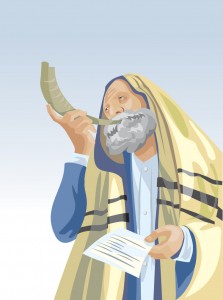
Yom Teruah or the Day of Shouting or the Shofar Blasts (commonly called “Rosh Hashanah”) occurs at the end of the summer months and marked the beginning of the fall harvest and biblical festival season for the ancient Hebrews. Prophetically, the summer months between the spring Feast of Weeks (Heb. Shavuot or Pentecost) and the fall feast of Yom Teruah is a spiritual picture of what is often called the “Church Age,” which is the period of time from the Feast of Pentecost in Acts 2 until the return of Yeshua the Messiah at the end of the age and lasting for approximately 2000 years. For many, especially those living in hotter climes, summer is a time of leisure, vacation, weariness and fatigue due to the excessive heat. Likewise, many Bible believers have fallen asleep spiritually growing weary while waiting for the return of the Messiah. Yeshua discusses this issue in the Parable of the Ten Virgins (Matt 25) who are all found snoozing awaiting the coming of the Bridegroom (Yeshua).

This all changes on the first day of the seventh month of the biblical Hebrew calendar when off in the distance the sound of a shout (or shofar blast?) suddenly pierces the atmosphere and awakens the virgins from their summer doldrums. Not only does the sound signal the beginning of the seventh month when the new crescent moon is sighted, but it announces the return of the Bridegroom (Yeshua) coming for his bride (the virgin saints). As in the Parable of the Ten Virgins, the cry went forth that the bridegroom was coming and all awoke from their slumber to prepare for his arrival. In these end days, that cry is going forth even now for all to hear, to awake and to prepare for the arrival of Yeshua the Messiah.

In the biblical calendar, the visible sighting of the crescent new moon always marks the beginning of the month and is announced by the shofar blast (Ps 81:3). Likewise, on the first day of the seventh month of the biblical calendar, the arrival of the new moon (Heb. rosh chodesh) when the shofar sound marks the beginning of Yom Teruah. This is the first day of the fall (festival) harvest season and is the time when the call goes out for the Continue reading →


After Two Days (Is That Now?)

Hosea 5:15–6:3, I will go and return to my place. This passage is a clear prophecy concerning the resurrection of the righteous dead of which Messiah Yeshua is the first to raise.

Verse two contains a Hebrew parallelism, which is a Hebraic literary device where the same thought is expressed differently back-to-back. The word revive is the Hebrew word chayah, the basic Hebrew root verb meaning “to live or to have life.” The word raise up is the Hebrew word quwm meaning “to rise, arise, stand, stand up.” According to TWOT, the basic meaning of this word “denotes rising up from a prostrate position (e.g. Josh 3:16).”

YHVH is speaking here in the broader context of this passage concerning his Messianic role as the lion of Judah (Rev 5:5). After presenting himself as such to both houses of Israel (Ephraim [i.e., the Christians] and Judah [i.e., the Jews]) at his first coming, verse 14 states that Messiah would “go away … and none shall rescue him.”

Then in verse 15 we read that, “I [Messiah speaking] will go and return to my place till they [Ephraim and Judah] acknowledge their offense and seek my face ….” (This refers to Yeshua’s absence from the earth between his first and second comings.) What is their offense? Continue reading →


New Video: Elijah and John the Baptist Generations—Rise Up Against Evil!

In the end times before the second coming of Yeshua (Jesus) the Messiah, Elohim (God) is raising up a new generation of righteous servants who will boldly and in the power of the Holy Spirit stand against evil on this earth preparing the way for Messiah. They will walk in the powerful anointing of Phinehas, David, Elijah and John the Baptist. In this video, find out if you’re called to be part of this end-times army of spiritual warriors.


New Video: Islam—YHVH’s Judgment on Christians to Bring Spiritual Revival

This video discusses how the biblical prophets predicted the rise of the demonic religion of Islam in the days before the second coming of Yeshua the Messiah. This would coincide with the end-times spiritual apostasy of Jews and Christians, and would be part of Elohim’s divine plan to lovingly discipline his wayward children and bring them back to him through repentance resulting in spiritual revival and the eventual demise of Islam.


Islam: YHVH’s Judgment to Bring Jews & Christians Back to Him

This is a hard message. Few will be able to receive it. But the watchman must give it anyway (Ezekiel 33:1–11).

The Ancestry of Modern Arabs

In Genesis 32, Esau and his army stood in the way preventing Jacob and his descendants from returning to their homeland — the land YHVH had promised to them. This historical event is prophetic of what will happen in the end times as the Jews and the rest of the Israelites endeavor to receive their promised inheritance and the kingdom of Elohim.

198298

Not only that, YHVH used Esau to test Jacob’s who had grown overly self-confident due to his business acumen and his ability to produce a large family clan. In the ancient world, he had reached the pinnacle of wealth and power. However, what mattered to YHVH more than these things was the character of a man. Would Jacob have faith in his Creator, or would he trust in his own abilities to outwit his adversaries and come out on top as he had done twice previously with his brother Esau and Laban, his uncle? Jacob’s confrontation with his brother at the threshold of the land of Israel and his wrestling with the Messenger from heaven were the two tests that he had to pass. The Bible calls this Jabob’s Trouble and prophesies that something similar will occur in the end times to Jacob’s descendants (Jer 30:7).

According to Genesis 32, Jacob divided his wives and children into two camps (Gen 32:1, 7). This was prophetic of what would eventually occur to the nation of Israel after the death of King Solomon. The one nation of Israel became two houses or kingdoms — the Northern Kingdom of Israel and the Southern Kingdom of Israel. The descendants of these two kingdoms are presently — loosely speaking — the Jews and the Christians. But who are the descendants of Esau historically and, more importantly, today. Why is it important to know?

Many, if not most of the modern Moslems (especially the Arabs) trace their lineage back if not biologically then spiritually to Ishmael, the son of Abraham by Hagar. Islam in its religious book, the Koran, claims that it was Abraham and Ishmael who founded the religion of Islam and built the Kaaba, which is the small building containing a stone that supposedly fell from heaven. This shrine is located in the midst of the great mosque in Mecca, Saudi Arabia. Of Ishmael and his descendents, the Bible prophesies in Genesis 16:11–12,

The Messenger of YHVH said to her further, “Behold, you are with child, and you shall bear a son; and you shall call his name Ishmael, because YHVH has given heed to your affliction. And he will be a wild donkey of a man, his hand will be against everyone, and everyone’s hand will be against him; and he will live to the east of all his brothers.”

The Koran has further twisted the biblical account to declare that the biblical patriarchs were Muslims and that Abraham gave the birthright blessing to Ishamael instead Isaac. Both Israelites and Arabs, therefore, believe that they have a right to the Promised Land of Canaan, and, hence, thus forming the basis for the modern Arab-Israeli conflict. Continue reading →


The New Covenant? Now or Later?

Jeremiah 31:31, New covenant. When does this new covenant take effect?

covenant

Yeshua initiated the new covenant at the Last Supper (Matt 26:28), and will finalize it as per this prophecy at his second coming. It will be finalized after YHVH has gathered (or redeemed, v. 11) all the families of Israel (v. 1; i.e., the houses of Ephraim or Israel­—loosely speaking, the Christians and Judah—loosely speaking, the Jewish people, vv. 9, 20, 27, 31) from the north country, the coasts of the earth and the isles (vv. 8, 10) where they have been scattered, and brings them back to Zion (the land of Israel) with joy, singing and dancing (vv. 12–13, 24). Obviously, this hasn’t happened yet in its entirety. This will occur after Ephraim (Christians) repents (v. 20, of Torahlessness) and YHVH’s daughter turns away from her backsliding (vv. 21–22), and comes out of her captivity (v. 23, in spiritual Egypt or Babylon the Great, see Rev 18:4).

At that time, YHVH will make (or finalize) a new or renewed covenant with the two houses of Israel (vv. 31–33).

Also at this time, all Israel will know Elohim from the least to the greatest. Again, this prophecy has yet to be fulfilled. The writer of Hebrews quotes this verse in Hebrews 8:8. (See notes at Heb 8:8.)


Are You an End-Times Elijah? Here Are Your Marching Orders!

Isaiah 40:1–26, The End-Times Elijah Generation Preparing the Way for Messiah

Isaiah the prophet ministered in Judah for about 40 years from 740 to 697 b.c., approximately 100 years before the southern kingdom of Judah fell to the Babylonians in 586 b.c. Judah’s captivity in Babylon would last for 70 years. The Book of Isaiah contains more messianic prophecies than any other book in the Tankah, and many of those prophecies specifically relate to the redemption through the Messiah of the two houses of Israel.

Elijah against the king 36931605

In the Isaiah 40 prophecy, according to rabbinic understanding, Isaiah is prophesying (in verses 3–5) concerning Israel’s deliverance from exile seventy years after her captivity (The Soncino Pentateuch, p. 777). This is not an incorrect interpretation of this prophecy, although it is not necessarily the only one, for we know, as with many of the Scripture’s ancient prophecies, there are sometimes multiple fulfillments. Because the old adage that says, “history repeats itself,” is true, and because human behavior remains unchanged from time immemorial, though the players and costumes change on history’s theatrical stage, many biblical prophetic themes have cyclical patterns. In the present case, where Isaiah speaks in verse three of “a voice crying in the wilderness,” (Isa 40:3) we know that the gospel writers ­applied this to John the Baptist preparing the way for the coming of Yeshua the Messiah (Matt 3:3; Mark 1:3; Luke 3:4; John 1:23). What in this prophecy did the gospel authors see as applying to Yeshua the Redeemer and Savior of Israel? First, Yeshua himself declared John the Baptist to be that messenger who would prepare the way for the Messiah that Malachi prophesied about (cp. Matt 11:10 and Mal 3:1). The messenger of Malachi 3 and 4 seems to be the same individual mentioned in Isaiah 40. Furthermore, Isaiah 40:3 speaks of preparing the way for YHVH and making a highway in the desert for Elohim. Clearly, the gospel writers recognized that Yeshua was YHVH Elohim based not only on his claims to deity, but based on the fact that Isaiah states that the Messiah, the Redeemer of Israel, would not only be YHVH Elohim, but that he was the arm of YHVH (Isa 53:1) making him a manifestation, if you will, of YHVH.

Not only did the gospel authors see John the Baptist in the Isaiah 40 prophecy (Isa 40:3–4 cp. Matt 3:3; Mark 1:3; Luke 3:4–5; John 1:23) because they recognized who Yeshua was Continue reading →