When the forces of Antichrist come knocking on your door literally or figuratively, what should be our response? Flee, fight, stand your ground, acquiesce or something else? What did the Book of Acts saints do? What was their response to persecution and deprivation of lifestyle expectations and personal and inalienable rights? This is a heavy subject with no easy answers. What did Yeshua instruct us to do? What is the way of the cross? Many of us have never been here before, and we do ourselves a great disservice and place ourselves at a spiritual disadvantage by not discussing these often over-looked subjects.
The following is an email question that I recently received and will then answer below:
I’m asking this tough question for myself but also on behalf others out there. The world ID and money system, or at least part of it, has already been launched and is growing fast.
Q: Which point of view should we have, A or B?
a) It is staunchly against Elohim to take part in this, because it’s the front door to or an early stage of the mark of the beast system and all its surveillance and eventual tyrannical control.
We should instead get out of Babylon and trust in YHVH and refuse to sign up for a system that represents evil globalist tyrants and their world government system which will be used to enslave us,
or
b) This is not the mark of the beast per se. No under the skin mark is presently a requirement of joining or being able to buy or sell using the system. Until that’s the case, there’s no moral or biblical prohibition against signing up for or partaking of the new WorldID system, giving an iris scan, etc. YHVH understands if sooner or later we sign up and become involved in this WorldID/money system. If regular fiat currencies become worthless, we will still have to eat, pay the rent, and buy the necessities of life.
Nathan’s Response
This is a timely question in light of current world events as they relate to end times Bible prophecy. However, the answer to this question is not as simple as the either…or answer suggested above. As we shall see, my answer is much more nuanced, since there are some deeper spiritual implications that we need to consider before determining a course of action vis-à-vis the mark of the beast (Rev 13:15–18). Thusly, in answering this relevant question, we will take this discussion in a different direction than expected. Let’s step outside the paradigmatic box of our natural thinking and step into a different realm and reality—that of the Spirit and the supernatural. As begotten sons and daughters of the Most High Elohim, is not this spiritual dimension our destiny—the higher goal and level to which we are all aspiring? Is not our physical life merely a proving ground, a place to be refined, a school to graduate from and a stepping stone to the blessed higher level or our ultimate existence? Yes! So let’s now explore how we can overcome this satanic world as we appropriate the victory that Yeshua our Messiah experienced when he led the way for us as he overcame all evil to ascend to the right hand of the Power in heaven.
To start with, in several places, the Bible informs us that the just or righteous person shall walk by faith, not by sight. That is to say, our faith ultimately must be in YHVH, not in anything else including the events we see transpiring around us, or other people, ourselves, or what we think we have to do to protect our physical lives.
What is faith? Faith is trusting YHVH to work things out for our ultimate good, regardless of what the physical circumstances around us appear to be. Why is such trusting faith important. The Bible gives many reasons. But for our discussion here, it is because no one knows exactly what will happen in the future, so it is impossible to game our perfectly what to do. Think about this: Look back over the last 40, 30, 20, 10 or even five years of you life. Did everything go exactly as you planned or expected it to go? Probably not. So what makes you think that you will be able to figure out the future including what to do when it comes to your exact course of action in response to preparing not to take the mark of the beast or how you will survive outside the New World Order’s mark of the beast system? Prepare? Yes. Know the exact details? No. This is where faith in YHVH comes in. He knows the end from the beginning, so we must look to him for our future provision and security as to how we will survive without taking the satanic mark. Several scriptures give us guidelines in this regard.
Trust in YHVH with all thine heart; and lean not unto thine own understanding. In all thy ways acknowledge him, and he shall direct thy paths. (Prov 3:5–6)
Trust in YHVH, and do good; so shalt thou dwell in the land, and verily thou shalt be fed. Delight thyself also in YHVH; and he shall give thee the desires of thine heart. Commit thy way unto YHVH; trust also in him; and he shall bring it to pass.…Rest in YHVH, and wait patiently for him: fret not thyself because of him who prospereth in his way, because of the man who bringeth wicked devices to pass.… YHVH knoweth the days of the upright: and their inheritance shall be for ever. They shall not be ashamed in the evil time: and in the days of famine they shall be satisfied.… For such as be blessed of him shall inherit the earth; and they that be cursed of him shall be cut off. The steps of a good man are ordered by YHVH: and he delighteth in his way. Though he fall, he shall not be utterly cast down: for YHVH upholdeth him with his hand. I have been young, and now am old; yet have I not seen the righteous forsaken, nor his seed begging bread.…Wait on YHVH, and keep his way, and he shall exalt thee to inherit the land: when the wicked are cut off, thou shalt see it.… But the salvation of the righteous is of YHVH: he is their strength in the time of trouble. And YHVH shall help them, and deliver them: he shall deliver them from the wicked, and save them, because they trust in him. (Ps 37:3–5, 7, 18–19, 22–25, 34, 39–40).
Therefore I say unto you, Take no thought for your life, what ye shall eat, or what ye shall drink; nor yet for your body, what ye shall put on. Is not the life more than meat, and the body than raiment? Behold the fowls of the air: for they sow not, neither do they reap, nor gather into barns; yet your heavenly Father feedeth them. Are ye not much better than they? Which of you by taking thought can add one cubit unto his stature? And why take ye thought for raiment? Consider the lilies of the field, how they grow; they toil not, neither do they spin: And yet I say unto you, That even Solomon in all his glory was not arrayed like one of these. Wherefore, if Elohim so clothe the grass of the field, which to day is, and to morrow is cast into the oven, shall he not much more clothe you, O ye of little faith? Therefore take no thought, saying, What shall we eat? or, What shall we drink? or, Wherewithal shall we be clothed? (For after all these things do the Gentiles seek:) for your heavenly Father knoweth that ye have need of all these things. But seek ye first the kingdom of Elohim, and his righteousness; and all these things shall be added unto you. Take therefore no thought for the morrow: for the morrow shall take thought for the things of itself. Sufficient unto the day is the evil thereof. (Matt 6:25–34)
In light of these Bible truths, ask yourself this: Since you have been a redeemed believer, during the past 40, 30, 20, 10 or even five years did you ever starve? Go naked? Live homeless? Have to beg for food or shelter? Likely not. YHVH provided. Therefore, have faith that he will take care of you in the future. As the saying goes, prepare as if it were up to us, and pray as if it were up to Elohim.
It is true that YHVH instructs his people to exit Babylon (Rev 18:4). But what exactly does this mean? As far as leaving Babylon goes, is there really any way to leave this global system completely? Realistically, to do so, you would have to leave the planet! The truth is that we will only completely leave Babylon when Yeshua destroys this satanic world order at his second coming and sets the captives free. Think of the children of Israel and their exodus from Egypt. YHVH kept his children safe and protected in the land of Goshen, but they weren’t free to leave Egypt until he brought divine judgment down upon that nation. As Yeshua told his disciples, though we are in the world, we are not of it. That said, YHVH has the sovereign ability to protect his people even in the eye of the proverbial storm.
So let’s now consider the concept of Babylon the Great as the futuristic Book of Revelation presents it. In the past, Babylon was a geographical entity in the Near East—a localized city and a regional empire called Babylonia. Now Babylon is a global technocracy that is run electronically with the help of a power grid, satellites, computers, artificial intelligence, government surveillance, digital banking, biometric identification, robots and much more. It is difficult to operate outside this system including holding a regular job, traveling, purchasing food and the necessities of life and paying your bills, unless you live in a log cabin off-grid in Alaska or the Yukon territory. If so what are you going to do when you are buried under ten feet of snow for months at a time in 40 degree below zero weather and you lose your ax or survival knife, run out of gun powder or flour? Most likely, you will have to go back into the global system to buy these things. How are you going to pay for them? With gold dust? Assuming the stream next to your cabin contains gold. Get the point?
This said, if you can and it is Elohim’s will for you, in the mean time, consider relocating as far outside of urban areas as possible. Cities are environments where people are more easily controlled and surveilled by tyrannical governmental systems. If you relocate to a rural area, you will likely have more privacy and be able to live somewhat self-sufficiently. But even then, if you want to keep your land, you still have to pay your property taxes with money. So now, we’re back in the world’s economic system again. Regardless of where you live, however, YHVH’s arm is not shortened in his ability to protect and provide for you. How? Don’t know. Again, that is where faith comes in.
In this video, Nathan answers the following emailed question:
I’m asking this tough question for myself but also on behalf others out there. The world ID and money system, or at least part of it, has already been launched and is growing fast.
Q: Which point of view should we have, A or B?
a) It is staunchly against Elohim to take part in this, because it’s the front door to or an early stage of the mark of the beast system and all its surveillance and eventual tyrannical control. We should instead get out of Babylon and trust in YHVH and refuse to sign up for a system that represents evil globalist tyrants and their world government system which will be used to enslave us,
or
b) This is not the mark of the beast per se. No under the skin mark is presently a requirement of joining or being able to buy or sell using the system. Until that’s the case, there’s no moral or biblical prohibition against signing up for or partaking of the new WorldID system, giving an iris scan, etc. YHVH understands if sooner or later we sign up and become involved in this WorldID/money system. If regular fiat currencies become worthless, we will still have to eat, pay the rent, and buy the necessities of life.
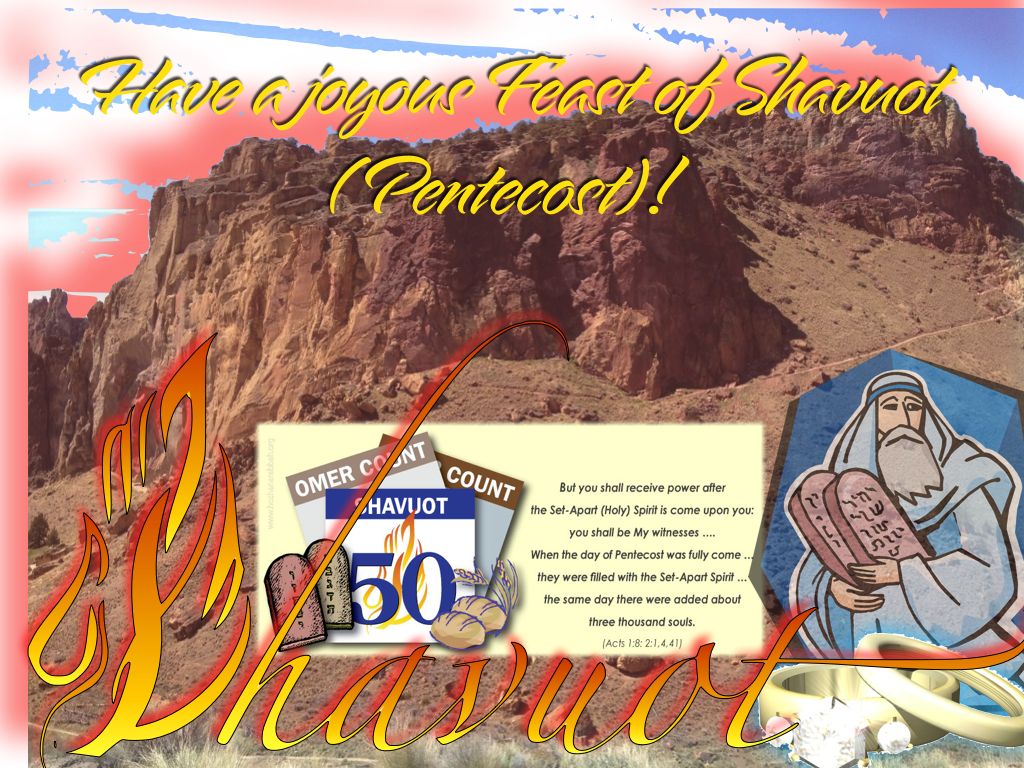
In the roughly 49 days between Passover (Pesach) and the Feast of Pentecost (Chag haShavuot), a momentous spiritual dynamic occurs. This period of time is comprised of forty-nine days or seven days of seven weeks, which is seven times seven—the biblical number for complete or full perfection. Add one day and you arrive at Pentecost. Fifty is the biblical picture of jubilee picturing redemption from the enslavement to this world.
Historically, the children of Israel were redeemed from their sins by the blood of the lamb on the first Passover in Egypt. At this time, YHVH betrothed himself to Israel (Exod 6:7). YHVH then led them out of Egypt into the wilderness, and on Shavuot he married them at Sinai (Exod 24 cp. Ezek 16:8; Jer 2:2; 31:32). At the same time, YHVH gave them his Torah, which was their ketubah or marriage vows.
Shavuot is a picture of the bride of Yeshua the Messiah coming into full maturity spiritually and coming to marriageable age. She has gone from being a spiritual child and slave in Egypt to becoming the fully mature spiritual bride and queen of the King of the universe.
At the time of Yeshua, he betrothed himself to both houses of Israel on Passover. Then, on Pentecost, he then sent his Spirit, the Comforter, as a seal of this covenant. He hasn’t married this bride (that’s you and me) yet — something that occurs at his second coming. In the mean time, he has placed her in a 2000-years-long wilderness to get ready for him — to fall in love with him (to love him by keeping his Torah commands; John 14:15) by receiving his Torah into their hearts.
In the end times, he’s going to bring his bride (the saints) out of the wilderness of Babylon (called the Second Exodus), and they will repent of their Torahless ways. We are now getting ready for this day.
Understanding the prophecies of the Bible that speak of these end-time events, and understanding who the principal players are (the two houses of Israel) is the key to insure that we’re ready for our Messiah — that we’ll be wise and not foolish virgins who have our lamps full of oil (the Torah and Spirit of Elohim).
Shavuot, along with Passover (Pesach) and the Feast of Tabernacles (Sukkot) are three times each year when YHVH commands his people to gather together to celebrate before him (Exod 23:14–17).
To fully comprehend Shavuot, we must step back and view this feast in its context with the other six biblical feasts that YHVH gave to Israel.
YHVH’s Seven Biblical Feasts
The seven annual biblical festivals of YHVH Elohim (or, in our English Bibles, the LORD God), of which Shavuot (Pentecost) is the third of seven, are prophetic shadow-pictures or symbols of the steps that sinful man must take to be reconciled to YHVH Elohim, his Heavenly Father. They are YHVH’s plan for man’s salvation or redemption rolled up into seven easy-to-understand steps. Though even a child can understand these seven feasts, the truths contained in these divine time-space vessels can be expanded and unfolded until the entire message of the Bible from Genesis to Revelation lies open before us like a road map. It is a road that leads us to a trove of spiritual treasures whose vastness and depth is staggering, rich and unfathomable. These feast days are literally the skeletal structure upon which the truths of the entire Bible hang. The message of redemption, sanctification, salvation, the atonement, glorification, end-time events (eschatology), the history of Israel, the entire gospel message, the covenants of the Bible, the marriage of the Lamb, the bride of Messiah and Yeshua the Messiah are all prefigured within the glorious template of YHVH’s set-apart feast days contained in seven steps—seven being the biblical number of divine perfection and completion.
Before delving into the subject of Shavuot, we first need to understand why we should not only study, but also celebrate YHVH’s biblical feasts, and how they relate to the seven steps of redemption. To fully appreciate Shavuot, this background understanding is essential.
Seven Reasons to Study and Celebrate YHVH’s Appointed Times
YHVH’s feasts are a prophetic shadow-picture of things to come (Col 2:16–17; Heb 10:1). When they were given to ancient Israel, they pointed forward to future events that would occur to that nation. The spring feast days, for example, pointed to Messiah’s first coming, while the fall feast days point to his second coming leading into the Messianic Age (or Millennium) and into eternity beyond.
All the feast days point to Yeshua. The name Yeshua means “salvation” and these days all point to the various steps along the path of salvation that redeemed believers find themselves on.
Many of the feast days point back to historical events that occurred in Israel’s history from which we can learn lessons and which are representative of our own spiritual journey (1 Cor 10:1–6,11).
In the Scriptures, YHVH commands his people to keep the biblical feasts. They are called moedim, which is a Hebrew word meaning “divine appointment.” They are times when YHVH makes a spiritual appointment to meet with his people (Lev 23:1–2,4). That time, YHVH teaches his people about his wonderful plan of salvation or redemption of the world through Yeshua the Messiah.
The feasts are in the Bible, which is the inspired Word of Elohim (2 Tim 3:16). He commands his people everywhere to obey his Word and to observe his feasts (Matt 4:4; Lev 23; Matt 5:17–20) forever (Lev 23:14,21,41; Mal 3:6; Heb 13:8)!
The feast days set forth the pattern of heavenly things on earth (Heb 8:1–2, 5; 9:8–9, 23; Exod 25:8–9, 40; 26:30; Num 8:4; Ezek 43:1–6, 10–12).
We as physical beings need physical means and methods to help us understand spiritual realities. YHVH gives us things to do in this physical dimension to help us to understand the supernatural (or spiritual) level (1 Cor 2:9–13).
The Seven Feasts Represent YHVH’s Seven-Steps Plan of Salvation for Mankind
To understand Shavuot we must understand how it fits into the context of the other six biblical feasts that come before and after it. Together all seven festivals of YHVH form a glorious mosaic with each building upon the one before as YHVH’s plan of salvation progressively expands and unfolds.
The first feast of YHVH’s annual festival cycle is Pesach (Passover), which is the first step in a parade of seven prophetic dress rehearsals or set-apart convocationsor appointed times when the Creator of the universe met with his chosen and called out people. These special occasions all point to the redemptive work of Messiah Yeshua in the life of the redeemed believer. There are three festivals in the spring of the year that are prophetic shadow-pictures of Messiah’s first coming to earth, and there are four fall feasts, which are prophetic shadow-pictures of his second coming at the end of this age.
Passover (Pesach)
The first festival in YHVH’s glorious seven-step plan of redemption is Pesach or Passover, which occurs in the early spring of the year at the time of the rebirth of the creation after a long and dead winter season. Likewise, it was the time of the birth of the nation of Israel. The children of Israel had been enslaved in Egypt for many years, but they could not extricate themselves from the death grip of Pharaoh, a picture of Satan, without divine intervention. YHVH heard their cries of anguish, and he instructed them to sacrifice a lamb and smear its blood on the doors of their homes. This they did by faith and YHVH extended his grace and mercy upon them when he spared them from his judgment and passed over their homes. Though sinful and worthy of death, YHVH delivered the Israelites from the wages of their sins, which is death, and at the same time the Egyptians, who were also sinners, received judgment unto death because they were not under the blood of the lamb. The blood of the lamb made it possible for Israel to leave Egypt.
Spiritually one must leave the world (spiritual Egypt), a place of spiritual oppression and slavery, darkness and false religion. This is the realm or kingdom of Satan, the prince of death. One cannot leave the kingdom of darkness on one’s own strength, however. One cannot free oneself from slavery to the strong tyrants and masters of this world, the flesh or the devil. A greater power than these must deliver us from the spiritual slave masters who keep humans in their death grip. Only by the blood of the Lamb of YHVH smeared on the door posts and lintels (representing our actions and thoughts) of our houses (representing our lives) will YHVH’s judgment against sin pass over us. This is because Yeshua the Lamb of YHVH defeated the enemy at the cross and defeated the death sentence or death grip of sin by resurrecting from the grave on the third day after his death (Col 2:12–15). The Israelites, by faith, trusted in the blood of the lamb (a prophetic picture of Yeshua the Lamb to come), and by YHVH’s grace their sins were not credited to their account, but were forgiven them. They were then free to began to leave Egypt.
Feast of Unleavened Bread (Chag HaMatzot)
The Israelites left Egypt on the first day of this seven-day long festival. Leaving Egypt was a relatively simple process, but now began the process of “getting Egypt out of them.” Dying to one’s sin nature and overcoming all the sinful habits in our lives is a process. We cannot do this by our own efforts, but we need the help of the Redeemer to deliver us. This is illustrated during Chag HaMatzot when YHVH commands his people to remove all the physical leavening from their homes. Leavening is a biblical picture of sin, pride and bitterness, since yeast is sour and causes bread to rise and puff up. Pride and hypocrisy deceives one into believing that one is righteous when he is not. This is the state of spiritual delusion in which all humans naturally find themselves.
YHVH has given men six days (or 6000 years) to come to realize his sinfulness. The seventh day of this week-long festival is a high Sabbath day that pictures YHVH’s Messianic Age (Millennium) when humans will be living in harmony with YHVH and resting in the saving work of the blood of Yeshua the Lamb slain from the foundation of the world. It represents victory over sin (leavening).
This concept is illustrated when Israel celebrated the Passover in the Promised Land, and then marched around Jericho for six days. On the seventh day, the walls of Jericho came down! Because of the context of this Scripture passage, it is probable that Israel did this during the seven days of Unleavened Bread and on the seventh day of that festival the walls of Jericho came down (see Josh 6:10–7:1–16). If so, this very well could be a prophetic picture of a similar scenario of what will occur in the near future when the exiled redeemed Israelites return to the land of Israel at the second coming of Yeshua the Messiah. YHVH will have to supernaturally destroy those Canaanite inhabitants of the Promised Land who will be blocking the entry of YHVH’s saints into the land of their promised inheritance.
Okay, let’s be realistic. If end times Bible prophecy is true, and it is, and we are living in the end times, then it is going to get extremely dark before King Yeshua sets foot on this earth once again. The forces of evil are in an epic battle to prevent the inevitable and unstopable advance and ultimate establishment of King Yeshua’s millennial kingdom on earth. However, before this occurs, Scripture tells us that the forces of antichrist will take over the world, and a shroud of satanic darkness will descend on this planet. Despite it all, this is not the time for the saints of the Most High Elohim to shrink back in fear! Yeshua not only instructed his disciples to watch and pray, but to occupy until he comes! How can we do this? Here is a list of helpful suggestions.
Be the most holy and righteous person you can be. The example of your life may be the only Bible that some people will ever read.
In all areas of your life, be salt and light. Let your light shine. Be friendly and happy. Spread love, peace, joy, hope and good will everywhere you go.
Be a river of life to those around you. In every way possible, point them to Yeshua and his Torah-Truth.
Meet people at their point of need, and then share the gospel.
Pray for the sick and everyone else who is in need. Everyone has a need that Yeshua can fulfill.
Feed the hungry physically and spiritually.
Cloth the naked physically and spiritually.
Share the Word of Elohim with people—the hope of the gospel message.
Have lots of children and teach them YHVH’s ways.
Be the educators of your children as the Torah in the Shema passage commands. Don’t leave their education in the hands of the secular, humanistic, antichrist State schools. Homeschool your children.
Teach your children the Bible. For example, you can use Hoshana Rabbah’s free online Torah Explorers year-long study program as a homeschool curriculum.
Start a Bible study, prayer group or home fellowship.
Use social media to influence as many people as possible for the kingdom. Always keep Yeshua and the hope of the gospel message at the center of your outreach efforts. Don’t use social media to pass on fear-porn, weirdness, actual conspiracy theories or silly nonsense. When sharing news items, deal only with reputable sources and provable facts and then point people to the Bible and to Yeshua through it. This can include being a social influencer through having a YouTube channel, a blog, a website, and Facebook page or the like.
If you have a social platform, position of authority or sphere of influence, use them to share the gospel. Platforms can include…
Being a family leader (parent or grandparent)
Being a business owner or leader.
Being in ministry leadership position (pastor, Bible teacher).
Being in a position of social or civil leadership.
Being in a professional position of influence (doctor, teacher, professor, counselor, scientist, lawyer, politician).
Being a social media influencer (start a blog, a podcast, an online video channel, create memes, a social media page).
Be a prayer warrior or intercessor.
Yeshua has called his disciples to be spiritual warriors, and not to shrink back in fear when evil comes!
If YHVH has blessed you with financial resources, use it to help spread the gospel or to support those who are doing so.
Stand up for truth and righteousness wherever and however you can. Be outspoken. Talk to others. Let your voice be heard.
Ask YHVH for ministry assignments such as putting people in your path to whom you can minister, for opportunities to come your way to help advance his kingdom.
These are all ways to occupy until King Yeshua returns. This is how YOU can be salt and light, a menorah on a hill, to those around you, and to help make the world a better thus fulfilling the great commission of Yeshua to “preach” the good news of the kingdom of heaven everywhere to everyone.
What suggestions can you add to the list above? Please share them in the comments section of this article.