The High Priest—A Prophetic Picture of the Saints

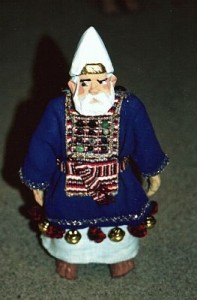
Exodus 39:1, The holy garments for Aaron. The vestments of the high priest (kohen hagadol) are symbolic of the robes of righteousness that saints should be wearing in preparation for the return of the Messiah.

High Priest

  • Gold symbolizes purity of heart.
  • Blue symbolizes heaven and spirituality. White linen pictures robes of righteousness.
  • White symbolizes purity and sinlessness.
  • Red represents blood—the blood of Yeshua that cleanses from sin.
  • The high priest wore a belt that represents truth, according to Paul (Eph 6:14).
  • White linen pants represented sexual purity.
  • The white turban represented purity of thought and humility (the opposite of conceit).
  • He wore a gold crown inscribed with the words, “Kadosh l’YHVH” meaning “Set-Apart to YHVH.”
  • The dangling pomegranates represented the fruits of the Spirit of Elohim, which should be manifesting in the life of the saint. The golden bells jingled when the priest walked.

As we walk through life, people should hear and see our good spiritual fruits. All of our actions speak loudly and clearly as to who we are and what we believe. Also, Continue reading →


Blog Scripture Readings for 3-6 Through 3-12-16

Aside

THIS WEEK’S SCRIPTURE READINGS FOR STUDY AND DISCUSSION:

Parashat Pekudei — Exodus 38:21 – 40:38
Haftarah — 1 Kings 7:51 – 8:21
Prophets — Isaiah 6:1 – 12:6
Writings — Psalms 138:1 – 144:15
Testimony — John 7:25 – 10:21

Most of this week’s blog discussion points will be on these passages. If you have general comments or questions on the weekly Scripture readings not addressed in a blog post, here’s a place for you to post those. Just use the “leave a reply” link below.

The full “Read Through The Scriptures In A Year” schedule, broken down by each day, can be found on the right sidebar under “Helpful Links.” There are 4 sections of scripture to read each day. One each from the Torah, the Prophets, the Writings, and from the Testimony of Yeshua. Each week, the Torah and haftarah readings will follow the traditional one-year reading cycle.

Weekly Blog Scripture Readings for 3/6 through 3/12/16.


What to with your kids on the Sabbath…

Shabbat shalom!

Shabbat shalom!

Shabbat shalom guys!

I got this excellent question this morning from one of our blog readers, which I will answer below. It’s about how to keep the Shabbat in your family when you don’t have a congregation to attend (or even when you have one to attend, for the that matter!):

Hi Natan. Shabbat Shalom!
I am a newbie. And your teachings and encouragements are so fantastic. And as a newbie, I still need practical advise. I am a young father of three young children (under 5). Can you please encourage me on/write a post about/make a video about how to include my kids as much as possible and how I can be as spirit filled as much as I can with kids that really feel like a distraction on the sabbath day. Even more so since this is the day that I want even more to be close to Him. You know what it was like, I am certain. It’s hard enough that there is no assembly here to congregate with, and I am the only person in my circle of life that keeps Shabbat. But I want so much to honor YHVH on the sabbath day, and be filled with his spirit, and give light and life to my children on the sabbath day. But it is really hard.

I have been where you are. My wife and I have four children, and at one time, three were in diapers at the same time!

YHVH has called you to be the priest, prophet and king of your home. You must understand and own these identities, for they are spiritual callings. A priest brought people to YHVH, interceded for the people, and taught YHVH’s people his ways. A prophet declares the word of Elohim over his people, brings the word of Elohim to the people, and points, warns, disciplines and encourages the people. A king Continue reading →


Are you a spiritual “cannibal?”

John 6:54, Flesh…blood. This is a Hebrew idiom for “the whole person” (see Matt 16:17; 1 Cor 15:50; Gal 1:6; Eph 6:12; Heb 2:14). This relates to Moses’ instructions that “man shall not live by bread alone…but by every word that proceeds from the mouth of YHVH” (Deut 8:3).

Communion 5805991

This applies to Yeshua who was that Word of Elohim who “became flesh and dwelt among us” (John 1:1 and 14). When one puts their faith in Yeshua (John 6:29 and 5:24), then one must also believe him—that is, not only accept him as the Son of Elohim and one’s Savior, but also follow and obey (or “eat”) him who is the Living Manna-Word of Elohim from heaven.

This involves believing his words by loving him and keeping his Torah-commands (John 14:15, 23 cp. Exod 20:6), which are his literal words. This is why YHVH instructed the Israelites to eat the whole Passover lamb, and to leave nothing left over (Exod 12:10).

This teaches us that we are to “eat” all of Yeshua—his whole Person as represented by the bread and the wine at communion on Passover. We are to accept the totality of his Word, not just the parts that suit us, or fit with our conventional religious viewpoints as per the traditions of men.

Many claim to eat all of his flesh and drink all of his blood, yet through their anti-Torah theologies they rip pages out of their Bibles and toss them into the spiritual trash can claiming it is for the Jews and not for them.

This is exactly what Adam and Eve did when they listened to the serpent’s lies at the tree of knowledge and rebelled against YHVH’s clear commands. The Bible defines sin as violating the words, commands or Torah of Elohim (1 John 3:4). It is also a sin not to believe in Yeshua (John 16:9; 3:18–19) who is the Living Torah-Word of Elohim incarnate. It is also sin to act in unrighteousness (1 John 5:17). The Bible defines unrighteousness as violating YHVH’s Torah commands (Ps 119:172), which are the words of Yeshua. In summary, when we accept all of Yeshua by eating his flesh and drinking his blood, (i.e., partaking of the bread and wine at communion) we are confessing that we accept the totality of who he was and is.

If we fail to believe and obey all of his words, then to the degree that we do so we are walking in sin, don’t love him and don’t even know him (1 John 2:3–4).


Three Doors, Five Bars and Four Pillars and How They Point to Yeshua

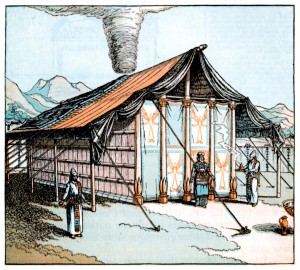
Exodus 36:32, Five bars. To what might these prophetically point? Possibly two things. There are five books in the Torah, which contain the light of Elohim’s truth, and which point man to Yeshua the Messiah who is the Living Torah-Word of Elohim and the spiritual light of the world.
Tabernacle-b 257138

Furthermore, upon his ascension, Yeshua gave the fivefold ministry (apostle, prophet, evangelist, shepherd and teacher) to bring the saints into “the measure of the stature of the fullness” of himself (Eph 4:10–13). It is the duty of those who hold these ministry offices to reveal to the world the light of Yeshua the Messiah and to show people the way to him.

Even as these five bars helped to hold up the tabernacle sanctuary containing the furnishings that pointed the way to a more intimate spiritual relationship with Yeshua, the Torah is the vessel that contains the truth that points the way to the Messiah, and he has commissioned his ministers to be anointed vessels who contain the message of Yeshua and are to proclaim him as the Savior of the world.

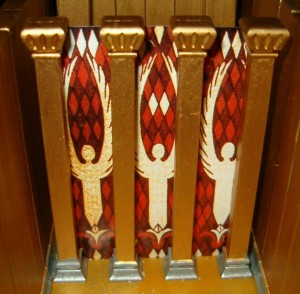
Exodus 36:35, He made a veil. There were three doors to the tabernacle or mishkan. In the previous chapter, two are mentioned (Exod 36:35–37; see also Exod 26:31–37). The three doors are the veil or parochet between the set-apart place and the most set-apart place, the outer door to the tabernacle and the door or screen to the tabernacle courtyard.
tabernacle veil

Yeshua likened himself to a spiritual door that one must enter in order to saved  and to experience an abundant life (John 10:7–10). As we have learned in our other studies on the Tabernacle of Moses, everything about it prophetically points to Yeshua the Messiah. The door to the set-apart place of the tabernacle was held up by four gold-covered acacia wood pillars. These represent the four Gospels, which proclaim the good news salvation through Messiah. Moreover, these four books of the Bible are the entry point through which most people come when first hearing the message of Yeshua.

Each of the three doors was blue, scarlet, purple and white. All three colors point to different aspects of Yeshua, his origin and mission (blue is for heaven, scarlet is for blood, white is for spiritual purity or righteousness, purple is for royalty or kingship). The four colors point to the four Gospels each of which highlights a different aspect of Yeshua’s life and ministry, and each of which are the doors through which one enters into a spiritual relationship with him.

Why was there a veil between the set-apart place and the most set-apart place? Who does this represent? (See Heb 10:19–20.) Why could no one except the high priest once a year enter through that veil into the most set-apart place without dying? (Rom 3:23; Rom 6:23; Ezek 18:4). How do we now have access to the Father through the veil? (Heb 10:19–22) Why was the veil in the temple rent at the time of Yeshua’s death on the cross (Matt 27:51)?

 

The Words of Yeshua and Moses Go Hand-In-Hand

John 5:46–47, Believed Moses. These two verses at the end of chapter five can easily be overlooked, but their implications are huge. Quite simply, Yeshua is saying that those who don’t believe the writings of Moses (i.e., the Torah) won’t believe the words of Yeshua who himself upheld the Torah and taught its validity in the lives of his disciples.

MED0001012

This then begs the following question: Where does this leave all those who claim to be followers of Yeshua, but who believe that the law of Moses was abrogated? It’s hard to be absolutely black and white on this matter, since only YHVH can judge the heart condition of each individual, for undoubtedly many who claim the law was “done away with” still adhere to many of the law’s tenets (e.g., you shall not steal, murder, lie, commit adultery, worship idols and you shall honor your parents, etc.) and are thus obedient to the law to one degree or another.

However, we can safely say that it’s a matter of degrees. To the degree that we don’t believe the words of Moses, we don’t believe the words of Yeshua who was a proponent (and, in reality, as the Word of Elohim, the Originator) of the Torah-law of Moses. John makes a similar statement in his first epistle from which we can deduce the following: To the degree we don’t keep the (Torah) commandments of Elohim, we won’t know him; that is to say, conversely, if we keep his commandments which are a reflection of his character, will and heart, we will be able to know what pleases him, which in turn will determine the depth of our spiritual relationship with him (1 John 2:4).

In reality, these should be simple concepts to grasp and put into practice in one’s spiritual walk, yet, sadly, most religious leaders have misled Christians to believe anything and everything but the simple truth through their convoluted doctrines and traditions of men by which they have made the word of Elohim of no effect (Mark 7:13). It’s time for Elohim’s people to come out of the Babylonian church system with its webbed mixture of truth along with half-truths and outright lies (Rev 18:4).

Moreover, Yeshua is saying here that Moses’ prophecies about the coming Messiah formed the foundation for all the subsequent biblical messianic prophecies and the eventual coming of Yeshua the Messiah. If one couldn’t believe these prophecies of Moses, how would they recognize, much less believe in, Yeshua when he did come?


Sinful America and the West Compared to Ancient Israel

Isaiah 1:1–27, Israel Is a Sinful Nation Then and Now

Repentance

Based on this passage in Isaiah, can we see any spiritual parallels between Judah and America (and most other nations, for that matter)? Some might ask what a prophecy given by a Hebrew prophet to the Jewish nation some 2600 years ago has to do with us today? To answer that question we would pose several questions: Have YHVH’s standards of righteousness and law and order ever changed? Is sin still sin today as it was then? Is there a day coming when YHVH will hold men accountable for their sinful action? Is there a heavenly judgment seat before which all must eventually appear? Is there a day coming at the end of the age when Elohim will pour out his wrath and man will be punished for his sins against his Creator? With these things in mind, let’s see if the sinful activities of men have changed much in 2600 years since Isaiah’s time.

1:2, They have rebelled against me. What is the scriptural definition of rebellion? Rebellion against what? For the concept of rebellion to be relevant and applicable there has to be a standard or rule of law the violation of which constitutes rebellion. What is YHVH’s standard of righteousness by which he will judge nations and individuals? Has that standard ever changed? Make no mistake, it is his immutable Word that will judge us. There is no escaping this fact. (Read John 12:48 and Deuteronomy 18:19.)

1:3, The ox knows its owner. Apostasy and spiritual degradation leads to one place: a complete loss of one’s spiritual identity. One forgets one’s spiritual heritage Continue reading →