Are you a picky eater?

John 6:54, Flesh…blood. This is a Hebrew idiom for “the whole person” (see Matt 16:17; 1 Cor 15:50; Gal 1:6; Eph 6:12; Heb 2:14). This relates to Moses’ instructions that “man shall not live by bread alone…but by every word that proceeds from the mouth of YHVH” (Deut 8:3). This applies to Yeshua who was that Word of Elohim who “became flesh and dwelt among us” (John 1:1 and 14).
20101995

When one puts their faith in or believes in Yeshua (John 6:29 and 5:24), then one must also believe him — that is, not only accept him as the Son of Elohim and one’s Savior, but also follow and obey (or “eat”) him who is the Living Manna-Word of Elohim from heaven. This involves believing his words by loving him and keeping his Torah-commands (John 14:15, 23 cp. Exod 20:6), which are his words.

This is why YHVH instructed the Israelites to eat the whole Passover lamb, and to leave nothing left over (Exod 12:10). This teaches us that we are to “eat” all of Yeshua — his whole Person as represented by the bread and the wine at communion on Passover. We are to accept the totality of his Word, not just the parts that suit us, or fit with our conventional religious viewpoints as per the traditions of men.

Many claim to eat all of his flesh and drink all of his blood, yet through their anti-Torah Continue reading

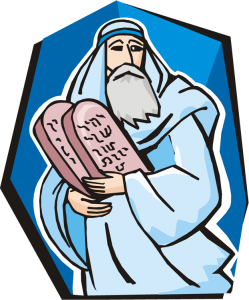
 

Traditions of Men Vs. Believing Moses (and Yeshua)

John 5:46–47, Believed Moses. These two verses at the end of chapter five can easily be overlooked, but their implications are huge.

Quite simply, Yeshua is saying that those who don’t believe the writings of Moses (i.e., the Torah) won’t believe the words of Yeshua who himself uphold the Torah and taught its validity in the lives of his disciples.

Moses 10 Cs 1

This then begs the question, “Where does this leave all those who claim to be followers of Yeshua, but who believe that the law of Moses was abrogated?” It’s hard to be absolutely black and white on this matter, since only YHVH can judge the heart condition of each individual, for undoubtedly many who claim the law was “done away with” still adhere to many of the law’s tenets (e.g., you shall not steal, murder, lie, commit adultery, worship idols and you shall honor your parents, etc.) and are thus obedient to the law to one degree or another. However, we can safely say that it’s a matter of degrees: To the degree that we don’t believe the words of Moses, we don’t believe the words of Yeshua who was a proponent (and, in reality, as the Word of Elohim, the Originator) of the Torah-law of Moses.

John makes a similar statement in his first epistle from which we can deduce the following: Continue reading


Exodus 34: A Prophecy About the Second Coming

Exodus 34:1–35, Moses’ second ascension of Mount Sinai is a prophetic picture of the saints’ resurrection and glorification at the second coming of Yeshua the Messiah.

According to Jewish tradition, Moses ascended Mount Sinai to receive the second set of stone tablets containing the Ten Commandments on the first day of the sixth month or 30 days before Yom Teruah, which occurs on the first day of the seventh month. Forty days later on Yom Kippur he descended from the mountain carrying with him the second set of tablets as a sign of YHVH’s forgiveness of the children of Israel after the golden calf incident. This signaled YHVH’s renewed relationship with Israel after they had repented of golden calf worship.

We know that a biblical Israelite bride, while waiting for her betrothed to arrive from his father’s house, would hear the sound of the shofar in the distance as her bridegroom approached. If she were alert and not asleep (as were the ten virgins in Matt 25), she would have had time to put on her wedding robes, trim her lamp’s wick, and have it filled with oil and ready to light as soon as he arrived.

Prophetically, the Scriptures tells us that the saints of Yeshua are to be resurrected and to meet the returning Messiah Yeshua in the air at the seventh or last shofar blast on Yom Teruah (Day of the Trumpets, Shouting or Shofar Blasts, see 1 Cor 15:52; Rev 11:15–18). From the time the saints begin hearing the shofar blasts in the distance signaling the arrival Continue reading


Holy Water: Your Ticket into the Kingdom of Elohim

John 3:5, Of water and the Spirit. This phrase is a literary device that is common in Hebraic literature called a hendiadys, which is a grammatical structure where two nouns are linked by the word and, and at the same time have a coordinate rather than a subordinate relationship. The two nouns represent a single modified concept rather than two separate concepts. For example, if we say “the coffee is nice and hot,” what we really mean is “it’s nice hot coffee.”

15221168

In this case, a better translation of Yeshua’s words would be “unless one is born of spiritual water, one cannot enter the kingdom of heaven.”

Biblically, water is a spiritual metaphor for both the Holy Spirit and the Word of Elohim, which are, in reality, two sides of the same coin. That is to say, one can’t understand the Word of Elohim without the Holy Spirit who, according to Yeshua, helps us to understand the Word of Elohim (John 16:13–14).

Perhaps this understanding gives new meaning to the concept of “holy water.”


The Golden Calf Incident: A Prophetic Picture of the Church

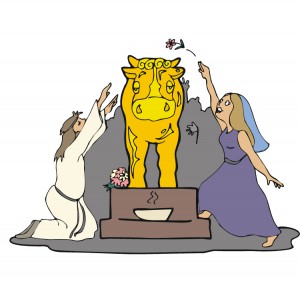
Exodus 32, On Shavuot (the Feast of Weeks or Pentecost), at Mount Sinai, YHVH entered into a marriage covenant with the children of Israel, but they were not ready to live up to the terms of that covenant. Those terms, simply stated, involved the Israelites being faithful and obedient only to YHVH, Israel’s Elohim (God) and spiritual husband, and to his instruction in righteousness, the Torah. This Israel quickly demonstrated they were not willing to do, for they had hardly said “I do” to their marriage vows (Exod 24:3, 7) when they turned their hearts away from YHVH and began worshipping the golden calf—a pagan deity from Egypt. After the golden calf incident and up until Yom Teruah (the Day of Trumpets or Shofar Blasts) when Moses received the second tablets of stone from YHVH containing the Ten Commandments, the children of Israel, the bride of YHVH, prepared herself not only to receive YHVH’s instructions again, but this time to be faithful to her marriage vows. This Israel did. She remained faithful to YHVH for approximately 38 years while trekking through the wilderness of Sinai, after which she entered the Promised Land and “stayed the course” until after the death of Joshua.

Golden Calf 6 21409020

Sadly, the cycles of history often repeat themselves. This time, it involved the descendants of the children of Israel who were at Mount Sinai. In the early first century A.D.,  the redeemed Israelite followers of Yeshua received the Torah written on the fleshly tablets of their hearts by the finger of the Spirit of Elohim on the Day of Pentecost (Shavuot) as recorded in Acts 2. But starting at about A.D. 70 with the destruction of the temple in Jerusalem and continuing up through the Second Jewish Revolt of A.D. 135 until the time of Emperor Constantine (in the fourth century), the first-century spiritual bride of Messiah had, for the most part, abandoned YHVH’s Torah-commandments and turned, to one degree or another, to a mixed form of worship (of which ancient Israel’s worship at the golden calif was a prophetic foreshadow) where some pagan practices were assimilated into the early churches’ belief system (most notably, Sunday replaced the Sabbath, and Christmas, Easter and other paganistic holidays replaced the biblical feasts).

Moses’ descent of Mount Sinai on Yom Teruah with the second set of tablets containing the Torah prophetically foreshadows Yeshua’s second coming. As Moses renewed YHVH’s Continue reading


Who was the God of the Old Testament?

John 1:1, The Word was Elohim. Is Yeshua or the Father the God (Elohim) of the Old Testament (Tanakh)? For many believers in Yeshua, there is confusion as to who it was in the Godhead who interacted with the Israelites in the Tankah. Was it the Father or the Son? In the minds of the apostolic writers, there was no confusion about this.

Yeshua, in his preincarnate state, was the One that YHVH Elohim the Father used to both create (John 1:3; Col 1:16; Heb 11:3), and then to interact with mankind. He was the Word of YHVH Elohim, the Father, who become flesh and dwelt among men (verse 14). This truth is easily confirmed in several passages in the Testimony of Yeshua (New Testament).

First, Yeshua himself claims to be YHVH or the I Am of the burning bush (see John 8:58 cp. Exod 3:14). The Jews viewed Yeshua’s claim to be deity as blasphemous, which is why they picked up stones to kill him (John 8:59). Next, Yeshua in declaring to the Jewish religious leaders that “I send you prophets, wise men and scribes: some you will kill…” (Matt 23:34), he is claiming the rights and prerogatives of YHVH — a right and role that solely belonged to YHVH in the Tanakh.

Yeshua also declared that no man has seen the face of Elohim the Father (John 5:37). Yet Continue reading


A Quick Tour of the Tabernacle

The Outer Courtyard

The Outer Curtain (Exod 27:9–19)

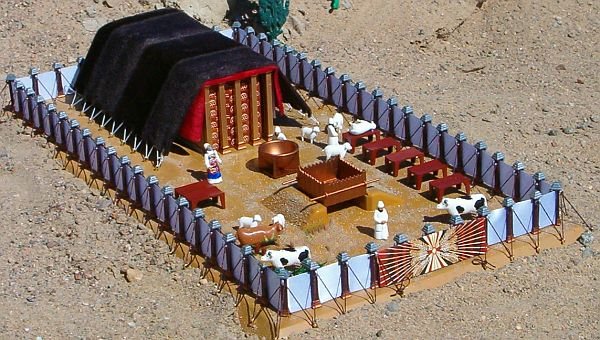
The tabernacle’s outer court was approximately 150 feet long by 75 feet wide (or 11,250 square feet, which is about one-fourth of an acre) in size.

The curtains of the outer court (Exod 27:9–19) were made of fine white linen and was seven-and-a-half feet tall. The linen curtains speak of robes of righteousness the bride of Yeshua will wear on her wedding day (Rev 19:8).

Sixty pillars supported the outer curtain. They were set in heavy bronze (or brass) bases topped by silver capitals. These pillars represent redeemed humanity wearing robes of righteousness. Wood symbolizes humanity, while bronze symbolizes judgment against man because of sin, and silver represents redemption or Elohim’s ransom price for man’s sin.

tabernaclekit4

The Door to the Tabernacle (Exod 27:16–17)

The door of the outer court curtain contained three colors woven into white linen fabric: blue, purple, crimson, and white. These four colors speak of different attributes of Yeshua, whom Scripture likens to the door of salvation (John 10:1–18). These four colors combine to form a full picture of Yeshua, the Redeemer and Savior of Israel. Only through him can man come to the Father, have salvation, eternal life and inhabit the glorious New Jerusalem pictured by the glory cloud over the Holy of holies in the tabernacle. The four colors also correspond to the four faces of the living beings around the throne of Elohim (Ezek 1).

Crimson symbolizes the human aspects of Yeshua, for red is the color of man and red clay Continue reading