The Law of the Fringes and You

Shofars, Davidic worship dance, prayer shawls (talit or tallit), a Torah scroll and tzitziyot (plural for tzitzit) (fringes or tassels) all have something in common: they are hallmark symbols of those who are returning to the Hebrew roots of their faith. When a Christian begins to discover their ancient spiritual roots, it’s like coming home, or like a hand fitting into a glove. It’s not long before they begin acting out their renewed faith in a highly demonstrable manner such as growing beards, wearing fringes, blowing shofars, keeping the Sabbath and biblical feasts. Outsiders may view this as mere religious fanaticism and exhibitionism, but to the saint who truly feels that he has returned to his spiritual roots, these things are symbols of a faith that is more than superficial in nature. They represent a connectedness to his spiritual family tree, to the nation of Israel and eventually to the God of Israel, YHVH Elohim, the originator of that faith, family tree and nation.

tzitzitblue

As a wedding ring symbolizes the covenantal agreement between spouses, so the blue fringes worn on the corners of one’s garments are an outward symbol of one’s spiritual commitment and devotion to the Elohim of Israel through obedience to his instructions in righteousness as found in the Torah portion of the Scriptures.

Indeed, it is not because of a man-made tradition, but because of a direct command in the Torah that redeemed Israelites wear tzitziyot, for we read in Numbers 15:37–41,

And YHVH spoke unto Moses, saying, “Speak unto the children of Israel, and bid them that they make them fringes [Heb. tzitziyot] in the borders of their garments throughout their generations, and that they put upon the fringe of the borders a ribbon of blue. And it shall be unto you for a fringe, that you may look upon it, and remember all the commandments of YHVH, and do them; and that you seek not after your own heart and your own eyes, after which you use to go a whoring, that you may remember, and do all my commandments, and be set apart unto your Elohim. I am YHVH your Elohim, which brought you out of the land of Egypt, to be your Elohim: I am YHVH your Elohim.’”

In the eyes of YHVH, this command is serious enough that he repeated it again in Deuteronomy 22:12,

You shall make you fringes upon the four quarters [Heb. kanapah meaning “wings”] of your garments, wherewith you shall cover yourself.

Let’s discuss what is said in these two passages. Continue reading →


Blog Scripture Readings for 3/24 through 3/30/13

Aside

Parashat — There is no Parashah reading this week due to Passover
Haftarah — 
none this week (see above)
Prophets — Isaiah 46:1 – 53:12
Writings — Proverbs 19:1 – 25:28
Testimony — Acts 7:38 – 10:48

Most of this week’s blog discussion points will be on these passages. If you have general comments or questions on the weekly Scripture readings not addressed in a blog post, here’s a place for you to post those. Just use the “leave a reply” link below.

The full “Read Through The Scriptures In A Year” schedule, broken down by each day, can be found on the right sidebar under “Helpful Links.” There are 4 sections of scripture to read each day. One each from the Torah, the Prophets, the Writings, and from the Testimony of Yeshua. Each week, the Torah and haftarah readings will follow the traditional one-year reading cycle.

Weekly Blog Scripture Readings for 3/24 through 3/30/13.


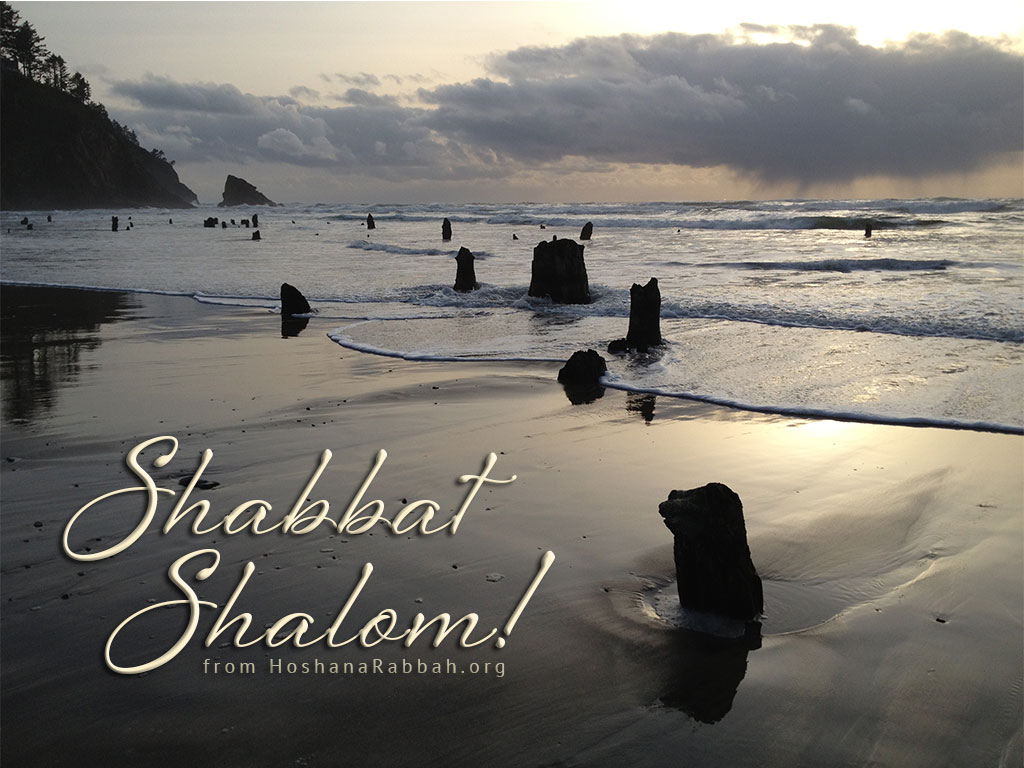
Shabbat Shalom from the Ghost Forest on the Oregon Coast


shabbat_shalom_coast
 My wife Sandi and I are spending the weekend at the world class scenic Oregon Coast, which is about an hour-and-a-half drive from our home. Today, Shabbat, is our anniversary. Twenty-two years and four children ago, we were married on this day.

From one of my business clients, we have rented their beach home that overlooks the mighty Pacific Ocean.

As the sun was setting, from the picture window of the house, I saw some cool light patterns on the beach, so I quickly put on my boots and donned my heavy jacket and headed down to the edge of the ocean where I snapped this photo.

Interestingly, the stumps sticking up out of the sand are a story unto themselves. They are a unique geological feature that is known as the Neskowin Ghost Forest. You can Google this and read about it. In brief, these tree trunks aren’t driftwood or old pier pilings. Rather, they are the remnants of an old Sitka Spruce forest that 1700 years ago sat perched on a knoll just above the beach. Due to an earthquake, the bank slipped into the beach area and the trees were submerged under water and sand where they were preserved until about 15 years ago. At that time, some violent storms eroded the sand away from these old trees exposing them for the first time.

Some of these now barnacle-encrusted spruce trees were originally six feet in diameter. I found one stump on the beach that is still about five feet in diameter, which means it was hundreds of years old when it was buried 1700 years ago. This stump was probably already several hundred years old when Yeshua was born! Imagine this! Here’s a close up picture of this ancient wonder. I placed my hat next to it for size comparisons purposes.

IMG_0260

I am continually in awe of the wonders of YHVH Elohim’s creation. It speaks silently, yet at the same time shouts loudly for those who have ears to hear, of the unfathomable greatness of our Creator.

This Sabbath, please join me in giving YHVH Yeshua, the Creator of all things, the praise He deserves for all that He has done, all that He is, and for the salvation He has given you and me!


Are You an End-Times Elijah? Here Are Your Marching Orders!

Isaiah 40:1–26, The End-Times Elijah Generation Preparing the Way for Messiah

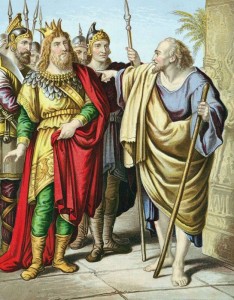
Isaiah the prophet ministered in Judah for about 40 years from 740 to 697 b.c., approximately 100 years before the southern kingdom of Judah fell to the Babylonians in 586 b.c. Judah’s captivity in Babylon would last for 70 years. The Book of Isaiah contains more messianic prophecies than any other book in the Tankah, and many of those prophecies specifically relate to the redemption through the Messiah of the two houses of Israel.

Elijah against the king 36931605

In the Isaiah 40 prophecy, according to rabbinic understanding, Isaiah is prophesying (in verses 3–5) concerning Israel’s deliverance from exile seventy years after her captivity (The Soncino Pentateuch, p. 777). This is not an incorrect interpretation of this prophecy, although it is not necessarily the only one, for we know, as with many of the Scripture’s ancient prophecies, there are sometimes multiple fulfillments. Because the old adage that says, “history repeats itself,” is true, and because human behavior remains unchanged from time immemorial, though the players and costumes change on history’s theatrical stage, many biblical prophetic themes have cyclical patterns. In the present case, where Isaiah speaks in verse three of “a voice crying in the wilderness,” (Isa 40:3) we know that the gospel writers ­applied this to John the Baptist preparing the way for the coming of Yeshua the Messiah (Matt 3:3; Mark 1:3; Luke 3:4; John 1:23). What in this prophecy did the gospel authors see as applying to Yeshua the Redeemer and Savior of Israel? First, Yeshua himself declared John the Baptist to be that messenger who would prepare the way for the Messiah that Malachi prophesied about (cp. Matt 11:10 and Mal 3:1). The messenger of Malachi 3 and 4 seems to be the same individual mentioned in Isaiah 40. Furthermore, Isaiah 40:3 speaks of preparing the way for YHVH and making a highway in the desert for Elohim. Clearly, the gospel writers recognized that Yeshua was YHVH Elohim based not only on his claims to deity, but based on the fact that Isaiah states that the Messiah, the Redeemer of Israel, would not only be YHVH Elohim, but that he was the arm of YHVH (Isa 53:1) making him a manifestation, if you will, of YHVH.

Not only did the gospel authors see John the Baptist in the Isaiah 40 prophecy (Isa 40:3–4 cp. Matt 3:3; Mark 1:3; Luke 3:4–5; John 1:23) because they recognized who Yeshua was Continue reading →


Origin of the Anointing Oil, Ordination, and the Anointed One

Leviticus 8:12, Anointing oil … consecrates [Heb. kadash]. The Hebrew word kadash signifies the state of something that belongs to the realm of the sacred, and that is set-apart for divine use and has been separated from the sphere of the secular, common or profane. The Bible often uses the term holy (meaning “set-apart”) to signify this state of being. The word of Elohim designates many things as set-apart:

Anointing oil

Anointing oil

  • The ground upon which YHVH is standing (Exod 3:5; Josh 5:15)
  • The people of Israel (Exod 19:6; Deut 14:21; 26:19)
  • The Sabbath (Exod 16:23; 20:8)
  • The Tabernacle of Moses (Exod 26:33)
  • The garments worn by the high priest (Exod 28:2)
  • The altar of sacrifice (Exod 40:10)
  • The offerings made on the altar (Lev 6:18)
  • YHVH’s feast days (Lev 23:2)
  • The camp of Israel (Deut 23:14)
  • Heaven as the abode of Elohim (Deut 26:15)
  • YHVH Elohim (Job 6:10; Pss 22:3; 78:4; 99:5)
  • Zion and Jerusalem (Ps 2:6; Matt 27:53; Rev 22:19)
  • The Spirit of Elohim (Matt 1:20)
  • The angels (Matt 25:31)
  • The servants of Elohim (Mark 6:20)
  • The name of YHVH (Luke 1:49)
  • Yeshua (Acts 2:27; 3:14)
  • YHVH’s prophets (Acts 3:21)
  • The saints (1 Pet 2:9;Rev 22:11)
  • The Torah (2 Pet 3:21)

YHVH’s people are to learn to make a difference between that which he designates as being kadash (holy) and that which is profane (Lev 10:10). In order to do this, one must know what YHVH defines as set-apart and then align our thinking and lifestyle with that.

The act of consecrating someone (or something, e.g. Exod 30:26) as occurs in Leviticus 8:12 often involves the ritual of pouring olive oil on them to signify their being set-apart for a special work or service. This is called anointing (see Exod 28:41; 29:7; 1 Sam 16:12; 1 Kgs 1:34; Isa 61:1; 2 Cor 1:21).

Yeshua’s title is Messiah (Heb. Mashiach/ משח) literally meaning, “one who is anointed, smeared or consecrated with (olive) oil.” The English word Christ derives from the Greek word Christos, which is the Greek equivalent of the Hebrew word mashiach. In Biblical thought, the Messiah would be One coming from heaven who would possess a super-anointing of the Spirit of Elohim (Isa 11:1–10; 42:1–21; 61:1–3; John 3:34) to accomplish the purposes of Elohim on earth.


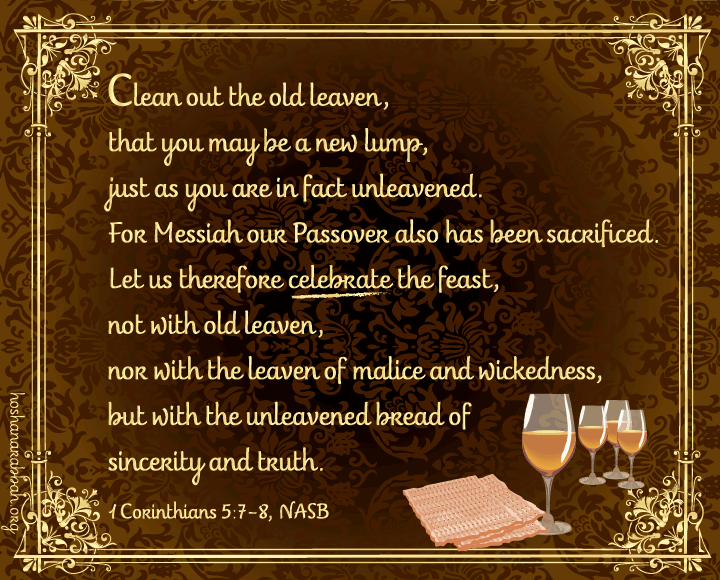
New Video: Let Us Celebrate the Feast of Unleavened Bread—1 Cor 5:8

In 1 Corinthians 5:8, the Apostle Paul tells us to keep (or celebrate) the Feast of Unleavened Bread, which occurs right after the Passover. Though many in the church feel that Paul liberated Christians from the law of Moses (the Torah) including the Sabbath and the biblical feasts, here Paul is telling us to celebrate it.

In this video, learn what the the significance and relevance of this biblical holiday is to you. It is the story of your life—past, present and future! A complimentary study guide is available at http://www.hoshanarabbah.org/pdfs/unlbread.pdf.

chag_hamatzot_720


The Baptism of the Holy Spirit: Who, What, When, and Why?

The Baptism of the Spirit Brings Power to Advance the Kingdom of Elohim

  • The gifts of the Spirit are the tools YHVH has given his saints to advance his kingdom.
  • They are for ministry purposes to bring glory to YHVH.

Baptism of Spirit 21398485

Born of the Spirit Vs. Baptized in the Spirit — What’s the Difference?

Is there a difference between being born of the Spirit and being baptized in the Spirit? Yes. Water baptism (or baptism for the remission of sins) occurs at one’s conversion and symbolizes being spiritually regenerated by dying to the old sin nature and being resurrected in the newness of life unto the righteousness of Yeshua. It marks the beginning of walking in victory over sin as a spiritual overcomer. The result is being able to live a life of righteousness through obedience to the commandments of Elohim. The outward evidence or fruit of this spiritual work in one’s life is the manifestation of the fruits of the Spirit the greatest of which is love. By contrast, the baptism of the Holy Spirit (as Yeshua describes it in Act 1:5–8 and Luke 24:49) is for ministry empowerment purposes. It enable the saints to yield more to the leading of the Spirit of Elohim as they confront the evil darkness in this world via the power of the Elohim. It is for the purpose of boldly and powerfully advancing the kingdom of Elohim through the preaching of the gospel message to those who are spiritually lost with miraculous signs and wonders following.

Yeshua describes the process of receiving the Holy Spirit of Elohim in John 3:5–8. Continue reading →