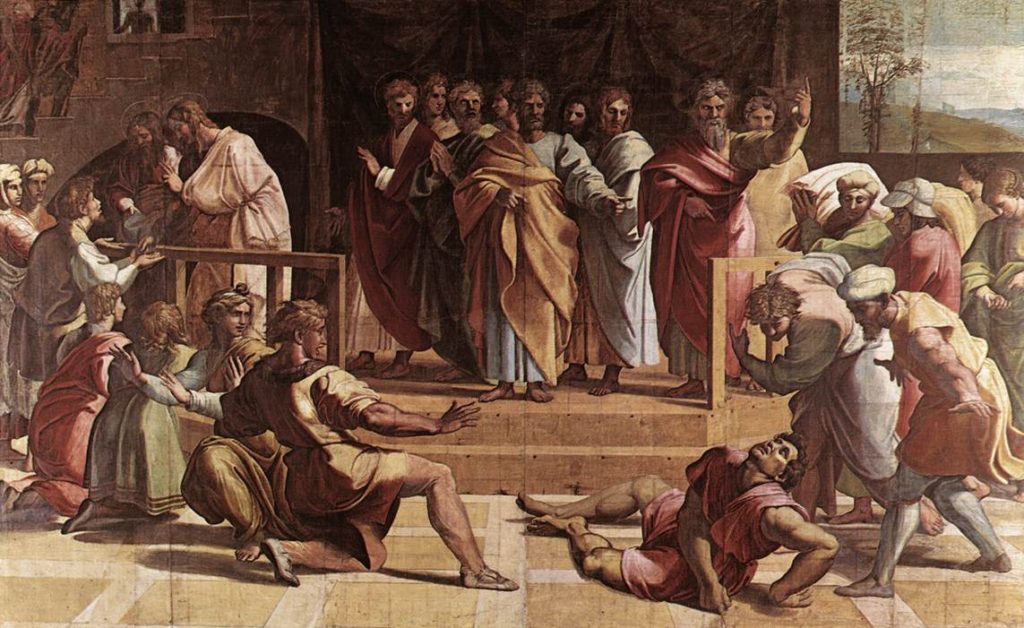
Acts 5:1–11, The deaths of Ananias and Sapphira. Why did Elohim kill them? It is because they committed the unpardonable sin in that they willfully and in a premeditated plot lied to the Elohim. There is no sacrifice or forgiveness for willful sin. YHVH was showing us that even in the age of the New Covenant, the so-called “age of grace,” Elohim’s grace doesn’t cover willful sin. Let us all fear YHVH Elohim and tremble before him all the time!
Some scholars suggest that YHVH killed them because they violated the Torah laws regarding the handling of devoted things, for which there was a death penalty (Lev 27:28–29). Perhaps so. Whatever the case, it’s interesting to note that YHVH struck Ananias and Sapphira dead after the cross in, what many Christians call, the dispensation of grace era when, in their minds, sin doesn’t carry the same severe penalty us under “old covenant,” law of Moses era. What we learn from this is that YHVH still views sin as sin, and the wages of sin is still death (Rom 6:23). This has never changed before or after the cross of Yeshua. Just because one isn’t struck dead immediately upon having sinned doesn’t mean one hasn’t incurred the death penalty. That death penalty is only waived when one repents of their sin and asks for YHVH’s forgiveness through faith in Yeshua whose death paid the death penalty price for our sins.
Likely, such divine judgments still occur in our day more frequently than we realize. It may not involve the death of the individual, but rather sickness, demonic attacks, financial setbacks and other adversities that occur to us. The problem is that because of human pride and spiritual deafness and blindness, most people fail to recognize the cause of their problems. We attribute them instead to random circumstances and time and chance instead of to YHVH’s hand of judgment against us because of our sin, which we fail to recognize and repent of.
Paul addresses this issue in 1 Cor 11:27–32 with regard to those who eat of the communion elements in a careless or indifferent manner.
Therefore whoever eats this bread or drinks this cup of the Lord in an unworthy manner will be guilty of the body and blood of the Lord. But let a man examine himself, and so let him eat of the bread and drink of the cup. For he who eats and drinks in an unworthy manner eats and drinks judgment to himself, not discerning the Lord’s body. For this reason many are weak and sick among you, and many sleep. For if we would judge ourselves, we would not be judged. But when we are judged, we are chastened by the Lord, that we may not be condemned with the world.
Many of you who are new to this blog may also be new to the biblical festivals, which Yeshua and his disciples, including the book Acts believers, all celebrated in accordance with the Creator’s (that’s Yeshua) life-giving, blessing-producing commandments.
Over the years, Hoshana Rabbah not only through this blog, but through our website and You Tube channel have produced numerous resources to help you to understand as well as to celebrate the Feast of Unleavened Bread in the biblical way. Today is the first of seven days
Below are some free resources that will help you to do just that.
Happy studying, and as you come to understand better the biblical roots of our faith, may you grow in your spiritual walk and your love for the Word of Elohim and Yeshua our Messiah!
Tomorrow, Wednesday April 8, is Passover. Tomorrow (Wednesday) evening, my family and I will be celebrating Passover by conducting a gospel, oriented, Yeshua-centered Passover seder including in our home including the taking of communion and a foot washing service as Yeshua did with his disciples at his last supper.
Some people choose to eat their Passover meal at the earlier time when Yeshua did it (Tuesday evening), while others choose to eat their Passover meal at the end of Passover day when the Torah commands it and when the children of Israel kept the first Passover in Egypt. Our family chooses to eat the Passover meal at this latter time, for this is when Yeshua would have kept Passover with his disciples if he had not been hanging on the cross at the same exact time BEING THE PASSOVER LAMB. Whenever you choose to eat the Passover meal, whether at the beginning of Passover or at the end of Passover and overlapping into the first high holy day of the Feast of Unleavened Bread, we encourage you to JUST DO IT as the Bible commands!
Here are some resources to help you to celebrate your own Passover at home with your loved ones.
Passover Resources Page including a free and printable Passover Haggadah (order of service) to help you to celebrate your own Yeshua-centered, gospel-oriented Passover seder at home. https://www.hoshanarabbah.org/pesach.html
After the death of the last apostle, and as time went one, the early church fathers took on a more strident tone against the Jews and their beliefs including the law of Moses. Here are several examples of this:
Ignatius, Bishop of Antioch (98-117A.D.) – Epistle to the Magnesians
“For if we still live according to the Jewish law, and the circumcision of the flesh, we deny that we have received grace” (chap 8).
“Let us therefore no longer keep[ the Sabbath after the Jewish manner…But let every one of you keep the Sabbath after a spiritual manner…After the observance of the Sabbath, let every friend of Christ keep the Lord’s Day as a festival, the resurrection-day, the queen and chief of all the days [of the week]” (chap 9).
“It is absurd to speak of Jesus Christ with the tongue, and to cherish in the mind a Judaism which has now come to an end. For where there is Christianity there cannot be Judaism” (chap 10).
Epistle of Mathetes to Diognetus, chap 4 (A.D. 130)
“But as to their scrupulosity concerning meats, and their superstition as respects the Sabbath, and their boasting about circumcision,and their fancies about fasting and the new moons, which are utterly ridiculous and unworthy of notice” (chap 4)
Ignatius Bishop of Antioch (98–117A.D.) — Epistle to the Philadelphians
“But if any one preach the Jewish law unto you, listen not to him” (chap 6).
Ignatius Bishop of Antioch (98–117A.D.) — Epistle to the Philippians
“If anyone celebrates the Passover along with the Jews, or receives the emblems of their feast, he is a partaker of those that killed the Lord and his apostles” (chap 14).
Justin Martyr — Dialogue with Trypho (Between 138A.D. and 161 A.D.)
Justin claims that the Scriptures no longer belong to the Jews, but to the Christians, thus asserting anti-Semitic replacement theology (chap 29).
Historical Notes on Marcion of Sinope
Since the writings of Marcion of Sinope (c. 85 – c. 160; e.g. Antitheses or Contradictions) have been lost, Tertullian’s five books refuting Marcionism as recorded in Antitheses is our best source of information on Marcion’s teachings.
Isaiah 25:7, The surface of the covering. This is a cryptic passage. What does it mean? Other translations render it as follows:
And on this mountain He will swallow up the covering which is over all peoples, even the veil which is stretched over all nations. (NAS)
On this mountain he will destroy the shroud that enfolds all peoples, the sheet that covers all nations. (NIV)
And swallowed up hath He in this mountain The face of the wrapping that is wrapped over all the peoples, And of the covering that is spread over all the nations. (YLT)
Before YHVH establishes his millennial kingdom on earth, he will have to remove something evil that has been covering the earth and its people like a veil. Is this referring to the web of lies that Satan and his Luciferian stooges on earth have woven to control the minds of earth’s inhabitants, so that they could accomplish their nefarious schemes to enslave the human population spiritually, economically and politically? Or could it refer to an electromagnetic web put in place by the global power elite or something similar that covers the earth to enslave the human population for its evil purposes of power and control? Maybe it’s both. Whatever it is, Yeshua will destroy it at his second coming.
The context of this passage is millennial. Chapter 24 prophesies of Elohim’s impending judgment on the whole earth followed by his reigning from Mount Zion in Jerusalem (v. 23). Chapter 25 continues the same prophecy. In verse nine, we read that, “We have waited for him, and he will save us…We will be glad and rejoice in his salvation [Heb. Yeshua].” This is speaking of the second coming of Yeshua and the establishment of his millennial kingdom on earth after having destroyed the end times Babylon the Great New World Order.
So what is this veil or web that will cover the earth like a veil in the end times just before the second coming of the Messiah that the Spirit of Elohim revealed to Isaiah the prophet? Well, we’re all familiar with the term, “the worldwide web.” In and of itself, this is not evil. It can be used for both good and bad purposes. The worldwide web or internet has been hugely instrumental in helping to spread the gospel and awaken lost and scattered Israel to return to its biblical roots and heritage. However, do you think that this pleases Satan and his minions who hate Elohim and his word, and don’t want to allow their developed technology to be used to counter the spirit of antichrist?
Don’t be surprised if controls aren’t put in place to greatly restrict or even curtail the use of the internet as a vehicle to spread the gospel. In the mean time, as the saying goes, “Make hay while the sun shines!”
But there’s more. In the book of Revelation we read about an end time Satanic world governing and economic system that will control the entire earth including all nations and most people. Satan the devil empowers this system (Rev 13:2), and many people will be so in awe of it that they will literally worship Satan and his antichrist new world order system (Rev 13:3–4).
During this time, for three-and-one-half years, Satan and his human minions will wage war against the saints and will even overcome some of them (Rev 13:5–7). This will be a time of both great persecution and spiritual refinement for the saints of Elohim. Only those who patiently persevere will come through victoriously (Rev 13:10). This patient perseverance involves loving Yeshua and keeping his Torah-commandments (Rev 14:12). Satan will persecute those who don’t love Yeshua by keeping his Torah-commandments (Rev 12:17 cp. John 14:12; 1 John 2:3–6).
An aspect of this persecution relates to “the image of the beast” by which “he deceives those who dwell on the earth” (Rev 13:14). At the same time, a false religious system that resembles a lamb, but which is a demonically inspired wolf in sheep’s clothing (Rev 13:11–12), will arise and join forces with the political and economic system that’s led by Satan and his minions as previously discussed.
Through the combined efforts of the political, economic and religious systems several things will happen. False signs and wonders will occur that will be visible to all men (Rev 13:13). This will lead to the deception of earth’s inhabitants (Rev 13:14), and the image of the beast will be humanesque in appearance causing awe and wonderment among those who are deceived resulting in men worshipping it (Rev 13:14–15; 16:2). This demonic antichrist economic-political-religious system that controls the earth will force men to worship this image and receive this system’s mark or seal of approval and membership on their bodies, thus allowing them to participate (and survive) economically in it (Rev 13:16–17 cp. 19:20). This seal or mark will likely involve men being required to take an oath of allegiance such that they will have to deny the true Yeshua of the Bible in favor of the false antichrist messiah. James seems to be warning against this when he writes, “But above all, my brethren, do not swear, either by heaven or by earth or with any other oath. But let your ‘Yes,’ be ‘Yes,’ and your ‘No,’ ‘No,’ lest you fall into judgment.” (Jas 5:12). This is why those who take the Antichrist’s mark will never have a chance at eternal life in Elohim’s kingdom, but are destined for the lake of fire (Rev 14:11 cp. 20:1–15).
In light of the prophecies of the Bible discussed above, and in light of the recent advances in modern science, it seems likely that modern biometric, instant digital communication and artificial intelligence combined with robotic nanotechnology involving the internet of all things (or IOT) will all come together to form a global oligarchic technocratic net or veil over this earth that will politically, economically and spiritually attempt to control all life to the exclusion of the true saints of YHVH-Yeshua the Messiah.
This is coming upon us like a freight train, and it seems that thousands of years ago, YHVH may have revealed this to Isaiah the prophet.
Sadly, however, most people, including the Torah-obedient disciple of Yeshua, are too sound asleep in their spiritual complacency eating, drinking, giving in marriage and pursing their middle class lifestyles to give any of this much thought. They are modern day obscurantists. The Bible calls them Laodiceans. They don’t have time to study their Bibles, to fast or to pray, but they sure have time to plan their vacations, play their video games, talk to their “friends” on social media and watch NetFlix! As long as they’re smugly wearing their Christian, Messianic or Hebrew Roots label for all to see, they feel they’ve done their duty. Yeshua called them white-washed sepulchres and empty cups! He said, “You draw near with your lips, but your hearts are far from me.” Peter called them clouds without water! John refers to them as naked, blind, poor and miserable.
Of course, none of this applies to anyone reading this. It’s always the other guy. Right?!?
Parashat — (No reading for this week) Haftarah — (No reading for this week) Prophets — Isaiah 27:1 – 35:10 Writings — Proverbs 29:1 – 31:31; Job 1:1 – 4:21 Testimony — Acts 3:1 – 7:16
Our new annual Scripture Reading Schedule for 2019-2020 with daily readings is available to download and print. If you are still working through 2018-2019’s Scripture Reading Schedule, the link will still be available on the right sidebar under “Helpful Links”. If you are using a mobile device or tablet, the link may be below, meaning you’ll need to scroll down instead.
Most of this week’s blog discussion points will be on these passages. If you have general comments or questions on the weekly Scripture readings not addressed in a blog post, here’s a place for you to post those. Just use the “leave a reply” link or the “share your thoughts” box below.
The full “Read Through The Scriptures In A Year” schedule, broken down by each day, can be found on the right sidebar under “Helpful Links.” There are 4 sections of scripture to read each day: one each from the Torah, the Prophets, the Writings, and from the Testimony of Yeshua. Each week, the Torah and haftarah readings will follow the traditional one-year reading cycle.
Weekly Blog Scripture Readings for 4/5 through 4/11/2020.
Recently, I’ve had several inquiries as to when a biblical day starts, with those asking the question asserting that a biblical day begins in the morning, not in the evening as most Hebraic-minded people believe, and as the rabbinic Jews teach. I have answered this question before on this blog, but my previous response didn’t fully address all the main issue, so I have just written this present article to more properly address the issue. — Natan
The Hebrew Yom (Day) Defined
To help us to understand when the biblical day begins, let’s first define the Hebrew word for day which is yom. This will give us a clearer, contextual understanding of how the biblical writers use this word and what its many meanings are and how, and if, it relates to the 24-hour period we normally think of as a day.
According to the The Theological Dictionary of the Old Testament (or The TWOT), the primary meaning of yom is “day, time, year.” Yom can represent a point of time and a sphere of time. It can represent (a) a period of light in contrast to a period of darkness, (c) a period of 24 hours, (c) a general vague time (e.g. time in general, a long time, a season of time, “the day of the Lord,” or years of time), (d) a point of time, (e) a year or years. Reflecting these various meanings, we find yom translated in Scripture (the KJV) using the following English expression:
today
when
in the time of
as long as
day
continually
The TWOT goes on to note that other Hebrew words sometimes translated in Scripture as day include the Hebrew word ohr meaning “light” as well as boqer (or boker) meaning “morning.” Conversely, antonyms of yom include layila meaning “night,” and erev meaning “evening.” The TWOT also notes that the Bible reveals that the day can start in the evening (Est 4:16; Dan 8:14) as well as in the morning (Deut 28:66). This fact adds confusion to the question as to when a biblical day actually begins. We will discuss this below. So, what does this all have to do with the biblical definition of a day? It is important to know this, for how else are we to know when to observe the biblical Sabbath and feast days?
Does a Biblical Day Begin at Sunset or Sunrise?
The Creation Model
At the creation, Elohim defined a day as beginning in the evening (Gen 1:5, 8, 13, 19, 23, 31). Each of the six days of creation follow this model. Although the phrase “And the evening and the morning were the [first, second, etc.] day” is not found in reference to the seventh day Sabbath (Gen 2:1ff), the parallel linguistic construction of the first six days beginning at evening strongly suggests or hints (a remez) that the same pattern for delineating the beginning point of the seventh day would continue over into the Sabbath. Some argue that daylight or morning begins the day since light was the first thing that Elohim created. While spiritual light (not physical light [i.e. the sun, moon and stars] were created on day four) is what was created on the first day, this in no way nullifies how Scripture defines a physical day in the same creation account. All attempts to say that because spiritual light was created first as proof that the day begins in the morning overlook the plain (or pashat) meaning of the text, which says that “the evening and the morning were the [first, second, etc.] day.” We will discuss this point further below.
The Model of the Biblical Feasts
The fact that evening begins the day in Scripture—a pattern that is clearly laid out in the Genesis chapter one account—is transmitted into the starting times of several of the biblical feasts as well.
Exodus 12:6—Passover
In this verse we find the command to keep the Passover. We read,
On the fourteenth day of the first month in the evening [Heb. beyn ha-er’va’im literally meaning “between the evening] is YHVH’s Passover. (adapted from KJV)
We see this same grammatical construction elsewhere (Lev 23:5 and Num 9:3, 5,1. ) plainly showing that the day of Passover is to be kept “between/beyn the evenings/ha-er’va’im,” that is, between the setting of the sun of one day and the setting of the sun of the next day. This correlates with the Genesis one account that shows that the Bible reckons a day beginning at sunset and continuing until the sunset of the next day.
It must here be noted that confusion often occurs if the reader doesn’t understand that Scripture uses the word Passover to mean two different things. First, the word Passover can refer to the actually day of Passover, that is, the fourteenth day of the first month of the biblical year (Lev 23:5). But the word Passover can also refer the actual lamb that was slaughtered on Passover day (Exod 12:21). While it was slaughtered and roasted on the day of Passover (Exod 12:5–6), the Passover lamb was eaten after Passover day had passed and the next day (the fifteenth day of the first month) had begun the following evening after the daylight portion of the fourteenth day had ended (Exod 12:8). The point of this brief discussion is that just because the Israelites ate the Passover lamb in the evening, this was not the evening of Passover day, which occurred 24 hours earlier when that day begin. By the time they were eating the Passover lamb, Passover day had already ended and they were now eating the lamb at the beginning of the next day (the fifteenth day of the first month), which was the first high holy day (a Sabbath) of the Feast of Unleavened Bread.