Isaiah 14:12–21, Lucifer. Linking the king of Babylon to Satan can present a hermeneutical problem unless one interprets this passage metaphorically. If so, is there biblical precedence for doing so? Yes, for elsewhere in the Scriptures, Babylon is a metaphor for this world’s anti-Elohim system of which the ultimate spiritual head of that system is Satan himself (Rev 13:2,4 cp. Rev 17:5; 18:1–24; 20:1–3) who is the god of this world (2 Cor 4:4).
The name Lucifer means “morning star,” which is also a name for Yeshua the Messiah (Rev 22:16). This emphasized the fact that Satan as the great counterfeiter and imitator has as his basic strategy the impersonation of Yeshua. After all, in this Isaiah passage, he says, “I will be like the Most High….” To this point, elsewhere we read that Satan comes as an angel of light in attempts to deceive even the saints of Elohim (2 Cor 11:13–15).
The parallels between Lucifer, the king of Babylon and the end times Man of Sin and Antichrist figure who plays a prominent role in the end times Babylon the Great worldwide system are striking. Moreover, like the king of Babylon, Satan will fall from glory in defeat and will be cast into a pit and into the lake of fire (Luke 10:18; Rev 12:9; 20:1–3, 10).
Isaiah’s taunt of the king of Babylon in this passage goes to the heart of both the king’s and Satan’s rebellion against YHVH,which is pride. Both were attempting to deify themselves as the king of the earth, even as will the case with the end times Man of Sin, Antichrist figure along with the beast and whore systems with which he is aligned as revealed in Revelation chapters 13, 17 and 18.
Isaiah 6:5, Man of unclean [Heb. tamay] lips.Profanity, cursing and swearing—foul and unclean words from the lips of ungodly people—surrounds and overwhelms us like a tidal wave of barnyard manure! Nowadays it’s the norm, not the exception—even for women. This can have an adverse influence on the saint too.
Like barnacles attaching themselves to a ship or a whale, the bad habit of unclean words can attach themselves to the otherwise righteous saint. The downward, magnetic pull of Baalism is ever with us and is powerful. The upward pull toward Elohim and righteousness…well, that’s another thing—is not always so strong!
Was this the case in Isaiah’s day as he found himself surrounded by apostate, backslid Israel? Did he struggle with profanity and impure words? Is this why he had to ask YHVH to cleanse his unclean [Heb. tamay] lips?
Tamay means “polluted, impure or defiled both ethically and religiously.” We must cry out to YHVH to deliver us from the often involuntary habit of profanity and polluted words. By his Spirit, he can and will.
But, again again, like barnacles on a ship’s hull, this habit often tries to reattach itself to our lips. From time to time, a ship has to have its hull scraped of these pesky and unclean crustaceans, or seek the cleansing waters of a fresh water port. Barnacles can’t survive in fresh water and fall off. Likewise, may the cleansing waters of YHVH’s Word wash our minds and mouths of foul, unclean words that leaven our souls and contaminate our spirit man.
Here’s yet another example of the struggle against barnacles. Barnacle encrusted whales catapult themselves out of the water not merely to show off, but to knock the barnacles off of them through the slapping action of the water against their bodies. Similarly, sometimes we have to take determined action and cry out to Elohim for his strength to break the curse of the bad habits of unclean words coming from our lips.
This is part of the deleavening process that we will spend a lifetime engaged in! May YHVH give us help and strength to overcome this tidal wave of evil!
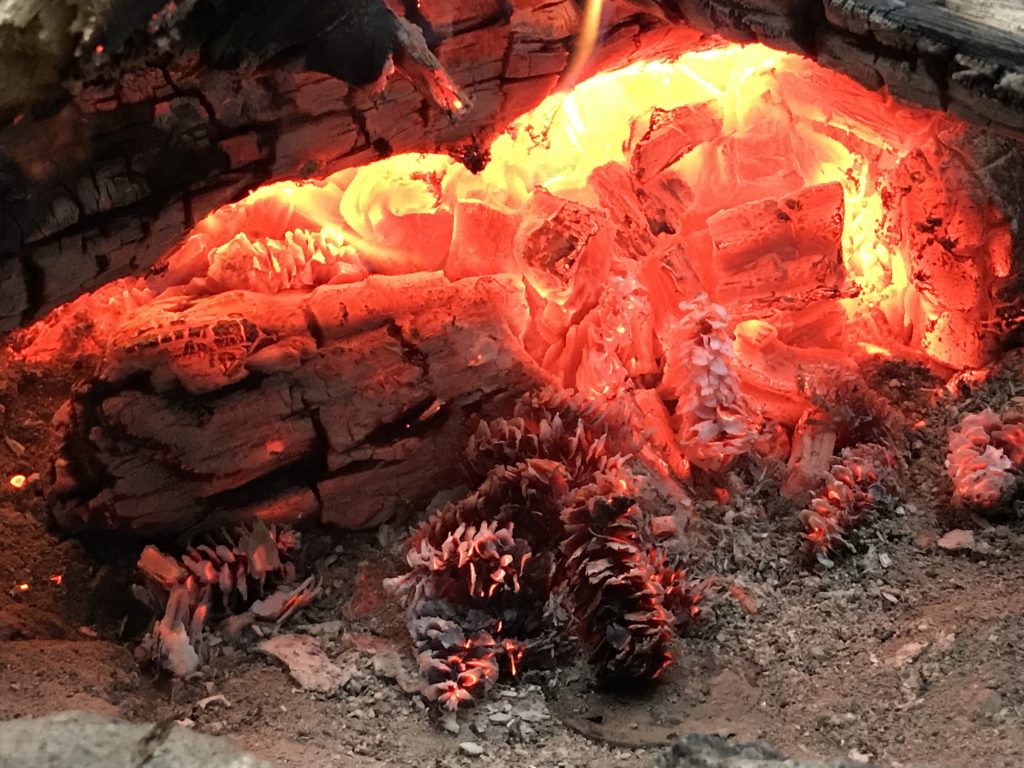
Isaiah 6:4–7, Coal …from the altar. Which altar in the temple did this coal come from and what did it represent spiritually and prophetically? What deeper truth was YHVH trying to teach Isaiah here? There were two altars in the Tabernacle of Moses: the altar where animals were sacrifice—a symbolic and prophetic picture of Yeshua’s atoning death on the cross, and the incense altar in the holy place.
The Hebrew word for altar here is mizbeach and can refer to both the altar of sacrifice in the tabernacle’s outer courtyard, and to the altar of incense in the holy place just in front of the veil leading into the holy of holies picturing the throne room of Elohim. If the coal came from the altar of sacrifice, it pictures cleansing from sin by Yeshua’s death on the cross. If the coal came from altar of incense, this coal still came from the altar of sacrifice, which still points to Yeshua’s atoning death. It just adds to the picture the further truth that not only can we not come before our Almighty Father in heaven except through the atoning sacrifice of Messiah, but we must do so with a heart of prayer, praise and worship, since that is what the altar of incense scripturally represents (Rev 5:8; 8:3).
Through this one event as recorded in Isaiah 6:4–7, we have illustrated a beautiful and encouraging spiritual truth. It is this: Even though Isaiah was a righteous and saintly man, he still fell short of being accepted at the throne of Elohim. Man’s best righteousness is still as filthy rags as Isaiah would write later on (Isa 64:6). But through Yeshua’s atoning work at the cross, and through our acknowledgement of our spiritual lack and through humility, confession of sin coupled with praise and worship, we can still be cleansed by Yeshua’s blood, and made acceptable by the imputed righteousness of Yeshua, which cloth in the robes of his righteousness. HalleluYah!
Isaiah 3:1–5, 12, YHVH…takes away…children…insolent…women rule over them. When YHVH’s judgment comes on a sinful nation, godly leadership and his protection is removed from that nation leaving a moral and spiritual vacuum. When the fear of Elohim is gone, so goes wisdom. With the absence of the wise, foolish people rise up and take over a nation.
Into this godless vacuum will move ungodly, silly and rebellious youth and feminized male leaders and masculinized female leaders—spiritual Ahabs and Jezebels! Children who are insolent against their parents and elders are proof of the spiritual declension of a nation and YHVH’s hand being taken off that nation and his resulting judgment against it are the result. Isaiah clearly lays out this process in this passage. The cause and effect results were as true then with ancient Judah as they are today with modern America.
Since my youth (growing up in the 1960s and 70s), I have seen children go from acting respectfully to their parents and adults in general (“Yes sir,” “No Sir,” “Mr.” and Mrs.”) to total foul-mouthed disrespect and mocking scorn for older people. Correction and discipline of these rebellious brats has gone out the window, been tossed in the trash can of political correctness. When was the last time you saw a paddle in the school principal’s office? It was the norm in my day. Now such a school leader would be fired and convicted of “child abuse.” Moreover, gender roles, in many cases, have been reversed. The term “house husband” now has common currency. Many women have become masculine and many men have become feminized. As an example of this, names that have been traditionally reserved for the male gender or now popular for girls along with woman smoking cigars, sporting tatoos, men wearing hair buns, earrings, painting their toenails, and the list goes on. Now there’s even gender identity confusion and “gender reassignment” operations. Is it any wonder?
This process has been horrendously sad and deeply painful for those of us in the older generation to watch, but it is merely symptomatic of a nation that has turned its back on Elohim. We know what things used to be like when families still went to church, there was prayer in schools, patriotism was taught in our institutions of education, mothers raised their children at home, divorce was rare, godly masculinity was a virtue and the fear of Elohim and adherence to biblical values still, to one degree or another, was the norm societally.
This is much more than looking back and waxing eloquent for the good old days. It’s about mourning for a nation that has lost its moral and spiritual compass and has gone from a God-fearing nation to one that loathes to keep Elohim in its collective, societal conscious, and is too blind by its own pride and self-absorption to recognize that two plus two still equals four.
May YHVH Elohim help us to be children of his light in these times of gross darkness. Do not become weary in well-doing!
Based on this passage in Isaiah, can we see any spiritual parallels between Judah and America (and most other nations, for that matter)? Some might ask what a prophecy given by a Hebrew prophet to the Jewish nation some 2600 years ago has to do with us today? To answer that question we would pose several questions: Have YHVH’s standards of righteousness and law and order ever changed? Is sin still sin today as it was then? Is there a day coming when YHVH will hold humans accountable for their sinful action? Is there a heavenly judgment seat before which all must eventually appear? Is there a day coming at the end of the age when Elohim will pour out his wrath and man will be punished for his sins against his Creator? With these things in mind, let’s see if the sinful activities of humans have changed much in 2600 years since Isaiah’s time.
Isaiah 1:2,They have rebelled against me.What is the scriptural definition of rebellion? Rebellion against what? For the concept of rebellion to be relevant and applicable there has to be a standard or rule of law the violation of which constitutes rebellion. What is YHVH’s standard of righteousness by which he will judge nations and individuals? Has that standard ever changed? Make no mistake, YHVH’s standard of righteousness is his immutable Word, and by it he will judge all humans. There is no escaping this fact. (Read John 12:48 and Deuteronomy 18:19.)
Isaiah 1:3,The ox knows its owner.The “Beasts of the Field Explained.” Apostasy and spiritual degradation leads to one place: a complete loss of one’s spiritual identity. When one forgets one’s spiritual heritage and relationship with their Creator, they becomes, in a sense, like an animal, maybe even worse. (See 2 Pet 2:12 and Jude 1:10.)
As an interesting side note, Scripture prophesied that Israel would become animalistic in its apostate condition as it sought to imitate the heathen nations around it. As a result and in judgment, YHVH would allow Israel to be taken over and swallowed up by the same nations, which Scripture refers to by the Hebraism or Hebrew poetic metaphor “the beasts of the field.” In Deuteronomy 7:22, we see that this same Hebraism represent the nations of the earth from which Israel was to stay separate. (See also Jer 12:9; 27:6; Dan 7:3.) The children of Israel were scattered or exiled and became “meat” or prey for all the beasts of the field (Isa 56:9; Ezek 34:5; Hos 2:12). Scripture likens exiled Ephraim (the Northern Kingdom), who fell into idolatry and mixed with the beast (Gentile) nations, to beasts of the field themselves (Hos 2:16–19 cp. Acts 10:12). In the future, YHVH will make a covenant (a marriage betrothal agreement or ketubah) with Israel who had themselves become “beasts of the field” (Hos 2:18; see also Jer 31:31–33 cp. Rom 1:23,18–25).
Can you see America and the formerly Christian West in this? These nations were once a predominately Christian, but now have rejected and scorn their spiritual heritage. What has been the result of this spiritual and moral declension? What is the current state of Christianity in these formerly Western Christian nations? Can we not see how YHVH has been lifting his hand of blessing off of them, and how with their spiritual and moral decline they have been declining economically, goepolitically and culturally?
Isaiah 1:4,A sinful nation.The Word Goy Explained. The word nation is the Hebrew word goy (Strong’s H1471) meaning “gentile”or, in a spiritual sense, “heathen”This is one of a number of passages in Scripture where Israel is referred to as a gentile nation.
In the KJV, Goy is translated in the Tanakh as nation 374 times, as heathen 143 times, as Gentiles 30 times, and people 11 times. Whenever the word gentile is used in the KJV it is the word goy. According to Strong’s Concordance, the meaning of goy is “a foreign nation; hence a Gentile; also (fig.) a troop of animals, or a flight of locusts.”According to GeseniusHebrew-Chaldee Lexicon,the word goy means “a people, a confluence of men,” and “contextually in holy Scripture it is used to refer to the other nations besides Israel, the foes of Israel, and strangers to the true religion of Israel.”
There are times when this word refers specifically to Israel:
The descendants of Joseph in general (Gen 48:19)
The Southern Kingdom of Judah when it forsook Elohim and its covenant with him and became like the surrounding heathen nations (Isa 1:4)
The Northern Kingdom of Israel or Ephraim or Samaria (Isa 9:1)
Israel in general (Isa 26:2; 49:7; Ps 33:12; Gen 12:2; 35:11).
There are numerous other instances in Scripture where the words goy or goyim (plural) are applied to the descendants of Abraham. Scripture’s use of the term is unbiased and lacks any of the pejorative implications that have been applied to the term subsequently (e.g. Gen 17:4, 5, 6, 16; 18:18; 25:23; 46:3; Exod 19:6; 33:13; Deut 4:6, 7, 8, 34; Ezek 37:22).
As already noted, goy simply means “people group.” The Greek word ethnos (Strong’s G1484) as found in the Testimony of Yeshua is equivalent in meaning to the Hebrew word goy.
Isaiah 1:4,They have forsaken YHVH.As a society, the West has forsaken its biblical heritage, and has turned its backs on YHVH. Not long ago, a popular bumper sticker read, “God Bless America.” Many want YHVH’s blessing, but how can he bless us when we have become an irreligious, amoral, irreverent, rebellious and hedonistic people? He will not bless wickedness! That bumper sticker instead should read, “Bless God America!” or perhaps even humbly beg, “Please God, bless America.” It is only when we begin blessing him through worshipping him and obeying him that he can then bless us. We will then show him by our righteous actions that we are not forsaking him. The Torah and the Prophets sections of Scripture all reveal that YHVH’s were conditional upon Israel’s obedience to Elohim. Curses were the result of disobedience. This is stated no more clearly than in Deuteronomy 28.
This article was inspired by the comments made on this blog a few months back by John from Tasmania. He got me thinking about it, and I researched it out, and this article is a result of that. Thank you John!
A case can be made that the first 39 chapters of the Isaiah are representative of the 39 books of the Old Testament or Tanakh, and that the last 27 chapters of Isaiah focus more on the coming Messiah, the preaching of the gospel as contained in the 27 books of the New Testament or Testimony of Yeshua.
Isaiah Part One (chapters 1–39) focuses on calling national Israel to repentance for its spiritual apostasy and predicts judgment upon her if she fails to turn from her wicked way. YHVH’s judgment against Israel largely comes at the hands of those heathen nations surrounding Israel. Isaiah devotes a many chapters pronouncing divine judgment upon those nations, who touched YHVH’s anointed Israel.
Amidst the woeful message of Israel’s apostasy and impending judgment, the prophet also offers many glimmers of hope for backslid Israel including giving prophecies concerning the coming Messiah, the return of Israel’s captive exiles, the Messianic Age or Millennium that will come upon the earth at the end of days, as well the coming of what has become known as the New Testament or the Testimony of Yeshua.
In Part Two of Isaiah (chapters 40–66), the central theme is the Messiah, his coming kingdom—in short, the message of the gospel. In fact, the term gospel or good news originates from the book of Isaiah. Also included in this section of the book are numerous prophecies concerning the regathering of the Israelite exiles back to the land of Israel, divine judgment against heathen nations, the Millennium, the New or Everlasting Covenant, the rebuilding of the temple and the rebirth of the nation of Israel in the end times.
It is evident that there is thematic overlap and commonality between part one and two of the book of Isaiah. This is because the message of repentance from sin, divine judgment against sin, the mercy of YHVH and redemption of his people are relevant universally applicable down through ages because people don’t change and neither do YHVH’s standards or righteousness. However, in my opinion, Isaiah part two seems to place more emphasis what gospel themes, hence it’s prophetic allusions to the Testimony of Yeshua.
Now, let’s make an overview list of the main themes of each section of Isaiah and with their corresponding chapters, so that you can see what we’re talking about.
Isaiah Chapters 1–39
Holy or Set-Apart Spirit, The—Isa 27:13; 30:21; 32:15
From A.D. 70 to A.D. 135 — How the Church Became Divorced From Its Hebraic Roots
What is called Christianity today in many ways is very dissimilar, and in many respects, outright antagonistic to the religion of the first-century, book of Acts believers. How did this come to be?
Many modern Christian churches prides themselves on being “a New Testament church,” yet what they practice and believe is often very different from and even opposed to the teaching and practices of the apostles and primitive, first century church. For example, life for the apostolic believers in Jerusalem revolved around the temple (Acts 2:46; 3:1; 5:19-21; 5:42; Acts 21:26; 22:17; 24:18; 25:8; 26:21), and for those outside of the land of Israel, on most Sabbaths, they attended the local synagogue (Acts 13:14; 14:1; 17:1–2; 18:4, 7, 8, 19, 26; 19:8). Not only did the first apostles and early believers not celebrate any pagan influenced holidays such as Easter, Christmas, Halloween, Lent, and the rest, but they adhered to the Torah or law of Moses (see references below). The Book of Acts record is also clear that early believers kept the Bible festivals (as outlined in Lev 23; Acts 2:1; 18:21; Acts 27:9; 1 Cor 5:8; Jude 12) of Passover, Unleavened Bread, Pentecost, Day of Trumpets, Day of Atonement, Feast of Tabernacles, and the Eighth Day.
What’s more, the book of Acts records that both Stephen and Paul were falsely accused of teaching that the laws and customs of Moses were nullified, and, as a result of this false accusation, both lost their lives defending Torah-obedience.
A hundred other examples could easily be given showing how the Christian church has veered away from the Hebrew or Jewish roots of its faith, but hopefully, the reader gets the point.
So what happened to cause Christianity to veer so widely from the Hebrew or Jewish roots of its faith and to arrive at the place where it hardly resembles that religious faith from which it sprang? This is not an easy question to answer since one must look back nearly 2000 years and attempt to reconstruct the times in which our spiritual forefathers lived. Moreover, we must understand what was transpiring politically, religiously, and socially at the time to answer this question properly. It is also imperative that we understand the contextual social and linguistic fabric, the backdrop of history, and the parade of political and economic events which happened one after another between the years of A.D. 70 and A.D. 135. Then and only then can we understand how the church became divorced from its Hebraic roots and became Greco-Roman and Western in nature and combined itself with an admixture of with pagan and antibiblical doctrines along with pagan practices, traditions and beliefs.
Now, let us go back nearly 2000 years for a short lesson in history. The early church was Jewish and much of what they did centered around the synagogue and the temple. As already noted, references are made 25 times in the Book of Acts to the Jerusalem temple and 19 references to various local synagogues.