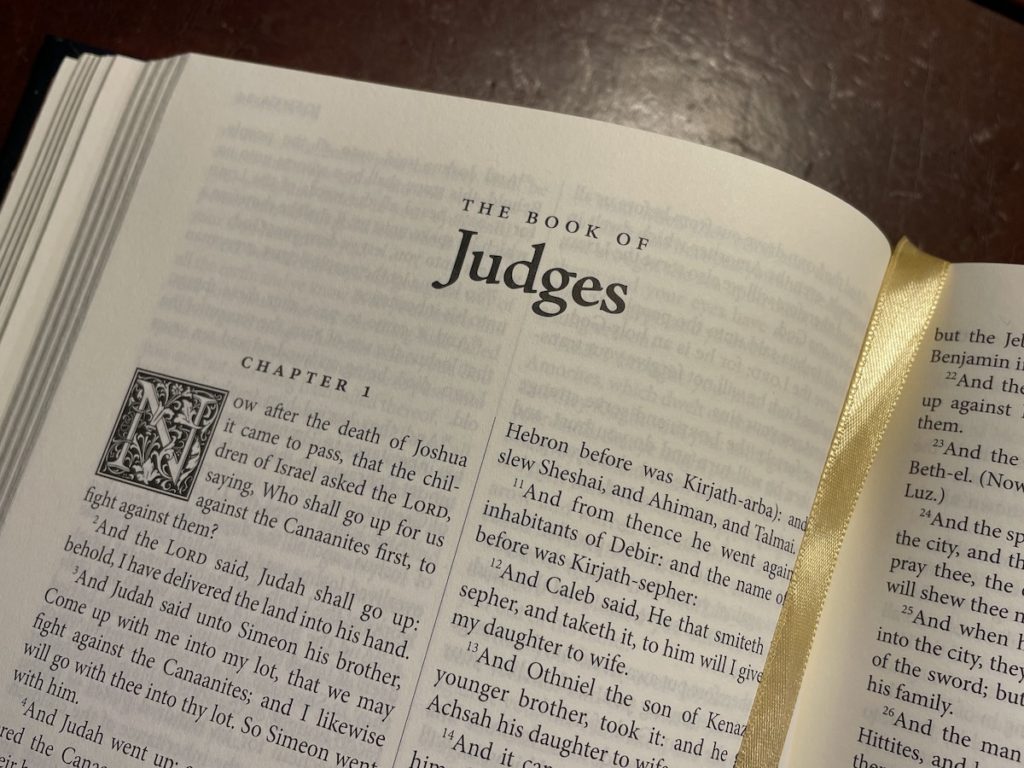
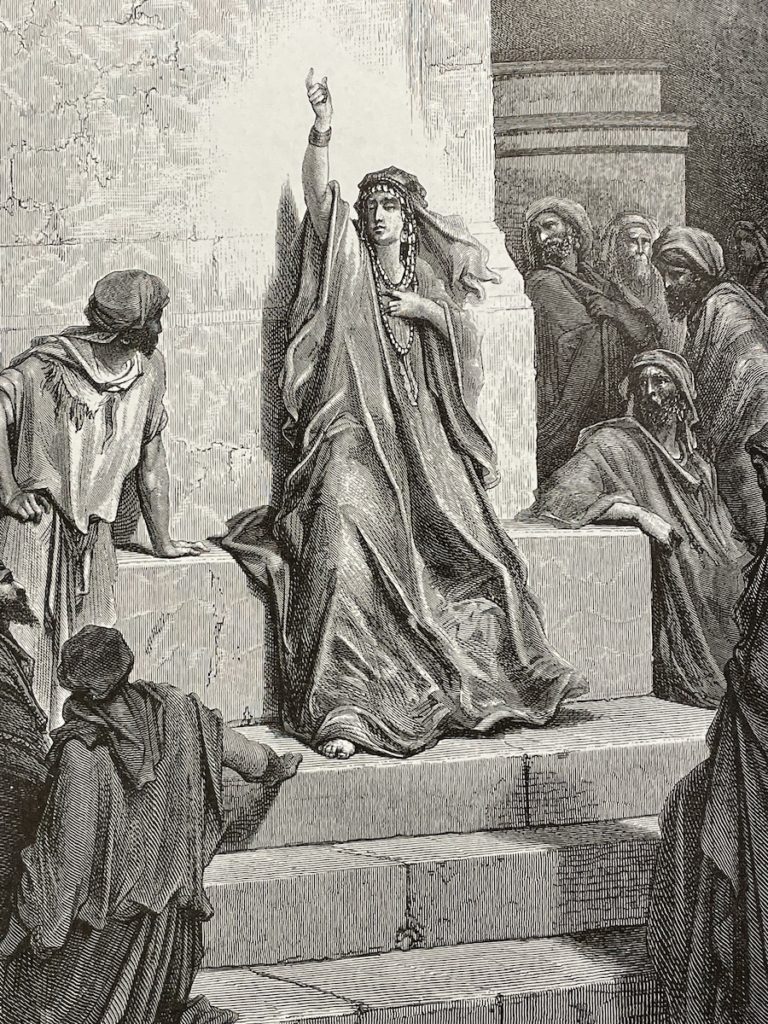
During the time of the judges, the nation Israel was languishing under oppressive foreign powers, yet on numerous occasions, YHVH mercifully sent them a savior to deliver them and through miracles and against overwhelming odds, Israel defeated its oppressors and the nation was brought to a new spiritual level. During this time, YHVH raised up powerful leaders, some of whom were prophets, to lead his people in national spiritual revival and to defeat their oppressive enemies. Most of these leaders were men, but when no man would step forward, he would use women to deliver his people. Deborah, a fiery woman of Elohim, was such a leader.
I have encountered no better description of Deborah the prophetess than this one found in a dusty old book in my library:
Deborah—what a strong solitary ray of light strikes from her story and song, upon the peaks of the past! A mother in Israel, the wise woman of her neighborhood, curing diseases, deciding differences, perhaps, at times, conducting the devotions of her people—how little was she, or were they, aware of the depth which lay in her heart and in her genius. It required but one action and one strain to cover her with glory. In her, as in all true women, lay a quiet fund of strength, virtue, and courage, totally unsuspected by herself.…The Great Spirit, seeking for a vent through which to pour a flood of ruin upon the invaders of Israel, found this woman sitting under her palm tree, on the mountain side, and she did his bidding.…The calm matron becomes the Nemesis of her race, and the mantle of Miriam falls on her shoulders, and the sword of Joshua flames her hand. [Her] prophetic fury sinks not, till the enemy of her country is crushed, and till she has told the tidings to the earth, to heaven, and to all after-time. And then like a sword dropped from a hero’s side, she quietly falls back into her peaceful solitude again.…How wonderful are the gust which surprise and uplift men, and women too, into greatness—greatness before unknown, and terrible even to themselves. (The Bards of the Bible, p. 98, by George Gilfillan, 1851)
The story of Deborah often brings up the question concerning the role of women among YHVH’s people. Proponents of women in leadership roles point to Deborah as a champion to their cause. Those who decry any sort of women leadership within the Christian church often blush when the example of Deborah is brought up, and are quick to add that she was a one-time exception to this rule. What does the Bible say about women leadership among believers?
As proof that on numerous occasions, YHVH raised up to prominent leadership roles among his people, please note the following examples as Batya Wootten points out in her book, Mama’s Torah—the Role of Women:
Miriam was a prophetess and coworker with her brothers Moses and Aaron in leading Israel (Mic 6:4).
YHVH used the daughters of Zelophehad to help instruct Moses, and on the basis of their wisdom, the Torah was amended (Num 27:1–11).
Huldah was a prophetess and an advisor to King Josiah (2 Kgs 22:11–20).
Queen Esther helped to write law (Est 9:29).
Phoebe was a deacon or minister within the spiritual body of early Messianic believers (Rom 16:1–2).
Junia along with Andronicus, her husband, are listed as apostles (Rom 16:7).
Priscilla and Aquila were a husband and wife ministry team and pastored a congregation that met in their home. There are times when the Scripture even records Priscilla’s name first. She was evidently a dynamic leader, along with her husband (Acts 18:2, 18, 26; Rom 16:3; 1 Cor 16:19; 2 Tim 4:19).
The women in Corinth prayed and prophesied publicly (1 Cor 11:5–6).
Philip had four daughters who prophesied (Acts 21:9).
A nucleus of women developed a congregation at Philippi (Acts 16:12–15,40).
Wootten then deduces from the biblical record that “believing communities should be aligned with biblical patterns of the Scripture. And while it clearly depicts a pattern of male leadership, is also clearly shows female participation” (ibid. p. 37).
In light of the example of Deborah we must ask the question: will YHVH’s plans and purposes be put on hold or thwarted simply because there is no person of the male gender to fulfill those plans? For example, can he who spoke through the mouth Balaam’s donkey, and who, Yeshua declared, could raise up rocks to declare his praises not also use women as he so chooses, when there lacks male leadership for the job? At the very least, could he not use women in powerful and instrumental ways to assist men in fulfilling the purposes of Elohim?
Judges4:4,Deborah the prophetess. Deborah is but one of a number of women prophets or, more correctly, prophetesses that are mentioned in the Bible. Miriam, the sister of Moses and Aaron was the first prophetess mentioned (Exod 15:20). Huldah the prophetess ministered in the time of righteous King Josiah (2 Kgs 22:14; 2 Chron 34:22). The wife of Isaiah the prophet was also a prophetess making them a prophetic team (Isa 8:3). Noadiah the prophetess ministered in the time of Nehemiah (Neh 6:14). She must have been notable, since other prophets, presumably male, are listed along with her, but she is the only one whose name is mentioned. There was also Anna the prophetess who ministered near the temple and recognized the young Yeshua to be the Messiah (Luke 2:36). Philip the evangelist had four daughters who also prophesied (Acts 21:9). Beyond that, Joel the prophet predicted that a time would come when both men and women would prophecy (Joel 2:28). Peter recognized that this prophecy was, at least, in part fulfilled on the day of Pentecost (Acts 2:17). Joel’s prophecy was also likely fulfilled in the church at Corinth where everyone was allowed to prophecy, presumably both men and women, for the purpose of edifying the brethren (1 Cor 14:29–33), and Paul refers to them all as “prophets” (1 Cor 14:29, 32).
The wife of Lapidoth (KJV).TheArtScrollTanach has translated this phrase as “a fiery woman” since the Hebrew word lapid means torch. This implies that Deborah was energetic and decisive. The Jewish sages teach that Lapidoth is but another name for Barak since both names connote flashes of lightning, and therefore are used interchangeably (The ArtScroll Rubin Edition Joshua/Judges Commentary, p. 137). If the sages are correct, then Deborah was assisting her husband, Barak. He was the military leader of Israel, while she was the spiritual leader. Does this shake your paradigm about the role of women in biblical societies? Many times fiery women are labeled and branded as persona non grata. Is this a fair thing to do if they are women who walk in and uphold biblical standards of righteousness, and who honor and defer to male headship, if there is righteous male headship worthy of honor?
Often Barak is viewed as a reluctant, even cowardly military leader. Is this a fair assessment? Didn’t he display great faith when he heeded the Word of Elohim through Deborah, and furthermore abandoned the strategic high ground when attacking the enemy on the plain where the enemy’s chariots would be most advantageous? If Barak and Deborah were husband and wife, what does this story teach us about husbands and wives not only respecting, but heeding each other’s counsel, and then working together as a team? Who knows, YHVH may be using your wife or husband to speak to you right now!
Judging Israel at that time. Not only was Deborah a prophetess, but she acted as a judge—a de facto head leadership position in Israel at that time when there was not central leadership or government.
Judges4:11, 17,The children of Hobab. This is another name for Jethro, the father-in-law of Moses, the priest of Midian, who was a righteous man and a descendant of Abraham. Thus, the children of Hobab and the Israelites were blood related cousins and possibly fellow believers in the Elohim of Abraham. Perhaps this is why Jael was willing to kill Sisera, the heathen enemy of Israel. Because of family and, possibly, spiritual ties, despite her people being at peace with Israel’s enemies, who was will to kill Sisera out of family loyalty and devotion to Elohim.
Judges4:14,Deborah said to Barak. Deborah, on the instructions of Elohim, commissioned Barak to go up with his army to fight Sisera with his 900 chariots of iron. This required great faith and human boldness on Barak’s part, for this would be like lightly armed infantry soldiers in our day going up against tanks. Yet armed with a prophetic word from Elohim and faith, Barak obeyed. Had Barak been a sexist, he would have dismissed the prophetesses words and not secured the victory for Israel. If Barak was the wife of Deborah (see notes at verse 4), then the lesson here is that men should listen to their godly wives. If they were not married, then men still need to listen to the counsel of godly and Spirit-led women.
Our new annual Scripture Reading Schedule for 2021-2022 with daily readings is available to download and print. If you are still working through 2020-2021’s Scripture Reading Schedule, the link will still be available on the right sidebar under “Helpful Links”. If you are using a mobile device or tablet, the link may be below, meaning you’ll need to scroll down instead.
Most of this week’s blog discussion points will be on these passages. If you have general comments or questions on the weekly Scripture readings not addressed in a blog post, here’s a place for you to post those. Just use the “leave a reply” link or the “share your thoughts” box below.
The full “Read Through The Scriptures In A Year” schedule, broken down by each day, can be found on the right sidebar under “Helpful Links.” There are 4 sections of scripture to read each day: one each from the Torah, the Prophets, the Writings, and from the Testimony of Yeshua. Each week, the Torah and haftarah readings will follow the traditional one-year reading cycle.
Weekly Blog Scripture Readings for 10/24 through 10/30/2021.
Judges 1:2,Judah shall go up. Elohim has traditionally used the tribe of Judah (from which come the Jews) as the leader of the other eleven tribes of Israel. For example, when the Israelites were wandering in the wilderness, Judah was the first of the twelve tribes to break camp and lead the way to the next camp (Num 2:9; 10:14). At times, YHVH instructed Judah to lead the way into battle (e.g., Judg 20:18). From Judah came the kings of Israel including the Messiah,who is the Lion (or King) of the Tribe of Judah (Gen 48:8–12; Ps 78:68–72; Heb 7:14; Rev 5:5). Jerusalem, the capital of Israel was located in the area of Judah. In the regathering of the tribes of Israel back to the Promised Land as numerous Bible prophecies predict will occur in the end times and on into the millennial reign of Yeshua, the Jews will be the first to return to the land of Israel as we have seen occurring in recent history in the rebirth of what is currently known as “the (Jewish) State of Israel.”
Judges 1:28–7,Jerusalem. The Jews temporarily took possession of Jerusalem, but quickly lost it to the Canaanites (v. 21). David eventually retook it and made it the capital of Israel several hundred years later. By this time, the Canaanites had fortified the city to such an extent that it could not easily be taken by a frontal attack.
Judges 1:12,Caleb. Caleb, the native Canaanite, was grafted into the tribe of Judah. (See notes at Num 13:16.)
Judges 1:20,Sons of Anak. The Anakim were the remnants of the satanic nephilim of Genesis 6:2–4, or the giants that inhabited the Promised Land, and which YHVH instructed the Israelites to annihilate.
Judges 1:21,The Jebusites who inhabited Jerusalem. After quickly taking Jerusalem from the Canaanites (v. 8), the Israelites promptly lost it again. The Israelites were generally overwhelmingly victorious in the their battles against the Canaanites while taking possession of the Promised Land, but not always. In this case, the took and then quickly lost Jerusalem. This teaches us that, even with Elohim on our side, sometimes our battles against our enemies is not always immediately conclusive. We have to struggle a while before we eventually come out on top. Our enemies could be financial, marital, human relationship, health, familial or other issues.
Judges 1:27–36,[Did not] drive out. As we move in to the Promised Land of our spiritual inheritance, even with Elohim on our side, our battles against the world, the flesh and devil are not always immediately conclusive. Sometimes the immediate victory that should be ours eludes us. For example, sometimes saints die before their time due to sickness, but the will achieve the ultimate victory when they receive their glorified body and full spiritual inheritance at the resurrection of the righteous dead and the second coming of Yeshua.
Judges 2
Judges 2:1, 4,Angel of YHVH. Yeshua is speaking to us to day through his word and Spirit to make no alliances with the world, tear down the pagan altars in our lives all in preparation to be his bride.
Judges 2:2,Make no covenant. Do not be unequally yoked with unbelievers. This can only lead to one to spiritual compromise and accommodation with the world, the flesh and the devil and lead one away from YHVH. This includes business partners, marriage partners and other voluntary close relationships where a saint is not in complete control of a situation and is thus potential subject to the influence of those who do not follow biblical standards.
Tear down their altars. We cannot go out into the world and tear its altars, but we can tear down the altars to pagan gods in our churches and our lives today.
Psalm 18:20, 24,Reward me according to my righteousness. The Bible not only teaches that there is a righteousness that is imputed to the saints, that is, the righteousness of Yeshua, but that there is also a works-based righteousness that is a result of the good works of the saints himself that will form the basis for his eternal rewards. Yeshua alludes to this in Matt 5:19–20 as does John in Rev 19:8 (see also Matt 16:27; Rom 2:6; 2 Cor 5:10; Eph 6:6; 1 Pet 1:17; Rev 2:23; 19:12 22:12).
Psalm 18:25–27,With the merciful. To one degree or another, Elohim responds to humans in the same manner they respond to him both positively and negatively. Our relationship with him has a cause and effect component to it—we reap what we sow. This is a form of heaven’s reality discipline upon humans to ultimately, hopefully, bring them to Elohim.
Psalm 19
Overview of Psalm 19
This psalm contains three sections that show a wonderful and logical progression from the greater (Elohim) to the lesser (man),that is, from the macro level downward to the micro level. At first appearance, these three sections may seem unrelated, but upon second glance, each section actually flows logically into to the next revealing some deep mysterious truths about YHVH Elohim’s plan of redemption for humans.
Section one (vv. 1–6) describes the creation of Elohim, which points to the glory of YHVH Elohim, the Creator. It concludes by describing the sun, which is the physical light of the world, and which is like a bridegroom in his full glory emerging from his private chambers about to marry his bride. Moreover, the physical universe is governed by physical laws, which keep it functioning in an orderly manner.
Section two (vv. 7–11) describes the glorious attributes of the Torah-law of Elohim, which reveals the character of the Creator, and it shows man what his response should be to the Almighty upon viewing the glories of his creation. Man is to worship the Creator, not the creation. When followed, the Torah helps to keep man’s life structured in a way that brings order, blessing and causes his life to function smoothly, even as the universe is structured and ordered by Elohim and functions smoothly because of his physical laws.
A Torah lifestyle is also how the saint of Elohim is a spiritual light to the world (Deut 4:6).
Moreover, as the sun’s light pierces the physical darkness of the world, the light of the Torah brings the spiritual light of Elohim into the world along with bringing many benefits to the obedient person including a blessed life.
Section three (vv. 12–14) explains what happens when the light of Elohim’s Torah shines into the darkness of a one’s life as it exposes the hidden dark areas of sin. It also shows man how to walk blamelessly before and in a right relationship with Elohim, his Creator.
This psalm then ends by stating that YHVH is man’s strength and redeemer. This is another way of saying that man is morally and spiritually weak and needs redemption from the consequences and the power of sin.
Thankfully, YHVH has the answer to this problem: he is man’s strength and Redeemer. Yeshua the Messiah is man’s Redeemer and as the sun is the physical light of the world, Messiah is the spiritual light of the world (John 1:6–9; 8:12). Elsewhere, Scripture even calls Yeshua the Sun of Righteousness (Mal 4:2), and, in his glorified state, his face shines like the sun in its full strength (Rev 1:16).
And ultimately, when a person follows the Torah through a relationship with Yeshua the Redeemer, one will eventually be raised to glory and shine like the stars in heaven (Dan 12:3; Matt 12:43), for they will be like Yeshua (1 John 3:2). HalleluYah!
Psalm 19:7–9,The Torah of YHVH. Listed here are the seven attributes of the Torah and the corresponding blessings for Torah-obedience. These are:
The Torah is perfect resulting in converting the soul of man from spiritual darkness to spiritual light.
The Torah is sure (i.e., to build up or support; to foster as a parent or nurse; to render or be firm or faithful, to trust or believe, to be permanent or quiet; morally to be true or certain) imparting wisdom to simple people.
YHVH’s Torah is right (or straight) bringing joy to a person.
Elohim’s Torah is pure (or beloved, choice, clean and clear) light bringing one spiritual enlightenment.
The Torah that engenders the fear of YHVH (which is the beginning of wisdom and knowledge [Ps 111:10; Prov 1:6; 9:10]) is pure and last forever (it has neverbeen done away with!).
The Torah is true (i.e., stability, certainty, truth and trustworthiness).
The Torah is righteous (i.e., right or just).
These are the seven attributes of YHVH Elohim’s Torah-law. Why is it important to know these? Because they give us an insight into the fundamental character of Elohim. That is to say, the Torah is an extension of the very character, heart, mind, will and personality of our Creator. This is why it is patently absurd and borderline, if not totally, blasphemous to declare that the Torah-law that YHVH revealed to his people through the patriarchs and eventually in a codified form to Israel through Moses has been done away with! The perfect and immutable character of Elohim cannot be changed, annulled, improved on or abridged in any way. Make no mistake, for anyone to think that this is possible is simply a manifestation of one’s sinful arrogance, impudence, rebellion, defiance and puerile impudence against the Almighty. Elohim will never tolerate any effort of man to impugn his character. Those who do so will be judged accordingly—especially those who teach YHVH’s people these false traditions of man by which the Word of Elohim has been made of none effect.
Psalm 19:13,Great [much] transgression. Is this to be contrasted with “small or little transgression”?
Psalms 22–24
A Prophetic Messianic Trilogy. Psalms 22, 23 and 24 form a prophetic trilogy pointing to the circumstances surrounding the death (Psalms 22 and 23), resurrection (Psalm 23) and enthronement of Yeshua as King over Israel (Psalm 24). Psalm 24 shows how a person can ascend the “mountain” of Elohim and come into the presence of our Father in heaven. This psalm also presents the Messiah as YHVH and as the doorway to righteousness and salvation for those who seek him. He is the only way to the Father in heaven, if one will only open the door of one’s heart and let him come into one’s life.
Psalm 22
Psalm 22:1–7,You forsaken me…enthroned in the praises. When it seems that Elohim has forsaken us and the heavens seem like brass, this is the time to praise Elohim, and his presence will come. It is also the time to recall and even remind him of all the good things that he has done for us in times past (vv. 4–5). This is despite the fact that the brutish and abusive behavior of others against us often makes us feel as low as a worm (vv. 6–7). Praising and trusting in Elohim at such times is counter intuitive to the natural human mind. It is in such times that one is inclined to cease believing in their Creator and, to one degree or another, forsake him and or abandon their faith altogether. Yet at these times, this is when the faithful saint seeks the Almighty all the more, even as Yeshua did while in praying in the Garden of Gethsemane and while hanging on the cross—the very thing to which this psalm prophetically pointed. For it is verse one of this psalm that Yeshua quoted while hanging on the cross dying. He was telling us that we was the fulfillment of the prophecies contained in this psalm. In fact, this psalm has several prophetic referential touch points to Yeshua’s last moments just prior to his ignominious death. They are:
As some of you have noticed, this Bible reading season, I am focusing my Bible commentary notes on the two sections of the Bible that I have previously overlooked on this blog: The Writings and the Prophets. In the past, I have focused primarily on the the Torah and the Testimony of Yeshua (NT). For those of you who still desire to read my thousands of blog posts on these sections of the Bible, I invite to search out these you Scriptures them out by book or by topic on the search engine on this blog’s main page.
For the Writings and Prophets sections of Scripture, I have many commentary notes that I have not shared publicly, and am also in the process of writing more commentary as we go along.
Joshua 22:24,For fear. The eastern tribes of Israel constructed the altars along the banks of the Jordan River out of a fear of Elohim, and not because of idolatry. If everything that we do is based on our reverential as well as our dread fear for Elohim (these are the two aspects of the true biblical fear of Elohim), then we will be less likely to commit sin, that is, to stray from his commanded ways. This is because, as the Scripture elsewhere teaches us, the fear of Elohim is basis or beginning of both wisdom and knowledge. Knowledge is the revelation of YHVH’s divinely revealed Truth, and wisdom is the proper and use and application of that knowledge in our daily life.
Joshua 23
Joshua 23:7,Make mention. Here Joshua forbids the mention of the names of pagan deities by the Israelites, yet, ironically, the translators of the Bible, in the same verse, mention two names that were applied to pagan deities long before being used in reference to the Elohim of the Bible. They are: Lord and God.
Joshua 23:10,One man of you shall chase a thousand. See notes at Lev 26:8.
Joshua 23:12,Make marriages with them. In the Torah, and elsewhere in Scripture, we find many such warnings against the saints intermarrying with unbelievers. For example, Paul warns the saints in Corinth (and us), “Do not be unequally yoked together with unbelievers. For what fellowship has righteousness with lawlessness? And what communion has light with darkness? And what accord has Messiah with Belial? Or what part has a believer with an unbeliever? And what agreement has the temple of Elohim with idols? For you are the temple of the living Elohim. As Elohim has said: ‘I WILL DWELL IN THEM AND WALK AMONG THEM. I WILL BE THEIR Elohim, AND THEY SHALL BE MY PEOPLE.’ Therefore ‘COME OUT FROM AMONG THEM AND BE SEPARATE, SAYS THE LORD. DO NOT TOUCH WHAT IS UNCLEAN, AND I WILL RECEIVE YOU,”’ (2 Cor 6:15–17). In this present generation of general lukewarmness and a Laodicean attitude among most Christians, where a watered down gospel is being preached, coziness with the world is now acceptable. The problem is that in a marriage situation, being unequally yoked with an unbeliever, or even being married to someone who is not as zealous as you are can result in untold friction and conflict in a marriage—something that a wise person will avoid at all cost. The continual bad influences of an ungodly spouse may even corrupt the righteous spouse and cause them eventually to fall away spiritually. As Paul warned elsewhere, “Do not be deceived: “Evil company corrupts good habits,” (1 Cor 15:33).
Joshua 24
Joshua 24:15,As for me and my house. This is one of the most popular verses in the Bible, and many people have posted this passage from Joshua on placards near the doors to their houses. But what does it mean to serve YHVH Elohim? Many people claim Yeshua (Jesus) as their Savior, but when it comes to him being their Master (or Lord), well, that is another thing. To a large degree, many if not most Christians are still the lord of their own lives serving themselves. If the Bible (the Word of Elohim of whom Yeshua became the Living Word) commands them to do this or that, they filter it through their own thinking (as Adam and Eve did when tempted to disobey Elohim and eat of the forbidden fruit, thus committing the first sin), and they decide whether they want to obey or not. In many cases, they refuse to obey the Word of Elohim because they decide, for one reason or another, that it does not suit them. In this case, Yeshua is not the Master of their life and they are, in reality, not serving him but are serving their own carnal natures.
Joshua 24:19,You cannot serve YHVH. The carnal, non-Spirit filled, individual (e.g. the children of Israel) cannot serve or obey Elohim in their own strength and power. The children of Israel demonstrably proved this point while wandering in the wilderness for forty years. But since Yeshua sent his Set-Apart (or Holy) Spirit to live inside of this disciples (that is you and me), we are now without excuse, for it is the Spirit that empowers us to obey Elohim, when it writes his laws on our hearts.
He is a holy El. What is YHVH Elohim’s chief attribute? Most Christians have been taught that it is love, for Scripture tells us that Elohim is love (1 John 4:16). But while love is an important attribute of Elohim’s character, it is not his chief attribute. Holiness is. This we know because the spirit beings in heaven who surround Elohim’s throne are continually shouting, “Holy, holy, holy” (Isa 6:3 and Rev 4:8).
Holy is the Hebrew word kadosh meaning “pure, undefiled, separate and set apart.” Pure and undefiled from what? From the pollution and defilement of the world, the flesh and devil; Elohim is totally without sin.
Moreover, the Bible declares that without holiness, no one will see Elohim or come into his presence (Heb 12:14). What is the biblical definition of holiness? It is much more than just what many churches teach it is: not swearing, not drinking, not going to movies or dancing, and the like. Holiness involves obeying the commandments of Elohim (Num 15:40; Deut 28:9).
From the beginning of the Bible to the end and in many ways, YHVH commands his people to become holy as he is holy (Lev 11:44–45; 19:2). Being holy by obeying YHVH’s Word is whole lot more than simply following the man-made dictums of ones religious organization. The rules and regulations of most churches are more like the entrance requirements to join and maintain membership in an exclusive country club, not the requirements for entrance into the family and kingdom of YHVH Elohim! This is not a popular message in most churches. This is because, as Yeshua declared, “[N]arrow is the gate and difficult is the way which leads to life, and there are few who find it” (Matt 7:14).
Joshua 24:21,No but we will serve him. Many people want to serve Elohim, and even claim to do so, but do not. Similarly, many Christians claim to serve or obey Yeshua, but in reality do not or only do so partially or only to the degree that they want to. They operate under self-delusion. Their words say one thing, while their actions paint a completely different picture. No one obey’s Elohim perfectly, which is why we need his grace and the imputed righteousness of Yeshua to be credited to our spiritual bank account, so to speak. But this is no excuse not to obey his commandments as best we can with our whole hearts. This issue of obedience will come to a critical head at the judgment seat of Yeshua when the actions of all humans, including the saints, will be judged, for everyone must pass be judged before being granted either eternal life or eternal death (Rom 14:10; 2 Cor 5:10; Heb 9:27). The Torah-law of Elohim will be the standard by which all will be judged (Matt 5:19; John 12:48 cp. 2 Cor 5:10). This will be a day of great revelation, for in that day, many Christians will think that their religiosity will have guaranteed them a place in the kingdom of Elohim will be deemed insufficient in the eyes of Elohim because of their lack of obedience to his Word which will judge them (see Matt 7:21–23 and Rev 3:14–21).
Joshua 24:22–24,You are witnesses against yourself. Many humans are well-meaning in their desire to serve Elohim, but when the pressures of temptation and persecution from the world, the flesh and the devil come their way, their resolve to be faithful to Elohim eventually crumbles and they give in. Joshua knew that because of man’s innate, downward-bent carnal nature, it is difficult, if not impossible, for anyone to remain faithful to Elohim and his Word for very long. Moreover, Joshua knew the Israelites better than they knew themselves. After all, he was only one of two individuals from the generation that was born in Egypt to make it into the Promised Land. The rest perished in the wilderness because of their doubt, unbelief in Elohim and their general sinfulness. The sad truth is that Joshua correctly and the people’s inability to remain faithful to Elohim when he prophetically predicted, “You cannot serve YHVH,” despite the people’s objections to the contrary (vv. 21–22). Biblical history records that the Israelites only ever remained faithful to YHVH for brief periods of time usually lasting no more than 30 or 40 years. For example, some of the most righteous Jewish kings produced some of the most wicked and pagan sons, who completely turned their backs on Elohim and led Israel into total apostasy and evil practices that were often worse than the heathen nations around them. This is a warning to us all: “Therefore let him who thinks he stands take heed lest he fall!” (1 Cor 10:12).
Joshua 24:27–28,Joshua let the people depart…inheritance. At the end of his or her life, all that a righteous and faithful leader of Elohim (whether they are a parent, pastor or in some other position of spiritual power and influence) can do is to is to encourage those people over which he has influence to obey Elohim and to warn them of the consequences if they do not. After that, he must leave the people as he departs the scene. The proverbial ball is now in people’s court, and it is up to them whether they will follow the leader’s wise counsel or not; each individual has to make his or her own choice in such matters. From that point on, each person will reap what he or she sows, and they will inherit the fruits of their actions whether good or bad.