
New Video: The Horns of the Altar and Yeshua the Horn of Our Salvation
2

The Twice Daily Sacrifices and the Saints Daily Devotions
This twice daily offering was known as the continual burnt offering (Heb. olah tamiyd), and was offered at the door of the tabernacle (verse 42). The word continual (Heb. tamiyd) means “continually.” This sacrificial offering has great spiritual implications for the serious disciple of Yeshua and relates to his or her daily life.
The Hebrew word for burnt offering is olah meaning “ascent, stairway or steps,” and derives from the basic Hebrew verb, alah, meaning “to go up, climb or ascend.” In this offering, the fire consumes the entire animal, and the word olah refers to the smoke of this whole burnt offering ascending to heaven, which is a “sweet aroma” to YHVH (verse 41). The olah was an offering or gift (Lev 1:2, Heb. qorban) to YHVH and could be a bull, goat, ram, turtle dove or a pigeon as long as it was a perfect specimen without defect (Lev 1). If an Israelite sinned, he could bring this gift-offering to the door of the tabernacle where he would place his hands upon the head of the animal, after which the priests would slaughter it, and sprinkle its blood around the altar of sacrifice just inside the door of the tabernacle (Lev 1:2, 4, 5). The meat was then prepared and arranged on the altar and entirely burnt (Lev 1:6–17). When the sinner laid his hands on the animal, it was as if he were transferring his sins onto the innocent, blemish-free animal, where upon YHVH accepted it as an atonement for the person’s sin (Lev 1:4).
The writer of Hebrews clearly teaches that this offering (along with all the other offerings in the sacrificial system) pointed to Yeshua, our Great High Priest, whose atoning death on the cross fulfilled all the types and shadows of the Levitical, sacrificial system (Heb 4:14–5:7; 7:1–10:18).
Besides the obvious antetypes pointing to Yeshua’s death on the cross, what else can we learn from the olah tamiyd offering rituals? What are the spiritual implications and the lessons to be learned for the redeemed believer living in the twenty-first century? Matthew Henry in his commentary on Numbers 28:1–8 sums it up very nicely:
The particular law of the daily sacrifice, a lamb in the morning and a lamb in the evening, which, for the constancy of it as duly as the day came, is called a continual burnt-offering (v. 3), which intimates that when we are bidden to pray always, and to pray without ceasing, it is intended that at least every morning and every evening we offer up our solemn prayers and praises to [Elohim]. (emphasis added)
This olah tamiyd sacrifice was connected to the rising and setting of the sun as implied by the words of the psalmist (Ps 113:3). At the same time, the priest was to burn incense on the incense altar (Exod 30:7–8) as part of the olah tamiyd sacrifice.
The biblical writers foresaw a time coming when either there would be no tabernacle or temple in which to offer the sacrifices and incense, or the designated place of worship would be inaccessible to the Israelite. In this situation, Hosea admonishes sinful Israel to return to YHVH and to offer up the sacrifices (lit. the calves or young bulls) of our lips, while expecting Elohim to graciously receive them and take away their iniquity (Hos 14:2). Paul embraced this idea when he admonished the saints to become as “living sacrifices…unto Eohim” (Rom 12:2). In John’s vision of heaven, he sees the prayers of the saints as being like sweet smelling incense before the throne of the Almighty One (Rev 5:8; 8:3). Not only does YHVH view the prayers of the righteous as incense, but their praises of him as a sacrifice or a thanksgiving offering as well (Jer 33:11; Heb 13:15). The psalmist goes on to connect the dots between the olah tamiyd sacrifice, incense, prayer and praise when he writes,
Let my prayer be set forth before thee as incense; and the lifting up of my hands as the evening sacrifice. (Ps 141:2)
How is the non-priest to offer incense before the YHVH? This is done through prayer and worship as the prophet Malachi indicates:
For from the rising of the sun even unto the going down of the same my name shall be great among the Gentiles; and in every place incense shall be offered unto my name, and a pure offering, for my name shall be great among the heathen, saith YHVH of Hosts. (Mal 1:11)
The Torah prohibits offering sacrifices anywhere YHVH has not placed his name. What’s more, Yeshua has fulfilled the sacrificial system by his death on the cross once and for all, and has become our Great High Priest. So how then do the nations offer up sacrifices in every place as Malachi prophesies except by prayer and praise? The same is true, of course, for redeemed believers who are now part of Yeshua’s royal priesthood as Peter testifies:
Ye also, as lively stones, are built up a spiritual house, an holy priesthood, to offer up spiritual sacrifices, acceptable to Elohim by Yeshua the Messiah. (1 Pet 2:5)
However, since there is no longer either a temple or a Levitical priesthood, yet the saints are called priest of Yeshua (Rev 1:6; 5:10; 20:6), how shall we as the saints of the Most High fulfill our priestly duties if not by serving our Master Yeshua through our twice daily prayer and praise?

Exodus 29:12, Horns of the altar. The four horns of the altar of sacrifice was the place where the blood of atonement was sprinkled (also Lev 4:4, 17, 18, 25, 30, 34; 8:15; 9:9; 16:18). But there’s more.
Horn is the Hebrew word qeren meaning “horn, hill or ray.” This word is used to describe the rays of light rays emanating from the face of Moses after his encounter with YHVH (Exod 34:29) and the horns of an animal (Ps 69:31). In ancient cultures, the horn was a metaphor for physical strength or spiritual power (Deut 33:17; 2 Sam 22:3; Ps 18:2).
Elsewhere, YHVH is referred to as man’s “horn of salvation” meaning he is the strength of our salvation. The Hebrew word for salvation is yesha meaning “deliverance, rescue, safety, welfare, victory, prosperity.” The root of yesha is the verb yasha meaning “to save, to deliver, to give victory.” Not only is YHVH called our “horn of salvation” in the Tanakh, but this designation is applied to Yeshua as well in the Testimony of Yeshua (Luke 1:69). Interestingly, Yeshua is a derivative of the Hebrew name Yehoshua (or Joshua), which also derives from yasha.
It should be evident from this quick study that the horns of the altar are a picture of Yeshua, who is the horn or strength of our salvation and who shed his blood for our sins on the altar of the cross. This being the case, why then are there four horns on the altar? This is likely symbolic of the four attributes of Yeshua, even as the four colors of cloth used throughout the tabernacle prophetically symbolize the same thing. Crimson speaks to Yeshua’s humanity, purple to his kingship, blue to his divinity, and white to his sinlessness or righteousness.
Additionally, the Jewish sages view the four horns as symbolizing the four corners of the earth, for, in Hebraic thought, the earth is nothing more than a large altar dedicated to Elohim. (See The ArtScroll Tehilim/Psalms commentary on this verse and notes at Ps 118:27.) The horns on the four corners of the altar could also prophetically point to the fact that Yeshua came to save all humans (who would trust in him) from the four corners of the earth.
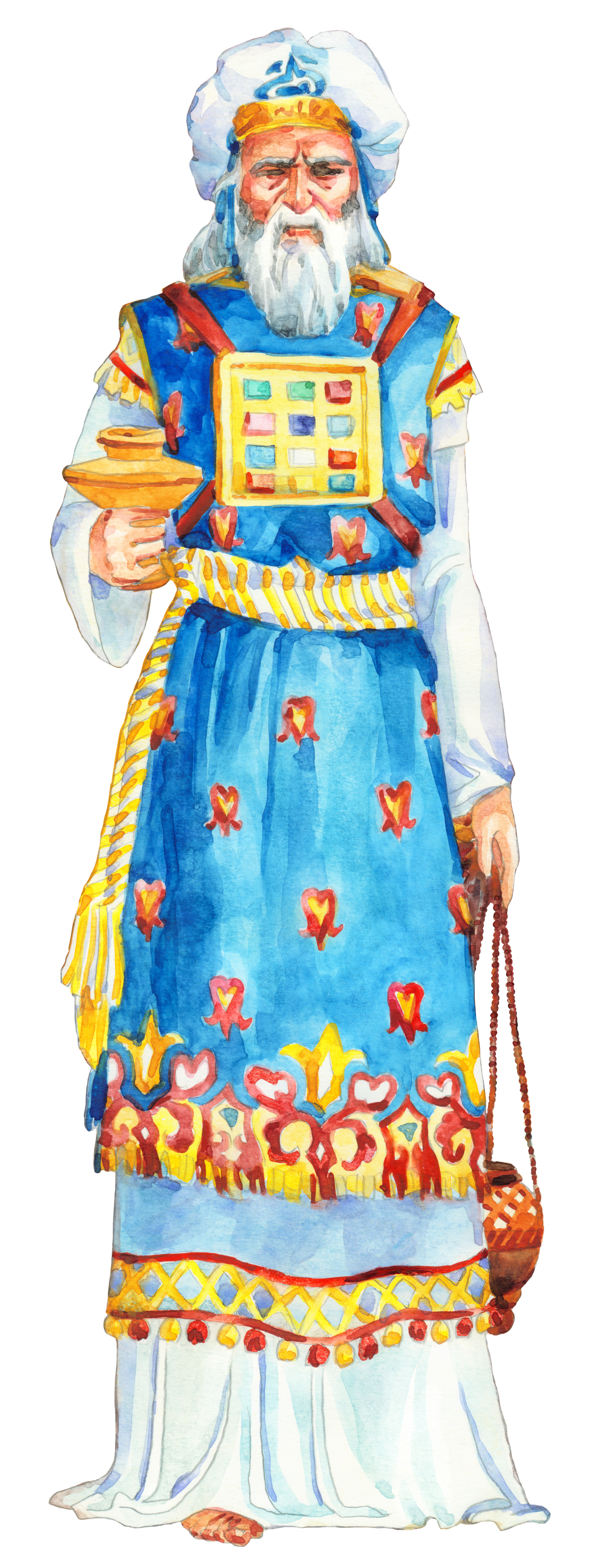
The Seven Steps to Consecrating a Priest &
the Seven Steps to Salvation (from Exodus 28–29 ; Lev 8)
Now let’s note the seven steps of consecrating the priests and compare them with the steps a believer goes through to become a “chosen generation, a royal priesthood, a set-apart nation, a peculiar people that you should show forth the praises of him who has called you out of darkness into his marvelous light” (1 Pet 2:9). Notice how these seven steps relate to the steps a new believer takes in his conversion process and how they relate to one’s spiritual journey from outside the mishkan where the altar of the red heifer is located representing the cross of Yeshua, then into the door of the tabernacle (i.e. Yeshua who is the door), to the altar of sacrifice (i.e. a prophetic picture of communion) to the bronze laver (i.e. immersion for the remission of sins and being washed in the water of the Word of YHVH), into the set-apart place where the Ruach (Spirit of Elohim) is and onward and upward spiritually into intimate relationship with the Father. In Exodus chapters 28 and 29 we find the following:
Step One: They were taken from among the children of Israel ( Exod 28:1). This prefigures divine election (see John 15:16). YHVH calls or chooses each person. Yeshua called his disciples. They did not call or choose him, but they had to respond to that call.
Step Two: They were brought into the door of the tabernacle (Exod 29:4). The door of the tabernacle is Messiah Yeshua who is the door to the sheepfold. No man comes to the Father except through Yeshua (John 10:1–5, 7, 9) The door is four colors which speak of the person and work of Yeshua: blue, scarlet, white and purple. It also speaks of the four Gospels, which is the door to understanding the Person and work of Yeshua.
Step Three: They were washed (Exod 29:4). Upon accepting the work and Person of Yeshua one must be immersed for the remission of sins (Acts 2:28) to identify spiritually with the death, burial and resurrection of Yeshua (Acts 2:38; Rom 6:3–14), and the washing of the water of the Word (Eph 5:26).
Step Four: They were clothed in their official garments (Exod 29:4–9). The redeemed believer is to put on the robes of righteousness (note Gal 3:27, “For as many of you as have been baptized into Messiah have put on Messiah”). Paul talks about fruits of righteousness through Yeshua in Philippians 1:1. Righteousness is Torah obedience (Ps 119:172) and is a mark of the end time believers/saints (Rev 12:17 and 14:12) and of the bride of Messiah (Rev 19:8).
Step Five: They laid their hands on the head of the animals which were sacrificed (Exod 29:10–26, 32–33). The blood of an animal was shed and sprinkled on Aaron and his sons and matzah (unleavened bread) was waved and burnt and they ate the flesh of the ram and the matzah.
Each born-again believer has to take personal responsibility for his own sins. The sacrifice of Yeshua, the Lamb of Elohim, at the cross must become personal to each person (see Heb 10:19; 13:12; 1 Pet 1:2; 1 John 1:17 and Rev 1:5). Each believer has his own personal relationship with Yeshua. Each must eat the flesh and drink the blood of Yeshua individually (John 6:35–58). Communion is a personal and individual matter.
Step Six: They were anointed with oil (Exod 29:21). Each person must receive the Set-Apart Spirit (Ruach) of Elohim (see Acts 8:17; 19:6).
Step Seven: They are sanctified or set-apart for a special, divine purpose (Exod 29:44). Only after going through these steps is one set-apart unto YHVH as a set-apart priesthood doing the set-apart work of YHVH (see Rom 15:16; 1 Cor 1:2; 6:11; Heb 10:10,14; 1 Pet 2:9).
Only on the basis of following YHVH’s steps, as outlined above, can one have fellowship with the Father. And what was the result of this consecration process? Relationship with the Father! Read Exodus 29:44–46 below,
And I will sanctify the tabernacle of the congregation, and the altar: I will sanctify also both Aaron and his sons, to minister to me in the priest’s office. And I will dwell among the children of Israel, and will be their Elohim. And they shall know that I am YHVH their Elohim, that brought them forth out of the land of Egypt, that I may dwell among them: I am YHVH their Elohim. (emphasis added)
This is all accomplished through Yeshua living in us spiritually. Yeshua is the Chief Cornerstone of our faith (Eph 2:20). He is the end result or goal of the Torah (Rom 10:4). He is the Author and the Finisher of our Faith, the Beginning and the End, the Aleph and Tav (Alpha and Omega) of everything.
To whom coming, as unto a living stone, disallowed indeed of men, but chosen of Elohim, and precious, you also, as lively stones, are built up a spiritual house, a set-apart priesthood, to offer up spiritual sacrifices, acceptable to Elohim by Yeshua the Messiah. Wherefore also it is contained in the Scripture, “Behold, I lay in Tzion a chief corner stone, elect, precious, and he that believes on him shall not be confounded. Unto you therefore which believe he is precious, but unto them which be disobedient, the stone which the builders disallowed, the same is made the head of the corner, and a stone of stumbling, and a rock of offence, even to them which stumble at the word, being disobedient: whereunto also they were appointed. But you are a chosen generation, a royal priesthood, a holy nation, a peculiar people; that you should shew forth the praises of him who has called you out of darkness into his marvelous light, which in time past were not a people, but are now the people of Elohim, which had not obtained mercy, but now have obtained mercy. (1 Pet 2:4–10)
Our faith in Yeshua stays alive and vibrant because of the sacrifices of devotion and praise we offer up daily, morning and night. We are called to do the same work the priests of old did, but in a spiritual or fuller sense.
John 5:46–47, Believed Moses. These two verses at the end of chapter five can easily be overlooked, but their implications are huge.
Quite simply, Yeshua is saying that those who don’t believe the writings of Moses (i.e. the Torah) won’t believe the words of Yeshua who himself upheld the Torah and taught its validity in the lives of his disciples.
This then begs the following question: Where does this leave all those who claim to be followers of Yeshua, but who believe that the law of Moses was abrogated? It’s hard to be absolutely black and white on this matter, since only YHVH can judge the heart condition of each individual, for undoubtedly many who claim the law was “done away with” still adhere to many of the law’s tenets (e.g., you shall not steal, murder, lie, commit adultery, worship idols and you shall honor your parents, etc.) and are thus obedient to the law to one degree or another. However, we can safely say that it’s a matter of degrees. To the degree that we don’t believe the words of Moses, we don’t believe the words of Yeshua who was a proponent (and, in reality, as the Word of Elohim, the Originator) of the Torah-law of Moses.
John makes a similar statement in his first epistle from which we can deduce the following: To the degree we don’t keep the (Torah) commandments of Elohim, we won’t know him; that is to say, conversely, if we keep his commandments which are a reflection of his character, will and heart, we will be able to know what pleases him, which in turn will determine the depth of our spiritual relationship with him (1 John 2:4).
In reality, these should be simple concepts to grasp and put into practice in one’s spiritual walk, yet, sadly, most religious leaders have misled Christians to believe anything and everything but the simple truth of the Bible and instead of concocted convoluted man-made doctrines and unbiblical traditions by which they have made the word of Elohim of no effect (Mark 7:13). It’s time for Elohim’s people to come out of the Babylonian church system with its webbed mixture of truth along with half-truths and outright lies (Rev 18:4).
Moreover, Yeshua is saying here that Moses’ prophecies about the coming Messiah formed the foundation for all the subsequent biblical messianic prophecies and the eventual coming of Yeshua the Messiah. If one couldn’t believe these prophecies of Moses, how would they recognize, much less believe in, Yeshua when he did come?

John 5:4, Troubled/stirred the waters. The Greek word for stir or trouble can mean “to agitate, disquiet, make restless, cause inward commotion, to strike one’s spirit with fear, perplex the mind, render anxious or distressed or to cause dread.”
The troubling of the waters at the Bethesda Pool was more than just a breeze causing some riffles over the waters. Those at the pool’s edge must have sensed something supernatural when the angel troubled waters—that something supernatural was about to occur. Perhaps they sensed the presence of Elohim in their spirit. The outward stirring of the waters (with the inward stirring of the spirit?) coupled with their acting in faith to get to the waters to be healed brought about healing.
What is the lesson here for us? When we sense the presence of the Almighty to heal us, we must step forth in faith seeking Elohim’s healing touch in our lives. Our seeking might result in our finding heaven’s miracle for our lives.
Many times I have been in meetings when I sensed the Presence of YHVH’s anointing on me in a powerful and unique way. To me this is a signal from heaven that I’m supposed to pray for someone there. When this leading of the Spirit is obeyed, miracles and spiritual breakthroughs occur.
Let’s be tuned into this moving of YHVH, so that we can be a greater tool in YHVH’s hands to be a river of life to those around us!
This is a gospel-oriented Torah study. Our goal is to connect the good news of Yeshua the Messiah (the gospel message) to its Hebraic, pro-Torah roots or foundations. The information given here is more than head knowledge. Understanding and wisdom (the right application of knowledge that is based on truth) is taught thus making biblical truth practical, relevant and applicable to your daily life. The truths of the Bible not only have the power to transform your life here and now for the better, but eventually to take you past the veil of death and into eternity.
This Torah study is subdivided in sections by topic in a magazine format thus making it easy to watch at several sittings.
May you be blessed as you watch this video.
For a free, printable adult and youth Torah study guide on this Torah portion (parashah), please go to http://www.hoshanarabbah.org/parshiot.html