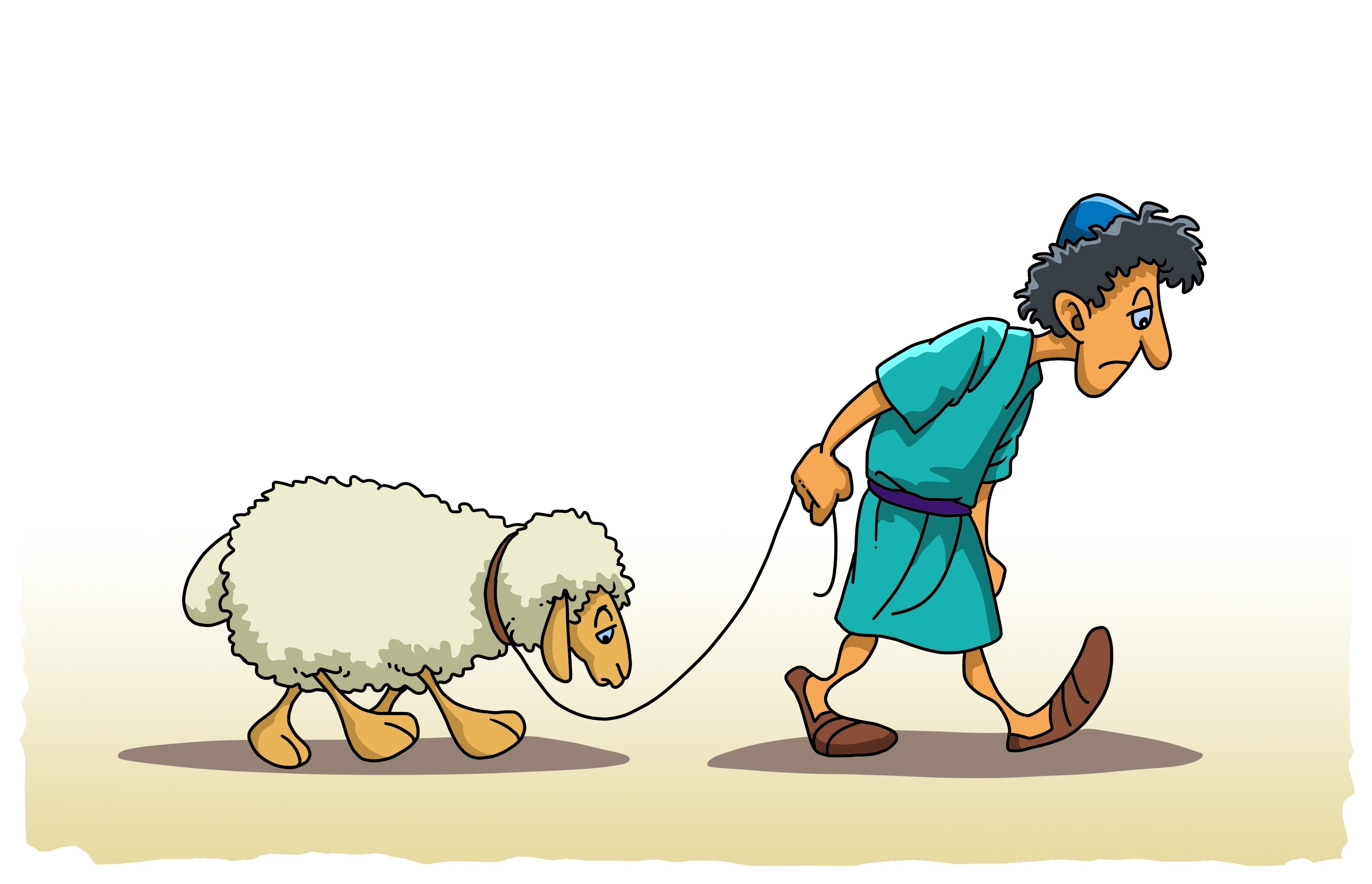
Is your offering to Elohim a profane or holy one?

Are our lives—our time, talent and treasure—that we’re offering to Elohim a holy or unholy sacrifice, pure or impure, blemished or unblemished, the best or the left-over crumbs?

Leviticus 22:1–31, Profane Vs. Holy. In this section of the Torah, YHVH makes some strong delineations between that which is profane, polluted or contaminated and that which is kadosh or set-apart in service to YHVH. To come into his Presence demands that men follow high and exacting standards. Why? It is to teach sinful man that although YHVH is high and lifted up above the mortal and mundane plane in his set-apartness and righteousness, he is not unapproachable by men if they will prepare themselves properly to come into his Presence. (Read Eccl 5:1–2.) He wanted to impress this upon the Israelites as they began the service of the tabernacle.

Therefore, YHVH specifies that certain offerings brought to his altar that are contaminated will be rejected if (a) the offerer is in a state of physical contamination, (b) he is contaminated through improper marriage, or (c) he is offering a blemished animal. What can we learn from this? What offerings do we bring to YHVH’s altar now? Our time, our money, our energy, our talents and spiritual gifts, our devotion? Do we give him the best? Do you pray to him and study his Word in the morning when you are the freshest, or do you give him the crumbs of your day after a hard day’s work just before bed when you offer up “sleepy time” prayers and read the Scriptures as your drifting off to sleep? Are your tithes the crumbs and leftovers after all the bills are paid, the government has taken out its portion and your play money has been set aside?

If you are a young person, are you serving YHVH while you have the health and vigor of youthfulness, or are you planning on playing now and serving YHVH after you have sated the lusts of the flesh, if at all? (Read Eccl 11:9–10; 12:1–14 and Matt 6:24.) Examine your life. Are you giving YHVH the best in all areas? If not, repent and change your priorities, and then see what happens in your spiritual walk and relationship with him!


Blog Scripture Readings for 4-29 Through 5-5-18

Aside

THIS WEEK’S SCRIPTURE READINGS FOR STUDY AND DISCUSSION:

Parashat Emor — Leviticus 21:1 – 24:23
Haftarah — Ezekiel 44:15-31
Prophets — Jeremiah 3:1 – 9:26
Writings — Job 33:1 – 39:30
Testimony — Acts 25:1 – 28:31; James 1:1 – James 2:26

Our annual Scripture Reading Schedule for 2017-2018 is available to download and print.

Most of this week’s blog discussion points will be on these passages. If you have general comments or questions on the weekly Scripture readings not addressed in a blog post, here’s a place for you to post those. Just use the “leave a reply” link below.

The full “Read Through The Scriptures In A Year” schedule, broken down by each day, can be found on the right sidebar under “Helpful Links.” There are 4 sections of scripture to read each day: one each from the Torah, the Prophets, the Writings, and from the Testimony of Yeshua. Each week, the Torah and haftarah readings will follow the traditional one-year reading cycle.

Weekly Blog Scripture Readings for 4/29/18 through 5/5/18. This week is the fourth week of seven complete weeks of the count of the omer.


Where are YOU on the political spectrum? Conservative Vs. Progressive

Generally speaking, social conservatives tend to act on the basis of principles—what is morally right or wrong. On the other hand, leftists, “progressives,” socialists, Marxists or fascists tend to act on the basis of whatever is politically expedient at the moment and justify their actions on the basis of their particular feelings, or what is politically correct at the moment. They act on the basis of “group think” and tend to favor mob rule—as long as their mob is ruling. What is morally right or wrong has little if any bearing on what they think or do. It’s whatever feels right to them at that moment.

Another way to characterize the actions of those who lean toward the left or “progressive” side politically is that for them “the (political) ends justify the means,” which is one step away from the satanic motto of “Do what thou wilt,” which is another way of saying, “If it feels good, do it.” This is nothing more than situational ethics or moral relativism. This is the religion of secular humanism where the rule of YHVH Elohim is rejected in favor of self-rule. In reality, this is nothing more than embracing the lie of the devil serpent at the tree of knowledge in the Garden of Eden, when he questioned the Creator’s rule of law. When the first humans fell for Satan’s lie, this resulted in the introduction of sin and rebellion and destruction and death and man being separated from Elohim.

Broadly speaking, the political conservative tends to act more on the basis of universal and unchanging principles of right and wrong that are ultimately based on the divinely revealed truth of the laws found in the Bible. On the other hand, the political socialist acts on the basis of feelings and what man (not Elohim) thinks is right and wrong. We know what the Bible says about this:

There is a way which seemeth right unto a man, but the end thereof are the ways of death. (Prov 14:12)

The conservative, by contrast, believes in self-rule and limited government because they don’t need big government to regulate every aspect of their lives by telling them what is right and wrong: They have God/Elohim and his word, the Bible, to do that and they realize that they are ultimately answerable to the Creator for their actions, and not to government. They walk in the fear of Elohim, not man. This makes them wise and knowledgeable, for the Bible says the fear of Elohim is the beginning of both knowledge and wisdom. This understanding keeps them on the moral straight and narrow path. Because they base their thoughts and actions on the firm foundation of divinely revealed biblical truth, they find that the constantly shifting moral standards of leftist “progressives”  to be illogical, foolish and impossible to understand. To the conservative right is always right and wrong is always wrong, and these definitions don’t change over time. Not so with the leftist “progressive.”

The social progressive leftist wants government (the bigger the better) to legislate their view of morality, which changes from generation to generation, hence the term “situational ethics” or “moral relativism.” They then turn their view of “morality” into an ideology and then into a political agenda, which they then they demand that the government enforce by the rule of law and cram down the throats of those who disagree with them. This is a form of fascism or government mandated authoritarianism. Extreme socialism is fascism. (The Nazis were fascists. Remember that the word Nazis was merely an acronym for Nationalsozialist or National Socialist.)

The ideology of government determining what is right and wrong becomes the socialist’s religion and is based on what the socialist feels (based on politically correct group-think) is best for society (i.e. their politically driven agendas). The state becomes the de facto god of the nation to enact and to enforce the socialist ideology. In the leftist socialists’ mind, this will lead to their version of a utopia or heaven on earth, which is a godless replacement for the paradise regained of the Garden of Eden heaven on earth, which the Bible refers to as the New Jerusalem, which Elohim promises to all those who embrace the biblical gospel message by trusting in and obeying Yeshua the Messiah.

The conservative loves Elohim as their God and is happy to follow his divinely revealed principles of the Bible, while the leftist socialist “progressives” are either ambivalent, apathetic or downright hateful toward Elohim and the Bible, and instead follow their feelings, which is usually based on politically correct group-think, which is the political system called democracy—or social democracy (i.e. socialism plus democracy). This is in opposition to the republican form of government which rules on the basis of principles that define what is right and wrong. These principle are often codified in a document like a constitution upon which all of society’s laws are based and which all members of society must follow. Most socialists disdain if not hate the U.S. Constitution, since it constrains them from fulfilling their unconstitutional agendas. By contrasts, a republican form of government, ideally, is based on a unchanging principles, while a democracy is based on the vicissitudinous feelings of the masses (beliefs that change over time).

In the United States, those who believe in a republican form of government believe in limited government and tend to be more biblically based, while those who believe in a more democratic form of government tend to reject the Bible and Christianity and want the state, without overtly admitting it, to be their god (to tell people what to do). This is ultimately rebellion against and a rejection of God and the Bible.

The Bible has a several terse statements for the secular humanist who prefers government over God/Elohim, and wants man to decide what is morally right and wrong instead of the Creator.

The way of a fool is right in his own eyes: but he that hearkeneth unto counsel is wise. (Prov 12:15)

He that trusteth in his own heart is a fool: but whoso walketh wisely, he shall be delivered. (Prov 28:26)

Wisdom is too high for a fool: he openeth not his mouth in the gate. (Prov 24:7)

The fool hath said in his heart, There is no God. They are corrupt, they have done abominable works, there is none that doeth good. (Prov 14:1)

For those who have ears to hear and a heart and mind to understand, I leave you with this:

If the foundations are destroyed, what can the righteous do? (Ps 11:3)

 

Blood Drinking and Letting, Human Sacrifice, Tattoos, Cannibalism & Pedophilia

Admittedly, this is a nasty and disgusting subject that, justifiably, should make a decent person’s stomach turn, but it’s in the Bible, was part of the heathen culture around ancient Israel, and, more importantly, IT IS PART OF THE HEATHEN CULTURE AROUND US TODAY! Many innocents are being victimized by evil people in high and low positions of power in our society today. Yeshua said that the devil comes to kill, steal and destroy. This is not just figurative language. It is literally happening in your neighborhood, city, state, region and country as I’m writing this. So please read on…inform yourself, so you can be part of the solution. Make no mistake, the preaching of the gospel is the best defense and offense against these horrific activities.

Leviticus 17:1–14, Exploring the concepts of sacrifice, blood letting and eating blood.

The sacrificing of animals as an act of worship or for any reason is a foreign concept in our modern, secularized society, but this was not the case in the ancient biblical world. Concomitant with sacrifices is the idea of freewill offerings,which, in the ancient world, were often made together as an act of worship to various deities. 

With regard to sacrifices, man’s first act of worship outside the Garden of Eden was to make offerings and sacrifice to Elohim (Gen 4:1–4). Making a sacrifice to Elohim was also Noah’s first act of worship after the flood (Gen 8:20). The same is true of Abraham upon receiving the covenant from Elohim (Gen 12:6). At key points in his spiritual journey, Abraham repeated this same act of worship (Gen 12:8; 13:3, 18). The same is true of the Israelites who after having received the Torah at Sinai made a sacrifice to Elohim as they entered into a covenantal agreement with him (Exod 24:4). Subsequently, YHVH instructed the Israelites to establish an entire sacrificial system as a means to be reconciled to him. Similarly, animal sacrifices and offerings being made to various deities was an important aspect of the heathen cultures of the biblical world. Even in the first century, the Greeks were still sacrificing animals in their pagan temples to their gods and goddesses (1 Cor 8:1–13; 10:20) as were the Jews prior to the destruction of their temple in A.D. 70 (Acts 21:24 cp. Num 6:13–21).

So, in the mind of the ancients, what was the purpose of sacrifice? The ritual killing and offering of an animal was part of a religious ritual either to appease or to gain the favor of a deity. 

With this concept in mind, several points should be noted. Man’s rebellion and sin against Elohim in the Garden of Eden caused man to be cut off from his Creator and incur his judgment against man’s sin. The Garden of Eden and the fall of man event is part of the mythos of many ancient civilizations Continue reading


Leviticus 16—Who Is Azazel?

Understanding the Yom Kippur Goat Rituals. Understanding and interpreting the rituals of Lev 16 can be perplexing and complicated task. This is because often encrypted in certain scriptural passages the deep and open-minded Bible student will find multiple levels of meaning and prophetic fulfillments. The serious biblical researcher understands this and is not put off by any seeming discrepancies between a surface or literal fulfillment of a scripture vis-à-vis its prophetic fulfillment. An example of this would be the virgin and child prophecy of Isa 7. There was both a historical or immediate fulfillment of this prophecy and a future one relating to the coming Messiah. 

Moreover, we must keep something else in mind when dealing with biblical passages that are difficult to understand because they contain figurative language of a prophetic nature that often employ typologies (types and shadows). By definition, a type is a person or thing that represents someone or something else. When dealing with prophetic types in Scripture, the type never perfectly mirrors that to which it is prophetically pointing. The type is merely a shadow of what is to come (Col 2:17; Heb 10:1; 8:5), and therefore it is neither a perfect representation of the reality nor its there a perfect one-to-one correlation between the two. However, there are enough similarities to deduce a correlation between the two, even as a shadow is the shape and outline of the image it represents, but it doesn’t contain all the details of it.

Having laid these things out, it is the opinion of many biblical scholars including Alfred Edersheim that the Yom Kippur ceremonies of Lev 16 were completely fulfilled by Yeshua at his first coming. Alfred Edersheim, the Continue reading


Was Paul Validating the Need for Sacrifices in Acts 21?

Acts 21:23–27, Vow.  When Paul offered a sacrifice, is this  proof that the sacrificial system is still in force today, even after the death of Yeshua the Messiah on the cross? Some people say yes despite what the writer of Hebrew’s lengthy discussion about how Yeshua’s death replaced the sacrificial and Levitical systems (Heb chapters 8–11; 10:10). 

The rituals that Paul and his fellow Israelites did in Acts 21 actually fits the description of one who is coming out of a Nazirite vow (see Num 6:1–21). This was a sin offering and was the only way that the Torah allows one who has taken a Nazirite vow legally to terminate his vow to Elohim. A sacrifice was to be made at the door of the tabernacle (later the temple) by a priest. 

Today, one can’t technically do a Nazarite vow, since there is no way legally to come out of it unless, of course, one stays a Nazirite until he dies. This is because there is no tabernacle or temple, and there is no Aaronic priest who is available to make the sacrifice. However, in Paul’s day, the priesthood still existed, and the temple still stood. 

The sacrifice for coming out of a Nazarite vow is the only example of a disciple of Yeshua performing any sacrifice after Yeshua’s resurrection. Therefore, this sacrifice was a special exception for believers doing a sacrifice, else how could one legally come out of a Nazarite vow?

Why would Paul involve himself in a sin-sacrifice in Acts 21:24 after the death of Yeshua? We mustn’t read too much into the text. It is true that coming out of a Nazarite vow involved a sin offering. However, Acts doesn’t say that Paul was coming out of his own Nazarite vow. What the text says is that he was acting as a wealthy patron—an act of charity—for four individuals who, presumably were unable to afford the costs of paying for the necessary sacrifices to exit a Nazarite vow. 

Admittedly, this is a perplexing passage. None of the Bible commentaries I examined on this text could give an adequate explanation as to why Paul would involve himself in this particular ceremony to prove to the Jerusalem mob that he was Torah-observant. The Acts text just doesn’t give us enough background information on the subject. One thing seems certain though. Paul was not making a sin offering for himself. His paying for the sacrifices of the Nazarites seems to have been a public relations gesture to appease those in the Jewish mob who were slandering him. It is a logical overreach and reading into the text to take Paul’s act of charity as him making a doctrinal statement favoring the continued validity of the sacrificial system after the death Yeshua, especially in light of what the other apostolic writers had to say about Yeshua’s fulfilling that system by his death. Certainly, the writer of Hebrews makes this point abundantly clear.


How Do You Come Before the Throne of Elohim in Heaven?

Leviticus 16:1—The Protocols for Coming Into the Presence of the Almighty Creator

How do humans come into the presence of YHVH Elohim? There is one proper way to do so, and many improper ways. The Torah’s discussion pertaining to the rituals associated with the Day of Atonement (Yom Kippur) reveal to us what the proper protocol is and also alludes to the fact that there is an improper way to approach the Almighty Creator as well—something which brings disastrous results.

Now YHVH spoke to Moses after the death of the two sons of Aaron, when they offered profane fire before YHVH, and died… (Lev 16:1)

Elohim killed Nadab and Abihu because they came into the holy of holies in the Tabernacle of Moses (a representation of Elohim’s heavenly throne room) in a careless and indifferent manner. Not only were they intoxicated with alcohol, but they failed to follow the proper ceremonial protocols outlined by YHVH Elohim to come into his presence. The next few verses lay out what those protocols are to come before the King of the universe. To not follow those protocols brings the death penalty on the person. Such a person is entering illegally as an unauthorized trespasser.

Before exploring how to enter the presence of Elohim properly, let’s bring this abstract concept down to a level we can understand. For example, who hasn’t seen signs on private property that say something like this: “Private Property, No Trespassing,” “Government Property, No Trespassing,” “Unauthorized Entrance Prohibited,” “Violators Will Be Prosecuted to the Full Extent of the Law,” or “Violators Will Be Shot”? What happens to an uninvited intruder who climbs over the fence around the White House or Continue reading