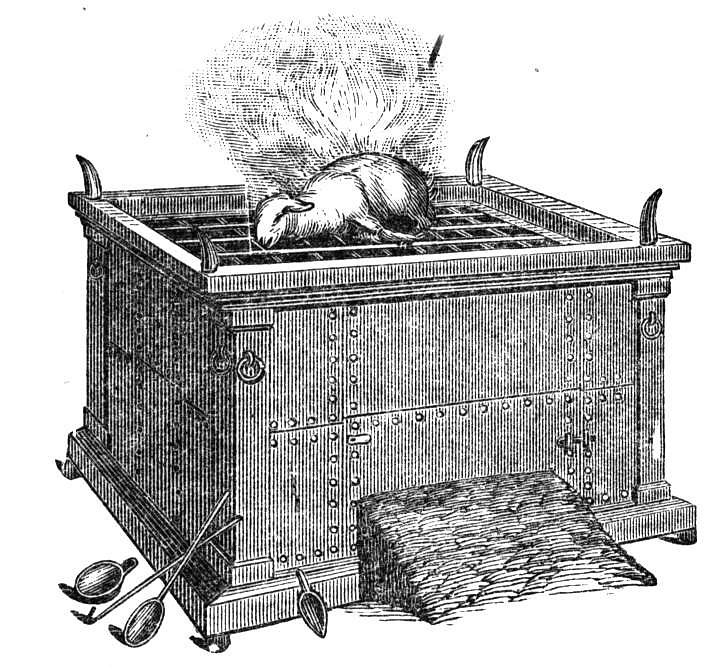
The Twice Daily Sacrifices and the Saints Daily Devotions

The Tabernacle of Moses’ twice daily offering known as the continual burnt offering (Heb. olah tamiyd) as commanded by YHVH Elohim was offered on the bronze altar (Exod 29:42) was the central feature and beating heart of the tabernacle. This sacrificial offering has great spiritual implications for the serious disciple of Yeshua and relates to his or her daily life of devotion, praise and worship to YHVH Elohim. Christians now refer to this time in the saint’s life as one’s “daily devotional.” Let’s now discover the amazing and prophetic parallels between the twice daily sacrifices prescribed under the Torah’s Law of Moses and this quotidian activity in the life of the serious believer. 

The word continual (Heb. tamiyd) in verse Exodus 29:38 means “continually.” The Hebrew word for burnt offering is olah meaning “ascent, stairway or steps,” and derives from the basic Hebrew verb, alah, meaning “to go up, climb or ascend.” In this sacrificial offering, the fire consumed the entire animal, and the word olah refers to the smoke of this whole burnt offering ascending to heaven, which to YHVH was a “sweet aroma” (verse 41). Why did the Creator of the universe consider such a mundane thing as smoke from cooking meat to be a pleasant aroma? Let’s dig into this idea and discover the rich and significance implications of this curious religious ritual.

The olah was an offering or gift (Lev 1:2, Heb. qorban)to YHVH and had to be a kosher animal such as a bull, goat, ram, turtle dove or a pigeon as long as it was a perfect specimen without defect (Lev 1:10). What was the point of this sacrificial offering? If an Israelite sinned, he could bring this gift-offering to the door of the tabernacle where he would place his hands upon the head of the animal, after which the priests would slaughter it, and sprinkle its blood around the altar of sacrifice just inside the door of the tabernacle (Lev 1:2, 4, 5). The meat was then prepared and arranged on the altar and entirely burnt (Lev 1:6–17). When the sinner laid his hands on the animal, it was as if he were transferring his sins onto the innocent, blemish-free animal, where upon YHVH accepted it as an atonement for the person’s sin (Lev 1:4). In reality, offering was a down payment on a debt that the sinner owed to YHVH, which prophetically pointed to and would ultimately be paid by Yeshua’s death on the cross.

The writer of Hebrews clearly teaches that this offering (along with all the other offerings in the sacrificial system) pointed to Yeshua, our Great High Priest, whose atoning death on the cross fulfilled all the types and shadows of the Levitical, sacrificial system (Heb 4:14–5:7; 7:1–10:18).

Besides the obvious antetypes pointing to Yeshua’s death on the cross, what else can we learn from the olah tamiyd offering rituals? What are the spiritual implications and the lessons to be learned for the redeemed believer living in the twenty-first century? Matthew Henry in his commentary on Numbers 28:1–8 sums up the main relevant object lesson to be learned from the twice daily sacrifices in this concise way:

The particular law of the daily sacrifice, a lamb in the morning and a lamb in the evening, which, for the constancy of it as duly as the day came, is called a continual burnt-offering (v. 3), which intimates that when we are bidden to pray always, and to pray without ceasing, it is intended that at least every morning and every evening we offer up our solemn prayers and praises to [Elohim]. (emphasis added)

Thus this olah tamiyd sacrifice was connected to the rising and setting of the sun as implied by the words of the psalmist (Ps 113:3). At the same time, the priest was to burn incense on the incense altar (Exod 30:7–8) as part of the olah tamiyd sacrifice. This obviously signifies a spirit of repentance, self-deprecation and humility coupled with praise and worshipful adoration on the part of the saint while engaged in prayer to one’s Father in heaven. 

The biblical writers foresaw a time coming when either there would be no tabernacle or temple in which to offer the sacrifices and incense, or a designated place of worship would be inaccessible to the Israelite. In this situation, Hosea admonishes sinful Israel to return to YHVH and to offer up the sacrifices (lit. the calves or young bulls) of one’s  lips, while expecting Elohim to graciously receive them and take away their iniquity (Hos 14:2). Paul embraced this idea when he admonished the saints to become as “living sacrifices…unto Eohim” (Rom 12:2). In John’s vision of heaven, he sees the prayers of the saints as being like sweet smelling incense before the throne of the Almighty One (Rev 5:8; 8:3). Not only does YHVH view the prayers of the righteous as incense, but their praises of him as a sacrifice or a thanksgiving offering as well (Jer 33:11; Heb 13:15). The psalmist goes on to connect the dots between the olah tamiyd sacrifice, incense, prayer and praise when he writes,

Let my prayer be set forth before thee as incense; and the lifting up of my hands as the evening sacrifice. (Ps 141:2)

But how is the non-Levite priest supposed to offer incense before YHVH? This is done through prayer and worship as the prophet Malachi indicates:

For from the rising of the sun even unto the going down of the same my name shall be great among the Gentiles; and in every place incense shall be offered unto my name, and a pure offering, for my name shall be great among the heathen, saith YHVH of Hosts. (Mal 1:11)

The Torah prohibits offering sacrifices anywhere YHVH has not placed his name. What’s more, Yeshua has fulfilled the sacrificial system by his death on the cross once and for all as the writer of the Epistle to the Hebrews clearly informs us, and has become the saints’ Great High Priest. So how then do the people of the nations offer up sacrifices in every place as Malachi prophesies except but through prayer and praise? The same is true, of course, for redeemed believers who are now part of Yeshua’s royal priesthood as Peter testifies: 

Ye also, as lively stones, are built up a spiritual house, an holy priesthood, to offer up spiritual sacrifices, acceptable to Elohim by Yeshua the Messiah. (1 Pet 2:5)

However, since there is no longer either a temple or a Levitical priesthood, yet the saints are called priest of Yeshua (Rev 1:6; 5:10; 20:6), how shall we as the saints of the Most High fulfill our priestly duties if not by serving our Master Yeshua through our twice daily prayer and praise?


 

The Importance of Having a Daily Devotional

Twenty-One Reasons to Have a Dedicated, Daily Devotional (or Time Alone With YHVH)

The reasons are too numerous to mention! Here are only a few reasons.

  • Draw near to Elohim and he will draw near to you. That is to say, incline your heart to Elohim and  he will incline himself to you. The converse is also true. Disincline your heart to him and he will respond accordingly. (Pss 71:2; 78:1; 88:2; 102:2; 119:36; 141:4) 
  • You are what you eat. What you feed on is what you will become; what a person puts into his mind and heart is he who he is (Prov 23:7). If you do not feed on the Word of Elohim, you will not grow spiritually, and the converse is also true. 
  • We need to be continually renewing our mind by spiritually brainwashing our mind and heart with the Word of Elohim to combat the distracting and hell-bent influences of the world, the flesh and the devil. We wash or cleanse our minds by washing in or feeding continually on the water of the Word of Elohim (Rom 12:2; Eph 5:26).
  • Yeshua instructs us to ask, seek and you shall find, and knock (Matt 7:7). YHVH Elohim like is a vast ocean wisdom, knowledge, understanding and truth, and we are little children on the edge of that ocean. How can we learn and grow spiritually if we do not ask and seek?
  • If we don’t ask through prayer, we will not receive from our Father in heaven (Jas 4:3).
  • The Bible commands us to pray without ceasing (1 Thess 5:17), and even to pray for our enemies (Matt 5:44). 
  • With regard to prayer, Yeshua instructed us to pray (Matt 6:9–13). The implication was not if you pray, but when you pray. Yeshua lived a life of prayer and set us the example of being prayerful. If we are followers of Messiah, then are we not to imitate him in all areas of our life, to walk in his footsteps (1 Cor 11:1; 1 John 2:6) and to do all that he commanded us to do (Matt 28:20)?
  • The Bible commands us to be thankful in all things (Col 3:17). We express our gratitude to our Father in heaven through prayer.
  • David, a man after YHVH’s heard prayed and thanked Elohim seven times a day (Ps 110:164).
  • The morning and evening sacrifices are our example to follow for the sacrifice of our lips (Pss 27:6; 50:8–15; 69:30–31; Hos 6:6; 14:2 [KJV]; Heb 13:15; 1 Pet 2:5).
  • The Bible instructs us to a living sacrifice, that is, live a life of prayer, fasting, worship, praise, self-negation and service (Rom 12:1; Phil 2:17; Heb 13:15–16; 1 Pet 2:5).
  • Study to show yourself approved by rightly dividing the Word of Elohim (2 Tim 2:15).
  • Be like a noble Berean by searching the Scriptures daily (Acts 17:10–11).
  • Be like a tree planted by (Yeshua) the river of life by meditating day and night on YHVH’s Torah-Word, so that you will bear much spiritual fruit and you will not whither spiritually in the day of adversity (Ps 1:1–6).
  • Abide in and be strongly attached to Yeshua (and his word) who is the true vine and we are the branches (John 15:1–8).
  • Walk  in the Spirit by not fulfilling the lusts of the flesh, which war against the Spirit (Gal 5:16–17). Establish good disciplines in your life. Self control or self-discipline is a fruit of the Spirit (Gal 5:23). Learn to reign in the lusts of the flesh by not always doing the things our flesh wants to do (Gal 5:19–21), but following the prompting of the Spirit by spending time with Elohim, which is an act of self-discipline.
  • Feed your inner spirit man by feeding regularly on the Word of Elohim as opposed to continually feeding your soul man (i.e., your mind, will and emotions) (Gal 5:5:16–18; Col 3:1–2; 2 Cor 10:4–5).
  • If you don’t know the Word of Elohim, how are you going to do spiritual warfare by resisting the temptations of the devil with the Word of Elohim as Yeshua did when combatting the devil (Matt 4:1–11), and by taking every thought captive to the mind of Yeshua (2 Cor 10:4–5)?
  • How are we to fulfill Romans 12:2 by being transformed into the image of the Messiah (Rom 8:29) by renewing our minds and not being conformed to this world if we are regularly reading and studying the Word of Elohim?
  • The wise virgins in Yeshua’s parable were ready for Yeshua their Bridegroom, since they had oil (i.e., the Spirit and the Torah-Word of Elohim) in their lamps (Matt 25:1–4).
  • Seek first the kingdom of Elohim and his righteousness by starting every day with our daily devotionals (Matt 6:33). YHVH deserves the first and best part of each of our days.

Things That Keep Us From Having a Daily Devotional

We have become spiritually lukewarm.

Continue reading
 

Leviticus 21 Emor–”In Vain They Worship Me”—Praise & Worship in the Church

In this video, we examine the Christian church’s typical praise and worship themes and then juxta pose them with the book of Psalms and how the Bible defines praise and worship. A major disconnect is exposed! Learn what the true praise and worship is that is pleasing to our Abba Father in heaven—YHVH Elohim.

This is a gospel-oriented Torah study guide. Our goal is to connect the good news of Yeshua the Messiah (the gospel message) to its Hebraic, pro-Torah roots or foundations. The information given here is more than head knowledge. Understanding and wisdom (the right application of knowledge that is based on truth) is taught thus making biblical truth practical, relevant and applicable to your daily life. The truths of the Bible not only have the power to transform your life here and now for the better, but eventually to take you past the veil of death and into eternity.

This Torah study is subdivided in sections by topic in a magazine format thus making it easy to watch at several sittings. May you be blessed as you watch this video.

For a free, printable adult and teen Torah study guide on this Torah portion (parashah), please go to http://www.hoshanarabbah.org/parshiot.html


Good (Godly) Versus Bad (Demonic) Music

And so it was, whenever the spirit from God was upon Saul, that David would take a harp and play it with his hand. Then Saul would become refreshed and well, and the distressing spirit would depart from him. (1 Sam 16:23

1 Samuel 16:23, The spirit from Elohim.YHVH sovereignly has the power to use anyone or anything to accomplish his purposes including evil spirits. This evil spirit was a judgment against Saul for his rebellion against YHVH’s instructions which was a form of witchcraft (1 Sam 15:23–24). Saul sought power, fame, wealth and glory at the expense of obeying YHVH (1 Sam 15:22) as did Balaam the false prophet. Thus Saul was inclined toward the dark side and, as a result, attracted evil spirits. As a result, YHVH, sent him a troubling spirit to agitate him back to the good side as represented and evidenced by the David’s harp music. When Saul felt better after hearing this music, he should have repented of his sinful ways and come back to Elohim, but he did not, since his heart was predisposed and inclined toward evil. Thus, YHVH used the evil spirit to goad and provoke Saul thus putting him to the test to see whether he would return to the right path. Obviously he did not repent but continued in the downward spiral of evil which led him acquiescing to a murdering spirit eventually to his consulting the witch of Endor resulting in his ultimate and untimely death as well as the erasure of his lineage.

Harp…refreshed…distressing spirit would depart.Johann Sebastian Bach declared that the sole aim and purpose of all music should be nothing else but the glory of Elohim and the refreshment of the spirit. Evil spirits do not like quality much less godly music. YHVH created Lucifer to be musical (Ezek 28:13), but when he rebelled, his mind along with his musical tastes and abilities became twisted and perverted, which is why quality music is anathema to an evil spirit, for Satan is the father of it ungodly music. From evil and twisted minds comes dark forms of music along with perverted lyrics and discordant “rhythms”. Most modern music (both rock and classical) comports with this genre of “music”. Science has even discovered that the patterns of the sound waves that such music makes is confusing, disorganized and senseless. One can only imagine the physiological impact of the sound waves that such music has on the cells of the brains of its listeners. Apparently, such music also has a deleterious effect on plants that are subjected to it compared to quality music. Conversely, the Bible reveals that quality, godly and uplifting music brings on the anointing of YHVH (2 Kgs 3:15), as well as the prophetic word of Elohim (1 Chron 25:1–3; 2 Chron 20:14). Moreover YHVH inhabits or is enthroned on the praises of his people (Ps 22:3), while at the same time such music repels evil spirits as was the case when David played the harp for the demonically oppressed Saul. Praise and worship music can even defeat the militaristic enemies of YHVH’s saints (2 Chron 20:21–23) Thus, the playing of good music is a form of spiritual warfare, while evil music attracts evil spirits and those who are inclined toward the dark side.


The Psalmists’ Extreme Passion for Elohim and YOU

David, the author of the majority of the psalms in the Bible, along with several other psalmists, were men who followed hard after Elohim. No less than Elohim himself called David a man after his own heart (1 Sam 13:14–16). The spiritual cup of David’s heart as well as the hearts of other psalmists were full and overflowing with passion for Elohim, which expressed itself in quantifiable, extreme and radical ways by today’s Western standards. What can we learn from such individuals, and how can we come to this same place of passionate and enthusiastic (meaning “inspired or possessed by God”) devotion to YHVH Elohim?

David did not merely express his passion for Elohim intellectually in the psalms through music and poetry, for Scripture records that in one case he actually removed his kingly robes that hindered the movement of his arms and legs, and danced leaping and whirling, almost naked, with all of his might in the streets of Jerusalem praising and worshipping YHVH to the disdaining scorn of his less than passionate wife. Needless to say, after that incident, David refused to have intimate relations with his wife ever again to the day of her death (2 Sam 6:23). This was likely because her heart was in a very different place than that of her husband, and he could never get close to her again. This incident demonstrates the seriousness with which David took his passion for YHVH and how he viewed those close to him who were of a dissimilar or antithetical passionate disposition.

To be sure, David was not the only Hebrew given to outward displays of passion. The Hebrews, in general, like many inhabitants of the Near East to this day, were a dynamic and emotionally passionate people, whose lives were a river that customarily overflowed its banks with a emotionally enthusiasm for their Creator. David was a quintessential stereotype of this cultural norm. But many of the Hebrew prophets demonstrated a similar emotional exuberance when urging the Israelites to return to YHVH and to worship and obey him only. This passion worked itself out in many seeming bizarre stunts in their attempts to capture the attention of a people who had lost their passion for Elohim. For example, on one occasion, Isaiah prophesied virtually naked through the streets of his city for three years warning Israel of its impending doom (Isa 20:3). One prophet even adorned himself with iron horns and then prophesied to the kings of Israel and Judah (1 Kgs 22:11). Once Jeremiah prophesied with a wooden yoke wrapped around his neck (Jer 22:11). Another time, YHVH instructed Ezekiel to build a model city of Jerusalem and to construct siege walls and battering rams to symbolize the fall of Jerusalem at the hands of the Babylonians (Ezek 4:1–4). After that, YHVH commanded Ezekiel to lay on his left side for 390 days and then on his  right side for another 40 days to symbolize YHVH’s judgment against Israel (Ezek 4:4–6). If that was not enough, during this time, YHVH instructed Ezekiel to eat only beans, lentils, millet and spelt baked on a fire fueled by human excrement (Ezek 4:9–12). These are just several example of the extreme passion with which the biblical people of Elohim were willing to serve and obey their Creator.

Admittedly, in our day, YHVH is seldom asking his people to engage in such extreme practices as the ancient biblical prophets did in service to him. But sadly, most people are not even passionate enough to do the minimum that YHVH expects. For example, how many people are willing to put aside their electronic devices to which they are addicted along with their other secular activities long enough to pray for an hour a day as Yeshua instructed (Matt 26:40–41)? 

Make no mistake, we are capable of becoming passionate about many things that are of interest to us—things that we really want to do, and we definitely make time in our busy schedules for these things. We can spend hours glued to our television and computers screens watching movies, engaged in social media on our electronic devices, listening to podcasts, watching sports events, playing video games and the like. In fact, today how many people hoot and holler acting crazy cheering their favorite sports team, but when it comes to being fanatical for YHVH, well, “that’s emotionalism” and “I’m not that kind of person,” we tell ourselves. “What will people think of me?”

There is no lack of distractions out there whose octopus-like arms laden with suction cups will grab us and suck us in to its jaws, while drawing us away from seeking YHVH. Why is this? Its is because too many of us have let our hearts become hard and cold for Elohim and as a result of this we have fallen into a state of lukewarmness, lost our first love for Yeshua along with the joy of our salvation.

So what is the aim and goal of this brief written homily? It is to hold up in front of each of us a mirror in which to see ourselves, and then to compare what we see with what pleases YHVH Elohim as recorded in Scripture, and thus hopefully to challenge each us to repent of our lassitude and incite us to “break up your fallow ground: for it is time to seek YHVH, till he come and rain righteousness upon you,” (Hos 10:12). Our as Jeremiah chides us to do, “For thus saith YHVH…Break up your fallow ground, and sow not among thorns. Circumcise yourselves to YHVH, and take away the foreskins of your heart, ye men of Judah and inhabitants of Jerusalem: lest my fury come forth like fire, and burn that none can quench it, because of the evil of your doings,” (Jer 4:3–4). Or as Yeshua warns us, “Nevertheless I have somewhat against thee, because thou hast left thy first love. Remember therefore from whence thou art fallen, and repent, and do the first works; or else I will come unto thee quickly, and will remove thy candlestick out of his place, except thou repent,” (Rev 2:4–5). These are sober and challenging warning words from our Messiah!

Perhaps, just perhaps, the citations below quoted verbatim from the psalms will not only reveal something about the inner hearts of righteous people who sought YHVH passionately, but will show us what they actually did to obtain and to keep their passionate hearts alive and burning with zeal. Read, mediate and pray as you allow the words of Scripture to spur you to action and to fan the flames of your love for and faith in YHVH Elohim—Yeshua the Messiah. Selah and amein.

Do you long to see and experience spiritual revival in these days of overwhelming darkness and evil? Well, revival starts in the heart of each individual as each of makes the conscious and determinate decision to seek YHVH and to allow him to revive us. Revival starts with YOU! Selah and amein.

How intense is YOUR worship of YHVH Elohim?

Shout joyfully to YHVH, all the earth; break forth in song, rejoice, and sing praises.…Shout joyfully before YHVH, the King. (Ps 98:4, 6)

Seven times a day I praise You, because of Your righteous judgments. (Ps 119:164)

Oh come, let us sing to YHVH! Let us shout joyfully to the Rock of our salvation.… Let us shout joyfully to Him with psalms.…Oh come, let us worship and bow down; let us kneel before YHVH our Maker. (Ps 95:1–2, 6)

And her saints shall shout aloud for joy. (Ps 132:16)

Lift up your hands in the sanctuary, and bless YHVH. (Ps 134:2)

I will praise You with my whole heart; before the gods [or mighty ones] I will sing praises to You. (Ps 138:1)

Let them praise His name with the dance. (Ps 149:3)

Let the high praises of Elohim be in their mouth, and a two-edged sword in their hand… (Ps 149:6)

Praise Him with the timbrel and dance… (Ps 150:4)

How intensely passionate are YOU in seeking YHVH Elohim?

My heart pants, my strength fails me; as for the light of my eyes, it also has gone from me. (Ps 38:10)

Ps 42:1 As the deer pants for the water brooks, so pants my soul for You, O Elohim.

O Elohim, You are my Elohim; early will I seek You; my soul thirsts for You; my flesh longs for You in a dry and thirsty land where there is no water.…When I remember You on my bed, I meditate on You in the night watches. (Ps 63:1, 6)

My soul longs, yes, even faints for the courts of YHVH; my heart and my flesh cry out for the living Elohim. (Ps 84:2)

My knees are weak through fasting, and my flesh is feeble from lack of fatness. (Ps 109:24)

I spread out my hands to You; my soul longs for You like a thirsty land. (Ps 143:6)

How much do YOU love Elohim’s Torah-Word?

I opened my mouth and panted, for I longed for Your commandments. (Ps 119:131)

My soul breaks [or is crushed] with longing for Your judgments at all times. (Ps 119:20)

I hate the double-minded, but I love Your law. (Ps 119:113)

Therefore I love Your commandments more than gold, yes, than fine gold! (Ps 119:127)

My eyes are awake through the night watches, that I may meditate on Your word. (Ps 119:148)

How passionate are YOU about being in the presence of YHVH?

For a day in Your courts is better than a thousand. I would rather be a doorkeeper in the house of my Elohim than dwell in the tents of wickedness. (Ps 84:10)

O YHVH, Elohim of my salvation, I have cried out day and night before You. (Ps 88:1)

When I awake, I am still with You. (Ps 139:18)

How long do YOU spend in the Word of Elohim each day?

Oh, how I love Your law! It is my meditation all the day. (Ps 119:97)

I rise before the dawning of the morning, and cry for help; I hope in Your word. (Ps 119:147)

How passionate are YOU in seeking YHVH through prayer?

Evening and morning and at noon I will pray, and cry aloud, and He shall hear my voice. (Ps 55:17)

In the day of my trouble I sought YHVH; my hand was stretched out in the night without ceasing; my soul refused to be comforted. (Ps 77:2)

I rise before the dawning of the morning, and cry for help; I hope in Your word. (Ps 119:147)

How much do YOU long for Elohim’s salvation (i.e., for Yeshua)?

My soul faints for Your salvation [i.e. Yeshua], but I hope in Your word. (Ps 119:81)

My eyes fail [cease working] from seeking Your salvation [Heb. Yeshua] and Your righteous word. (Ps 119:123)

I will also clothe her priests with salvation, and her saints shall shout aloud for joy. (Ps 132:16)

How much does the thought of sin distress YOU?

My soul melts from heaviness; strengthen me according to Your word. (Ps 119:28)

How much are YOU troubled by YOUR enemies?

I am weary with my groaning; all night I make my bed swim; I drench my couch with my tears. My eye wastes away because of grief; it grows old because of all my enemies. (Ps 6:6–7)

My tears have been my food day and night, while they continually say to me, “Where is your Elohim?” (Ps 42:3)

Let the high praises of Elohim be in their mouth, and a two-edged sword in their hand, to execute vengeance on the nations, and punishments on the peoples; to bind their kings with chains, and their nobles with fetters of iron; to execute on them the written judgment—this honor have all His saints. Praise YHVH! (Ps 149:6–9)

How much to do YOU loath evil and evil-doers who are the enemies of YHVH?

Early I will destroy all the wicked of the land, that I may cut off all the evildoers from the city of YHVH. (Ps 101:8)

I hate the double-minded, but I love Your law. (Ps 119:113)

Do I not hate them, O YHVH, who hate You? And do I not loathe those who rise up against You? I hate them with perfect hatred; I count them my enemies. (Ps 139:21–22)

Let the high praises of Elohim be in their mouth, and a two-edged sword in their hand, to execute vengeance on the nations, and punishments on the peoples; to bind their kings with chains, and their nobles with fetters of iron; to execute on them the written judgment—this honor have all His saints. Praise YHVH! (Ps 149:6–9)

How consumed with passion are YOU for the lost who do not know the Truth of YHVH’s Word?

Rivers of water run down from my eyes, because men do not keep Your law. (Ps 119:136)

My zeal has consumed me, because my enemies have forgotten Your words. (Ps 119:139)

How obedient and passionate are YOU about sharing YHVH’s with others?

Declare His glory among the nations, His wonders among all peoples. (Ps 96:3)

How much do YOU fear YHVH Elohim?

Oh, worship YHVH in the beauty of holiness! Tremble before Him, all the earth. (Ps 96:9)

How much do YOU tremble before Elohim?

My flesh trembles for fear of You, and I am afraid of Your judgments. (Ps 119:120)