Hoshana Rabbah Blog

Midrash with Natan Lawrence

Hoshana Rabbah Blog

Parashat Tzav Leviticus 6:8[1]-8:36

Haftorah Reading

Jeremiah 7:21–8:3; 9:22(23)–23(24)

Testimony of Yeshua

On being a living sacrifice: omans 12:1–2

On Yeshua being our High Priest and the ultimate sacrifice: ebrews 4:14–5:10; 7:1–28; 8:1–6; 9:1–28; 10:1–39; 13:10–14

On being a pure spiritual temple:  Corinthians 6:14–7:1; 1 Peter 1:14–16

On the spiritual priestly garments of the saints: phesians 5:27; 6:10–18; Revelation 7:13–14; 19:8

Outline of This Week’s Parashah (Torah Portion)

—6:8 (1) The Law of the Elevation or Burnt (Olah) Offering

—6:14 (7) The Meal or Grain (Minchah) Offering

—6:24 (17) The Sin (Chatat) Offering

—7:1 The Guilt (Asham) Offering

—7:11 The Thanksgiving (Todah) or Peace (Shelamim) Offering

—7:19 Eating in a State of Contamination

—7:22 Fat and Blood Not to Be Eaten

—7:28 The Parts of the Offering to Be Burned and Those Given to the Priests as Gifts

—8:1 Consecration of Aaron and His Sons for the Priestly Service in the Tabernacle

Study Questions for This Week’s Midrash (Torah Discussion)

1 6:10 [6:3 in Jewish bibles], Linen britches. The Jewish sages teach that every Israelite should be a human temple. If he is set-apart (kadosh), then the temple of his body will be kadosh; if he sins he contaminates it. This is consistent with the teachings of the apostles (see the Testimony of Yeshua readings above). Furthermore, in this parashah we see the high priest donning a “fitted” linen tunic and britches “on his flesh,” which was an illusion to robes of righteousness (Lev 6:10 [3]). Most of us have too casual a view of sin—something a righteous and set-apart Elohim hates and calls an abomination (Ps 5:5; Prov 6:16–19). Sin that is not repented of will damn us eternally (Ezek 18:4, 20; Rom 6:23). Our sin sentenced Yeshua to a hideous death on the cross in our place. (Selah: pause and reflect.)

Perhaps the greatest area of sin is with our mouths; it defiles our spiritual temples probably every day! (Read Mark 7:14–23 and Jas 3:1–12.) Our mouths sow discord among brethren, speak vanities, murders and lies—things that Elohim (his Hebrew name referring to the judgment side of his character) hates and calls an abomination in Proverbs 6:16–19. The tongue is a world of iniquity, especially behind closed doors where we let down our guard with our family and loved ones. There our tongues rip, slice, slash, murder, speak vanities and hypocrisy almost without measure. The word Babylon comes from the Hebrew word bavel meaning “confusion or mixture” referring to when the languages of men were confounded at the Tower of Bavel. How can we be a righteous and set-apart priesthood offering up praise and worship to our Creator with our lips when 30 minutes before our lips were murdering our wife, children, husband or someone else on the way to Shabbat services? Is this not confusion? A divided heart? A forked (serpent’s) tongue? The Scriptures plainly tell us to come out of Babylon’s ways (Rev 18:4). The writer of Hebrews says, “Follow peace (shalom) with all men, and holiness, without which no man can see the Master” (Heb 12:14). If we could but tame the tongue, then we would be able to steer the whole temple of our spiritual ship (to mix metaphors) into the glorious harbors of holiness and relationship with man and with our Creator. Let’s stop and take some time to repent of our sinfulness in these areas.

2 6:17 (10), No leaven. Why does YHVH stipulate this prohibition? The main Jewish commentaries are unable to answer this question. It is not until we understand the spiritual implications of leavening as revealed in the Testimony of Yeshua that this prohibition makes Continue reading →


From A.D. 70 to A.D. 135 — How the Church Became Divorced From Its Hebraic Roots

This is a long read—good for a Shabbat afternoon! But it’s important to know the historical facts. Knowing this truth will help us to better understand the background of the NT church and how the early second century church cut itself off from its Hebraic spiritual roots in so many way.— Natan

What is called Christianity today in many ways is very dissimilar, and in many respects, outright antagonistic to the religion of the first-century, book of Acts believers. How did this come to be?

Many modern Christian churches prides themselves on being “a New Testament church,” yet what they practice and believe is often very different from and even opposed to the teaching and practices of the apostles and primitive, first century church. For example, life for the apostolic believers in Jerusalem revolved around the temple (Acts 2:46; 3:1; 5:19-21; 5:42; Acts 21:26; 22:17; 24:18; 25:8; 26:21), and for those outside of the land of Israel, on most Sabbaths, they attended the local synagogue (Acts 13:14; 14:1; 17:1–2; 18:4, 7, 8, 19, 26; 19:8). Not only did the first apostles and early believers not celebrate any pagan influenced holidays such as Easter, Christmas, Halloween, Lent, and the rest, but they adhered to the Torah or law of Moses (see references below). The Book of Acts record is also clear that early believers kept the Bible festivals (as outlined in Lev 23; Acts 2:1; 18:21; Acts 27:9; 1 Cor 5:8; Jude 12) of Passover, Unleavened Bread, Pentecost, Day of Trumpets, Day of Atonement, Feast of Tabernacles, and the Eighth Day.

What’s more, the book of Acts records that both Stephen and Paul were falsely accused of teaching that the laws and customs of Moses were nullified, and, as a result of this false accusation, both lost their lives defending Torah-obedience.

A hundred other examples could easily be given showing how the Christian church has veered away from the Hebrew or Jewish roots of its faith, but hopefully, the reader gets the point.

So what happened to cause Christianity to veer so widely from the Hebrew or Jewish roots of its faith and to arrive at the place where it hardly resembles that religious faith from which it sprang? This is not an easy question to answer since one must look back nearly 2000 years and attempt to reconstruct the times in which our spiritual forefathers lived. Moreover, we must understand what was transpiring politically, religiously, and socially at the time to answer this question properly. It is also imperative that we understand the contextual social and linguistic fabric, the backdrop of history, and the parade of political Continue reading →


A t-Shaped Cross Vs. an I-Shaped Cross Discussed

Stauros, the Koine Greek word for cross, like most words in all languages, has several meanings. To arrive at the true meaning of a word, we can’t just look at the first meaning in a list of dictionary definitions or choose the meaning that best suits our personal biases or theologies.

Too determine which dictionary definition of a word best applies to a particular word in a literary situation, we must consider all the meanings of a word and then look at the context of the literature in which the word is found, and then choose the meaning that best fits.

Even then, well meaning people will have differences of opinions on this (e.g. The Companion Bible, by E.W. Bullinger, appendix 162). This is the dilemma that scholars who translate literary documents from one language to another face. This is the case with the Koine Greek word, cross, which is found in the NT some 32 times.

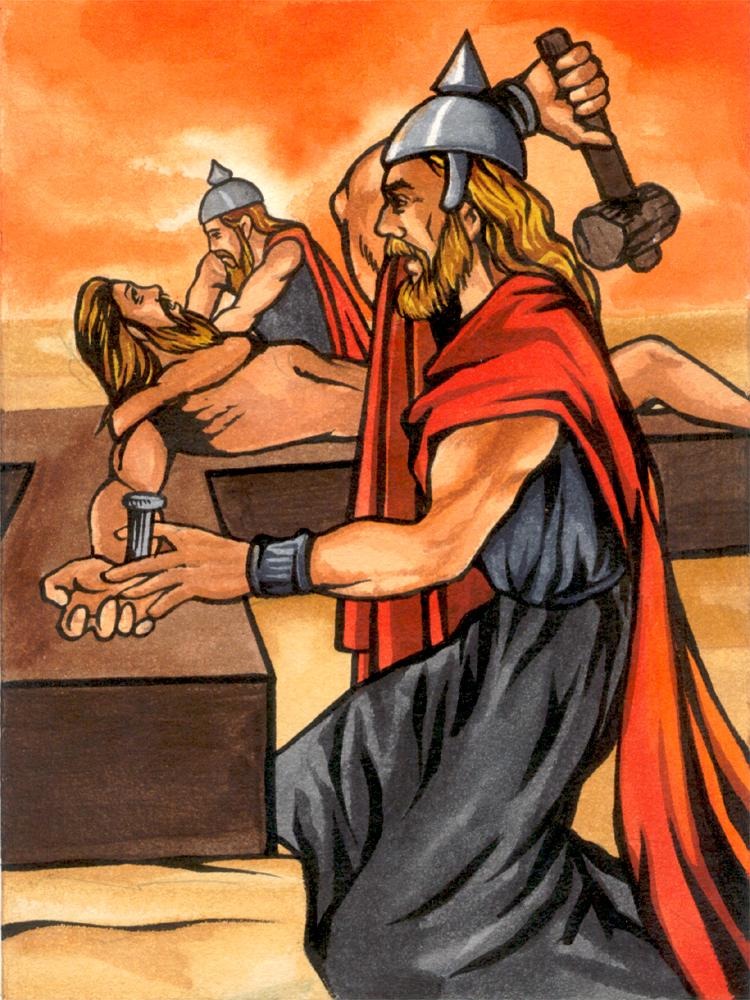
Stauros means “un upright, pointed stake used for fencing or in the construction of a stockade. It can also refer to a torture instrument, or a cross on which the Roman’s executed criminals. A stauros came in several basic forms: a vertical upright, pointed stake, or an upright stake with a crossbeam resembling our capital letter “T” or our small letter “t”, or it consisted of two intersecting beams of equal length like our letter “X”. Due to the sign that was attached to the top of Yeshua’s torture stake, it seems that his cross was shaped like a “t”; that is, the upright stake projected above the cross beam thus giving the Romans a place to attach the sign (The TDNT, vol 7, p. 572; International Standard Bible Encyclopedia, vol 1, pp. 826-827).

The reasons that I lean toward the idea that Yeshua was crucified on a t-shaped cross are several. As noted above, such a cross gave a place for the Romans to attach their sign (Mattt 27:37, Mark 15:26, Luke 23:38, John 19:19).

Additionally, more than one nail was used in Yeshua’s hands to attach him to the cross (John 20:25). The use of two nails would have been more necessary had the cross been t-shaped as opposed to an upright stake.

Moreover, the Tabernacle of Moses is a symbolic and prophetic picture of the death, burial and glorification of Yeshua. It is literally a multi-dimensional gospel tract! As such, the furnishings therein are arranged in the form of a t-shape cross.

Similarly, the tribal encampments around the tabernacle are laid out like a perfect t-shaped cross (see Num 2). This is a picture of the believer who, through the ritual of baptism for the remission of sins (see Rom 6:3–11) must symbolically identify with the death, burial and resurrection of Yeshua when coming to faith in him.

Furthermore, the marks made by the blood of the lamb on the doorposts of the Israelites’ homes on their first Passover in Egypt made the outline of a perfect t-shaped cross (Exodus 12:7). There are several dozen aspects of this first Passover that prophetically pointed forward to Yeshua who was the Passover Lamb of Elohim slain from the foundation of the world for the redemption of man from his sin, and who fulfilled these symbols perfectly by his death. The t-shaped cross is but one of these prophetic symbols. An I-shaped cross would not have fit this symbology.

Moreover, when Moses initiated the the tabernacle, his steps form a perfect cross—actually a cross with an arrow on it that points man into the holy of holies, which is a picture of YHVH’s heavenly throne room (Exod 40).

Next, when the angelic messenger of YHVH went through Jerusalem before its fall to the Babylonians to search out those saints that would be spared from that judgment, he put a mark in the form of a Paleo-Hebrew letter tav (shaped like our small letter t) on their foreheads. This was another prophetic symbol that pointed to Yeshua, who, through his work on the cross, is our salvation (Ezek 9:4).

Finally, when Jacob was prophetically praying over his two grandsons who whose descendants would largely become the Christian church, he crossed his arms in the shape of a Paleo-Hebrew letter tav, which, pictographically, some take to mean,”sign or seal of the covenant” (Gen 48:14).

With regard to the Scriptures that say that Yeshua was crucified on a tree, the Hebrew word for tree is etz, which can mean both tree and stick (e.g. see Ezek 37:16). A cross whether in a t or an I shape is still made of wood and both can fit the definition of the Hebrew word etz. But how many trees have you seen that don’t have branches? More trees in their natural state resemble a t shape than an I shape. Some trees even have trunks with branches that are opposite each other on the trunk like a t-shaped cross. So in light of these facts, it is not a logical stretch to call a t-shaped cross “a tree.”

Personally, I don’t care whether Yeshua died on a t or an I shaped cross—only that he died for my sins. This is the main point! Let’s never stray from the importance of this truth. Furthermore, I have no ax to grind in this argument. I could care less about defending any cherished doctrines or traditions of the church. I care only about finding and then believing the truth as a found in the Bible. The overwhelming evidence points to the fact that Yeshua was crucified on a t, and not an I shaped cross. That is the reason, and the only reasons, I subscribe to this idea.

I will conclude with this personal testimony. I was born and raised in a Torah-believing church that hated traditional Christianity. We had a sinful Pharisaical superiority complex. We rejected many biblical truths simply because the mainstream church believed them. The idea of a t-shaped cross was one of those ideas we rejected. It wasn’t until I was in my early 30s after leaving that church that I began to objectively examine the truth about the shape of the cross and became convinced based on the biblical evidence that it was t-shaped, not I-shaped as I had been brainwashed to believe. When I presented the biblical evidence to some family members who were still in that church, they flat-out rejected what I had to say—not because it wasn’t the truth, but simply because their minds were closed and the truth didn’t conform to their biases and bigoted opinions. They had been psychologically conditioned to believe something else for the wrong reason. Sadly, there are too many people in our day who are returning to the biblical, Torah foundations of our faith and are rejecting biblical truths simply because the church believes the same things. Shame on us for our lack of intellectual honestly. I’ve been there and done that! I had to repent to this sin.


What Shape Was Yeshua’s Cross?

John 20:25, Nails. The Greek word for nail is in its plural form. The plurality of the word nails is corroborated by the fact that all the major English translation of the NT whether from both the Alexandrian or Byzantine texts contain the Greek word helon (nails, plural) as opposed to helos (nail, singular). This is the case in the Aramaic NT as well (see the translations of Ethridge and Murdock, for example). William Mounce whose Koine Greek grammar book is used in the majority of seminaries in the U.S. in his Greek and English Interlinear NT designates this word as in the genitive case, plural form and masculine gender.

What is the point here? Yeshua was crucified on a standard t-shaped cross, not on an upright stake minus its cross arm. Had he been crucified on the latter torture instrument, only one nail would have been used to secure his hands to the one post, not more than one nail as this text indicates, which would have been required on the traditional t-shaped cross.


You Have Priestly, Spiritual Authority in Yeshua…Use It!

John 20:22, Remit. Remit or forgive is the  word aphiemi meaning “to send away, to bid going away or depart, to send forth, yield up, to expire, to let go, let alone, let be, to let go, give up a debt, forgive, to remit, to give up, keep no longer, to permit, allow, not to hinder, to give up a thing to a person, to leave, go way from one.” From the context of the previous verse, those who have received the Set-Apart Spirit have the divine authority to relieve someone of their sin burden, although ultimate forgiveness sins in the ultimate sense resulting in salvation in the final analysis belongs only to Elohim. Perhaps this means that a Spirit-filled believer can act as a high priest and intercede for someone who is burdened down with sin and relieve them of some of that sin burden. A person can become so burdened and bent down with the guilt, condemnation and shame of sin that they cannot easily come to YHVH. By relieving them of some of that burden, they may be more able to come to salvation. This seems to be what the high priest was doing on Yom Kippur in Lev 16, and perhaps Job was doing this when interceding for his children on their birthdays.

John 20:23, If you forgive the sins [NKJV] or Whose soever sins ye remit [KJV]. As in the binding and loosing scriptures (Matt 16:19 and 18:18), Yeshua is giving his disciples judicial authority to declare a person innocent or guilty (or bound or loosed) of the charges made against him by someone else. This seems to go hand-in-hand with Yeshua giving them the keys of the kingdom (Matt 16:19) as his spiritual authorities and representatives on earth. Along with this, he gave them power over demonic forces and Elohim’s enemies (Luke 9:1; 10:19), including over sickness and disease (Mark 16:17–18).


Respect Blood—Don’t Eat It!

Leviticus 7:26, Not eat any blood. YHVH revealed in the Torah that the life of flesh is in the blood (Lev 17:11). Therefore, the blood symbolizes the whole life of the living being. This is why the blood being poured upon the altar made atonement for the souls of men (Lev 17:11–12), since it represented and pointed to the shedding of Yeshua’s blood when he sacrificed his life on the cross in atoning for men’s sins. Respecting the blood is necessary not only because it symbolizes the sanctity of the life of man who was made in the Creator’s image (Gen 1:26 cp. 9:6), but more importantly, because of the blood of Elohim’s Son that was shed for man’s redemption (Lev 17:11). For one to eat the blood showed disdain for what the blood typifies. In times past, this was so important to YHVH that a violation of this prohibition resulted in banishment from the nation of Israel.

The blood was to be reserved for the sacrificial service, where it was used symbolically to represent Yeshua’s shedding his blood on the cross. The blood of a lamb was put on the door posts to protect men from YHVH’s judgment against sin (Exod 12:7, 13). Moses sprinkled the blood of oxen on the people symbolizing their coming into covenantal relationship with YHVH (Exod 24:5–8). Additionally, the blood of sacrificed animals was sprinkled throughout the tabernacle, on Aaron and his sons, and all around the altar to sanctify it. All these acts and uses of the blood were illustrative of the unrestricted cleansing power of the blood of Yeshua (Rev 1:5; 7:14; 12:11; 1 Pet 1:2, 19; Heb 9:12; 10:19–22; 12:24; 1 John 1:7; Matt 26:28), which is why YHVH expected his people to treat the blood with a reverence. Those who didn’t evidenced a heart of indifference for the set-apart or kadosh things of Elohim—an intolerable offence in the Creator’s eyes.

On the dark and satanic side, the blood of humans and animals is profaned through demonic rituals involving drinking it and even cannibalism. This is an abominable perversion of holy communion and was an aspect of ancient heathen religions (Ps 16:4; Ezek 39:17, 19 cp. Num 13:32), and is a practice in which the end time antichrist heathens of the Babylonian whore system will engage (Rev 17:6; 18:13, 24).


Growing Number of Americans Love Jesus but Don’t Go to Church, Barna Finds

Can anyone relate to this? I sure can! Personally, I’m rather burned out on the traditional church service model having been in church every weekend since I was born. 

I view as critically important that like-minded believers get together as often as possible—especially on the Sabbath and feasts, but not necessarily in a traditional churchy environment, which, quite frankly, isn’t really the biblical model, although there is nothing wrong with it. — Natan

From the Christian Post at http://www.christianpost.com/news/americans-love-jesus-dont-go-to-church-barna-179227/

The Christian Post

While an increasing number of Americans are reportedly abandoning the institutional church and its defined boundary markers of religious identity, many Americans still believe in God and practice faith outside its walls, a new Barna study has found.

RUNNER1928?WIKIMEDIA COMMONSParishioners sitting on church pews as seen from above.

Barna has released a report on the first of a two-part exploration of faith and spirituality outside the church, looking at the “fascinating segment of the American population who, as the saying goes, ‘love Jesus but not the church.'”

One-tenth of the population comprises those who self-identify as Christian and who strongly agree that their religious faith is very important in their life, but are “dechurched,” meaning they have attended church in the past, but haven’t done so in the last six months or more, the Barna study says, adding that only seven percent of the population belonged to this category in 2004.

More than 60 percent of the people in this group are women, and 80 percent are not millennials, between the ages of 33 and 70.

“This group also appears to be mostly white (63%) and concentrated in the South (33%), Midwest (30%) and West (25%), with very few hailing from the Northeast (13%),” the study reveals.

“This group represents an important and growing avenue of ministry for churches,” says Roxanne Stone, editor in chief of Barna Group. “Particularly if you live in a more churched area of the country, it’s more than likely you have a significant number of these disaffected Christians in your neighborhoods. They still love Jesus, still believe in Scripture and most of the tenets of their Christian faith. But they have lost faith in the church.”

What’s more, their beliefs about God are more orthodox than the general population, even rivaling their church-going counterparts, the study shows.

“For instance, they strongly believe there is only one God (93% compared to U.S. adults: 59% and practicing Christians: 90%); affirm that ‘God is the all-powerful, all- knowing, perfect creator of the universe who rules the world today’ (94% compared to U.S. adults: 57% and practicing Christians: 85%); and strongly agree that God is everywhere (95% compared to U.S. adults: 65% and practicing Christians: 92%).”

Furthermore, while they might not be comfortable with the church, this group still maintains a very positive view of religion, the study adds.

“When asked whether they believe religion is mostly harmful, their response once again stood out from the general population, and aligned with their church-going counterparts (71% strongly disagree, compared to 71% among practicing Christians and 48% among U.S adults).”

However, only 55 percent disagree, either strongly or somewhat, that all religions basically teach the same thing, much closer to the general population at 51 percent. Eighty-six percent of evangelicals disagree with the statement and believe in the distinctiveness of Christianity.

The study notes that this group falls outside of the characterization of “spiritual but not religious” folks. “But unlike practicing Christians and evangelicals, this spirituality is deeply personal—even private—with many preferring to keep spiritual matters to themselves: only two in five (18%) say they talk with their friends about spiritual matters often.”

For the study, Barna interviewed 1,281 U.S. adults via web-based surveys, in each of the 50 United States between November 4 and 15, 2016. The sampling error for this study is plus or minus 2.9 percentage points, at the 95% confidence level.

“The critical message that churches need to offer this group is a reason for churches to exist at all,” Stone concludes. “What is it that the church can offer their faith that they can’t get on their own? Churches need to be able to say to these people—and to answer for themselves—that there is a unique way you can find God only in church. And that faith does not survive or thrive in solitude.”