Shavuot (the biblical Feast of Weeks or Pentecost) is fast approaching. Actually, it is this coming Sunday, June 12, 2022 the ancient, biblical abib barley, visible new moon calendar.
Here are some free study materials from Hoshana Rabbah by Nathan Lawrence that will help you understand, appreciate and celebrate this important and YHVH-commanded biblical festival.
May YHVH Elohim bless you as you love him and Yeshua the Messiah, his Son, by walking out his ancient Torah-paths of Truth and righteousness. YHVH’s river of life is waiting for you to jump into it! Be blessed…Enjoy the journey to Elohim through Yeshua our Lord and Savior.
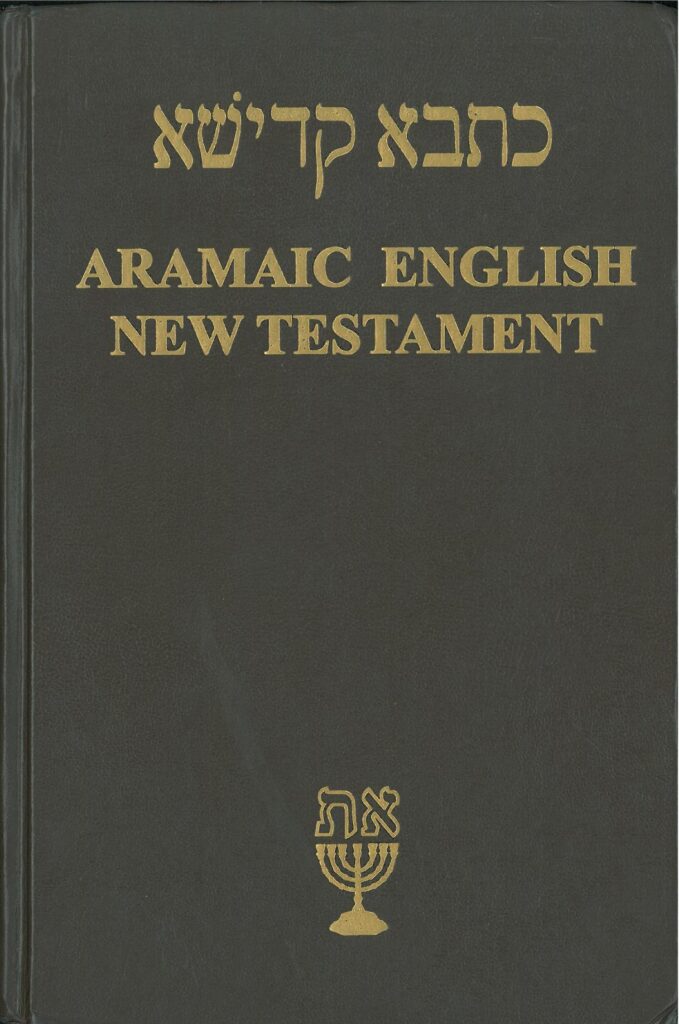
In this discussion, Nehemia Gordon gives proof that the Aramaic Peshitta New Testament was translated from the Greek, not the other way around.For the video version of Nehemia Gordon’s discussion with Michael Rood, go to:
The following is the transcript of this discussion between Nehemia Gordon and Michael Rood:
Michael: And then I was talking to him about the Peshitta, he said, “We don’t use the Peshitta. The Peshitta, Aramaic text…”
Nehemia: Let me stop you. This is the head scholar of the Aramaic…
Michael: Syrian Orthodox…
Nehemia: Aramaic-speaking church in Jerusalem.
Michael: And the head scholar of the Syrian Orthodox Church.
Nehemia: In Jerusalem.
Michael: In Jerusalem.
Nehemia: Wow.
Michael: He is the top of the entire school, okay? He is an old man, he’s in his 80s. And he said, “We don’t use the Peshitta. The Peshitta is a later Aramaic translation from the Greek.
Nehemia: Look, I’ve spoken to scholars about this. In fact, I sat down with a scholar at the Hebrew University of Jerusalem and I told him, “You know, people have suggested that this Aramaic Peshitta is the original Aramaic that Jesus, that Yeshua, spoke and taught, and the Greek is a translation from the Aramaic,” and this guy was an Aramaic scholar, specifically of Syriac-Aramaic, which the Peshitta’s written in. Actually, when I walked into his office, he was looking at this giant… it was like this big, this dictionary of Peshitta Aramaic. And I asked him for some proof, so I said, “Well, how can we know? You’re telling me…” I mean, look, people will tell you that this Hebrew Matthew, that this isn’t the original Matthew, it was written in Greek, so why would I believe you when you tell me that the Aramaic isn’t the original? The Greek is the Aramaic? I said, “I need some proof. I can’t trust your word for it.”
And this was just for me, I don’t think I’ve ever even shared this. I really just wanted to know for myself. And so, he started off, he told me a bunch of linguistic things about how the Aramaic that Yeshua spoke was completely different than the Aramaic that the Peshitta is written in. It’s a completely different dialect of Aramaic. He said, “It would be like the difference between German and Dutch.” Dutch is the language they speak in Holland. I don’t speak either of those languages, I read a little German. German is called in their language, “Deutsch”, and you have “Dutch”, which is the language of Holland. Originally, they were obviously a single language, but now they’re incomprehensible to one another, unless you’re from the border area there. But the German people can’t understand Dutch. But they’re that similar. The Aramaic that Yeshua spoke and the Aramaic the Peshitta is written in are similar, but they’re also different enough to be, essentially, he said if it was any other language, they’d be called two different languages. But for Aramaic, we consider all these different, very vastly different dialects, one language.
And he gave me specific examples I won’t go into, but you could look up at any Peshitta grammar, it’ll tell you what those differences are. They’re profound differences. But then he gave me some really powerful examples. I’m like, “This is it, it’s the end of the story. We’re done.” I wanted to know, and he answered me. Here’s an example of one of the things he showed me.
So, the Hebrew word for “covenant” is “brit”. Now, in American Jewish-speak we call it a “bris”, and that’s because the Hebrew letter Tav when it has a dot in it, it’s a tuh. When it doesn’t have a dot, it’s a thuh or in some dialects, suh. So, “brit, bris, brees.” It’s the same word, different pronunciations of Hebrew. So, the word is “brit” or “bris”, like I had my “bris” on the eighth day, the covenant, the circumcision, in that case.
Genesis 6:18 says, “I will establish My covenant with you.” The word is “diatheke”. “Diatheke” is the Greek word for “covenant”. Aramaic has a perfectly good word for covenant. The Aramaic word for covenant is “kiyam”. It comes from the Hebrew word, the Semitic root, “lakum, lehakim”, “to establish”. That word also appears, a form of that, in the Hebrew connected to covenant, but the actual word for covenant is “brit”, and you say, “lehakim brit”. And so, Aramaic takes that and it’s “kyam”, that’s the word for “covenant”.
So let’s look in the Targum, that’s the ancient Jewish translation of the Tanakh. And there, in the very same verse, Genesis 6:18 it says, “Ve’akeim yatkiami,” “And I established My kiyam,” “My brit, My covenant”. If you looked in the Peshitta, if it was the original Aramaic, you would expect the word “kiyam” to be used all over the place as the word for “covenant.”
Michael: Yeah, look in the…
Nehemia: In the New Testament.
Michael: Right, the New Testament, in Matthew, etc.
Nehemia: Right. So Matthew 26:28, I’m just choosing a verse here that has the word “covenant”. It says, Yeshua says here, “For this is My blood of the covenant.” Okay, so in the Greek, it has for covenant, “diatheke”, same word as when it translated “brit” in the Tanakh. So, we have Hebrew, “brit”, Aramaic, “kyam”, Greek, “diatheke”. What do you think you have in the Peshitta? The Peshitta’s Aramaic. Some people say it’s the original Aramaic that Yeshua spoke. Surely, you have the word “kiyam”, the Aramaic word for “brit”. And that would be a great word, because also, you get from that the word “lakum”, which means “to rise up”.
So, if the word “covenant” were connected to “rise up”, and Yeshua’s saying, “This is the blood of My rising up, of My covenant,” that would be a powerful message. But in the Peshitta, you don’t have “kiyam”, you have “diatheke”.
A Look at End-Times Bible Prophecies Relating to the Second Exodus
By Ya’acov Natan Lawrence Waters in the Wilderness, A Teaching Ministry of Hoshana Rabbah Biblical Discipleship Resources
The Issue in People’s Hearts
The Bible clearly teaches that the ten tribes of the ancient northern kingdom of Israel (known biblically by various names such as the house of Israel, Samaria or Ephraim) were exiled among the nations of the world because of sin. At the same time, the biblical prophets and Jewish sages over the past 2000 years have predicted that in the end times (at the coming of the Messiah), through a series of supernatural events, these tribes will be regathered and return to the land of Israel to be reunited with their Jewish brethren who are descended from the southern kingdom of Judah. Furthermore, there is clear biblical and historical evidence that the ten northern tribes of Israel collectively known as Ephraim are largely to be found among the Christian peoples scattered across the earth. I have attempted to prove this point from biblical, linguistic, archeological, historical and rabbinic Jewish sources in a previous work .
In these last days before Messiah’s second coming, more and more redeemed believers in Yeshua (the Hebrew name for Jesus) are discovering a new-found love for the Jewish people and the land of Israel. At the same time, they are awakening to the need to return to the Hebrew roots of the Christian faith by adhering to a more Torah-centered lifestyle and spiritual walk. It then follows that some are coming to the fundamental truth taught numerous places in the Testimony of Yeshua (the more biblically accurate name for the “New Testament”) that born-again believers are actually redeemed Israelites and are either the literal biological or are the “grafted in” descendants of Abraham. As such, many are beginning to see that the numerous promises YHVH (the LORD) made to Abraham and his descendants apply to them—especially the promises that the land of Israel is an important aspect of their promised future inheritance. With these revelations often comes a new-found zeal and enthusiasm about returning to the land of Israel. For many, it is a question of not if, but “when do we return?”
This is the question I will grapple with in the following study in attempting to determine the timing of the return of Ephraim to the land of Israel, often referred to as the second or greater exodus. This is a difficult and complex subject and many factors need to be considered. No one has all the answers and neither do I, but hopefully the presentation you are about to read will provoke thought and discourse that will move us all toward a greater understanding of this subject.
In this work, I will cover much ground in a panoramic manner without delving into the fine details of any one biblical passage. If my overall analysis is correct, then it is my hope that other biblical researchers will look at the evidence presented here and synergistically we can fine-tune the details and elucidate this subject.
Since there is no direct place in the Scriptures that tells us the exact year or date when Ephraim will be regathered and return to the land of Israel (although, many believe that the process will begin on a jubilee year), we must examine many prophecies and prophetic scenarios in order to extrapolate from them the answer to our question. Before we take the plunge, let’s review some fundamental biblical truths.
Ephraim’s Return to the Land of Israel Is a Fundamental Truth of the Torah
As the very words of YHVH Elohim (the LORD God) dictated to and written down by Moses, the Torah (the biblical books of Genesis through Deuteronomy) is the bedrock of biblical truth upon which the rest of biblical revelation is founded. This is the place to begin when discussing the timing of Ephraim’s return.
In Jewish thought, Deuteronomy 30:1–10 is the embryo from which all the other scriptures discussing Ephraim’s return are birthed. Here YHVH promises to gather Israel from all the nations where he has scattered them (because of spiritual apostasy), and he promises to return them to the land of Israel. This prophecy has not yet been fulfilled, and nor is it referring to the Jewish captives who returned from their 70 years exile in Babylonian, since the term “all nations” is used in this prophecy. The ancient empire of Babylon is not “all nations”!
Here is the prophecy in its entirety:
And it shall come to pass, when all these things are come upon you, the blessing and the curse, which I have set before you, and you shall call them to mind among all the nations, whither YHVH your Elohim has driven you, and shall return unto YHVH your Elohim, and shall obey his voice according to all that I command you this day, you and your children, with all your heart, and with all your soul; that then YHVH your Elohim will bring you back from captivity, and have compassion upon you, and will return and gather you from all the nations, wherever YHVH your Elohim has scattered you. If any of you be driven out unto the outmost parts of heaven, from thence will YHVH your Elohim gather you, and from thence will he fetch you: and YHVH your Elohim will bring you into the land which your fathers possessed, and you shall possess it; and he will do you good, and multiply you above your fathers. And YHVH your Elohim will circumcise your heart, and the heart of your seed, to love YHVH your Elohim with all your heart, and with all your soul, that you may live. And YHVH your Elohim will put all these curses upon your enemies, and on them that hate you, which persecuted you. And you shall return and obey the voice of YHVH, and do all his commandments which I command you this day. And YHVH your Elohim will make you plenteous in every work of your hand, in the fruit of your body, and in the fruit of your cattle, and in the fruit of your land, for good: for YHVH will again rejoice over you for good, as he rejoiced over your fathers: if you shall hearken unto the voice of YHVH your Elohim, to keep his commandments and his statutes which are written in this book of the law, and if you turn unto YHVH your Elohim with all your heart, and with all your soul. (emphasis added)
The Jewish Sages Affirm That Ephraim Will Return
The biblical prophets predicted that all the tribes of Israel (including the ten tribes of the northern kingdom or Ephraim) would be scattered to other lands outside of Israel, and that YHVH would regather them in the last days and return them to the land of Israel. This has also been the dominant belief of the Jewish sages as recorded in their writings and in their oral traditions including the Talmud. For example, the Scriptures tells us about the scattering of the twelve tribes,
And YHVH rooted them out of their land in anger, and in wrath, and in great indignation, and cast them into another land [eretz acheret], as it is this day.” (Deut 29:28)
The Babylonian Talmud, in Yevamot 17a (written ca. A.D. 500, The Soncino Talmud) confirms this when it states,
“[T]hey had declared them [i.e., the ten tribes of Israel, see rabbinic footnote below]19 to be perfect heathens [or gentiles]; as it is said in the Scriptures, ‘They have dealt treacherously against YHVH, for they have begotten strange children.’” A rabbinic footnote on this passage states, (19) ‘The ten tribes; (20) Hos 5:7.’”
TheArtScroll Tanach Series Bereishis/Genesis (an Orthodox Jewish commentary on Genesis) states, regarding Genesis 48:19, quoting Orthodox Jewish sage of the Middle Ages, Ibn Ezra:
Many nations will descend from him [Ephraim]. That is, the word, fullness, melo, connotes ‘abundance,’ the phrase meaning: ‘and his seed will become the abundance of the nations’ (Neter; Karnei Or, p. 2121).
According to Radak’s (R. Dovid Kimchi, a Torah scholar in the Middle Ages) commentary on the same verse,
This refers to the Exile when the lands of others will be filled with his scattered descendants. See also Hoshea 7:8: Ephraim shall be mingled among the nations (Ibid.).
Pertaining to the end-time regathering of the twelve tribes, the late well-known orthodox Jewish leader, Menachem Schneerson stated that the future King Messiah (Messiah Ben [Son of] David) will not only redeem the Jews from exile, but will restore the observance of the Torah-commandments to its complete state, which will only be possible when the Israelites are living in the land of Israel. At this same time, Schneerson who is quoting the notable rabbinic sage of the Middle Ages, Moses Maimonides also known as the Rambam, says,
[T]here will be an ingathering of the dispersed remnant of Israel. This will make it possible for the Davidic dynasty to be reinstated and for the observance of the Torah and its mitsvot to be restored in its totality. (emphasis added)
According to Jacob Immanual Schochet, the ten tribes of the northern kingdom of Israel will also return (as substantiation for his claim, he cites b. Talmud, Sandhedrin 110b) to serve YHVH (he also cites Ezek 20:32–37, 40–42).
Furthermore, The ArtScroll Bereishis, vol. 1(b) states in its commentary on Genesis 48:19 regarding Ephraim,
R. Munk explains:
“[W]hile it is true that the dispersion [of the descendants of Ephraim and Manasseh] was caused by the unfaithfulness and sinfulness of Ephraim’s descendants (Hos 7:8ff), Jacob’s blessing was not in vain for ‘they will return to [Elohim]’ and will have their share in the world to come ([Talmud] Sanhedrin 110b).” And R. Eliezer adds: “Even the darkness in which the Ten Tribes were lost will one day become as radiant as the day’ (according to the version of Avos d’Rabbi Nosson 36). And in the perspective of history, did not these exiled children of the Patriarchs enlighten the nations among whom they were scattered? They did so by teaching their conquerors the fundamental ideas of the knowledge and love of [Elohim], ideals they had never forsaken. Hence they too have a messianic vocation and their Messiah the Mashiach ben Yosef, Messiah son of Joseph (Succah 52a), also called Messiah son of Ephraim (Targum Yonasan on Exodus 40:11), will play an essential role in humanity’s redemption, for he will be the precursor of the Mashiach ben David, Messiah Son of David. It is therefore not surprising to find that the prophet Jeremiah (3:12) speaks affectionately of Ephraim. In this light, Jacob’s words, ‘his offspring will fill the nations,’ assume the significance of blessing.”
It’s time to wake up and face reality! When we obey the Creator’s laws we are blessed, and when we disobey his commandments we are cursed. The rise of national and global terrorism, rampant diseases and the threat of famines, even in the first world nations, is the consequence of our sinning against the Creator, of breaking his laws, and is a fulfillment of end time biblical prophecy. There is no need to be confused, frightened or alarmed by the crazy events going on around us if we are living righteously. In this video, we identify the problem, its root cause and the solution.
Divine Blessings and Curses Are Based on Obedience to YHVH’s Torah-Word
As divine blessings come upon people for Torah obedience, so do curses come upon a people who have forgotten their Elohim because they have been blessed materially and in their self-sufficiency have forgotten who is the source of their blessings as this chapter shows. These are immutable laws that are written in the universe and no human-devised philosophical or religious ideologies regardless of their cleverness can circumvent them. To go against these laws is like attempting to push a giant boulder up a steep mountainside. Eventually the boulder will role backwards crushing the pusher. What wisdom can be learned from this passage on blessings and curses?
YHVH’s Torah instructions continually stresses that blessings are contingent upon obedience to YHVH. Similarly, Yeshua reveals that rewards in his everlasting kingdom are also contingent on obedience to his Torah-laws. The greater the obedience, the greater the reward (Matt 5:17).These principles are universal, yet how prone humans are to forget the cycles of history that repeat themselves over and over again like the unstoppable turning of giant millstone grinding into powder those who refuse to learn the lessons from the past. Each generation proudly asserts its exceptionalism and that, somehow, it is immune to YHVH’s inexorable and immutable principles of divine judgment. Only in the perfect hindsight of history can we see the fallacy of this assumption. Ancient Israel failed to learn these lessons as have subsequent people who are both ignorant of Scripture as well as many who claim to follow the Bible.
In the case of America, and Great Britain before her (and other formerly European Christian nations as well), there was in times past a national consciousness of core biblical values and, to one degree or another, a general public acknowledgement, acceptance of and respect for the Elohim of the Bible. However, as the historical record reveals, as a nation becomes blessed, it reaches an apogee of prominence, power and wealth where it becomes rich and increased with goods and no longer needs Elohim—or so it thinks. It then becomes materially fat and forgets the source of its wealth and falls into a state of self-sufficiency leading to spiritual blindness in that it fails to recognize its true spiritual state (recall YHVH’s warning to a lukewarm church in Rev 3:14–22). This can happen to individuals, churches and to whole societies.
Because YHVH loves his people and wants to walk among them, to be their Elohim and to bless them (Lev 26:12), when they disobey him and walk in ways that are harmful to their well-being, like any loving parent, he is forced to discipline them. Again and again he sends them his prophets and watchmen to warn them that they are on a path of self-destruction. But because of pride, most people refuse to humble themselves and repent (Lev 26:40–41). It is the same old story over and over again. Human pride insists that “judgments cannot happen to us because we are so special, ” and “All things will continue as they have from the beginning and no evil shall befall us.” Such a self-assured individual and society retorts in mocking and scoffing tones in response to all those who would hold them accountable for their errant ways (2 Pet 3:3–7). If only the great people, nations and empires that have already trodden this well-worn path and are now in the dust bin of history could speak from their graves and this generation had heart ears to hear!
As a loving Father, YHVH does not lower the gavel of his full disciplinary judgments immediately upon his wayward children. He increases the dosage of his spiritual medicine incrementally in hopes that each successive ratcheting down of his judgments will bring healing to his spiritually apostate children such that they will humble themselves, confess their iniquity (or Torahlessness, Lev 26:40) and repent of their sin and submit to his laws, so that he can bless them.
In this chapter, YHVH reveals four sets of judgments with each one becoming seven times more severe than the previous one (Lev 26:18, 21, 24, 28). This reminds us of YHVH’s end-times judgments upon a rebellious world that has given itself over to devil worship just prior to the return of Yeshua as prophesied in the book of Revelation. In that book, there are seven seals, seven trumpets, seven thunders and, finally, seven bowl judgments.
What can you do? You may not be able to change society, but a societal change begins one step and one life at a time; it starts with your life! That is the only thing for certain that you can change. No one person can turn the whole earth into a beautiful garden, but you can start by eradicating the weeds from your own garden. You know what needs to be done. Just listen to your conscience—to YHVH’s Spirit knocking at the door of your heart (Rev 3:20), and then repent and obey YHVH and his commandments. It is that simple.
The corollary to this passage on blessings and curses with regard to Torah obedience is Deuteronomy chapter 28.
Some More Reflections on Divine Judgment
By dictionary definition, judgment is “a decision of a court or judge; a misfortune or calamity viewed as a divine punishment.”
The Bible speaks a lot about judgment. When we read about the subject of judgment in the Bible, it usually pertains to the “other guy” involving someone in the past, or someone in the future, or someone that we consider to be more sinful than we are. The problem is that our pride prevents us from thinking that Elohim’s judgment could happen to us.
Judgment is nothing more than suffering the consequences of our actions. It’s simply a function of the law of cause and effect. If you jump off of a building, you’ll suffer the consequences of your actions when you hit the ground. Similarly, when we break YHVH’s commandments, we will suffer the consequences. Judgment is also a matter of degrees. To the degree that we obey his commandments, we’ll reap the blessings of obedience. Conversely, to the degree we disobey them, we’ll reap the negative consequences (Lev 26:3ff cp. 14ff) in the same way that jumping off a two foot ledge versus a 500 foot ledge has different consequence—a twisted ankle compared to death. For most of us, our actions with regard to obedience to YHVH’s laws are a mixture of both good and evil, so we’re reaping both blessings and curses at the same time.