A Violent Elder or Pastor?

1 Timothy 3:3, Violent. This passage (vv. 3–7) lists the qualifications of an elder or leader of a congregation. One of the of character traits that he is not to possess is that of being a brawler (KJV), violent (NKJV) or pugnacious (NAS). What do the words brawler, violent or pugnacious mean here? It is the Greek word amachos meaning one who is by nature “a fighter, contentious, quarrelsome, one who causes strife, or one who is combative.” In modern terms, he’s a bully. Perhaps you remember the neighborhood bully from your years as a school child? An elder, overseer or shepherd of a congregation is not to be such a person. This is what Paul had in mind when he gave these instructions concerning the qualifications of an elder.

So let’s now explore this issue a little further. Is there ever a time when spiritual leaders may need to resort to forceful words or even forceful actions to protect YHVH’s spiritual sheep? What, for example, did David mean when he asks the following question in Psalm 94:16?

Who will rise up for me against the evildoers? Or who will stand up for me against the workers of iniquity?

What did Yeshua mean when describing a good shepherd versus an evil hireling shepherd when he said that unlike the evil shepherd, a good shepherd lays his life down for the sheep and protects them from those who come to kill, steal and destroy the sheep? He says that the good shepherd defends the sheep, while the evil shepherd runs away (John 10:7–15). Another example of an evil shepherd is found in Ezekiel 34 where such a shepherd fails to protect the sheep from the beasts of the field (Ezek 34:7–10). How does a shepherd protect his sheep from the wolves who want to kill them? With nice words and platitudes, while singing Kumbaya, holding a candlelight vigil and then begging the wolf to leave and go elsewhere “pretty please, with cream and sugar on top”? Hardly, for the twenty-third psalm speaks of a shepherd who is armed with a rod and staff—and such brings comfort to the sheep (Ps 23:4) who know that the good shepherd has their best interests in mind. The staff was for leading and guiding the sheep, while the rod was for protecting the sheep against predators. On the sheep farm I was raised on, we used a rifle instead of a rod to protect our sheep. It’s interesting how the Bible prophesies that Yeshua, our Chief Shepherd (1 Pet 2:25; 5:4), will rule the world with a rod of iron in the Millennium (Rev 20:7–10). Continue reading →


On Gathering Sticks and Misuse of the Tongue

Numbers 15:32. A man gathering sticks. The man gathering sticks on the Sabbath is an example of intentional sin, for which there is no sacrifice (atonement or forgiveness; Num 15:30–31).

Furthermore, the act of gathering sticks on the Sabbath teaches us something else. Sticks are used to start fires, something that the Torah commands us not to do on the Sabbath—especially if it relates to our work, business or secular activities such as building the tabernacle (Exod 35:3 cp. vv. 4–35 or cooking food, see Exod 16:23).

A fire is a biblical metaphor for strife and division, which is usually caused by the misuse of the tongue (Prov 16:27; 26:20–21; Jas 3:5–6). Those who stir up the fires of strife and division must be put out of the camp, even as the man who was gathering sticks on the Sabbath to build a fire had to be put out of the camp of Israel.

Paul gives instructions about putting individuals who misuse their tongues outside of the camp of Israel (or congregation of redeemed Israelites) in several places (Rom 16:17–18; Tit 3:10 cp. 1 Cor 5:9–11 in reference to a reviler).

Why should such individuals be treated as a pariah to the congregation of the righteous? Simply this, with smooth words and flattering speech they will deceive the hearts of the simple (Rom 16:17–18) and destroy the congregation. Paul calls such individuals who use their tongues to draw a following grievous or savage wolves and perverse men (Acts 20:29–30).


A Blessing and a Curse — The Oak Trees of Moreh and a Kingdom of Priests

(This study is taken from Natan’s Torah study guide for Parashat Re’eh.)

Deuteronomy 11:26–28, This Torah portion begins with the words,

Behold, I set before you this day a blessing and a curse; a blessing, if you will obey the commandments of YHVH your Elohim, which I command you this day; and a curse, if you will not obey the commandments of YHVH your Elohim, to go after other gods, which you have not known. (Deut 11:26–28)

After this, in verse 29, YHVH instructs the Israelites that upon entering the Promised Land, they are to stop between the mountains of Gerizim and Ebal, which are located at the entry point of the land. The former mountain represents a blessing, while the later represents a curse. The town of Shechem is located between the two mountains.

The Hebrew word Shechem means “shoulder” or “back” (Strong’s H7927). The shoulder supports the head, which through the disposition of the mind and the direction in which the head is pointed, determines the path a person will walk whether good or evil. It was at Shechem, between the two mountains representing good and evil, that Israel renewed its covenant with YHVH before entering the Promised Land (Josh 8:30–35).

The power of the covenant that the people made with YHVH on that day thousands of years ago is still visible in the modern land of Israel: Mount Ebal is bare and devoid of vegetation, while Mount Gerizim is lush and green with foliage. This fact stands as a loud testimony and reminder to man today to the power of blessing and cursing, and to the reality and validity of YHVH’s Torah, its covenants and its ability to bless or curse us depending on whether we obey it or not.

Israel renewed its covenant with YHVH at Shechem at the plains (or oak trees) of Moreh (Deut 11:30). What was significant about this place? It was this exact spot, at the entry point to the Promised Land, that YHVH had established his covenant with Abraham some 500 years earlier. We read about this in Genesis 12:6, “And Abram passed through the land unto the place of Shechem unto the plain [or oak] of Moreh [or teacher].” And it was to this exact spot that YHVH brought Israel to both fulfill and renew his promises he had made to Abraham. It was there YHVH would begin to teach them to walk victoriously and righteously before him in their promised inheritance IF they would choose to obey his Torah (or his instructions in righteousness) and to turn their backs on the pagan gods and practices of the nations around them. It was at the same spot that Jacob, upon entering the Promised Land, buried all his family’s false gods and pagan accoutrements (Gen 35:4). Continue reading →


Hosea Prophesies on the Second Coming

Hosea 5:15–6:3, I will go and return to my place. This passage is a clear prophecy concerning the resurrection of the righteous dead of which Messiah Yeshua is the first to raise.

Verse two contains a Hebrew parallelism, which is a Hebraic literary device where the same thought is expressed differently back-to-back. The word revive is the Hebrew word chayah, which is the basic Hebrew root verb meaning “to live or to have life.” The word raise up is the Hebrew word quwm meaning “to rise, arise, stand, stand up.” According to TWOT, the basic meaning of this word “denotes rising up from a prostrate position (e.g. Josh 3:16).”

YHVH is speaking here in the broader context of this passage concerning his Messianic role as the lion of Judah (Rev 5:5). After presenting himself as such to both houses of Israel (Ephraim [i.e., the Christians] and Judah [i.e., the Jews]) at his first coming, verse 14 states that Messiah would “go away … and none shall rescue him.” Then in verse 15 we read that, “I [Messiah speaking] will go and return to my place till they [Ephraim and Judah] acknowledge their offense and seek my face ….” (This refers to Yeshua’s absence from the earth between his first and second comings.)

What is their offense? Isaiah 8:14 states that that which offends both houses of Israel is “the stone of stumbling and … rock of offense.” Who is this Rock of offense? Verses 8 and 10b identifies it as Immanuel (El with us), which is one of the titles of the Messiah (see Isa 7:14 and Matt 1:23). The Christians have stumbled over Yeshua, the Written Torah-Word of Elohim made flesh, saying that the Torah-law has been done away with, while the Jews have stumbled over Yeshua, the Living Torah, declaring that he can’t be the Messiah.

However, after two days (i.e., 2000 years) YHVH will revive us or resurrect the righteous dead of Ephraim and Judah or those who have been grafted into the olive tree (a metaphor for Israel, see Jer 11:16; Hos 14:6) or into the commonwealth of Israel through Messiah Yeshua (see Rom 11:16–26; Eph 2:11–19) at the end of the age. This occurs on the third day, or in the third millennia from the time of Messiah’s first coming (or approximately in the year 6000 from the beginning of creation) when he will raise up (or resurrect) the righteous redeemed of Ephraim and Judah at his second coming.

As Messiah Yeshua raised from the dead on the third day becoming the first of the first fruits to raise from the dead (1 Cor 15:20, 23), even so, he will resurrect his saints at his second coming on the third day (or the third millennia after his “going away” after his first coming).  After that, he shall “go forth” and “shall come unto us” (i.e., the second coming) very much alive to lead his people during the Messianic Age (Millennium).


The Feast Days in the Messianic Age/Millennium

The following is a list of the scriptures that prophesy that YHVH’s people would observe the weekly Sabbath and biblical feasts during the church age and into the Millennium or Messianic Age.

  • Ezek 45:17 — The Sabbaths (plural, includes the weekly and annual Sabbaths; i.e., Holy Day festivals) and solemnities (moedim) or appointed times (see also v. 9).
  • Ezek 45:21 — Passover and Feast of Unleavened Bread
  • Ezek 45:25 — The Feast of Tabernacles
  • Ezek 46:1 — The weekly Sabbath
  • Ezek 46:9 and 11 — solemn or appointed times (moedim) and feasts (Heb. chag meaning “pilgrimage feast, festival, celebration, holy day, time of dancing, cyclical/yearly seasonal event; i.e., the feast days”)
  • Zech 14:16,18,19 — The Feast of Tabernacles

As you read these passages, you will see that it was not only Israel, but the nations of the world (i.e., the Gentiles) who would be celebrating YHVH’s appointed times.

It is curious to me how church leaders have told us for nearly 1900 years that the “Jewish” feasts were for the Jews only and not for the Christians. So let me get this straight: YHVH expected his people—ancient Israel—to celebrate the feasts, Yeshua celebrated them as did the early church and the apostles, yet when the Gentile church came along, they no longer had to do them, but then when Yeshua returns, YHVH will expect his people along with all the nations of the world to celebrate them, and if they don’t he will punish them for their disobedience? Something doesn’t add up here, and it’s not the Word of Elohim that’s off!

At this point, I’m reminded of the words of Yeshua in Mark 7:13, where when speaking to the religious hypercritical leaders of his day, he accused them of making of no effect the word of Elohim by their religious traditions.


Blog Scripture Readings for 6/3 through 6/9/12

Aside

Deuteronomy 6–12; Ezekiel 47–48; Hosea 1–12; and Psalms 66–72

Most of this week’s blog discussion points will be on these passages. The full year’s Bible Reading Schedule can be found on the right sidebar under “Helpful Links.”

If you have general comments or questions on the weekly Scripture readings not addressed in a blog post, here’s a place for you to post those. Just use the “leave a reply” link below.


The Reunification of Israel & the Return of the Messiah.

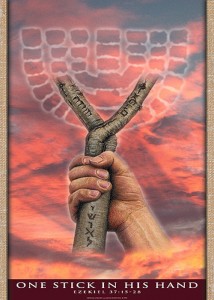
Ezekiel 37:14–28, The vision of the two sticks (trees). The second vision Ezekiel records in chapter 37 involves YHVH commanding him to take two sticks (or trees) and writing upon one stick “for Judah and for the children of Israel and his companions [i.e., those who have knit themselves together with or joined to the tribe of Judah],” and upon the other stick, write “for Joseph, the stick of Ephraim, and for all the house of Israel and his companions.” Ezekiel was to then join the two sticks together so that they would become one stick (or tree) in his hand (verses 15–17).

One Stick in His Hand

Image courtesy of messianicisrael.com

How were these two nations, which separated from each other some three thousand years ago, to be rejoined into one nation? That has been the subject of much debate between both Jewish and Christian commentators for years. Some modern historical revisionists view this prophecy as having been fulfilled when the Jews returned to the land of Israel in the time of Ezra and Nehemiah after their Babylonian captivity ended. But this interpretation leaves some unanswered questions. The book of Ezra, which chronicles the return of a remnant of Jews from Babylon to the land of Israel, lists the numbers and tribes of those who returned. All the tribes listed were originally from Jerusalem and Judah and were from the tribes of Judah and Benjamin (Ezra 2:1; 4:1; 10:9), and there is no mention made that any of the ten northern Israelite tribes joined the Jews in resettling the land of Israel. So far as the returning Jews were concerned, it is likely that they considered their northern brothers lost and assimilated among their Assyrian captors and that only they were left of all the twelve tribes to resettle the Promised Land. If this were so, this may explain why they considered themselves to be “all Israel” (Ezra 2:70; 6:17), since they considered themselves to be the representative remnant of all the twelve tribes, even though their numbers did not consist of the twelve tribes of Israel.

Furthermore, how do those who teach that the prophecy of the two sticks has already been fulfilled explain how anytime in Israel’s past history the two sticks became one nation, and how the once scattered twelve tribes of Israel were regathered from the nations of the world, and how all were resettled in their own land (Ezek 37:21)? Whenever in the past did all the twelve tribes of Israel completely disassociate themselves from the pollution and defilement of paganism and start serving Elohim in perfect righteousness (Ezek 37:23)? Moreover, has David ever been resurrected from the grave to rule over the regathered and reunited Israel as this prophecy declares will happen (Ezek 37:24–25)? After all, the Scriptures tells us that David is dead and buried to this day (Acts 2:29), and awaits the resurrection of the saints at the second coming of Yeshua.  Continue reading →