The Torah on Sustainability

The terms sustainability or sustainable living are currently fad concepts that are bandied about by those seeking to be politically correct—whatever that is supposed to mean. Wikipedia, the online encyclopedia, defines sustainability as follows:

Sustainability is the capacity to endure. For humans, sustainability is the long-term maintenance of responsibility, which has environmental, economic, and social dimensions, and encompasses the concept of stewardship, the responsible management of resource use. In ecology, sustainability describes how biological systems remain diverse and productive over time, a necessary precondition for the well-being of humans and other organisms.

Well, as the writer of the Book of Ecclesiastes said, there is nothing new under the sun. In the beginning, Elohim placed man in the idyllic paradise called the Garden of Eden instructing him to tend (serve, work, till, dress) and to keep (guard, observe, protect) the garden (Gen 2:15). Man was commanded to become the steward of what Elohim had created—to preserve, maintain and to care for it.

These instructions of YHVH’s have never been rescinded to this day even though modern environmentalists and conservationists may think they originated the idea of responsible stewardship of the environment. Long before Rosseau, Thoreau, the Sierra Club, Germany’s Green Party, and the Environmental Protection Agency (the EPA) in America the Torah was preaching sustainable living and responsibly caring for the environment—YHVH’s creation. Let’s note how:

  • For the overall health and vigor of fruit trees, they were to be allowed to become established for three years before commercially harvesting their fruit (Lev 19:23–25).
  • So as not to deplete the soil’s fertility, agricultural land was to lay fallow every seventh year (Lev 25:2).
  • Fruit trees were to be preserved in times of war (Deut 20:19).
  • So as not to mongrelize similar types of fruits and vegetables through cross pollination, mixed seeds were not to be sowed together (Lev 19:19; Deut 22:9).
  • Interbreeding of diverse kinds of livestock was prohibited (Lev 19:19).
  • Work animals were allowed to eat the grain that they helped to thresh (Deut 25:4).
  • If a farm animal was injured or in danger, one was obligated to help the animal even if it belonged to someone else (Deut 22:4).
  • For the safety and well-being of work animals, an ox and donkey were not to be yoked together when plowing (Deut 22:10).
  • Work animals were to be allowed to rest on the Sabbath (Exod 20:8–11; Deut 5:14).
  • Bird’s nests and young hatchlings were to be cared for (Deut 22:6–7).
  • Humans were to care for the earth (and prevent diseases) by burying their excrement (Deut 23:13).
  • The establishment of toxic waste dumps for disease contaminated materials (Lev 14:43–47).

What are some other biblical examples of YHVH mandating that humans care for the environment? 


Modern Day Slavery

Deut 23:15–16 states,

“You shall not give back to his master the slave who has escaped from his master to you. He may dwell with you in your midst, in the place which he chooses within one of your gates, where it seems best to him; you shall not oppress him.”

Furthermore, Paul in 1 Timothy 1:10 condemns “men stealers” or “kidnapers,” which in the Greek literally means “slave traders.”

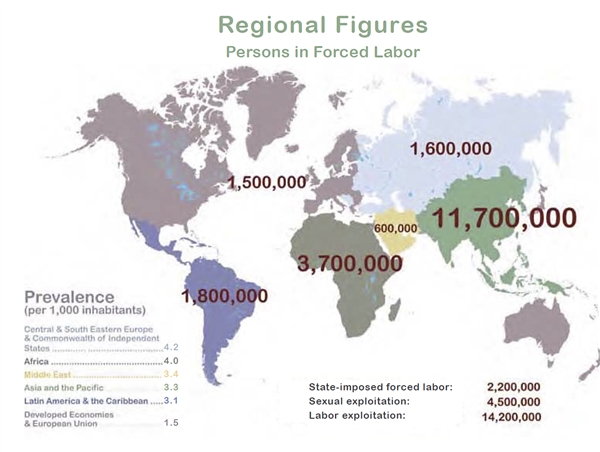
MSNBC has published an informative article about modern-day slavery by Ian Johnston titled “42,000 Modern-Day Slaves Rescued but Millions in Bondage, Trafficking Report Says” (read the article…).

US State Department Graphic
US State Department Graphic showing persons in forced labor in different parts of the world. From Trafficking in Persons Report, June 2012, Page 45.

Come King Yeshua, come quickly!


Got a Shofar?

Psalms 81:3, Blow the trumpet [Heb. shofar] at the time of the New Moon [or concealed, covered], at the full moon, on our solemn feast day (NKJV). The ArtScroll Stone Edition Tanach translates this verse alternatively as follows,

Blow the shofar at the moon’s renewal, at the time appointed for our festive day.


The origins of the Hebrew word keseh behind the phrase “full moon” is uncertain and there is debate among the experts on this subject. Some Hebrew lexicons relate it to a Hebrew root word meaning “to conceal, to cover” (Strong’s number H3677 cp. H3678), while others tell us that it is an Aramaic loan word meaning “full moon” (Brown Driver Briggs Hebrew Lexicon).

Orthodox Jewish scholars tell us that keseh means “to conceal or to cover.” They say that the only biblical festival that occurs at the time of the new moon (biblically, when the first sliver of the new moon becomes visible) is Yom Teruah (or Rosh HaShanah), which occurs on the first day of the seventh month (in late summer). At this time, the moon is nearly completely covered or concealed except for a small, visible sliver.

The next phrase in this verse speaks of a solemn feast day, which is the Hebrew word chag. This word refers to the three pilgrimage festivals, which are Passover/the Feast (chag) of Unleavened, the Feast (chag) of Weeks or Pentecost and the Feast (chag) of Tabernacles (Exod 23:14–16; Deut 16:16).

Jewish scholars relate the word chag to Yom Teruah (which they say refers to Rosh HaShanah, see The ArtScroll Tanach Series Tehillim/Psalms Commentary on this verse). The problem with this interpretation is that the Scriptures never call the day of the new moon (rosh chodesh) a chag, nor is Yom Teruah technically a chag either in the strictest sense. Therefore, the word keseh, if it means “concealment” must be referring to both the new moon day (the first day of each month, and to Yom Teruah, which occurs on the first day of the seventh month), while the chag must be referring to the three pilgrimage festivals.

Those scholars who take the word keseh to mean “full moon” say that the phrase in this verse containing this word refers to the pilgrimage festivals (Passover/Feast of Unleavened Bread, Feast of Weeks, and Feast of Tabernacles), which all occurred on or very near the time of the full moon.

Whichever interpretation you side with, the bottom line is this: The Scriptures command us to sound the shofar at the time of the New Moon, on Yom Teruah and during the three pilgrimage feasts. Similarly Numbers 10:10 tells us,

[Sound the shofar a]lso in the day of your gladness, in your appointed feasts, and at the beginning of your months, you shall blow the trumpets over your burnt offerings and over the sacrifices of your peace offerings; and they shall be a memorial for you before your Elohim: I am YHVH your Elohim. (NKJV)

So go get yourself a shofar and join in the fun!


Blog Scripture Readings for 6/17 through 6/23/12

Aside

Deuteronomy 20–26; Jonah 1–4; Micah 1–7; Nahum 1–3; Habakkuk 1–3; and Psalms 80–86

Most of this week’s blog discussion points will be on these passages. The full year’s Bible Reading Schedule can be found on the right sidebar under “Helpful Links.”

If you have general comments or questions on the weekly Scripture readings not addressed in a blog post, here’s a place for you to post those. Just use the “leave a reply” link below.


Moses—A Prophetic Picture of the Messiah

Deuteronomy 18:15–22. A prophet…like unto me. Let’s study the parallels between Moses (Heb. Moshe) and Yeshua the Messiah (Heb. Machiach) to see how Yeshua perfectly fulfilled this prophecy.

Moses’ early life seems to foreshadow some details of Yeshua’s life and ministry. This really should not surprise us when we consider the words of the book of Hebrews (10:7 from Ps 40:7), which attributed to YHVH-Yeshua, who said, “The volume of the scroll was written of me.” Yeshua himself, when confronting the Pharisees in John 5:46, said “For had you believed Moses, you would have believed me, for he wrote of me.”

This of course begs the question, when did Moses write about Yeshua? Of course there are many places in the Torah that speak of the Messiah in types and shadows. This is a section of scripture that definitely verifies the words of Yeshua. Let’s now explore this passage to see how it pointed to the Master.  Continue reading →


What Is the Test of a True Prophet?

13:2–6, A prophet or a dreamer … a sign or a wonder. A prophet may claim to receive his vision or “word from YHVH” while he was awake in a vision or in a dream while asleep (The ArtScroll Stone Edition Chumash, p. 1007). According to Rashi (the Jewish Torah commentator), a sign is a supernatural event in heaven while a wonder is a miraculous event on earth. There are those among the people of YHVH who, as Adam Clarke states in his commentary on this verse, “pretend to have a divine influence, so as to be able perfectly to direct others in the way of salvation” or shows some “miraculous proof of his mission … or some type of representation of what he wishes to bring you over to” (vol. 1, p. 774).

Yeshua warned about false prophets in the latter days who would deceive many (Matt 24:11) and false messiahs who might even deceive the “very elect” (verse 24). Paul talks about a “man of sin” that would arise showing signs and lying wonders such that some would fall from the truth of the salvation message of the gospel (2 Thess 2:1–12). Paul warns, “do not be soon shaken in mind, or be troubled, neither by spirit, nor by word … let no man deceive you by any means (verses 2–3). He then (in verses 15–17) encourages the brethren to stand fast in the simple truths of the gospel of Yeshua:

Therefore, brethren, stand fast, and hold the traditions which you have been taught, whether by word, or our epistle. Now our Master Yeshua the Messiah himself, and Elohim, even our Father, which has loved us, and has given us everlasting consolation and good hope through grace, comfort your hearts, and establish you in every good word and work.

As you learn more about the Hebrew roots of the Christian faith and the Written Torah-Word of YHVH, are you being led astray from the simple Word of YHVH, whether as found in the Tanakh (OT) or in the Testimony of Yeshua (NT) by people claiming to speak as an oracle from heaven? Deuteronomy 13:3 says that YHVH proves his people “to know whether you love YHVH your Elohim with all your heart and with all your soul.” Jude, the half brother of Yeshua, speaking of the spiritual delusion to occur in the last days exhorts us to “earnestly contend for the faith which was once and for all delivered unto the saints” (Jude 1:3).

There is no place in the Scriptures that indicates that the ministry of the prophet isn’t still valid within the body of Yeshua today (see Eph 4:11; 1 Cor 14 entire chapter; also Joel 2)—and all the more so as the time of Yeshua’s return draws near (see Joel 2:28–30).

How then can we tell the true from the false prophets? One simple test is this: All the true prophets of the Bible were obedient to the Torah. No exceptions! This is one of the major biblical proofs to determine the validity of a prophet. Regardless of whether one calls oneself a prophet, or whether men call someone a prophet is irrelevant. His living in accordance with and pointing people to YHVH’s Torah-Word is the determining factor.


Blog Scripture Readings for 6/10 through 6/16/12

Aside

Deuteronomy 13–19; Hosea 13–14; Joel 1–3; Amos 1–9; Obadiah; and Psalms 73–79

Most of this week’s blog discussion points will be on these passages. The full year’s Bible Reading Schedule can be found on the right sidebar under “Helpful Links.”

If you have general comments or questions on the weekly Scripture readings not addressed in a blog post, here’s a place for you to post those. Just use the “leave a reply” link below.