1 John 5 (pt 1)–The Spirit & Truth Come Together
Reply

Have you ever read the following end time prophecies in the Book of Revelation and wondered they would be fulfilled? I have been aware off this for many years, have seen it myself in many locations and have talked to eye w
The nations were angry, and Your wrath has come, And the time of the dead, that they should be judged, And that You should reward Your servants the prophets and the saints, And those who fear Your name, small and great, And should destroy those who destroy [or ruin] the earth.” (Rev 11:18)
The first angel sounded: And hail and fire followed, mingled with blood, and they were thrown to the earth. And a third of the trees were burned up, and all green grass was burned up. (Rev 8:7)
Then the second angel poured out his bowl on the sea, and it became blood as of a dead man; and every living creature in the sea died. (Rev 16:2)
Then the fourth angel poured out his bowl on the sun, and power was given to him to scorch [or burned] men with fire. (Rev 16:8)
Then the sixth angel poured out his bowl on the great river Euphrates, and its water was dried up, so that the way of the kings from the east might be prepared. (Rev 16:12)
The first angel sounded: And hail and fire followed, mingled with blood, and they were thrown to the earth. And a third of the trees were burned up, and all green grass was burned up. (Rev 8:7)
The following two videos might give us an idea how some of these prophecies in Revelation might come come to pass—and are even beginning to come to pass now.
Please take a look at the first (short video). If you want more info and proof, then watch the second video (a much longer one).
I present the following information as food for thoughtful consideration and something to file away in your understanding. I have been aware of geoeningeering for many years and have seen evidence of this first hand or heard about it from eyewitnesses, but it was not until I watched these videos that I decided to publish this info on my blog. Make of it what you will.
Note: Please do not post any comments until you have watched these videos. Examine the evidence before shooting off your mouth, so to speak. I have no patience for willful ignorance and biased based bigotry.
In this video, I share a bit of YHVH’s glorious creation along with a few of man’s creations and endeavors. Please enjoy.
Overview of Psalm 19
This psalm contains three sections that show a wonderful and logical progression from the greater (Elohim) to the lesser (man),that is, from the macro level downward to the micro level. At first appearance, these three sections may seem unrelated, but upon second glance, each section actually flows logically into to the next revealing some deep mysterious truths about YHVH Elohim’s plan of redemption for humans.
Section one (vv. 1–6) describes the creation of Elohim, which points to the glory of YHVH Elohim, the Creator. It concludes by describing the sun, which is the physical light of the world, and which is like a bridegroom in his full glory emerging from his private chambers about to marry his bride. Moreover, the physical universe is governed by physical laws, which keep it functioning in an orderly manner.
Section two (vv. 7–11) describes the glorious attributes of the Torah-law of Elohim, which reveals the character of the Creator, and it shows man what his response should be to the Almighty upon viewing the glories of his creation. Man is to worship the Creator, not the creation. When followed, the Torah helps to keep man’s life structured in a way that brings order, blessing and causes his life to function smoothly, even as the universe is structured and ordered by Elohim and functions smoothly because of his physical laws.
A Torah lifestyle is also how the saint of Elohim is a spiritual light to the world (Deut 4:6).
Moreover, as the sun’s light pierces the physical darkness of the world, the light of the Torah brings the spiritual light of Elohim into the world along with bringing many benefits to the obedient person including a blessed life.
Section three (vv. 12–14) explains what happens when the light of Elohim’s Torah shines into the darkness of a one’s life as it exposes the hidden dark areas of sin. It also shows man how to walk blamelessly before and in a right relationship with Elohim, his Creator.
This psalm then ends by stating that YHVH is man’s strength and redeemer. This is another way of saying that man is morally and spiritually weak and needs redemption from the consequences and the power of sin.
Thankfully, YHVH has the answer to this problem: he is man’s strength and Redeemer. Yeshua the Messiah is man’s Redeemer and as the sun is the physical light of the world, Messiah is the spiritual light of the world (John 1:6–9; 8:12). Elsewhere, Scripture even calls Yeshua the Sun of Righteousness (Mal 4:2), and, in his glorified state, his face shines like the sun in its full strength (Rev 1:16).
And ultimately, when a person follows the Torah through a relationship with Yeshua the Redeemer, one will eventually be raised to glory and shine like the stars in heaven (Dan 12:3; Matt 12:43), for they will be like Yeshua (1 John 3:2). HalleluYah!
Psalm 19:7–9, The Torah of YHVH. Listed here are the seven attributes of the Torah and the corresponding blessings for Torah-obedience. They are:
These are the seven attributes of YHVH Elohim’s Torah-law. Why is it important to know these? Because they give us an insight into the fundamental character of Elohim. That is to say, the Torah is an extension of the very character, heart, mind, will and personality of our Creator. This is why it is patently absurd and borderline, if not totally, blasphemous to declare that the Torah-law that YHVH revealed to his people through the patriarchs and eventually in a codified form to Israel through Moses has been done away with! The perfect and immutable character of Elohim cannot be changed, annulled, improved on or abridged in any way. Make no mistake, for anyone to think that this is possible is simply a manifestation of one’s sinful arrogance, impudence, rebellion, defiance and puerile impudence against the Almighty. Elohim will never tolerate any effort of man to impugn his character. Those who do so will be judged accordingly—especially those who teach YHVH’s people these false traditions of man by which the Word of Elohim has been made of none effect.
Psalm 19:13, Great [much] transgression. There are levels of sin. True, every sin (i.e., no matter how large or small) ultimately results in death (Rom 3:23), for the wages of sin is death, and all who sin will die (Ezek 18:3), but the Torah reveals different levels of punishment for various sins. The punishment fits the crime; this is righteous judgment. What the psalmist seems to be asking of YHVH here is to help him not to commit a great sin that brings great judgment, pain and suffering during this physical existence.
Overview of the Book of Job

Throughout the entire Book of Job, to Job’s credit, he was seeking higher divinely revealed Truth beyond the conventional wisdom of the religious folks of his day. In this book, several common religious misconceptions are addressed about the meaning of life, what is behind human suffering, the nature of Elohim and divine justice.
The first religious misconception that the Book of Job addresses is the prevailing viewpoint that all human suffering is a direct result of sin, and that blessing is a result of obedience to the laws of Elohim. (Actually, Yeshua addressed this is the same misconception among the Jews in his famous Parable of Lazarus and the Richman.) In the minds of those who hold this viewpoint, there is no middle ground between these two poles. Job’s wife took it a step further. She urged Job to take the easy way out by admitting that he was a sinner and then to curse Elohim and give up and die (Job 2:9). By contrast, Job was earnestly seeking the middle ground of truth, which is also the higher ground. He knew there was a higher truth that his friends and wife were missing and despite the discouraging and misguided lectures from is so-called friends, he doggedly sought that revelation in the midst of his suffering.
Job’s diligent persistence finally paid off when YHVH not only sent him a wise human counselor, but also wonderfully and mercifully revealed himself to the suffering Job at the end of his long and arduous ordeal. Job was the beneficiary of the ] promise that the future would make that those who persistently ask, seek and knock will acquire the desires of their hearts (Matt 7:7). Likewise, Paul teaches us that we will reap in due time if we don’t grow weary and faint in the mean time (Gal 6:9).
This, therefore, is the story of Job’s life, and should be our story too. Keep seeking the higher truth. Even as the earth doesn’t yield its gold nuggets without much digging and toil; likewise, heaven doesn’t give up its rich spiritual treasures and secret ways except to those who will value them enough to earnestly and with great effort dig for them.
On the other hand, to Job’s discredit, he needed to come to the higher ground of truth regarding his own level of righteousness, of which he had a high opinion . That truth is that all of man’s righteousness before Elohim is but mere filthy rags (Isa 64:6 cp. Isa 1:18–20—something that Job eventually learned. Throughout the book, Job asserts his own righteousness, and even goes so far as desiring to make this case before the Almighty.
At the end of the book, Elohim sets both Job and his three religious friends straight with regard to their misconceptions. Though Elohim considered Job to be the most righteous man on earth, Job needed to learn some humility. For their part, Job’s friends needed to learn that righteous people do suffer, and not because of sin, but because YHVH is refining their character and understanding to bring them to a higher level spiritually.
Wisdom About Life From the Book of Job
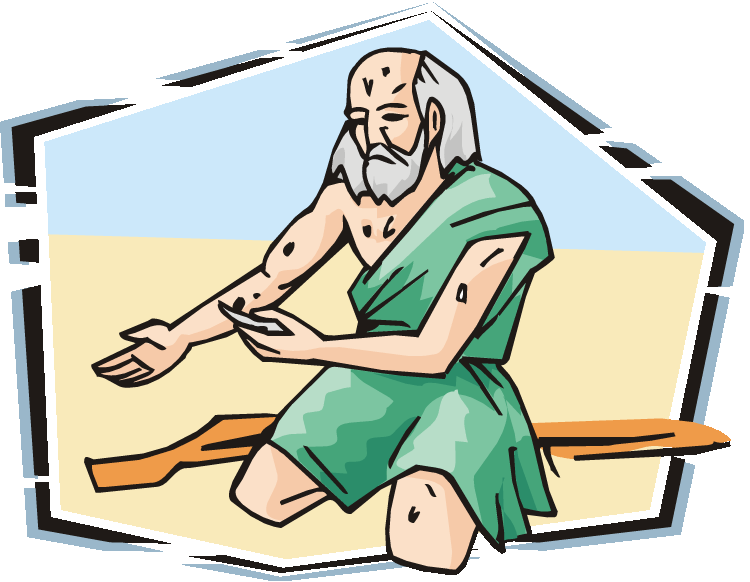
The Book of Job is the timeless story of a man who is seeking the answer to the age old question: what is the meaning of life? Unlike modern secular humanists be they atheists or agnostics, Job never questions the existence of the God of the Bible (or YHVH Elohim). Throughout the book, he perplexes over many basic conundrums of life that have been haunting humans from time immemorial. The Book of Job ends with a face-to-face encounter with Elohim where, though Job’s questions are not specifically answered, he reaches a place of stasis where he finds a certain peace and security with his station in life despite his still many unanswered questions. In this new place of faith, he discovers Elohim’s river of life and heaven’s blessings uninterruptedly flowing down upon him despite periods human suffering.
It is crucial to make the distinction between Job the theist and those modernists who deny or question the existence of Elohim. This is because this marks a critical delineation between the wise man and the fool. The Bible declares that only fools doubt the existence of Elohim (Pss 14:1; 53:1). Therefore, by biblical definition, atheists are fools, and the converse of this is that believers in Elohim are not fools; they may even be possessors of wisdom, which is the opposite of foolishness.
What hope does a fool have of finding the true meaning of life? He is like a blindfolded man who refuses to remove that which prevents him from seeing preferring instead to grope around in this own self-imposed darkness. On the other hand, Job is no fool, but is a wise and God-fearing man in pursuit of more wisdom and understanding about his Creator and the meaning of his life and the purpose of his existence in the presence of a superior, divine Being who is up there, but seems impersonal.
At the end, Job has a face-to-face encounter with his Creator, and this mind and heart are opened to the reality and presence of Elohim. Job declares, “I have heard of you by the hearing of the ear, but now my eye sees you” (Job 452:5). In the end, is this not the quest of every human who believes in the existence of God—to know him?
In the mean time, Job asks all of the perennial questions concerning the meaning of life, expresses the typical emotions including doubts and fears that all humans have, and confronts then ponders the many conundrums that life presents.
In the Book of Job, three categories of people present their viewpoints. All are religious and believe in a God. The book presents no opinions from atheists or agnostics. The biblical view is that the views of agnostics and atheists are mere foolishness and empty vanity (or literally, wind or hot air) and, therefore, not worth recording.
The first point of view are from Job’s three friends, which, to fair to them, are God fearing men, but whose knowledge about the ways of Elohim is incomplete and is a mixture of men’s opinions, philosophies and conjectures and is not based on a full understanding of him. These three men are feeding from the tree of the knowledge good and evil, and thus they have both correct and incorrect things to say.
The next perspective comes from Job, a godly man, who basically has a right understanding of Elohim, but has a plethora of unanswerable questions about the ways of his Creator that, quite frankly, are beyond man’s comprehension. Job is a man who is seeking to know Elohim better and wants to go deeper in his faith walk, but is stumbling over many deep and nagging questions of life. He is also somewhat blinded by his own goodness or self-righteousness,which prevents him from going deeper in his spiritual walk with Elohim.
The final human perspective comes from Elihu, who is a righteous man and whose views are unimpeachable in that Elohim fails to impute any wrong doing to him. Elihu is feeding from the tree of life and his views in accordance therewith.
Finally, Elohim, the Book of Job concludes by revealing the ultimate source of Truth. This occurs when YHVH Elohim answers Job in the whirlwind of human emotional, mental and spiritual struggles and turmoil over the meaning of life. YHVH gives job a larger perspective on life and the creation, which helps Job to focus on a much larger picture that is way beyond Job and his personal circumstances. This view helps to lift Job out of his self-imposed woe-is-me, pity party attitude and up to something or Someone much larger than himself. When this occurs, Job is able to step into the river of life,which flows from heaven’s throne and move into a new and higher place of spiritual understanding resulting in a revival of his faith leading to praise and worship. This is when heaven’s blessings begin to flow in Job’s direction and restoration occurs.
The circumstances and lessons of Job’s life mirror what many people of faith go through, and thus we can derive much light in our own time of need from this often over-looked book of the Bible.
Topics Discussed in the Book of Job
Job’s Questions About the Meaning and Purpose of Life and the Ways of Elohim
Wisdom from Elihu (from the Tree of Life)
Conclusion: What Job Learned From His Experiences
What did Job discover from his multitudinous questions concerning Elohim? At the end of his ordeal, Job discovered several, basic critical truths about life and Elohim. First, Elohim is infinite, exists in mystery and his ways are uninvestigatable by the human mind; therefore, man will never fully understand his Creator, for it is not possible for the finite to grasp the infinite. Second man is innately prone to pride and self-righteousness. These are faults of which he needs to repent in order to come into a right relationship with his Maker and to receive heaven’s approval and the blessings that result therefrom. Third, man needs to stay humble and know his place in the face of transcendent almighty and all wise Elohim.