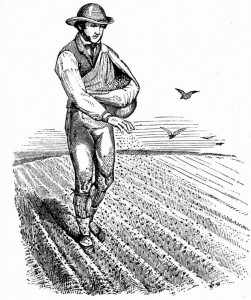
“Go Ye Therefore Into All the World”—A Guide to Sharing Your Faith

With the summer months upon us and the weather improving, people begin to interact more with each other. Here’s a practical guide to sharing your faith with others—on how to let your light shine in the darkness around you. After reading this, please share with this blog audience any ideas you have about sharing the gospel with others.

36928371

Motivation to Evangelize the Spiritually Lost

What should be our motivation to evangelize the lost?

Yeshua commanded his disciples (that’s us) to share our faith with those around us. This is called evangelism. Yeshua’s imperative command in Mark 16:15 to “go into all the world and preach the gospel…!” is not “the great suggestion,” but “the great commission!” To many, it has become “the great omission.” We’re often afraid to share our faith with others because we’re afraid they might think negatively of us if we do.

Human need demands that we reach out to the lost and hurting people around us. Like Yeshua, we must seek to save the lost (Luke 19:10). Like Yeshua, we must meet people at their point of need by finding the need and meeting it with the gospel message, the Word of YHVH and the love of Yeshua.

Compassion and love for the lost and hurting will compel us to share the good news with others. This is something Yeshua demonstrated (Matt 9:36; 14:14; 15:32; 20:34).

We must have a love for the lost. Pray to the Father that he gives you a supernatural love for the lost as Yeshua had. Love sensitizes us to the needs of others. Love makes you want to reach out to others. Love makes you forget about yourself and casts out the fear of witnessing or the fear of what others may think (1 John 4–18).

We will have an easy time sharing the gospel of Yeshua with others if we still have the joy of our salvation. If we have lost that joy, pray for it to come back as David prayed in Psalm 51:12–13. Perhaps sin, the cares of this life, fear or other things are blocking that joy.

The New Testament Model for Evangelism

A study of the Testimony of Yeshua (or New Testament) reveals that the dominant model Continue reading →


Can of Worms: Is Tithing for Us Today?

Numbers 18:21, I have given the children of Levi all the tenth. The children of Israel were to pay a tithe (a tenth) of their income to support the Levites—those who ministered to the Israelites and taught them YHVH’s Torah. Since the Levitical priesthood system no longer exists, some people interpret this to mean that tithing and giving to support those who minister to the saints and feed them spiritually is no longer obligatory. Some have the notion that pastors and Bible teachers are to minister free of charge. What does the Apostle Paul say about this? In 1 Timothy 5:17–18 we read,

Can of worms 20089224

Let the elders that rule well be counted worthy of double honour, especially they who labour in the word and doctrine. For the Scripture says, You shall not muzzle the ox that treads out the corn. And, The labourer is worthy of his reward. 

Now let us look at the tithing question in more detail in light of the Torah’s command to support the Levites. How does this translate into supporting those who feed and care for us spiritually today?

Continue reading →


The Leaven of Bitterness

1 Corinthians 5:8, Leaven of malice and wickedness. Interestingly in the Torah, there are two Hebrew words used for leaven, which is a biblical metaphor for sin. The first word, chametz refers to the sin of malice (or ill-will, malignity, desire to injure, or bitterness), while se’or, the second word, refers to wickedness or sin in general, which the Scriptures refers to as the violation of YHVH’s Torah commands (1 John 3:4). It is likely that Paul had this concept in mind when he wrote this verse.

20480193

  • chametz/ץמח, is a noun (Strong’s H2557) meaning “leaven, that which is leavened, bitter.” Chametz is from the root H2556 chametz/ץמח (a verb) meaning “to be sour, to leaven.” According to The Theological Dictionary of the Old Testament, the root word of chametz designates the action and result of yeast, which ferments or sours bread dough. This idea of becoming sour is extended to a person’s negative attitude. For example, in Psalms 73:21 chametz is translated as cruel [and in Ps 73:21 as grieved]. The Torah strongly instructs that anyone eating chametz during Passover and the Feast of Unleavened Bread will be “cut off” from Israel (Exod 12:19–20). Exodus 12:39 notes that Passover bread was not leavened because the Hebrews went out quickly from Egypt and thus had no time for their bread dough to rise. Thus it had the symbolic value of teaching Israel that having been redeemed from Egypt they should leave their old life [and sinful, “sour” carnal nature] behind quickly and set out toward the Promised Land in a sin-free state. Leavened bread was also prohibited in connection with the sacrificial system (Exod 23:18; 34:25). Neither it nor honey could be burned with the meal (Lev 2:11), and it could not be baked with the fire offering (Lev 6:15). But leavened bread could be eaten with the thank offering (Lev 7:13) and with the first fruits offering on Shavuot (or Pentecost). In later Jewish thought, leavened bread become a symbol of corruption and impurity, as also in Yeshua’s teachings (Pss 71:4; 73:21; Hos 7:4; Matt 16:2; Mark 8:15) and in one remark by Paul (1 Cor 5:8; TWOT, vol. 1, page 289).
  • se’or/ראשׂ (Strong’s H7603) means “leaven.” This is the generic term for leavening or leavened bread and is found five times in Scripture (Exod 12:15, 19; 13:7; Lev 2:11; Deut 16:4). In the first four references, se’or is used in parallel construction with chametz. In all places but Leviticus 2:11, it is used in reference to the Feast of Unleavened Bread, while in the former se’or is used in reference to the meal offering.

Sin as the violation of the Torah (1 John 3:4) is often discussed, but the sin of ill-will, bitterness, or a sour attitude toward others tends to be overlooked. This is because this sin so deeply rooted in one’s personality that it’s often hard for the sinner to see it in himself, although it may be clearly visible to others—especially its victims.

This sin is rooted in a heart of unforgiveness and bitterness toward others due to past hurts or wrongs committed against the person who is now harboring the bitterness (cp. Acts 8:23; Rom 3:14; Eph 4:31; Heb 12:15). If not dealt with, bitterness becomes like a deep root that penetrates deeply into the person’s heart and mind (Heb 12:15). It can permeate (like leaven) one’s entire soul, negatively affecting those around them—especially toward those who remind them of the past hurt committed against them causing the ill will to be triggered.


It’s Seder Night Live!

Ever wonder what a Passover seder is like? Well, now you can watch Congregation Elim’s 2013 six hour long seder in less than ten minutes. It’s like watching a movie trailer. Our seder is fun, interactive, innovative, gospel-oriented and true to the Scriptures. Enjoy!


Four New Videos

I’ve just uploaded four new (short) videos to our YouTube channel. They’re on the following subjects:

    • What is biblical meditation?

  • Is divorce and remarriage permissible for believers?

    • The feast tithe and the biblical command to imbibe alcohol.

  • The meaning of “turning the other cheek.”


Blog Scripture Readings for 6/2 through 6/8/13

Aside

Parashat Korach — Numbers 16:1 – 18:32
Haftarah — Isaiah 66: 1-24**  |  I Samuel 11:14 – 12:22
Prophets — Ezekiel 1:1 – 7:27
Writings — Ecclesiastes 3:1 – 9:18
Testimony — 1 Corinthians 3:1 – 8:13

Most of this week’s blog discussion points will be on these passages. If you have general comments or questions on the weekly Scripture readings not addressed in a blog post, here’s a place for you to post those. Just use the “leave a reply” link below.

The full “Read Through The Scriptures In A Year” schedule, broken down by each day, can be found on the right sidebar under “Helpful Links.” There are 4 sections of scripture to read each day. One each from the Torah, the Prophets, the Writings, and from the Testimony of Yeshua. Each week, the Torah and haftarah readings will follow the traditional one-year reading cycle.

Weekly Blog Scripture Readings for 6/2 through 6/8/13.

** A different Haftarah is read when it is a special sabbath in Jewish tradition. The sabbath for this week’s Parasha falls on a rosh chodesh on the traditional calendar. We’ve also included the usual Haftarah for this Parasha in 1 Samuel.


What the Koran Really Says

Startling Insights from the Koran—The True Face of Islam Unmasked

It is important to educate yourself with the facts!

Islam 1-20794873

The Koran (or Qur’an) is the sacred book of the religion of Islam. It contains the sayings of Muhammad, the founder of Islam. In the Koran, Muhammad (ca. 570 to 632) claims that the sayings of the Koran came to him from God (or Allah) via the angel Gabriel. Based on a passage in the Koran (Sura 7:157), many believe that Muhammad was illiterate and was incapable of writing these sayings down himself. At the very least, he was unlettered and unlearned. Shortly after his death, some of his followers who had memorized his sayings met together and recorded in written form what they remembered Muhammad to have said. This is how the Koran came to be.

The Koran forms the bedrock of the Islamic faith, although there are other sacred books belonging to the religion of Islam that have sprung up since the Koran was compiled.

Since some of the practitioners of Islam are presently on a crusade to forcefully convert many countries to Islam, and since many Muslims terrorists have demonstrated a particular hatred for Jews and Christians, and since there is much misinformation being broadcast in the western media, by western politicians and western educators as to what Moslems believe and what the Koran actually teaches, I took it upon myself to read the Koran from cover to cover to see for myself what it says. Below are some of the amazing facts about Islam that I learned from reading the Koran.

The following references are taken directly from the Koran. Chapter (Sura) and verse references may vary from Koran to Koran. Those listed below are from The Koran by Ivy Books (published by Ballantine books in 1993, a division of Random House, New York, ISBN 0-8041-1125-1). I will occasionally provide some alternate versions of the Koran as well for the purpose of confirming some of the more controversial passages by several translations.

Alternate versions of the Koran that I use for comparative purposes are:

  •  AKa (The Qur’an, by Abdullah Yusuf Ali; Elmhurst, N.Y. : Tahrike Tarsile Qur’an, Publishers and Distributors of Holy Qur’an, 2005, ISBN 1-879402-29-7)
  • AKb Koran: Quran—The Final Testament; Authorized English Version; translated from the Original by Dr. Rashad Khalifa, Ph.D. by Islamic Productions, 2003, http://www.quran-islam.org/93.html).

According to the Koran—

The Purpose of the Koran

  • The main purpose of the Koran is to warn all creatures (p. 294, Sura 38:79).
  • The Koran is a warning to the God/Allah-fearing (p. 375, Sura 69:48).

Muslim Theology

  • Moslems are to believe the Koran and the Bible (p. 58, Sura 4:136).
  • The koranic law of abrogation states that if something was written later in the Koran that contradicts something that was written earlier, the later cancels out the former (p. 10, Sura 2:100; p. 153, Sura 13:39).
  • One earns (immortality and) a spot in paradise or heaven by doing things that are right, and on the basis of one’s good works (p. 57, Sura 4:23; page 92, Sura 7:42; p. 198, Sura 20:111; pp. 251 and 255, Sura 29:6 and 57; p. 318, Sura 43:72). A sinner can be forgiven of his sins by paying alms, by being prayed over, through repentance and by his good works (p. 121; Sura 9:5–7). Paradise or heaven is guaranteed for those who fight and slay for the cause of Islam (pp. 121–122, Sura 9:11).
  • Those who oppose Allah and Muhammad will receive eternal hell fire (p. 117, Sura 9:64; p. 113, Sura 9:17; p. 164, Sura 16:31). The Koran portrays the torments of hell in the stereotypical manner reminiscent of Dante’s inferno (p. 208, Sura 22:20).
  • Allah misleads some people and guides others (p. 152, Sura 13:27; AKb 13:27; p. 154, Sura 14:4).
  • At the creation of man, Allah commanded angels to bow down to worship man (p. 159, Sura 15:30–33).
  • Allah gave the Torah to guide the children of Israel (p. 171, Sura 17:2; AKb 17:2; p. 264, Sura 32:23).
  • There are seven heavens (p. 214, Sura 23:17).  This is a concept that the Koran borrows from the pagan Greek philosophers.
  • Ishmael was a prophet and an apostle (p. 190, Sura 19:55).
  • Camels are used for sacrifices (p. 209, Sura 22:37) and for eating (p. 210, Sura 22:36).
  • The Koran teaches that Allah and the God of the Bible (YHVH Elohim) are one in the same, and the same God sent down the Book of the Law (the Torah) and the Koran (p. 254, Sura 29:45–46; AKb 29:46–47).
  • The soul of man is immortal soul (p. 255, Sura 29:58). This also is a concept that the Koran borrows from the pagan Greek philosophers who taught the concept of dualism.
  • There is no variableness in the way of Allah; that is, the word of Allah does not vary; i.e., the Bible and Koran do not  contradict (p. 279, Sura 32:45), since the Koran teaches that both books came from the same God (p. 254, Sura 29:45–46). At the same time, the Koran claims to clear up (or correct the errors of?) the Bible and replaces it (p. 64, Sura 5:18; p. 127; Sura 10:38).
  • Allah created the earth in two days (p. 307, Sura 41:8; AKb 41:9).  If this is true, how can the Bible and Koran both be truth and the word of God, since the Bible states the earth and everything else in six days? Elsewhere, the Koran claims that the earth was created in six days (p. 338; Sura 50:37).
  • Paradise or heaven is guaranteed for those who fight and slay for the cause of Islam (pp. 121–122, Sura 9:11).

The Koran on Muhammad

  • Muhammad was an “unlettered prophet,” which is interpreted to mean that either he was illiterate or was unlearned (p. 101, Sura 7:157; AKb 7:157 says Muhammed was a “gentile prophet” in place of “unlettered prophet”).
  • Muhammad had many slaves and wives and lots of sex (p. 269; Sura 33:49–51; AKb 33:50–51).

The Koran on the Fate of Infidels (Non-Muslims)

  • The Koran teaches Muslims to seize the infidels (non-Muslims), to slay them wherever Continue reading →