Isaac—A Man of Godly Character

Isaac—A Character Sketch

  • He was successful and blessed. (Gen 26:12)
  • He was obedient to his father.

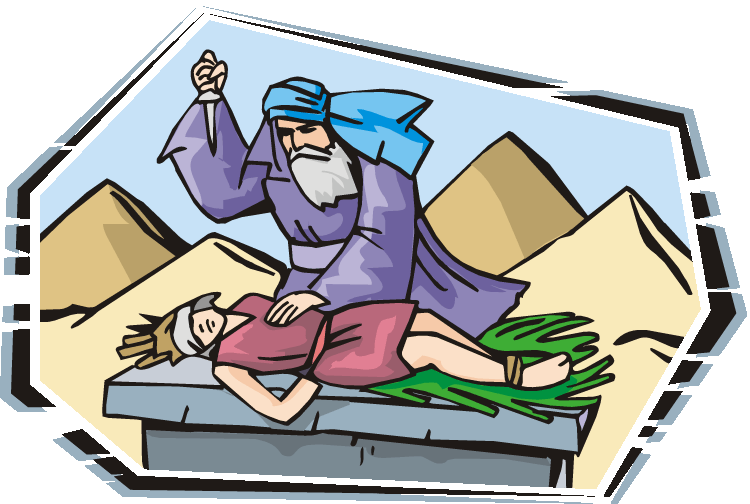
At age 37 Abraham bound Isaac to the altar (in Heb. called the akeidah, Gen 22).

Isaac was obedient to marry Rebekah, his parents’ choice, unlike Esau. He trusted and had faith in his parents even as he trusted his life with his father at the akeida.

Akeidah

  • He had a deep and personal relationship with YHVH.

Here we learn that obedience to and faith in and love for parents leads to devotion to YHVH. Honoring one’s parents is the key to honoring YHVH and entering into relationship with him. That is why the fifth commandment to honor one’s parents is placed after the commands to love Elohim. In Genesis 24:63 and 25:21, (see The Stone Tanach rendering of this verse in addition, The ArtScroll Beresheis, p. 1048, which says Isaac prayed abundantly and urgingly, i.e., persistent prayer, a penetrating prayer or request), we see that Isaac had a deep and personal relationship with his Creator. Continue reading →


Have Mercy on Us, Son of David!

Matthew 20:34, Eyes received sight…the followed him. When the Son of David has compassion on someone and touches their eyes, they receive sight and see him, and the automatic response will be to follow him. His having compassion is first preceded by the heart cry on the part of the potential recipient of Yeshua’s grace, “Have mercy on us, Son of David.” When one recognizes one’s pitiful state and desparate need, how can Yeshua not have compassion on us, touch us and heal us?

15213910


Where Are the Gideons of Our Day?

Where are the Gideons of our day who, called and empowered by the YHVH, will stand up against the enemies of YHVH Elohim and his chosen servants?

25489905

Gideon blowing shofar 33397793


How to Be Spiritually Complete

Matthew 19:16, What good thing. Yeshua’s answer to the rich young ruler when he asks him what he must do to have eternal life might, in a cursory reading, appear that Yeshua is promoting a works based salvation. However this is not the case. Yeshua cleverly shows the young man that he is incapable of obtaining eternal life through good works, for man isn’t capable of perfectly following the Torah. In the case of the young man’s, he thought himself to be perfectly righteous, when in reality, Yeshua showed him that he was covetous, and therefore still an unrighteous sinner thus disqualifying himself from reward of eternal life. Yeshua, by contrast instead of promoting a works-based salvation, instructs the young man to deal with his sin by selling his possessions and giving the proceeds to the poor, and then becoming a follower of him. The lesson here is that salvation and eternal life can come only as we turn from our sin and become a follower of Yeshua.

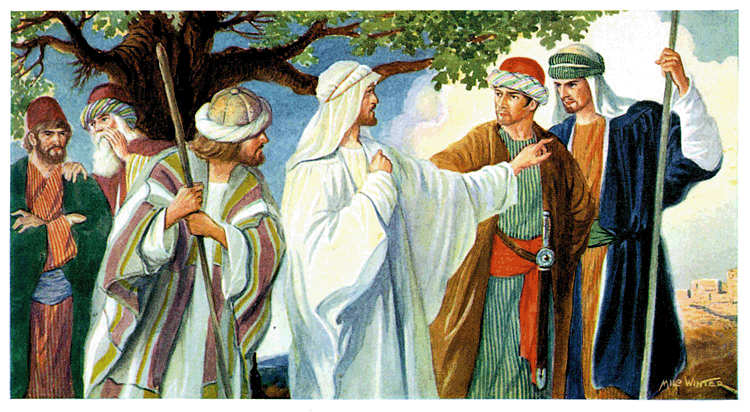
Yeshua teaching disciples

What Yeshua is really saying when he answers the young man’s question is this: “If you want to be perfect [Gr. teleios meaning “brought to its end, finished; wanting nothing necessary to completeness]” turn from sin by obeying the Torah more completely, but also follow the Messiah by becoming his disciple. Remember, to hear and to obey [Heb. shema] the Messiah was a command of the Torah as well (Deut 18:15), and to not believe in him is sin (John 16:9 cp. 3:18). So according to the Bible, to be spiritually perfect or complete one must, as Yeshua said, love him by keeping his (Torah) commandments (John 14:15). It is the Torah that shows us how to love Elohim (and our fellow man as well).

Yeshua makes a similar point in his exchange with a scribe in Mark 12:28–34. While extolling the virtues of Torah-obedience, and commending the scribe for his understanding of the deeper heart issues of Torah-obedience, Yeshua makes an interesting concluding statement. He tells the scribe, “You are not far from the kingdom of Elohim (v. 34) as if to tell him, “You’re on the right spiritual track with regard to your Torah-obedience, and you’re heading for the kingdom, but that alone won’t get you into the kingdom. You must also become a disciple of Yeshua.


Divorce Is a Sad Fact of Life — A Biblical View Point

Matthew 19:8, Put away your wives. Most churches allow for divorce, but some do not permit remarriage under any circumstances. This is may seem like an extreme position, those who teach this can make a strong case that this is the Bible’s position.

Divorce 33377550

Some churches teach that divorce and remarriage is acceptable in some instances, but not in others. This is where it gets sticky and depends on the interpretations of many clear as well as some unclear biblical passages. The truth is that each marriage and divorce case is unique. Each situation needs to be evaluated case by case based on biblical guidelines. My thoughts (below) on the subject of divorce and remarriage are only general in nature.

Some churches take the approach that all sins can be forgiven except the sin of divorce and remarriage. This would mean that divorce and remarriage is the unpardonable sin for which the blood of Yeshua is ineffective. This is a biblically untenable position.

The Scriptures say that YHVH hates divorce (Mal 2:16). Why? Continue reading →


Update: The Underground Church Is Coming…to America

GOV’T IN MASSIVE CRUSH OF RELIGIOUS FREEDOM

Woman thrown off metro for singing spiritual hymns

According to a lawsuit, the guard accused her of “publicly singing spiritual hymns.”

Read more at http://www.wnd.com/2013/10/govt-in-massive-push-to-crush-religious-freedom/#YMV1UDT2gWWFmGpD.99


Following YHVH Can Be Tough on Marriages

Genesis 22:19; 23:2, Abraham dwelt at Beersheba…Sarah died in…Hebron. At this point, Abraham and Sarah lived in two separate towns some 50 miles apart. Why was this? The Scriptures don’s say, so we can only speculate. Perhaps the trial of Abraham’s faith in the previous chapter where YHVH asked him to sacrifice Isaac and Abraham’s compliance to do so put such a strain on their marriage that they separated. Perhaps the idea that YHVH would ask Abraham to sacrifice their only son was so hard for Sarah to believe that she questioned whether Abraham had even heard correctly from YHVH about this.

20243059Whatever the case, following YHVH can be tough on marriages and families as Yeshua notes in Matthew 10:34–39. Sometimes families split as a result. Abraham wasn’t unique in his situation.

In Exodus 4:24–26, in all likelihood, Zipporah and Moses split up over YHVH’s request to circumcise their two sons, for we never hear of Zipporah again, except that Moses had sent her away (Exod 18:2). Some Bible scholars take this mean that he put her away or divorced her (likely because of her refusal to follow him onto the mission field). Later, we find Moses remarrying a Cushite woman (who was likely black; Num 12:1).

David had to leave his first wife Michal, the daughter of Saul, because she despised him for dancing before YHVH’s ark of the covenant (2 Sam 6:14–16, 23).

The situation with the prophet Hosea is notable, as well, in this regard. YHVH required him to marry a wife of harlotry as part of his spiritual walk, so that he would better understand the experience of YHVH who was married to the adulterous nation of Israel. Hosea didn’t even know whether the children born to his wife were his own, or those of another man, yet he was to love her unconditionally anyway.

In the apostolic era, we hear virtually nothing about the wives of the apostles. This in no way indicates that their marriages were troubled, but one can only wonder given the rigors of the spiritual assignment YHVH had given them.

Paul is a case in point. He was likely married, since it would have been uncommon for someone of his spiritual stature to not to have been married in the Hebraic culture in which he lived, yet no mention of his wife is made. At the same time, he mentions a thorn in the flesh to buffet him and to keep him humble (2 Cor 12:7). On can only wonder if this isn’t a reference to a difficult marriage situation. Perhaps his wife became antagonistic at his conversion to Yeshua resulting in his leaving the prestigious and affluent life of the religious elite of his day, and counting his past life as dung (Phil 3:8). This may have been too much for her to bear.