A Conversation Between God and Man(?!)

Genesis 35:1, 6–7, 9–10, 15 (cp. 32:23–31), Elohim said unto Jacob. This account of the encounter between Elohim and Jacob is so matter-of-fact and is written in such a manner as to be familial, if not almost casual. There are no embellishments or hyperbole, just statement of literal fact. Again, the plain (peshat) meaning of the text seems clear: Elohim spoke with man face-to-face. This was not the only time Jacob had experienced such a divine encounter as we have previously noted in is encounter with Elohim in Genesis 32.

It could be said that Elohim spoke to Jacob in some sort of a vision form, until we come to verse 13 and 14, which states that “Elohim went up from [Jacob] where he talked with him. And Jacob set up a pillar in the place where he talked with him.” These verses indicate that Elohim was literally there at that place and when finished “went up from [Jacob].” The word place in verse 13 is the Hebrew word maqowm, which is a “performative noun [which] represents the physical location where something is or ought to be … so it is translated place, home, room …” (TWOT, vol 2, p. 794). The well-respected Brown, Driver and Briggs lexicon, like TWOT, defines maqowm as a literally physical place, spot or locality (p. 879). The word maqowm is used 402 times in the Tanakh and only four times does it refer to YHVH’s heavenly dwelling place (1 Kgs 8:30; 2 Chr 6:21; Hos 5:15 and Mic 1:3); all other scriptural passages where the word is used is referring to literal or figurative place on earth including Genesis 35:13. The evidence is clear: YHVH Elohim was on this earth, speaking to Jacob in some form of diminished glory that man could see him and live.

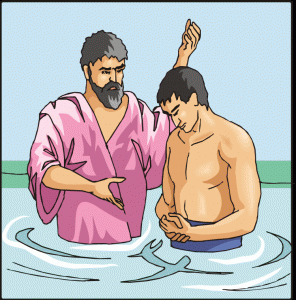
 

The Rite of Baptism Past and Present

Matthew 28:19, Baptizing. Let’s define some terms first. Mikveh (or mikvah) in Hebrew means “a gathering of waters.” Tevilah means “immersion/baptism in water.” So technically, we do tevilah at a mikvah.

Tevilah is an ancient custom that goes back to the levitical priesthood when YHVH required the priests to be cleaned in water (the bronze laver in the tabernacle) before they could even serve him. In fact, when consecrating the priests for service, Elohim instructed Moses to wash the priests (Aaron and his sons) before they could even begin to serve him. In fact, it was the third of seven steps in their consecration process (Exod 29:4). After that, they confessed their sins over a bull which was then sacrificed (Exod 29:10–11, the fifth step), then Moses anointed them with oil (the sixth step, Exod 29:21). These seven steps are a prophetic picture showing how one is “born again,” or spiritually regenerated when one comes into a relationship with Elohim through faith in Yeshua.

Baptism 2

What the priests went through is a picture of what we as believers must go through. This is elucidated in various places in the Testimony of Yeshua.

The Bible contains prophetic shadows of baptism even before the consecrating of the priests. Paul talks about the children of Israel being baptized into Moses when they went through the Red Sea (1 Cor 10:2). In a sense, the whole nation was consecrated to YHVH’s service through faith in the lamb’s blood on the doorposts at Passover, through baptism in the Red Sea so that they could become YHVH’s peculiar treasure, a kingdom of priests and his set-apart nation (Exod 19:5–6). They also washed their garments (another picture of ritual immersion) before coming into the presence of YHVH to receive the 10 Words at Mount Sinai (Exod 19:10). Additionally, throughout the Torah, there are numerous ritual washings for both the priests and the people of Israel associated with various sin-cleansing rites.

Now we come down to John the Baptist who came in the spirit of Elijah to prepare the Continue reading →


Confronting the Homosexualization of Our Society

Culture Wars Series — The Battle for the Soul of America

Today I looked at the headlines of a number of major Internet news sources (as I do every day). These included both conservative and liberal news outlets as well the major mainstream media outlets along with some smaller, yet respectable news networks. I was amazed at how many headlined stories relating to “gay” issues I found. Some news sites actually had several stories on their front pages on the subject. This phenomenon is no longer a unique occurrence.

The fact is that even though homosexuals make up a tiny minority of the population, they get a disproportionate amount of news coverage. Whether the “gay” agenda is being pushed on the majority of Americans who are heterosexual or not by a vocal and powerful minority isn’t the issue. Rather, it’s that “gay rights” is a front and center issue in America’s culture war pitting the clash of traditional Christian values with the post-Christian, more morally loose, modern generation.

It’s obvious to see that government at all levels along with the public educational system, the major media and the entertainment industry are actively forcing homosexuality as a normative and acceptable behavior on the American people. Those trumpeting the homosexual cause have as their weapons punitive so-called antidiscriminatory laws, the threat of lawsuits as well as boycotts and other means of exerting social pressure. In their cross hairs are any who oppose them including organizations, businesses, churches, schools, or individuals who dare oppose them. Already, the Girl Scouts and Boy Scouts have caved in to the pressure. The traditional family is being redefined by homosexual activists, as well as the concepts of “male” and “female.” Restrooms and locker rooms are now the new battlefield for those wanting to erase the lines between the sexes.  Regardless of one’s stand on homosexuality, we have to deal with it. Ignoring this issue isn’t an option!

With the current lay of the cultural landscape in mind, I would now like to express my views on the subject of homosexuality from a loving, yet solid biblical position. Continue reading →


Blog Scripture Readings for 11/10 through 11/16/13

Aside

Parashat Vayishlach — Genesis 32:4(3)* – 36:43
Haftarah — Obadiah 1:1 – 1:21
Prophets — 1 Samuel 4:1 – 10:27
Writings — Psalms 48:1 – 54:7
Testimony — Matthew 27:32 – 28:20; Mark 1:1 – 3:19

Most of this week’s blog discussion points will be on these passages. If you have general comments or questions on the weekly Scripture readings not addressed in a blog post, here’s a place for you to post those. Just use the “leave a reply” link below.

The full “Read Through The Scriptures In A Year” schedule, broken down by each day, can be found on the right sidebar under “Helpful Links.” There are 4 sections of scripture to read each day. One each from the Torah, the Prophets, the Writings, and from the Testimony of Yeshua. Each week, the Torah and haftarah readings will follow the traditional one-year reading cycle.

* Verse numbers in parenthesis refer to the verse number in Christian Bibles.

Weekly Blog Scripture Readings for 11/10 through 11/16/13.


There Is Hope for the Church and Nation — Remember Samuel!

1 Samuel 3:1, The word of YHVH was rare in those days; there was no widespread revelation [open, prophetic vision]. Into this environment of spiritual laxity in Israel, YHVH introduced Samuel, a man who was single-handedly responsible for the spiritual revival of that nation.

Samuel and Eli

The regime of Eli and his wayward sons can be likened to the state of the church in these last days in America. Eli was a weak, ineffectual, compromised, lukewarm, fat and blind leader spiritual leader. The modern church is filled with leaders who like Eli have little or no backbone to stand up to evil, to denounce sin, to refuse to toy with spiritual compromise, to stand up to false leaders who are in the ministry simply for their own personal gain and physical gratification.

On the surface, Eli looked good. He sported the title of High Priest, along with all the trappings and regalia that came with that exalted office including a glorious church building, ceremonial accoutrements and robes. He even had “throne.” Yet at the same time, he was blind and grossly fat. This is the spiritual state of many leaders in the church today. For their own benefit, they have plundered the people they lead becoming financially well off in the process. YHVH denounces these phony and carnal shepherds in Ezekiel 34 who feed themselves at the sheep’s expense caring little or nothing for them. This was the sin of Eli’s sons who not only forcefully plundered the people for their own gain (1 Sam 2:2–17), but Continue reading →


From the Archives: The Gospel Message in the Names of the 12 Tribes

See my earlier post at http://hoshanarabbah.org/blog/2012/07/31/names-of-the-12-tribes/. This is really cool. It’s worth revisiting.


Bible Trivia: Who lost his ear and almost his career?

Matthew 26:51, The servant of the high priest…cut off his ear. Was it Peter’s (John 18:10) intention to cut of the servant’s ear or head? Some theologians suggest that Peter was going for the head, but missed and got the ear (actually it was the earlobe; see TDNT 5:543) instead.

21413842

Likely, Peter’s intended target was indeed the ear, for the servant, who was a priest himself, would have been disqualified by the Torah from serving in the temple if he had any physical defect or blemish such as a missing ear (Lev 21:18–21).

Not only that, but Peter went for the right earlobe (Luke 22:50; John 18:10), which according to the Torah (Exod 29:20) had to be anointed with blood as part of the consecration process of a priest. An improperly consecrated priest was disqualified from service in the temple as well. So by cutting off the servant’s earlobe, Peter was striking a fatal blow to his career, not to mention his ego.