The Moral Integrity of Spiritual Leadership or a Moral Morass?

1 Samuel 12:3, Whose ass have I taken? The moral integrity of spiritual leadership is essential.

Most leaders in Christian or Messianic circles would strongly assert their probity (honesty and decency), and at the same time would deny that they are building their ministry kingdoms for personal benefit, but what is the real truth?

Greedy dogs!

Greedy dogs!

  • How do they treat their children and wives behind the scenes?
  • What is their response toward their detractors? How do they treat other “competing” ministries?
  • Do they live off of YHVH’s sheep, or do they use tithes and offerings for the care and feeding of YHVH’s sheep?
  • If they do receive income from their flocks, how dependent are they on that income?
  • To what degree do they make decisions affecting the congregation in order to solicit a response that will ensure the security of their position as chief leader and beneficiary of the congregation’s largesse?
  • To what degree do they angle their teaching and preaching to curry the favor of their constituents thus keeping the funds flowing toward them?

These are questions that spiritual leaders all need to ask of themselves from time to time.


The Life of Joseph—A Foreshadow of Messiah Ben (Son of) Yosef

The spirit of Antimessiah (Antichrist) is on a dramatic rise in this day and age. It is even alive in the Hebrew Roots or Messianic Israel Movement where some are losing their faith in Yeshua. A few are even converting to Rabbinic Judaism, which denies the messiahship and deity of Yeshua and the divine inspiration of the Testimony of Yeshua. Some of the blame for this can be laid at the feet of a few of the modern-day descendants of the non-believing Pharisees (i.e., the Rabbinic Jews) who use clever arguments to beguile unstable and unlearned souls into humanistic reasoning devoid of a living faith in Yeshua the Savior and Redeemer of man. Because of a spiritual blindness that Scripture prophesied would come upon the Jews producing hardness of heart toward Yeshua the Messiah, unbelieving Jews ignore the numerous prophetic shadow-pictures pointing to Yeshua the Messiah contained in their own Tanakh.

Joseph's coat 2-33397808May the following study strengthen your faith in Yeshua, in his divine origination in the very heart, mind and essence of Elohim, and in the fact that he was foreordained to come to this earth to reconcile sinful man to his Heavenly Father through his self-sacrifice on the cross. All this was prophesied long ago in the Hebrew Scriptures. The ancient Jewish rabbis speak of a messianic figure coming called Messiah ben Yosef, the Suffering Servant, whose life and ministry would parallel that of Joseph, yet these same rabbis fail to see the connection between Joseph’s life and that of Yeshua. Let’s now chronicle the striking and uncanny parallels between Joseph and Messiah, the son of Joseph, the Suffering Servant (Many of these comparisons come from the book, Gleanings in Genesis, by Arthur W. Pink):

  • Joseph had two names: Yoseph (meaning “to add, increase, do again”) and Zaphnath-panaaneah (41:45) (meaning “revealer of secrets”). How do these names point to Yeshua’s mission? Continue reading →
 

Samuel —A Boy Who Changed a Nation

Elohim used the boy Samuel to change a nation’s destiny and to bring spiritual revival. Maybe he can use you to do the same. Watch this video, and let it inspire you to do so.


Addressing the “Gay” Rights Agenda

The “Gay” rights agenda is pushing itself into all aspects of society and is on a collision course with Bible believers everywhere. What should be our biblical response? How do we help those with gender identity issues and same sex attractions? What should be a biblical and loving response? This video explorers these controversial issues from a loving, biblical, but firm perspective.


Blog Scripture Readings for 11/17 through 11/23/13

Aside

Parashat Vayeshev — Genesis 37:1 – 40:23
Haftarah — Amos 2:6 – 3:8
Prophets — 1 Samuel 11:1 – 17:58
Writings — Psalms 55:1 – 61:8
Testimony — Mark 3:20 – 6:55

Most of this week’s blog discussion points will be on these passages. If you have general comments or questions on the weekly Scripture readings not addressed in a blog post, here’s a place for you to post those. Just use the “leave a reply” link below.

The full “Read Through The Scriptures In A Year” schedule, broken down by each day, can be found on the right sidebar under “Helpful Links.” There are 4 sections of scripture to read each day. One each from the Torah, the Prophets, the Writings, and from the Testimony of Yeshua. Each week, the Torah and haftarah readings will follow the traditional one-year reading cycle.

Weekly Blog Scripture Readings for 11/17 through 11/23/13.


Yeshua in the War Zone — A Template for Ministry

Mark 1–3

It is interesting to note the order of events as Yeshua was launching his ministry. He was about to enter a war zone!

After John baptized Yeshua and he received his heavenly empowerment, he first went through a spiritual boot camp before stepping onto the battlefield of public ministry. Once in the “war,” it’s worth noting where the battle lines fell.

22065310

  • His spiritual boot camp was the wilderness where he fasted for forty days and nights to get his body, soul and spirit, and his mind, will and emotions in sync with the will of his Father in heaven (Mark 1:12–15).
  • His first battle was an internal one. The devil tested him in three areas: his body, soul and spirit, or, to put it another way, the lust of the flesh, the lust of the eyes and the pride of life (Mark 1:13). After overcoming himself and submitting to the will of his Father, he was now ready to launch into the war zone of public ministry.
  • His mission was to preach the message of the gospel of the kingdom of Elohim and repentance from sin (i.e. Torahlessness, 1 John 3:4; Mark 1:14–15).
  • Next he chose his cadre of spiritual warriors — his “army”— the twelve disciples (Mark 1:16–20).
  • Where better to start proclaiming the gospel message than in the local synagogue on the Sabbath (Mark 1:21)? After all, the religious folks there should be overjoyed to hear this good news, fresh message from heaven. Right? Continue reading →
 

Yeshua Eating With Sinners — Will the Real Sinner Stand Up?

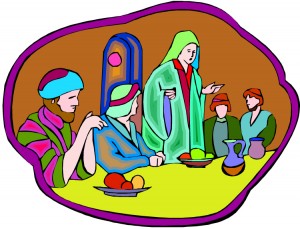
Matthew 9:10, Sinners. What is behind the Gospel writers’ use of the word sinner (see also Mark 2:16) to designate a class of people along with tax collectors? To the modern reader, this likely begs the question, aren’t all people sinners? This depends on one’s religious point of view. To understand the term sinners as used by the Gospel writers, we must understand the cultural, religious context of the day. According to David Stern in his Jewish New Testament Commentary, this term was used by the Pharisees (who were present at the time this event occurred, see verse 11) to refer to those of low reputation in society including prostitutes and thieves along with the despised, often greedy and mendacious tax collectors (or publicans), whose sins were blatant and obvious.

20794988

Furthermore, in Hebraic culture, table fellowship indicated intimate relations among those who shared it. As Keener points out (The IVP Bible Background Commentary NT in his notes on Mark 2:16), the Pharisees were especially scrupulous about their special rules on eating, and they didn’t like eating with who were less scrupulous than them — especially those of low reputation.

In this case, Yeshua responded graciously to his accusers (vv. 12–13) by pointing out to them the Father’s heart of mercy in reaching out to lost sinners. At other times, Yeshua, the spiritual activist, turned the tables on the self righteous and sacrosanct Pharisees when he taught that those who considered themselves righteous were, in reality, often worse off spiritually than those they ridiculed (see the Parable of the Pharisee  and the Tax Collector, Luke 18:10–14). From Yeshua’s example in dealing with the Pharisees, we learn that when we are accused there are times to be gracious and to turn the other cheek, and there are times to push back hard. Wisdom and the guidance of the Holy Spirit will help us to determine which response is appropriate at any given time.