The Daughters of Zelophehad: The Proper Way to Redress Grievances

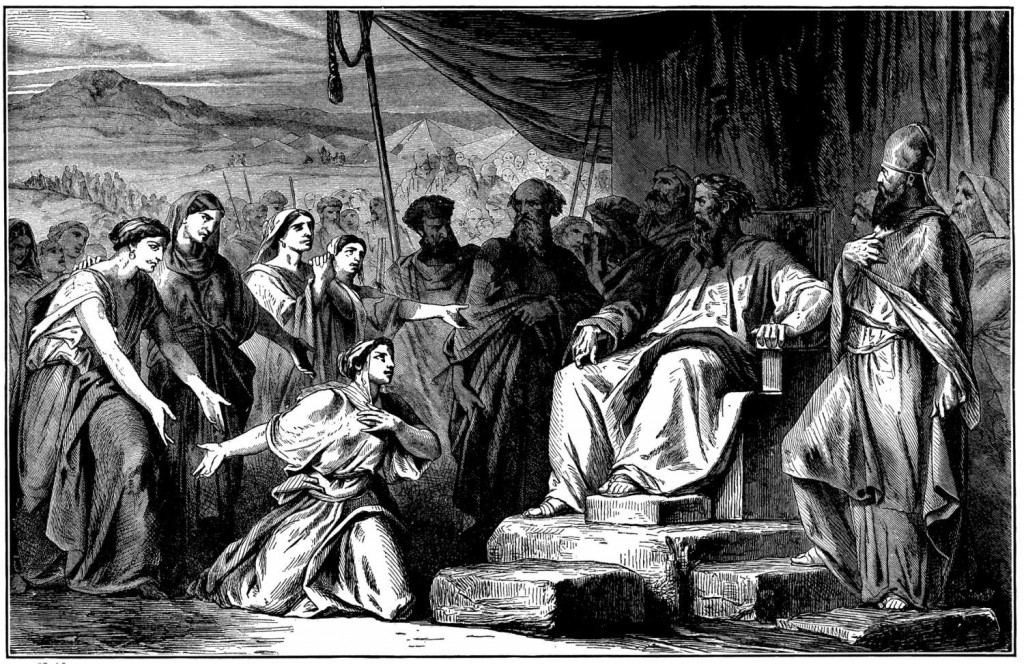
Numbers 27:1–11, The daughters of Zelophehad. A Torah Commentary For Our Times/ATCFOT (UHAC Press, NY, 1993) has an interesting discussion regarding the incident involving the daughters of Zelophehad (Num. 27:1–11) that may answer some questions that contemporary women have regarding the Torah’s view of women. “Modern commentator Jacob Milgrom contrasts ancient Israelite practices of inheritance with those of their neighbors.” He notes that the practice of equality of inheritance between sons and daughters was upheld in Egypt and Mesopotamia one thousand years before the codification of the Torah. Later on the Greeks can be added to this list of countries that practiced “equal rights.” Milgrom then asks, “In face of such ‘equality’ of treatment how then are we to explain the fact that the Bible gives women no inheritance rights except in the case where there are no sons?” Does the Torah seem to discriminate against women regarding the inheritance of land and property from the estates of their parents, he asks? (p. 80).
309567

“Milgrom suggest that in contrast to ancient Israel’s neighbors…where ‘centralized urban societies’ already existed, the early Torah laws of the Israelites reflect a nomadic-clan structure. In such a society ‘the foremost goal of its legal system was the preservation of the clan.’ Equity between members of the tribe or family preserves peaceful relationships and strengthens cooperation between all person.” He goes on to say that this explains the justness of the pleas of the daughters of Zelophehad where the principle of upholding the clan is preserved. The Torah sees that the daughters receive their father’s inheritance and at the same time that the clan and father’s name are preserved. (Ibid.)

This solution does not promote equal rights, as we know it today, with sons regarding inheritance. Both the Torah and Talmud teach that in most cases inheritance of property is from father to son and that women share the lot of their husbands and do not inherit from their fathers (Ibid., quoting from JPS Commentary: Numbers, pp. 482–484).

The Jewish rabbis further note that though the daughters aired their complaints about what they perceived to be an unjust situation, they nonetheless did so in a respectful and organized (not rebellious, loud, boisterous or aggressive) manner. They calmly “drew near” and “stood before Moses,” the high priest and the tribal princes of Israel (verses 1-2) and Continue reading →


Congregation Elim Shabbat Services 7-4-15

Congregation Elim is Hoshana Rabbah Biblial Discipleship Resources’ local congregation in the Portland, Oregon, USA area that meets on the Sabbath (Shabbat). Included in this video is praise and worship, testimonies and prayer, and biblcial teachings and discussion.


New Video: 19 Tips to Surviving Evil’s Onslaught Against Us in the End Times

The world and the devil are in an all out battle to the death against Bible believers. This was prophesied to occur in the last days before the second coming of Yeshua the Messiah. This video gives tips on how to survive this onslaught of evil against the saints of YHVH Elohim.


Are you harassing the Midianites in your life?

Numbers 25:17, Harass … and smite them. Midian is symbolic of the immoral pleasures of the society that surrounds the people of YHVH and that will subvert and overtake the righteous if left unchecked. YHVH commanded Israel to constantly harass and attack the Midianites for their subversion of Israel sexually.

The best defense is a strong offense.

As The ArtScroll Stone Edition Chumash points out, harassing the Midianites was to be an on-going state of mind (p. 877).

Likewise, fighting the sin that would attempt to gain entrance into our lives must be a constant state of mind. YHVH commanded Israel to harass the Midianites and then to smite them. When sin arises, because our offensive and defensive positions against sin are secure, we will be ready to smite the sin that dogs us.

What are you (especially you men) doing to combat the sexual enticements of the surrounding wicked and perverse generation? What do you watch on television or view on the internet? Do you listen to sexually suggestive or downright immoral music? Are your conversations with your friends and coworkers always clean and pure? Do you allow your eyes ever to see anything that is sexually explicit? Do you vigorously and aggressively confront it for the evil that it is and take a stand against it both in your heart and mind and do so openly?

As YHVH commanded Israel to view Midian as the enemy because of their lust for immoral pleasure, so we must despise the world around us as our enemy in this regard for its debauchery and idolatry. (Read 1 Cor 10:3–5.)

In reality, we need to come to hate and despise sin at all times (as does YHVH) rather than to toy with it. (See Pss 45:7; 97:10; 101:3; 119:104 ; Prov 8:13; Amos 5:15; Rom 12:9 cp. Ps 34:4;Heb 1:9.)


New Video: 19 Tips on How to Walk in YHVH’s Presence Continually

It’s time to break YHVH out of the religious boxes we’ve confined him to and make him a part of our daily lives continually. In so doing, we’ll experience his Presnece and life-giving spiritual river of life. Here are some practical steps how to accomplish this.


Resist Sexual Temptation Successfully By Setting Boundaries

Numbers 25:1, Commit whoredoms. Sexual immorality is the downfall of many who consider themselves to be strong and righteous, and there is a terrible price to pay for it as the Israelites found out.

Sex, having 20464412

The enemy (the world, the flesh and the devil) knows our weaknesses and will do what its most to capitalize on them for our destruction. Romans 13:14 says, “But put on the Master Yeshua Messiah, and make not provision for the flesh, to fulfill the lusts thereof.”

What doors of immorality have you kept open in your life to gratify the immoral cravings of the flesh? What spiritual stronghold exists in your life that the enemy can use to keep you under its thumb and from walking in the joy and freedom of the will of YHVH? It is time to cry out to YHVH for help and deliverance and to repent.

Setting immovable boundaries in one’s heart ahead of time is a major key to resisting sexual temptation successfully. It’s important to decide how far we can go without violating the spiritual guidelines the Scriptures lay out for us to stay righteous sexually, and then not allow ourself too get too close to those limits.

If you find yourself in a potentially compromising situation, flee that situation to alleviate the possibility of falling prey to moral compromise (2 Tim 2:22). Young people who are endowed with strong sexual urges need to bathe their minds in the godly admonitions found in Proverbs chapters one through nine (also note Eccl 11:9–10 and 12:1–14).

Learning the ways of wisdom and the fear of Elohim as revealed in these chapters in Proverbs is a vital component to staying strong morally and being triumphant over the wicked temptations of the world, the flesh and the devil.


Blog Scripture Readings for 7-5 Through 7-11-15

Aside

THIS WEEK’S SCRIPTURE READINGS FOR STUDY AND DISCUSSION:

Parashat Pinchas — Numbers 25:10 – 30:1 (29:40)* 
Haftarah — 1 Kings 18:46 – 19:21 | Jeremiah 1:1 – 2:3**
Prophets — Ezekiel 16:1 – 20:49
Writings —Ezra 1:1 – 7:28
Testimony — 2 Corinthians 2:1 – 8:24

Most of this week’s blog discussion points will be on these passages. If you have general comments or questions on the weekly Scripture readings not addressed in a blog post, here’s a place for you to post those. Just use the “leave a reply” link below.

The full “Read Through The Scriptures In A Year” schedule, broken down by each day, can be found on the right sidebar under “Helpful Links.” There are 4 sections of scripture to read each day. One each from the Torah, the Prophets, the Writings, and from the Testimony of Yeshua. Each week, the Torah and haftarah readings will follow the traditional one-year reading cycle.

* Verse numbers in parenthesis refer to the verse number in Christian Bibles when it differs from the Hebrew Bible or Tanakh.

** A different Haftarah is read when it is a special sabbath in Jewish tradition. This week is the Parasha following Tzom Tamm*z.

Weekly Blog Scripture Readings for 7/5 through 7/11/15.