


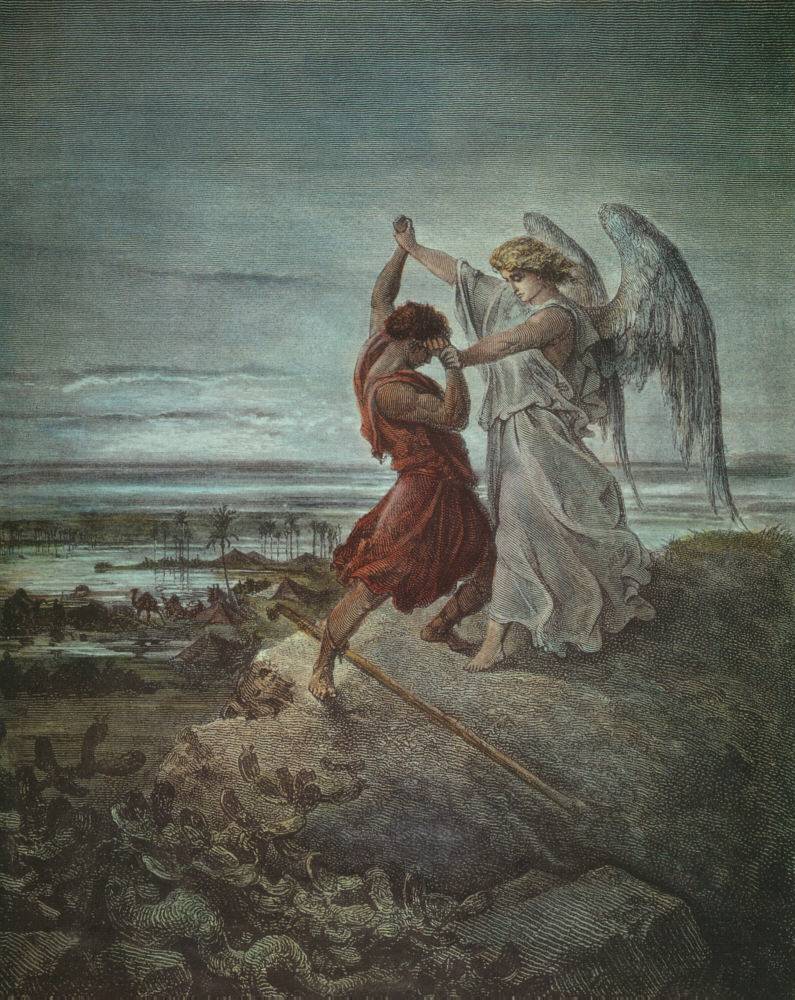
Genesis 32:24, Wrestled with him. Why did Elohim wrestle all night with Jacob? Why not just wound him early on and save the time and trouble?
What does this teach us about the long-suffering nature of Elohim who will continue to strive with us and our fleshy tendencies and self-reliances until we finally submit to him and recognize that only through him can we have real strength and victory, though we might end up physically lame in the process?
Why the wrestling all night “till the breaking of the day”? What does night and breaking of day represent metaphorically with regard to our spiritual walk? What does this teach us about faith, the struggles of this life and about not giving up until the very end when the blessings and dawning of a new day are about to break forth?
At the end of his struggle, Jacob received the new name of Israel (verse 28). Through this struggle, he took a quantum leap spiritually and became a new man with a new identity.
Has this ever happened to you? Don’t we progress spiritually only out of crisis? “There is no gain where there is no pain,” as the saying goes.
What were the results of Jacob’s struggle? Verse 32 says of Jacob, “as he passed over Penuel the sun rose upon him, and he limped upon his thigh.” Penuel means “faces of El.” Taking a little poetic license (at the drash, allegorical or third level of Hebraic biblical interpretation) here, we could paraphrase this verse as follows: “As Jacob emerged out of the darkness of self-reliance, the face of Elohim shined favorably upon him as he no longer relied on the flesh.” Pause to reflect on this for a moment and take quick stock of your spiritual walk in the light of these words.
Who are some other notable Biblical characters besides Jacob who struggled with trying to achieve their divine mission through human means? How about Abraham with Hagar, Moses when he murdered the Egyptian, Samson, or Peter when he cut off the ear of the high priest’s servant? Can you think of some others? What did these men learn about walking in the Spirit versus walking in the flesh?

Mark 5:1–20, The Gadarene demoniac. This encounter between Yeshua and this demon-possessed individual teaches us about the characteristics of one who is tormented or even possessed by an evil, unclean spirit.
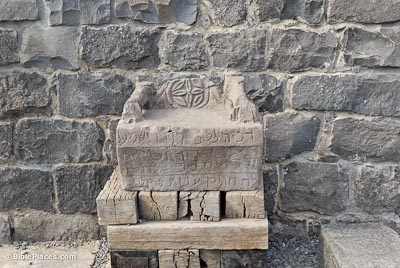
The seat of Moses in the Chorazin in Israel (bibleplaces.com/chorazin/)
Yesterday, a well-meaning reader of this blog posted a question in the comments section. He wondered why I didn’t come to the “higher level” spiritually by following the oral traditions of the modern-day Jews who are the spiritual descendants of the ancient Pharisees of Yeshua’s day. As supposed proof that we should, he quoted Matthew 23:2 and 3 where Yeshua declares that because the Pharisees sit in Moses’ seat, we will come to a higher level in our spiritual walk do whatever they tell us to do. (My short answer to this questions is this: If they haven’t discovered the most obvious truth that Yeshua is the Messiah, then…well, I’ll let you guess what the rest of my response would be.)
This is, in fact, a fair question, and is one that many who are leaving churchianity find themselves asking when they begin to explore the Hebraic roots of their faith.
Here is my long response.
Matthew 23:2, Moses seat. Here Yeshua is speaking against the leaven of the Pharisees and their non-biblical traditions and doctrines of men. They had omitted the weightier matters of the Torah. Moses’ seat in Matt 23:2 is easily misunderstood today when we don’t have all the facts. Because the Pharisees sit in Moses seat, Yeshua told his disciples to observe whatever they tell you to observe. The problem is that most people have no idea what Yeshua was really saying here. “Moses’ seat” was a colloquial expression that was understood by his listeners of that day, but the meaning is lost to most who read this passage today. Moses’ seat refers to a literal throne-like chair that sat in Jewish synagogues (where the Pharisees were the officiants) from which the religious leaders would make judgments concerning spiritual and civil matters. (One can type in “Moses’ seat” into an internet search engine and find actual photos of these seats that have discovered in ancient Jewish synagogues.) In a modern church, it would be like the pastors and board of elders making decisions for the church body they minister over. These leaders do not have the authority, however, to change the word or law of Elohim—only to administer it. Even the pope has a throne from which he makes rulings for the Roman Catholic Church.
Matthew 23:3, Whatever they tell you. The discussion that follows is in response to the idea that because the Pharisees (and the modern rabbinic Jews who are their spiritual descendants) sit in Moses’ seat, we should do whatever they tell us to do including following their traditions and oral law. Some even have embraced the idea that following rabbinic Judaism is to walk a higher spiritual road (because they ostensibly understand and observe the Torah. What is the truth of the matter and what is Yeshua really saying in this passage?
Admittedly, there is much we can learn from our Jewish brothers. If you have read my Torah study guides and commentaries and my hundreds of teachings, you would know that I draw heavily from the wisdom of the Jewish sages. My approach is very multi-faceted and my learning is very broad. In my mind, and in the mind of Yeshua and apostles (as we shall point out below) the sun does not rise and set on the Jewish sages. Moreover, the Judaism of today is not that of Yeshua’s era. It is true that the rabbinates of today are the direct Continue reading
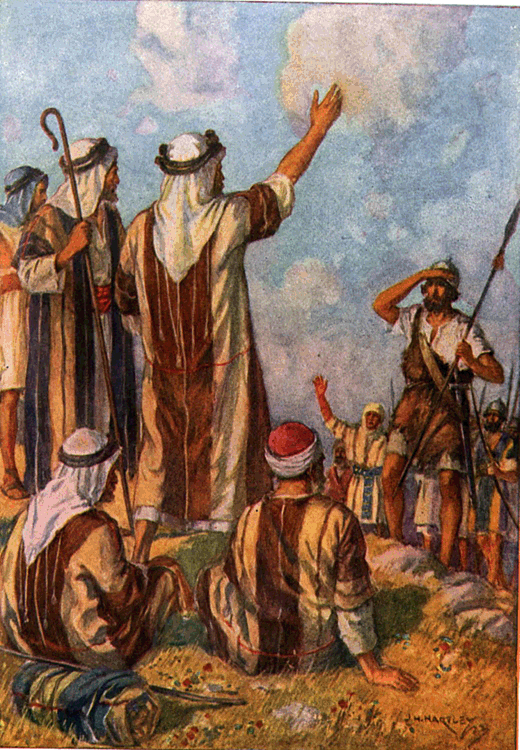
Genesis 32 is the story of Jacob’s return to Canaan after having been exiled from his homeland for 20 years. His exile occurred after he obtained his divinely promised birthright through shrewd if not unscrupulous means from his brother Esau resulting in his having to flee Canaan for fear of his life due to Esau’s vengeance. Jacob found refuge in the region of Babylonia at his Uncle Laban’s home where he married Laban’s two daughters, Leah and Rachel. Eventually, Jacob had to flee Babylon with Laban in angry pursuit. As Jacob and his family are returning to Canann, they encounter Jacob’s brother Esau who, along with his small army, physically stood in Jacob’s way from entering the land of his promised inheritance and wanted to kill Jacob.
This account is not only the story of Jacob’s personal, spiritual struggles, but it also has end times prophetic implications relating to the regathering out of exile of the twelve tribes of Israel (the Jews and the Christians) and their return to their Promised Land in Israel under Yeshua their Messiah at his second coming. The Scriptures refer to this as Jacob’s Trouble (see Jer 30:7).
The Jewish sages believe that the encounter between Jacob and Esau (no doubt informed by Jeremiah’s prophecy) is prophetic in nature and will happen again in the end times, but this time on a much larger scale and this time involving the numerous descendants of Israel and Esau. The end-times Continue reading
The use of trees or wooden poles as an object of worship in the ancient world was universal as a fertility or phallic symbol. In many places, the Bible strongly condemns involvement with this pagan custom. Obviously the tree of Jeremiah 10:1–5 is not the modern “Christmas tree” as we know it, since Christmas wasn’t invented by the Christians until about the late fifth century AD. However, the decorated tree is a pagan symbol as evidenced by history, which is why it was outlawed by the Puritans and many other religious groups in America in the 1700s. It was not until the 1850s with many Germans migrating to America with their Christmas tree tradition that Christmas became popularized again in this country.
The Scriptures advise us to abstain from all appearances of evil (1 Thess 5:22). At the very least, because of its pagan connotation, a Christmas tree is an appearance of evil. Furthermore, where in the Bible do we find any examples of YHVH’s people reclaiming a pagan tradition, sanitizing it, and then practicing it? This occurred only when Israel was in a state of apostasy or was attempting to syncretize the religion of the Bible with the pagan practices of the surrounding nations.
True, many things in our daily lives have been tainted by paganism. If we were to toss out everything that fits that category, we probably wouldn’t be able to say anything, wear anything, eat anything, or do anything. Some of us would even have to change our names! What we are to throw out are those things that the Bible forbids, anything that is indigenously pagan, or anything that leads us away from YHVH and his Word.
Often our view of the Scriptures is filtered through our emotions. We all struggle with this spiritual disease. When we’re extremely partial to a belief or an idea, we have a hard time conforming our lives to those biblical scriptures that disagree with us. Thus, we have a spiritual blind spot. For many, Christmas has become a spiritual blind spot because it is so ingrained in our families and the culture around us. It is perhaps the hardest thing for people to let go of because of family and emotional ties. Each of us has to make the choice: Do we love the praises of family or the praises of Elohim more (John 12:43)?
Jeremiah 10:1–5 is the perfect description of what has come to be known as a Christmas tree. Continue reading