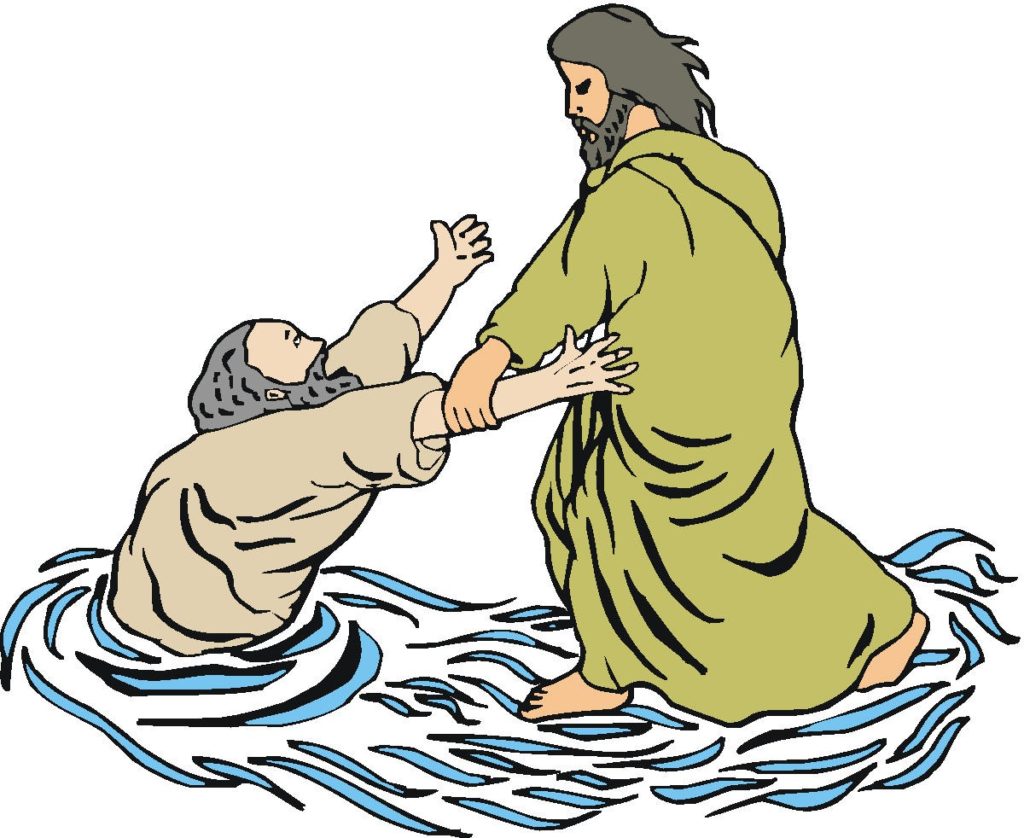
John 14:12, Greater works. Works is the Greek word ergon, and is the generic word meaning “deeds, acts, business, employment, or occupation,” and isn’t confined to just miraculous deeds. Throughout his ministry, Yeshua did many great works. He occupied each of the five-fold ministry offices (apostle, prophet, evangelist, shepherd and teacher, Eph 4:11), and performed all nine gifts of the Set-Apart Spirit (wisdom, knowledge faith, healing, miracles, prophecy, discerning of spirits, tongues and interpretation of tongues) were at his disposal if and when he needed them.
What are the greater works that his disciples and those who would follow in their footsteps down through the ages would do?
Yeshua has now distributed his ministry offices and the gifts of the Spirit throughout his entire spiritual body (1 Cor 12:7–11; Eph 4:7–11) to be used as the Set-Apart Spirit leads. Collectively, down through the ages, the saints have done theses same works—both miraculous and non-miraculous—that he did and greater. Yeshua made this promise to his disciples collectively, and that includes you and me. Moreover, this promise of Yeshua gives no indication that only one person would do all the mighty spiritual works that he did. He is unique in that he performed all them.
Also consider this. What were the greatest works Yeshua did during his earthly ministry? When answering this question, many people would instinctively and immediately think of the many miracles Yeshua performed. But these were not his greatest works. He declared that an evil and adulterous generation focuses on miracles (Matt 12:39). His mission was to call the lost sheep of the house of Israel to repentance from sin and to bring them into the kingdom of his Father in heaven (Matt 15:10; 4:17). When a sinner repents heaven rejoices (Luke 15:7). This is not said of miracles being performed on earth by the hands of YHVH’s servants. Therefore, it seems that the greatest work (or miracle) Yeshua did was to bring sinners to repentance. If Yeshua’s disciples are doing this, these are the greater works that he spoke of that would be done.
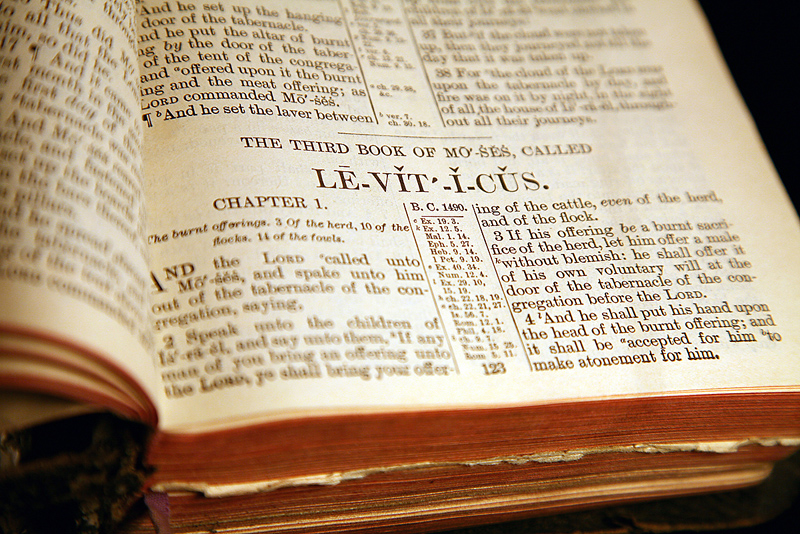
Leviticus is divided into to several main parts. Chapters one to 16 deal with laws of sacrifice and purification. In the second section (chapters 17–25), Elohim sets forth his demands for holy living that his people might maintain a right relationship with him. Chapter 26 lays out the blessings and curses for obedience to YHVH’s commands. The final chapter of the book ends with some miscellaneous laws. The following is an overview of Leviticus chapter-by-chapter.
The five main offerings (Lev 1–7)
The ordination of priests (Lev 6:8–7:38)
Laws of cleanliness (food, childbirth, diseases, etc.) (Lev 11–15)
Day of Atonement (Lev 16–17)
Moral laws regulating relationships between humans (Lev 18–20)
Regulations for priests, the offerings of the annual feasts (Lev 21:1–24:9)
Punishment for blasphemy, murder, etc. (Lev 24:10–23)
The Sabbatical year, Jubilee, land laws, slavery (Lev 25)
Blessings and curses (Lev 26)
Regulations pertaining to vows made to YHVH (Lev 27)
Themes and Main Points of Leviticus
Leviticus stands at the center of the Torah, and there’s a reason for this, since it shows man how to come into relationship with Elohim by addressing the sin issue and showing man the upward path of holiness and righteousness.
Holiness (or being set-apart) is the key theme of Leviticus. This includes the set-apartness of YHVH and the need for man to become set-apart as well if he is to come into a relationship with the Almighty (Heb. kadosh, Lev 11:44). Leviticus lays out the terms are laid out by which an unholy, profane, polluted or sinful people can come into a spiritual and even contractual and marital relationship with their holy, morally pure and sinless Creator. It also delineates the terms of the contract including penalties for its violation and blessings for adherence to it.
Leviticus carries on to completion the giving of the Torah-law, which started in Exodus 20, and which firmly established the Torah as Israel’s binding covenant with Elohim and the legally binding document that would govern that nation. The Torah literally became the nation of Israel’s constitution.
This book, for the first time in detail, shows man the way of expiation (or atonement) and forgiveness of sin, thus prophetically pointing the way in major detail to Yeshua the Messiah, the Lamb of Elohim, who was yet to come and who would ultimately take away men’s sin once and for all (without the continual need of animal sacrifices) by his sacrificial death on the cross.
The narrative of Leviticus covered probably only a month.
Leviticus is the first book of Torah that rabbinic Jews start teaching their young children, since they believe that those who are pure in heart (i.e. children) should be engaged in the study of purity (i.e. the laws of purification and atonement, which is the central themes of Leviticus).
Even today, Leviticus remains the foundation for Jewish life, since it includes the laws pertaining to diet, the biblical feasts, sex, marriage, family purity, and our relationship with our fellow man.
The emphasis the modern rabbinic Jews place on Leviticus is evidenced by the fact that the tabernacle service found in this book is at the heart of the modern Jewish synagogue prayer service, and forms the basis for their daily devotions. Jewish liturgical prayer is largely based on the tabernacle sacrificial system as outlined in Leviticus.
The offerings and other ceremonies revealed in Leviticus serve to show the holiness of YHVH.
Leviticus teaches us that YHVH can only be approached through proper and prescribed protocols.
In Leviticus, spiritual set-apartness (holiness) is symbolized by physical perfection. All blemishes or defects symbolize man’s spiritual defects, which break his spiritual wholeness. Therefore, the religious system in Leviticus required:
Perfect animals for sacrifices (Lev 1–7).
Priests without physical deformity (Lev 8–10).
A woman to be ritually purified from hemorrhaging after childbirth (Lev 12).
Ritual purification from sores, burns, baldness (Lev 13–14).
Ritual purification from a man’s bodily discharges (Lev 15:1–18).
Ritual purification after a woman’s menstrual cycle (Lev 15:19–33).
All of these ritualistic requirements point to one thing: the holiness of Elohim and man’s need to put off sin and the defilement of the flesh, which causes pollution and profaneness, thus separating us from a set-apart, pure and perfect Elohim. This teaches man to strive to reach higher spiritual levels and not to be content with the mundane, fleshly, earthly level of his own human existence, but to reach for the heavens where Elohim abides.
Leviticus reveals that those with certain diseases or ailments had to leave the camp (symbolic of leaving YHVH’s Presence—like Adam and Eve leaving the Garden of Eden after they had sinned). Israelites could be readmitted to the camp (symbolic of returning to YHVH’s Presence) only after certain protocols had been performed and the person had been pronounced whole by the priests.
In Exodus 19:6, YHVH’s call for Israel to become a kingdom of priests. As such, they were to be a light to the nations and, in a sense, to evangelize the world by showing Elohim’s glory to those nations around them (Deut 4:4–8). Israel was to be YHVH earthly representation of YHVH’s kingdom on earth. Leviticus showed Israel how to walk in a set-apart (kadosh or holy) manner before YHVH and the world—how to be in the world, though not of the world, as Yeshua taught his disciples in John 17:11, 14.
All Was Overseen by the Priests
The priests oversaw and controlled the sacrifices, rituals, ceremonies, the rest of the tabernacle service as well as the day-to-day life of the Israelites.
It was their job to establish Israel as a kadosh nation, and to instruct Israel in spiritual cleanliness and set-apartness (holiness), to preserve them spiritually, and to present them to YHVH as a pure and righteous people. YHVH has given the same responsibility to the five-fold ministry that he has raised up to operate within the spiritual body of redeemed believers today (Eph 4:11–16). This new, royal priesthood (1 Pet 2:9) is comprised of apostles, prophets, evangelists, pastors and teachers who have the purpose of “equipping of the saints for the work of ministry, for the edifying of the body of Messiah, till we all come to the unity of the faith and of the knowledge of the Son of Elohim, to a perfect man, to the measure of the stature of the fullness of Messiah” (Eph 4:12–13).
Holiness—The Dominant Theme of Leviticus and the Bible
But as many as received Him, to them He gave the right to become children of Elohim, to those who believe in His name… (John 1:12)
Behold what manner of love the Father has bestowed on us, that we should be called children of Elohim! Therefore the world does not know us, because it did not know Him. Beloved, now we are children of Elohim; and it has not yet been revealed what we shall be, but we know that when He is revealed, we shall be like Him, for we shall see Him as He is. (1 John 3:1–2)
Passover is just around the corner. It is the first step in YHVH Elohim’s plan of salvation or redemption of sinful humans to reconcile fallen man back to him. Did you ever wonder how this process really works?
Let’s now look at this miraculous process of how to overcome sin in more detail through a spiritual magnifying glass. How do we go from being a lost sinner—the walking damned or the living dead—to becoming the glorified and immortalized children of Elohim?
It works like this: When we confess and repent of our sins, Yeshua will pass over or forgive us of our past sins (Rom 3:25); Ps 103:8–12). From this point onward, we must embrace a new mindset and a new spiritual identity and reality; that is, we must reckon our old sinful man as being crucified with Yeshua, in that we are now dead to sin, no longer slaves to sin, freed from the power of sin, and alive to Elohim in Yeshua our Lord (Rom 6:7–11). Yeshua is the one who victoriously defeated the power or sting of sin, which is death, hell and the grave at the cross and through his resurrection (1 Cor 15:56–57; Col 2:13–15). Through our faith in him and our legal identification with his death, burial and resurrection through the metaphorical ritual of baptism, his victory is legally applied to us by the courts of heaven, which is how he has made us more than conquerors over sin and death (Rom 8:37; 6:1–14) such that the power of sin and death will no longer have dominion over us (Rom 6:12–14). He now gives us strength through his enabling and empowering grace to resist and overcome sin, that is, to not let sin control us any longer (Rom 6:12). He promises to give us a new, circumcised heart as he writes his laws or commandments on our hearts, so that we will be supernaturally inclined to love him by keeping his commandments (Jer 31:33; 24:7; Heb 8:10; 10:16; Ezek 36:25–27; Isa 51:7; Ps 40:8; 37:31; Deut 30:6; John 14:12 cp. Rom 7:22). What is that supernatural power that works in us to help keep us from sinning? It the Spirit of Elohim or the Comforter that Yeshua promised would come along side of us to aid us in the process of overcoming sin (John 14:16–18, 25–26; 15:26–27; 16:7–14).
To summarize, this whole supernatural and miraculous process of being victorious over sin is activated when we first acknowledge our sin, confess our sin, repent of our sin and then place our faith in Yeshua’s death and burial. This occurs when we appropriate or reckon, by faith, our old sinful man to have been crucified with Yeshua, and then been resurrected in the newness of spiritual life with him. We now embrace the new identity that he has given us—a spiritual reality that he has imparted to us and has been legally recorded in heaven (Col 2:14)—that we are a new creation and are victorious over sin (Gal 2:20; 2 Cor 5:17), and have become Spirit-begotten sons of Elohim. This whole process is summarized from beginning to end in Romans chapters six through eight. The end result, if we continue in a right spiritual relationship with Yeshua the Messiah for the rest of our lives, is that our names will be recorded in Elohim’s Book of Life, and our physical bodies will be glorified—we will be given immortality—at the resurrection, which occurs at the second coming of Yeshua.
This whole process or chain of events that transforms sinful humans into glorified and immortal children of Elohim begins at Passover which symbolizes the first steps a person takes when he comes to faith in Yeshua the Messiah.
Passover is just around the corner—in a couple of weeks. Here’s a checklist to help you prepare for this festival that YHVH commanded his people to celebrate, and which Yeshua, the apostles and early church also celebrated, and which will be celebrated in the Millennium.
Repent of Sin and Get Under the Lamb’s Blood. As the children of Israel applied the lamb’s blood to the door posts and lintels of their house, so we must apply the sin-cleansing and Satan-defeating blood of Yeshua afresh to our lives (i.e. to our thoughts as represented by the door lintel and and to our hands or actions as represented by the door posts). This occurs as we repent of our sins, and pray for and receive YHVH’s forgiveness. He will then cover our sins over or wash away our sins by Yeshua’s blood (1 John 1:9; Rev 1:5).
In Egypt at Passover time, YHVH judged all those who had failed to put the lamb’s blood on the door posts of their houses. In other words, they weren’t under the blood of the lamb, but were still under the penalty of sin, which is death (Ezek 18:4; Rom 6:23). Any unrepented of sin in our lives brings the curse of death on us. To the degree that one has sin in their life is the degree to which the spirit of death has a legal claim on us. Now is the time to repent of sin by confessing it and seeking Elohim’s forgiveness under the blood of Yeshua and then forsaking that sin through YHVH’s grace (1 John 1:9).
Here are some things of which to repent.
Pride. Do you always think that you’re right? Your opinion is what matters the most? Do you have a hard time with those who don’t see it your way, when you don’t get your way? Do you have a fit when people disagree with you? Do you criticize others and put others down (especially those who are closest to you)? Do you belittle, mock, scorn and ridicule others? Do you focus on other people’s faults? Do you have a hard time identifying any sins that you have committed? Are you proud of your humility? Are you proud of how Torah-observant you are (compared to others)? Are you overly defensive when someone corrects you or challenges your opinion? Do you blame others when things don’t go right instead of taking personal responsibility for your actions? Are you proud of (instead of grateful to YHVH for) your achievements in life? Do you constantly have to be talking about yourself? Is much of what you do, say and think focused on yourself? These are all signs of pride. Pride is self-idolization. Elohim hates pride and calls it an abomination (Prov 6:16–17).
Ungratefulness and selfishness. Are you ungrateful? Are you discontent about your place in life? Do you always want more? Are your material possessions and personal belongings really important to you? Do you have a hard time giving things away? This is a form of self-idolatry, pride and idolization of things.
The love of this world over love of YHVH and the things that matter to him. This is a form of idolatry. In this case, we’re concerned with what others think more than what Elohim thinks about things. Therefore, our thoughts and actions are geared at trying to please ourself and others instead of pleasing Elohim (Jas 4:4; 1 John 2:15).
Sins of the mouth include mean, selfish, unkind, angry, impatient, egotistical words and gossip. This is idolization of self. What matters most is what I have to say, how I feel, my opinions and I have the right to say what I want when I want. This is also pride.
The lack of the fear of Elohim. Are you more concerned with what others think than what YHVH Elohim thinks about something? Anything in our lives that we put ahead of Elohim is idolatry.
Ask yourself this: In everything that I do and say, am I advancing the kingdom of Elohim and bringing glory to Yeshua or am I doing the opposite? Am I being a river of life to all those around me, or am I dragging them downward by being a purveyor of negativity and darkness? Are my words, thoughts and deeds leading people to the light of YHVH Elohim and to Yeshua or away from them?
Tell the Redemption Story. It is the responsibility of parents and elders to pass on to the next generation the Passover story (Exod 12:24–27). Explain how the Israelites were enslaved in Egypt (a metaphor for the world), to Pharaoh (a metaphor for Satan), and how YHVH delivered the Israelites from the judgment of the destroyer (YHVH’s judgment against sin) because they put the blood of the lamb on their doorposts (a picture of Yeshua’s sin-atoning death on the cross). In reality, this is the basic gospel message. This is what the Passover seder is all about and why we celebrate it.
Celebrate the Feasts. Prepare your heart and mind to obey YHVH by keeping his appointed times of Passover and Unleavened Bread. Are you willing to obey his commands pertaining to these observances? How much do you love him (John 14:15)? How much do you want to know him (1 John 2:6–7)? Celebrating YHVH’s feasts help us to love him and to know him better.
Examine Yourself. At this time of the year, we must each examine ourselves to insure that we will not be partaking of the cup of redemption (i.e. the communion cup) unworthily (1 Cor 11:28).
Rediscover the Cross. It is time to rediscover the cross of Yeshua again and your place at its foot. It is also time to rediscover the power of the resurrected Yeshua in one’s life. Marvel at the miracle of the resurrection and consider the fact that you have access to Yeshua’s resurrected life through faith in him and through the work of his Set-Apart Spirit as you obey the Word of Elohim.
A Time of Spiritual Awakening and New Beginnings. Passover occurs in the spring at the beginning of the biblical year. Spring is a time of new beginnings physically and spiritually. It’s the time of year to take stock of one’s life, assess any weaknesses and deficiencies you have, and then resolve to make the necessary changes. It is the time to make improvements through the power of YHVH’s grace, his Word, his Spirit all through a vibrant, daily relationship with Yeshua our Master and Savior.
The Season for Spiritual Housecleaning. It’s Time to Deleaven. Passover is time of spring cleaning and deleavening our physical houses (Exod 12:15–20) and removing the leaven of sin from our spiritual houses as well (Pss 26:2; 139:1, 23–24). We must root out and eradicate the old sin habits from the crevices and dark areas of our life. In Scripture, leavening represents sin, pride, hypocrisy and false doctrine. Do the sinful practices, evil habits and illicit delicacies of Egypt still hold sway on us? Do any unclean spirits or filthy habits still have control over us? It is time to take control of these sins and eliminate them and become wholly consecrated unto YHVH-Yeshua, his Word, his plans and purposes. It is time to seek first his kingdom and his righteousness (Matt 6:33). One can’t serve two masters at the same time (i.e. the world and the flesh) and expect to be pleasing to YHVH (Matt 6:24). It’s time to forsake all these things that drag us down spiritually and pull us away from our Father in heaven. It’s time to move onward and upward spiritually!
Time to Renew Our First Love For Yeshua. Take this time to rediscover the glorious beauty of Yeshua our Heavenly Bridegroom (Rev 2:4–5). Now is the time to rekindle our passion and zeal for Yeshua and to repent of spiritual lukewarmness (Rev 3:15–21).
Our new annual Scripture Reading Schedule for 2019-2020 with daily readings is available to download and print. If you are still working through 2018-2019’s Scripture Reading Schedule, the link will still be available on the right sidebar under “Helpful Links”. If you are using a mobile device or tablet, the link may be below, meaning you’ll need to scroll down instead.
Most of this week’s blog discussion points will be on these passages. If you have general comments or questions on the weekly Scripture readings not addressed in a blog post, here’s a place for you to post those. Just use the “leave a reply” link or the “share your thoughts” box below.
The full “Read Through The Scriptures In A Year” schedule, broken down by each day, can be found on the right sidebar under “Helpful Links.” There are 4 sections of scripture to read each day: one each from the Torah, the Prophets, the Writings, and from the Testimony of Yeshua. Each week, the Torah and haftarah readings will follow the traditional one-year reading cycle.
* Verse numbers in parenthesis refer to the verse number in Christian English Bibles when they differ from Hebrew Bibles or the Tanakh.
Weekly Blog Scripture Readings for 3/22 through 3/28/2020.
Although the world around us is in a mess in so many ways, the sun is still rising and setting, the seasons are still turning round, spring is still bursting forth with new life, the flowers are still blooming and the birds are still singing. This means that the Creator is still on his throne. HalleluYah!
Exodus 40:1,You set up the tabernacle. This verse implies that Moses set up the tabernacle single-handedly without any help. To what does this point prophetically? (Read Hebrews 3:3–6.)
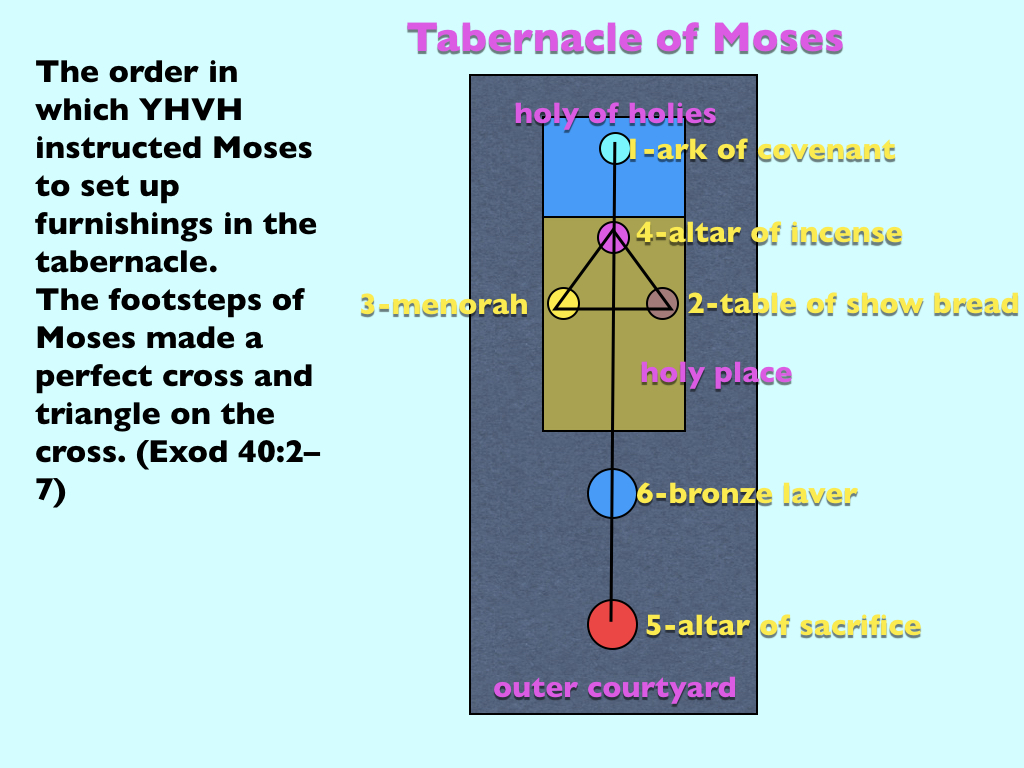
Exodus 40:2–7,Set up the tabernacle. YHVH’s instructions to Moses to set up the furnishings in the tabernacle followed a particular order. In fact, if one traces Moses’s footsteps in doing so, it forms an interesting geometric pattern that is highly significant spiritually. Let’s explore this.
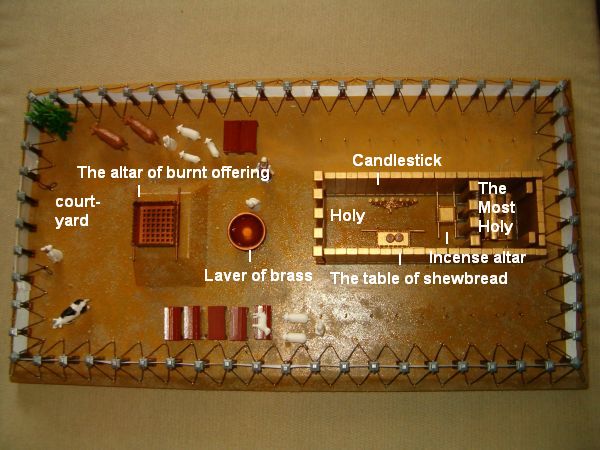
In placing the furnishings in the tabernacle, Moses first started in the holy of holies where he set up the ark of the covenant. After this, he went into the holy place and over to the right side where he set up the table of show bread. He then moved across to the left side of the holy place and set up the menorah. Next, he moved to the center of the holy place in front of the curtain or veil separating the holy place from the holy of holies where he set up the altar of incense. After this, Moses made a straight line and exited out of the tabernacle itself into the outer courtyard we he set up the altar of sacrifice. Having done this, Moses then set up the bronze laver, also in the outer courtyard just in front of the door leading into the tabernacle. If you trace Moses’ steps and make a line in the dirt, what is the outline?
The outline of Moses’ movements makes a triangle on a cross with the base of the triangle forming the arm of a cross. The base of cross corresponds to the altar of sacrifice, while apex of the triangle corresponds to the altar of incense and the top of the cross, which extends past the apex of the triangle is where the testimony in the holy of holies is. Why did YHVH instruct Moses to set up the tabernacle’s furnishings in this order, and not another order? What is the spiritual significance of this particular pattern? How does it relate to you and me? Let’s unpack this.
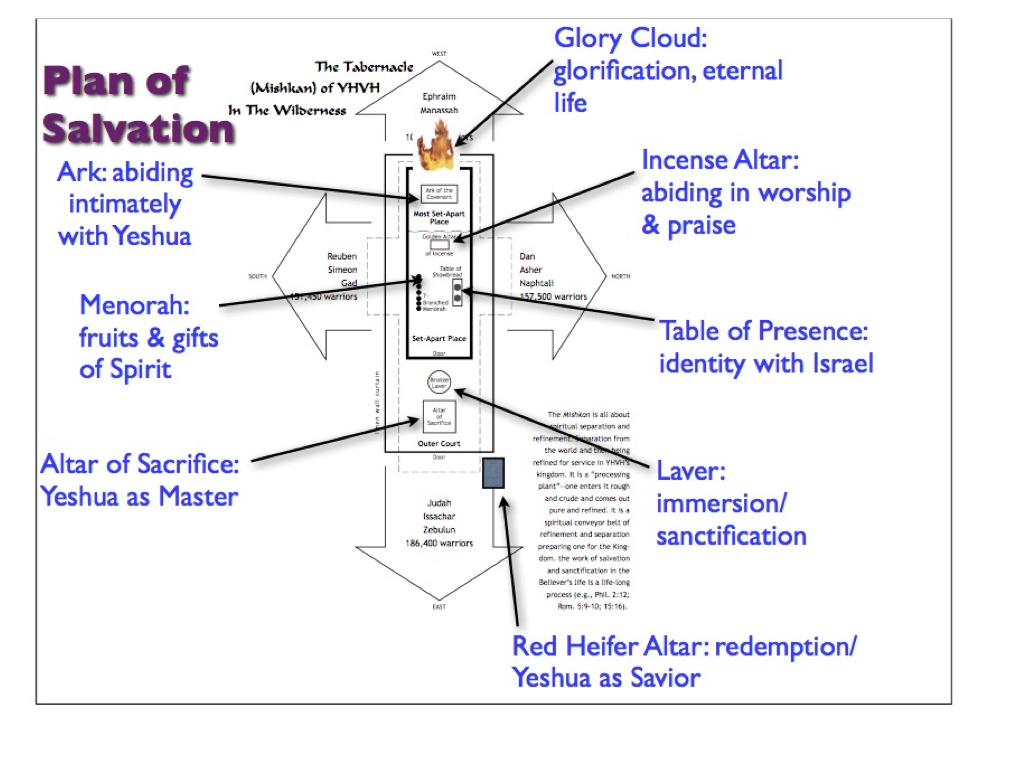
The base of this arrow is at the altar of sacrifice representing Yeshua’s death on the cross atoning for our sins. Next, the arrow points us to the bronze laver picturing a believer’s next step in his spiritual walk which is baptism for the remission of sins and legally identifying with Yeshua’s death, burial and resurrection, as well as receipt of Elohim’s Set-Apart Spirit and the washing of our lives by the water of the Word of Elohim. Next we come to the menorah picturing the Spirit of life in Yeshua the Messiah as the new believer manifests begins evidencing the fruits of the redeemed life, which is the fruits and gifts of the Spirit, which shine like a light into the dark world around us. Next we come to the table of the showbread picturing the regathering and unification of the tribes of Israel around the table of Yeshua’s body in sweet fellowship and covenantal relationship. Through the Messiah of Israel, the scattered tribes are regathered and can pray to and worship Elohim together unified at the altar of incense as they prepare to enter into the eternal kingdom of YHVH Elohim’s presence as pictured by the holy of holies under the glory cloud of YHVH himself.
The way to Elohim through Yeshua the Messiah is laid out in the Tabernacle of Moses making the outline of a cross and an arrow that points heavenward. This goes to show us that the tabernacle is, in reality, a giant gospel tract that shows sinful man the way of salvation leading to his glorification as immortal sons and daughters of YHVH Elohim, our Father in heaven.
Your way, O Elohim, is in the sanctuary; Who is so great a El as our Elohim? (Psalm 77:13)
Exodus 40:34, The glory of YHVH filled the tabernacle. The glory cloud that covered the tabernacle signaled YHVH’s approval of the work that was done. Had the Israelites not followed all of YHVH’s minute construction instructions would he have inhabited the tabernacle? Is there a lesson to be learned from this? Could YHVH’s anointing on our lives be greater if our obedience to YHVH’s instructions were greater?