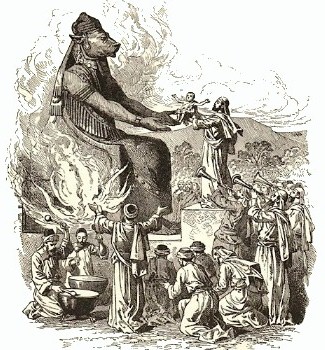
Leviticus 18:21, Pass through the fire.In the juxtapositioning of this passage directly after the Torah’s prohibition of illicit sex, it would appear that YHVH is broadcasting a clear message to his people. Extra-marital sex often results in unwanted babies. In our day, many choose to murder their unwanted offspring through abortion. In ancient times, some of these undesired children were likely sacrificed to the pagan Canaanite god Moloch by being burned alive. That is certainly the implication in this passage. Whatever the case, YHVH hates the murder of children for any reason!
This passage (along with Exod 21:22) is one of the strongest pro-life, anti-infanticide verses in the Scriptures. The penalty for those who sacrificed their children to Molech (or Moloch) was that the land of Israel would vomit the people out of it (vv. 25 and 28.) Could any clearer statement be made about how the Creator feels about the sanctity of life?
The murder of the innocent children is perhaps the greatest sin that a nation can commit. Abortion is a form of child sacrifice, which is something many ancient cultures practiced (the Aztecs, Incas, Phoenicians, pre-Islamic Arabs, and the biblical Canaanites). In the Bible, YHVH condemns the practice of heathens and apostate Israelites who made their children pass through the fire in worship of the demon-god Moloch (See Lev 18:21; 20:2–5; Deut 12:30–31; 18:10.) What judgment did YHVH place on the Jewish nation for sacrificing its children to Moloch? (See Jer 7:30–34; 32:35–36.)
The Bible, both the Tanakh (OT) and the Testimony of Yeshua (NT), promote male leadership, eldership and priesthood as normative. However, there have been times when men were not available to fulfill the plans and purposes of Elohim, so he used woman. A most notable example was Deborah who was both a prophetess and a judge in Israel (although she was most likely the wife of Barak who was a military leader in Israel, which would have made her the co-leader of Israel with her husband). Huldah was a prophetess, a judge and a counselor to kings.
The Testimony of Yeshua carries the idea of male leader into the church. In the apostolic era, the Head Leader, of course, was Yeshua himself, then there were his twelve male apostles, and then there were male elders over each congregation (1 Tim 3:1–7; Tit 1:5–9), and the head over each family was the husband and father (Eph 5:22–33).
The apostolic writings also promote the idea of the priesthood of all believers (e.g. 1 Pet 2:9; Rev 1:6). When it comes to salvation and spiritual equality, in YHVH’s eyes there is neither male or female, Jew or Gentile. All are equal and one in Messiah (Rom 10:12; Gal 3:28; Col 3:11).
However, the New Testament Scriptures record that the church was still led by male elders. Nevertheless, there are examples of husband and wife ministry teams. In Romans we see the husband and wife apostolic team of Andronicus and Junia (Rom 16:7). Another example of such a evangelistic-pastoral team was Aquila and Priscilla. They worked so closely together that sometimes Scripture mentions wife first, and sometimes the husband (Acts 18:2, 8, 26. Rom 16:3; 1 Cor 16:19; 2 Tim 4:19).
One example of a likely woman pastor is Lydia who, apparently, led a church in her home (Acts 16:40). The Bible reveals that if there is no man to do fulfill YHVH purposes, he will raise up a woman to do it. The only caveat is that to follow a biblical authority structure, she needs to be under the authority of or accountable to a male elder in some way. Lydia would have been under the eldership of Paul who led her to Yeshua and baptized her (Acts 16:14).
If a woman is leading a congregation and she is married, she should be doing so in conjunction with her husband, with his blessing. If she is not, then she is out of order spiritually. If she’s not married, then she needs to be working in conjunction with male eldership.
Leviticus 17:7, Sacrifices to demons. Sa’ar, the Hebrew word for goat, refers to the Egyptian goat gods, or goat demons that were believed to inhabit the wilderness (The ArtScroll Tanach Series Vayikra Leviticus Commentary, p. 313; Keil and Delitzsch, p. 593). In several places, the KJV and NAS translate this word as satyr (e.g. Isa 13:21; 34:14), which, in Greek and Roman mythology was associated with Pan, the half goat and half man-like creature. These demonic forces were believed to be destructive causing fear and turbulence, murder and mayhem (ibid. The ArtScroll Tanach Series Vayikra).
Interestingly, sa’ar and Se’ir as in Mount Seir, the home of Edom (Num 24:18), share the same Hebrew consonants and derive from the same root word. From this, the Jewish sages deduce that Edom, the descendents of Esau—Israel’s perpetual enemies down through the ages (even to the last days)—was the embodiment of evil (ibid.). Additionally, in occult lore, there exists a creature called Baphomet, which is represented by a horned goat’s head inside of an inverted star or pentagram. There is an ongoing debate whether this symbol goes back to the satyr or is of more recent origination. However, it is well-documented that the use of blood (in sacrificial and cannibalistic rites) and its veneration is an important aspect of Satanic rituals even into modern times. This is one reason why YHVH forbad the Israelites from eating animal blood (verse 10).
From this passage in Leviticus (and the surrounding verses), it should be clear that YHVH not only expected the Israelites to respect blood (see verse 11), but to properly dispose of it in a way that would preclude them from being tempted to engage in idolatrous and demonic rituals. In our notes under verse 11, we will see why YHVH valued the blood so highly.
Additionally, this passage teaches us several things. First, the blood carries the life force of a living being and, as such, represents life. Second, blood must be shed to atone for sin, which shows us the gravity of sin. The Bible elsewhere declares that the wages of sin is death (Rom 6:23), and the soul that sins shall die (Ezek 18:4).
Leviticus 17:10, Eats any blood.This prohibition is so serious that the Torah repeats it three other places (Lev 3:17; 7:26; 17:14), and the apostles make it one of the four requirements imposed on new Gentile converts before allowed into the fellowship of believers (Acts 15:29). This law was so serious that not only was it imposed on the children of Israel, but upon the strangers that sojourned with them as well (Lev 17:10). The penalty for doing so was basically capital punishment—to be cut off from Israel (vv. 9, 14).Why is the eating of blood so onerous in the eyes of Elohim? The context of this verse involves prohibitions against the demonic practices of the neighboring Baal-worshiping heathens. Eating and then the letting of blood was something that figured prominently in the demonic religious rituals of the heathens and is something YHVH wanted to keep his people from practicing. (For a further discussion of this, see notes on Lev 17:1–14.) In YHVH’s spiritual economy, blood was to be reserved exclusively for the atonement of sin and was to be respected as such.
The word gospel is one of the most common words in all Christendom. But what does it mean, and where does the concept originate? Most Christian believers would doubtless assume that the concept of the gospel is a New Testament one? As we shall soon see below, the term gospel (Old English for good news) originates in the Tanakh (Old Testament or OT) in the writings of the prophet Isaiah.
The word gospel itself is easily enough defined, but what about the concept behind the word? This will take us into another, deeper dimension of understanding this concept. Gospel or its synonyms are used 132 times in the Testimony of Yeshua (New Testament or NT). The word gospel literally means “good news or glad tidings.” Two Greek words (euaggellion and euaggelizo) are translated into English in the Authorized Version (KJV) via the following words: as a noun, gospel and as a verb, preach, bring good tidings, show glad tidings, declare, and declare glad tidings. As we can see, the word gospel is easily enough defined, but what really is the good news? Let us begin to answer this by seeing how the apostolic authors of the Testimony of Yeshua used this term:
Gospel of the kingdom or of Elohim (used five times, see Matt 4:23; 9:35; 24:14; Mark 1:14)
Gospel of Yeshua the Messiah or Yeshua (used 15 times, see Mark 1:1; Rom 1:16; 15:19; 1 Cor 9:12; Gal 1:7; Phil 1:27; 1 Thess 3:2)
Gospel of the grace of Elohim (Acts 20:24)
Gospel of Elohim (used five times, see Rom 1:1; 15:16; 2 Cor 11:7; 1 Thess 2:2,8,9)
Gospel of peace (Rom 10:15; Eph 6:15)
Besides these noun phrases just listed, in the majority of cases, the word gospel as found in the Testimony of Yeshua stands alone in its noun form as simply the gospel without any adjectival modifiers.
But again, what is the good news? One cannot read the Testimony of Yeshua without seeing that Yeshua the Messiah is at the center of this good news message. Thankfully, this same good news (or gospel) of “Jesus” has been at the center of the Christian message for two thousand years. This likely doesn’t comes as a new revelation to the reader. The famous passage of John 3:16 sums up this blessed message perhaps better than any other: “For Elohim so loved the world, that he gave his only begotten Son, that whosoever believes in him should not perish, but have everlasting life.” In brief, this good news of the Messiah (Acts 5:42; 1 Cor 1:23; 2:2; 2 Cor 2:12) involves understanding the spiritual significance of his death, burial and resurrection and how that relates to the redemption, reconciliation and salvation of sinful man through Yeshua’s shed blood at the cross of Golgatha. But is there more to the basic message of the good news that most have missed? There is more, much more as we are about to find out. Hopefully, this new understanding will activate and deepen your live for Yeshua the Messiah and for you Father in heaven who sent him to be a river of life to all those who will put their faith and trust in him!
Acts 15:1, Custom of Moses. My best understanding with regard to the “custom” or “manner” of Moses as mentioned in Acts 15:1 this: The principle of circumcision both of the flesh and the heart is from the Father and speaks to the need of humans to be heart circumcised of which physical circumcision of males (who are the spiritual heads of their homes, thus representing what needs to occur to the whole family both male and female) is but a symbol of a higher, spiritual and more important reality, namely, that of spiritual circumcision. So the overall principle comes from the Father. How it was specifically implemented and applied in daily life, or the exact details of how the law was walked out, was sometimes specific to the era in which humans are living. This is a fundamental distinction between the basic, eternal and over-arching principles of the Elohim’s Torah-law compared to “the law of Moses.” The principles of the former are for all time and for all people, while the latter are the specifics of how those principles are applied in the daily lives of a particular people at a particular time. Some of these specific laws may or may not apply to us today. For example, how many of us now use an ox for work or transpiration? We don’t, but the principle of the ox in the ditch still apply, even though most of us have never even seen an ox much less own or use one. The eternal principles of the Torah, like the ox in the ditch scenario, never change, but exactly how these principles are applied may vary from one generation and culture to another. This concept is very different than what the Christian church teaches about the law of Moses, which they say was “fulfilled” by Yeshua, which they take to mean was “done away with” or abrogated, so that we no longer have to do it. This concept, of course, is fundamentally flawed and illogical and is patently absurd. If it were true, then it would be now permissible to murder, lie, have sex with animals, not have to tithe to your church, etc., etc.
The law of Moses or the customs of Moses (which were also from Elohim) was the Torah put into a written or codified form like a national constitution that could then be referred to as a legal guide for governing a physical nation. That is the fundamental technical distinction, as I understand it, between the Torah and the law of Moses. The over-arching principles of the Torah are in no way nullified or abrogated by the law of Moses, since they really are one and the same, and Scripture uses the terms interchangeably, since one doesn’t contradict the other. However, the law of Moses is the application of those principles to the nation of Israel, which existed thousands of years ago in the Middle East and was basically an agrarian society with a tabernacle and priesthood, and was before the cross. Many of these conditions no longer exist for us today (as the Epistle to the Hebrews) points out, so how some of these eternal principles of the Torah are applied may not be the same for us today as they were in ancient times. For example, we can no longer stone people for willfully breaking the Sabbath, committing adultery or homosexuality, or being a witch, even though the Torah dictates the death penalty for these sins. That doesn’t mean that such people won’t die. The wages of sin is still death, and YHVH will ultimately pronounce a death penalty upon all unrepentant sinners (i.e. the lake of fire) at the white throne judgment. We humans just don’t carry out the death penalty upon offenders here and now as occurred under the law of Moses.
The “custom of Moses” with regard to circumcision is based on Exodus 12:48, where the law required that all males to be circumcised before being allowed to partake of Passover. In other words, be part of Israel, one had to become circumcised and observe the Passover and all Israel was required to do so (Exod 12:47). Foreigners were forbidden from keeping the Passover (Exod 12:43) until they were circumcised. From this, the Pharisees of the first century got the idea that circumcision is a prerequisite for salvation. In opposition to this false concept, Paul points out in Romans chapter four that Abraham was justified by faith, not by the rite of circumcision. After all, Abraham come into a relationship with YHVH 24 years before being circumcised. Therefore, the custom of circumcision as a prerequisite for inclusion within the nation of Israel was merely a physical requirement to be part of a physical nation. It is, however, not a requirement to be part of the spiritual nation of redeemed Israel or, as Paul calls it, the Israel of God (or Elohim, Gal 6:16), of which the saints are a part. Circumcision wasn’t a requirement for Abraham to be saved, and it isn’t a requirement for us to be saved either, again, as Paul points out in Romans chapter four. The custom of Moses requiring Israelite men to be circumcised was necessary in order to protect the sanctity and integrity of the physical nation of Israel from foreign and pagan influences and was not prior to or subsequent to the physical nation of Israel intended to be a prerequisite for eternal salvation as Paul, again, makes clear in Romans chapter four.
Acts 15:10, Yoke on the neck. Many Christian commentators teach that Peter is making a reference to the Torah when he speaks of a yoke being put around the neck of the people of Israel meaning that Torah-observance was an impossibility. Yet, Moses told the Israelites that Torah-obedience wasn’t impossible (Deut 30:11–14), and that it would be a source of life to them (v. 19), and would be a source of wisdom and understanding for them, thus eliciting the curiosity of the surrounding nations (Deut 4:6–8). Were Moses and Peter at odds with each other thus violating the unity of Elohim’s Word (John 10:35)? Or was Peter referring to something else other than the Torah-law of Moses? At issue in the Acts 15 Jerusalem council was whether circumcision was a prerequisite for salvation (Acts 15:1). True, the Law of Moses required all male children to be circumcised on the eighth day (Lev 12:2–3), and all males to be circumcised in order for one to partake of Passover (Exod 12:43–49). This later requirement may be construed to mean that circumcision is a prerequisite for salvation, and evidently some of the Pharisees of that day held to this belief. However, in the Testimony of Yeshua, neither Yeshua nor the apostolic writers make salvation dependent on the rite of physical circumcision. This position is correct, since Abraham come into a spiritual relationship with YHVH some 24 years before he was circumcised, as Paul states in Romans chapter four. The emphasis in the Testimony of Yeshua, rather, is placed on circumcision of the heart, which is the higher spiritual principle—even as it was in Moses’ day (Deut 10:16; 30:6)—to which physical circumcision pointed.
How do humans come into the presence of YHVH Elohim? There is one proper way to do so, and many improper ways. The Torah’s discussion pertaining to the rituals associated with the Day of Atonement (Yom Kippur) reveal to us what the proper protocol is and also alludes to the fact that there is an improper way to approach the Almighty Creator as well—something which brings disastrous results.
Now YHVH spoke to Moses after the death of the two sons of Aaron, when they offered profane fire before YHVH, and died… (Lev 16:1)
Elohim killed Nadab and Abihu because they came into the holy of holies in the Tabernacle of Moses (a representation of Elohim’s heavenly throne room) in a careless and indifferent manner. Not only were they intoxicated with alcohol, but they failed to follow the proper ceremonial protocols outlined by YHVH Elohim to come into his presence. The next few verses lay out what those protocols are to come before the King of the universe. To not follow those protocols brings the death penalty on the person. Such a person is entering illegally as an unauthorized trespasser.
Before exploring how to enter the presence of Elohim properly, let’s bring this abstract concept down to a level we can understand. For example, who hasn’t seen signs on private property that say something like this: “Private Property, No Trespassing,” “Government Property, No Trespassing,” “Unauthorized Entrance Prohibited,” “Violators Will Be Prosecuted to the Full Extent of the Law,” or “Violators Will Be Shot”? What happens to an uninvited intruder who climbs over the fence around the White House or over the walls of Buckingham Palace? He’s arrested if not shot on the spot. Similarly, there are penalties for coming into the throne room of the Almighty YHVH Elohim illegally.
…and YHVH said to Moses: “Tell Aaron your brother not to come at just any time into the Holy Place inside the veil, before the mercy seat which is on the ark, lest he die; for I will appear in the cloud above the mercy seat. (Lev 16:2)
YHVH Elohim doesn’t allow humans to casually saunter into his presence anytime and in anyway they want. Though he is our loving Heavenly Father, he is holy (set-apart) and is the Creator of the Universe who is to be feared and respected. He has the power of life and death; he gives life and can take it away. Humans (especially Christians) would do well to know their place before the Almighty, to treat him with the respect he is due and to follow his instructions in all areas of their relationship with him. Indeed, YHVH wants humans to come before him, but in the proper way.
Our new annual Scripture Reading Schedule for 2019-2020 with daily readings is available to download and print. If you are still working through 2018-2019’s Scripture Reading Schedule, the link will still be available on the right sidebar under “Helpful Links”. If you are using a mobile device or tablet, the link may be below, meaning you’ll need to scroll down instead.
Most of this week’s blog discussion points will be on these passages. If you have general comments or questions on the weekly Scripture readings not addressed in a blog post, here’s a place for you to post those. Just use the “leave a reply” link or the “share your thoughts” box below.
The full “Read Through The Scriptures In A Year” schedule, broken down by each day, can be found on the right sidebar under “Helpful Links.” There are 4 sections of scripture to read each day: one each from the Torah, the Prophets, the Writings, and from the Testimony of Yeshua. Each week, the Torah and haftarah readings will follow the traditional one-year reading cycle.
Weekly Blog Scripture Readings for 4/26 through 5/2/2020.