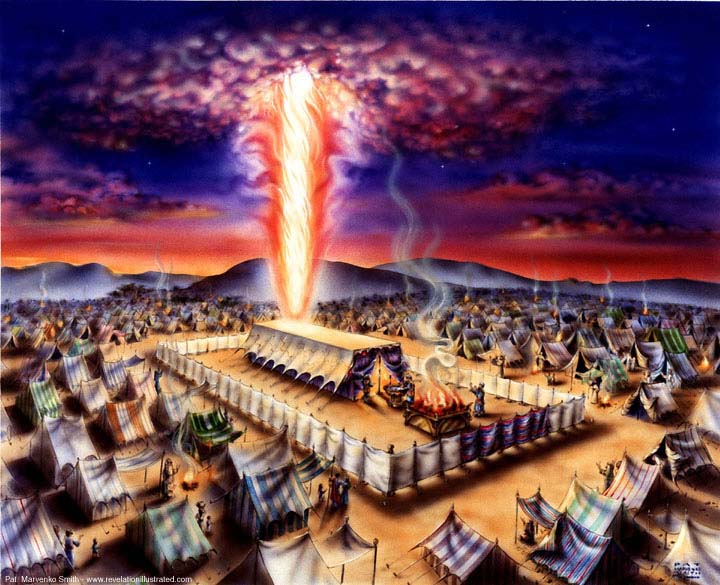
Exodus 14:19,Went behind them. Fire does two things: It both destroys and purifies substances depending on the durability of their composition. It consumes that which is flammable (e.g. wood, hay and stubble) and refines or purifies that which is inflammable (e.g. gold, silver and precious stones; see 1 Cor 3:12–15). To those people whose lives are characterized by wood, hay and stubble, fire is a threat and terror. On the other hand, to those whose lives are like gold, silver and precious stones, fire is welcomed, since they have nothing to fear; it will only refine, not destroy them.
Moreover, fire creates light. To those whose lives are characterized by light (i.e. truth and righteousness), fire is a positive thing, since it exposes sin and gives them light by which to go forward spiritually. To those people who live spiritual darkness (i.e. the world, the flesh and the devil), as was the case with Pharaoh and Egypt (a symbolic picture of the world), and those who love sin and hate Elohim and his righteousness (John 3:19–20), fire and light are feared because it will not only expose their evil deeds, but will consume them in judgment.
Therefore, the fiery flame that separated the Israelites from the Egyptians was a good thing and a blessing for the former and a bad thing and a curse and a terror for the latter. In fact, in Exodus 15:7, in poetic terms, the Egyptians are likened to stubble that YHVH destroys in his wrathful judgment. This same thing will occur again on a global scale when the earth is burned with fire and the wicked become ashes under the sole’s of the feet (Mal 4:3) of the righteous after the white throne judgment (Rev 20:11–15).
What is your life comprised of? Wood, hay and stubble, or gold, silver and precious stones:
For no other foundation can anyone lay than that which is laid, which is Yeshua the Messiah. Now if anyone builds on this foundation with gold, silver, precious stones, wood, hay, straw, each one’s work will become clear; for the Day will declare it, because it will be revealed by fire; and the fire will test each one’s work, of what sort it is. If anyone’s work which he has built on it endures, he will receive a reward. If anyone’s work is burned, he will suffer loss; but he himself will be saved, yet so as through fire. (1 Cor 3:11–15)
In this brief study, we will see how YHVH was using various experiences in the Israelites’ lives to instill obedience to his Torah-law as a way of blessing and life for them, and how his Torah-Word would guide them safely to the Promised Land. Torah is the Hebrew word found throughout Scripture that means “YHVH’s instructions, teachings, or precepts in righteousness.” We will discover how these lessons apply to us as we move forward in our spiritual walk to our promised spiritual inheritance.
Please note how the bolded phrases below a) relate to YHVH’s Torah-law, and b) relate to our everyday spiritual walk.
Exodus 13:21, “And YHVH went before them by day in a pillar of a cloud, to lead them the way, and by night in a pillar of fire, to give them light; to go by day and night. He took not away the pillar of the cloud by day, nor the pillar of fire by night, from before the people.” How does YHVH guide his people today? (Read Ps 119:105; John 16:13; Rom 8:14.)
Exodus 14:20, “And it came between the camp of the Egyptians and the camp of Israel; and it was a cloud and darkness to them, but it gave light by night to these: so that the one came not near the other all the night.” (Study 1 Cor 1:18; 2:14; Matt 10:16–25 to see how YHVH’s spiritual light guides and protects the righteous and, at the same time, is darkness or foolishness to the wicked.)
Exodus 15:25–26, “And he cried unto YHVH; and YHVH showed him a tree, which when he had cast into the waters, the waters were made sweet: there he made for them a statute and an ordinance, and there he proved them, and said, If thou wilt diligently hearken to the voice of YHVH thy Elohim, and will do that which is right in his sight, and wilt give ear to his commandments, and keep all his statutes, I will put none of these diseases upon thee, which I have brought upon the Egyptians, for I am YHVH that heals you.” Here we see that diligent obedience to YHVH and his Torah brings life and health and protects us from devastating diseases. (Consider Pss 91 and 103.)
Exodus 15:27, “And they came to Elim, where were twelve wells of water, and seventy palm trees, and they encamped there by the waters.” Water in Scripture symbolically represents the Torah-Word of Elohim (Deut 32:2; Eph 5:26). This oasis in the wilderness symbolically and prophetically represented many things. Twelve wells represents spiritual leadership (e.g. the 12 tribes of Israel and the 12 apostles), whose responsibility it is to proclaim the good news message of salvation, and to teach YHVH’s Torah to show people how to walk in righteousness after being redeemed from enslavement to sin. The 70 palms symbolize the elders that ruled Israel (later called the Sanhedrin), who made judicial rulings based on YHVH’s Torah (see Exod 18:20–26; Deut 17:8–13). Yeshua established his own Sanhedrin when he appointed 12 disciples (later, apostles) and then 70 more disciples and sent them out to spread the gospel message, and to advance the kingdom of Elohim at the devil’s expense (Luke 10:1–11, 17).
Exodus 16:4, “Then said YHVH unto Moses, ‘Behold, I will rain bread from heaven for you; and the people shall go out and gather a certain rate every day, that I may prove them, whether they will walk in my Torah-law, or not.’” In Scripture, bread from heaven often symbolizes the Word of Elohim and points to Yeshua the Word of Elohim made flesh and the spiritual bread of life. When we feed on the spiritual bread from heaven, we will be spiritually nourished and energized (see John 1:1–2, 14; 6:25–58).
Exodus 16:23, “And he said unto them, This is that which YHVH has said, ‘Tomorrow is the rest of the set-apart Sabbath unto YHVH. Bake that which you will bake today, and boil that you will boil; and that which remains over lay up for you to be kept until the morning.’ And Moses said, ‘Eat that today; for today is a Sabbath unto YHVH. Today you shall not find it in the field. Six days you shall gather it; but on the seventh day, which is the Sabbath, in it there shall be none.’” The seventh-day Sabbath or in Hebrew, the Shabbat, was, and still is, pivotally foundational in the life of YHVH’s people. It was a major spiritual stepping stone or portal into a deeper walk with Elohim. The Shabbat was literally the covenantal sign between YHVH and his people that distinguished them from the heathen nations around them. It was a set-apart or holy time of fellowship, communion and spiritual instruction, and part of the societal glue that held the people of Elohim together and kept them on the straight and narrow path of holiness. YHVH intended the Sabbath to a great blessing to his people forever (Isa 58:11–14) including during the future millennial reign of Yeshua (Isa 66:23).
Exodus 16:28–30, “And YHVH said unto Moses, ‘How long refuse ye to keep my commandments and my laws? See, for that YHVH has given you the Sabbath, therefore he gives you on the sixth day the bread of two days; abide ye every man in his place, let no man go out of his place on the seventh day.’ So the people rested on the seventh day.” Again, we see the central role the Sabbath played in the life of Elohim’s people. The Sabbath is not only a specific day at the end of each week that YHVH blessed and sanctified and when he commands us to rest from our creative activities as he did (see Gen 2:2–3; Exod 20:8–11), but the Sabbath has future prophetic implications as well. It pictures the spiritual Promised Land of Elohim’s eternal kingdom into which Yeshua will lead his redeemed, faithful and glorified saints when he returns (read Heb 4:1–11).
Exodus 17:6, “Behold, I will stand before thee there upon the rock in Horeb; and thou shalt smite the rock, and there shall come water out of it, that the people may drink. And Moses did so in the sight of the elders of Israel.” Who and what is that rock? It all points to the Torah-Word of Elohim, both the Written Torah and Yeshua (note Isa 8:14; Matt 7:24–27; 1 Cor 10:4), for Yeshua is the rock our salvation (see Deut 32:15; Pss 18:46; 62:2, 6; 89:26; 95:1).
Exodus 17:12, “But Moses’ hands were heavy; and they took a stone, and put it under him, and he sat thereon; and Aaron and Hur stayed up his hands, the one on the one side, and the other on the other side; and his hands were steady until the going down of the sun.” What does the stone spiritually represent? (See Deut 32:15; Pss 62:2; 95:1; Isa 17:10; 44:8; Matt 7:24–27; Rom 9:33.)
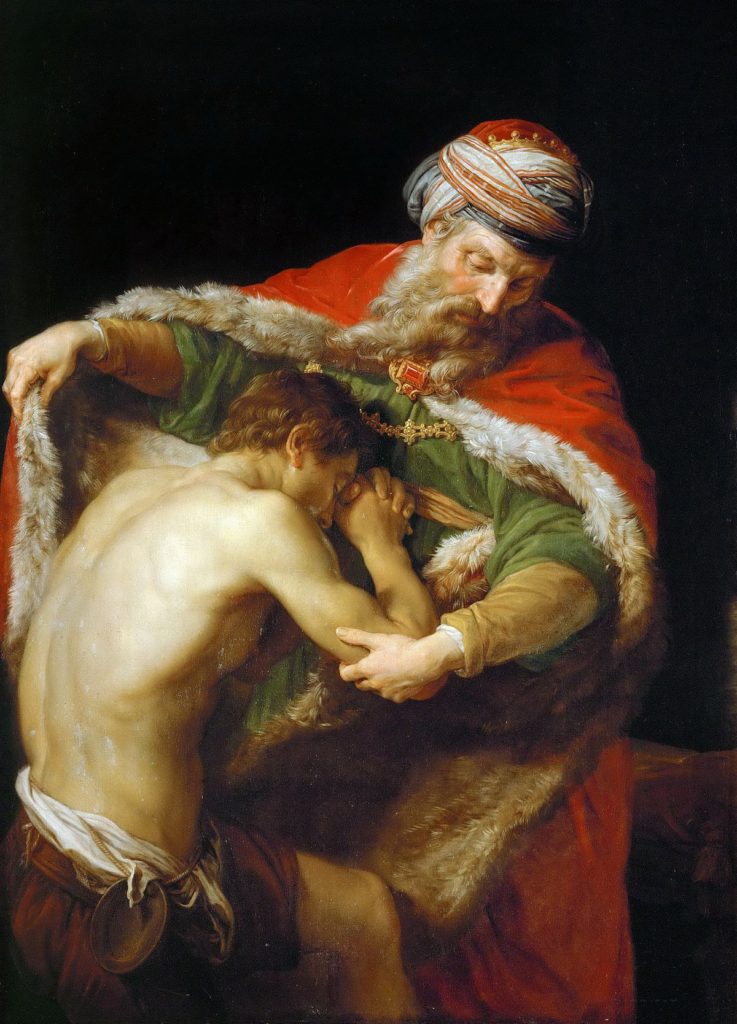
In this parable, a certain man had two sons the youngest of which requested his share of the inheritance of his father’s estate. The young man took his inheritance from his father and left home to journey into a far country where he wasted it on riotous living. A famine broke out and the penniless and hungry son joined (literally, glued, joined tightly) himself to a citizen of that country as a servant. His new master then sent him into the fields to feed husks to the swine. Conditions were so bad for the son and his hunger so acute that he desired to eat the swine’s food. Out of desperation and in realization of his sinful condition, the young man determined to return to his father’s house, willing no longer worthy to be received as a son, but to be received only a hired servant. His father spotted him a great way off, had compassion on him, ran to greet him and fell on his neck and kissed him where upon the son confessed to his father that he had sinned against heaven and that he was no longer worthy to be called a son. The father, out of joy, dressed his son in the finest robe, put a ring on his finger and shoes on his feet. The father had the fatted calf killed and merriment was made over the return of the prodigal. To the father, the son was dead, but was now alive, was lost and was now found. Feasting ensued with music and dancing. When the elder brother heard the feasting and found out about the return of his younger brother, he was angry and refused to participate in the celebration. The father pleaded with him to join the feast. The jealous older brother stated that he had faithfully served the father during the intervening years and that a feast had never been made for him, but that the younger son who had wasted his inheritance on harlots and riotous living was now receiving royal treatment. The father replied that the elder son had no reason to be angry since he had always been with the father enjoying the rights and privileges of that position and that it was only proper to celebrate the return of the prodigal brother who had been “dead” and was “alive” again, had been lost and was now found.
Prophetic Points to Analyze:
verse 11— two sons
verse 13— far country
verse 13— riotous living
verse 15— joined himself to a citizen of that country
verse 15— feed husks to the swine
verse 16— desired to fill his belly with the husks that the swine did eat
verse 18— return to my father
verse 22— best robe
verse 24— he was lost, and is found
verse 25— elder son
verse 27— your younger brother
verse 30— wasted his inheritance with harlots
verse 32— was dead and is alive again
verse 32— was lost and is found
This parable, in a nutshell, outlines much of the history of Israel up to the end time final redemption. This is a parable that is a genre of ancient Jewish literature called aggadah. The purpose of aggadic literature was not to establish line-by-line dogma, doctrine or theological truth, but was a means to teach general moral principles in story form. We will discuss this at greater length latter in our treatment of the Parable of Lazarus and the Rich Man in Luke 16.
Yeshua the Messiah was not your typical dinner guest. In fact, by today’s standards, he would have been considered impertinent, impolite, politically incorrect if not downright rude in how he treated his hosts. But since Yeshua was sinless in all that he did and totally led by the Spirit of Elohim, his behavior, as unconventional as it may seem, cannot be faulted. Why is this? This is because Yeshua always had one goal in mind: to advance the kingdom of his Father, to spread the light of Truth in the darkness of human delusion, lies and false concepts—to be spiritual salt and light wherever he went. Yeshua was always loaded for bear, so to speak. Luke chapter 14 is a perfect example of this.
Luke 14
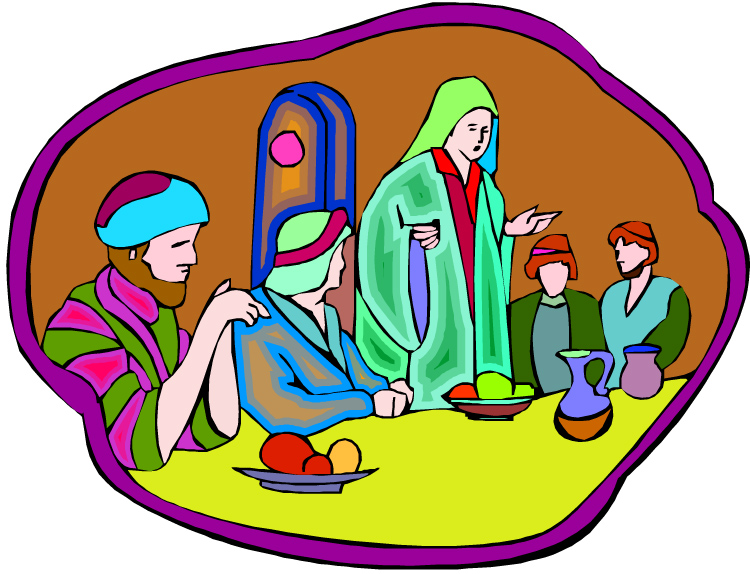
Luke 14:1, House of one of the rulers. Yeshua was invited to a Sabbath meal at the home of a Pharisee who was a ruler (likely a wealthy member of the Sanhedrin). Had Yeshua been a typical man, he would have engaged in the customary small talk of a polite and gracious dinner guest not wanting to offend his host. Yet Yeshua was not there to schmooze—to curry anyone’s favor in an effort to gain personal influence. As he required his own disciples to maintain a salty or spicy demeanor at all times (Matt 5:13; Luke 14:34–35), he was definitely up to the task to lead his disciples by example. The following discussion that Yeshua initiates is what some may consider to be a prime example of how to insult one’s host and the other guests.
First, Yeshua confronts a controversial issue head on by asking a question, and then by healing one of the other invited guests on the Sabbath, which was a Pharisaical taboo, though not contrary to the Scriptures (Luke 14:2–6).
Next, Yeshua takes some of the guests to task who were prideful social elites and religious status-seekers. He challenges them to humbles themselves and let Elohim exalt them in the eyes of men (Luke 14:7–14).
Yeshua then raises the discussion around the table to a higher level when he tells the Parable of the Great Supper (Luke 14:15–24). Doubtless, a few of the guests were made to feel awkward, since they likely resembled some of the characters in Yeshua’s story.
At this dinner table, there was no small talk of sports, the weather, one’s job or other tidbits of gossip. On the contrary, Yeshua was showing his disciples, and us, how to be salt and light wherever we go, even at the risk of offending one’s hosts, and all for the greater good of expanding the kingdom of Elohim in the lives of men.
Of course, it should go without saying that in being salt and light, one has to be totally led by the Spirit of Elohim or else more harm than good will be done.
Luke 14:18–24, Make excuses. This passage is a continuation of Yeshua’s previous discussion and must be seen in that context. Buying a piece of property and a yoke of oxen and getting married is equivalent today to buy a new home, a new car and getting married. These are among the three most notable, expensive and life-changing events to happen in a person’s life. In the eyes of a secular-minded man, to put one’s religion ahead of these things seems weirdly strange. Such a person will likely be viewed as a religious fanatic, extremist, a Bible thumper or Jesus freak. Yet such a reordering of priorities in one’s life is required of a person who desires to enter YHVH’s everlasting kingdom (Luke 14:15). The path to this lofty goal is narrow and sadly few will choose it.
Luke 14:26–33, If any man comes to me. This discourse is also a continuation of Yeshua’s previous thoughts, both of which were part of a larger discussion relating to the kingdom of Elohim that Yeshua initiated while at the dinner party of a rich Pharisee who was a ruler (likely a member or the Sanhedrin, Luke 14:1). In this part of the discussion, Yeshua continues the line of thought on what is required to enter the kingdom of Elohim. First, one must count the costs to enter the kingdom, which in the world’s eyes is high. Next Yeshua sets himself squarely in the position of being the door to entering the kingdom, and then demonstrates in the most graphic terms that one must love him above all else including close family members and even one’s own life if he wants to be part of YHVH’s kingdom. Such a man, for certain, would be viewed by his secular contemporaries as a religious fanatic! Yet this is what Yeshua requires of his disciple (Luke 14:33).
Luke 14:26, Hate his father and mother. Some people will quote this verse out of context thus turning Yeshua into a cruel, hateful and demanding tyrant. The key to understanding this clause is to read the rest of the sentence, which ends with the word, “yes, and his own life also.”
Unless they are psychotic, no one hates their own life. In fact, the Torah enjoins us “to love our neighbor as ourself,” which is part of the shema (Lev 19:18), and which is a partial summation of the entire Torah.
Even though the Greek word for hate is miseo meaning “to hate or detest,” Yeshua is using hyperbole here to make the greater point that to be his disciple, one must love him more than anything else. The world calls this fanaticism, but the world’s evaluations are based on hypocrisy. No one questions the almost worshipful fanaticism of a sports fan (short for fanatic) or a rock star groupie! This is socially acceptable. Thousands will fill vast arenas and stadiums adoringly hooting and hollering over their favorite team or rock music star, but when it comes to getting excited about Yeshua, well, that’s fanaticism.
What Yeshua hyperbolically is telling us in this verse is that we must love him more than anyone or anything including our closest family members…and even our own life. We must follow his example in that he laid down his life for us, and so we must be willing to do the same for him. The bottom line is that serving Yeshua must be the highest priority in our life!
Luke 14:34–35, Salt is good. Yeshua then ends his discussion with a pithy analogy involving salt. What is the hidden message in this? Elsewhere, Yeshua states that his disciples are to be salt and light in this world (Matt 5:13–14). In this passage, Yeshua implies the same thing and concludes that salt that has lost its saltiness is useless.
Salt is a necessary ingredient to the body’s survival. It also helps to enhance the flavor of the food it seasons, and it stand out if too much is added. Salt also acts as a food preservative in that it prevents spoilage by killing pathogens.
Yet Yeshua warns against salt losing its saltiness. How is this possible? This occurs through dilution. If Yeshua’s disciples are to be like spiritual salt to the world, then they can lose the quality as a seasoning, life preservative, killer of spiritual pathogens. This will occur if they allow their priorities and spiritual focus to become watered down, and if the cares of this life take precedence over the service and obedience to Yeshua as he outlines in the previous verses. This is a how a disciple of Yeshua loses his saltiness and becomes useless to the kingdom of Elohim.
In the book of Exodus, we read about the well known exodus of the children of Israel out of Egypt. In Jewish thought, this is referred to as “the first redemption.” Interestingly and unbeknownst to most Christians, there is a second exodus that will occur at the end of the present age before the return of the Messiah. The ancient Jewish sages refer to this event as “the final redemption.” This is because numerous biblical prophecies speak of this final redemption or second exodus. When will this second exodus occur, who does it involve and what do these people leave and where to they go? That will be subject of the discussion below.
The concept of the Messianic Age in Hebraic thought involves an understanding of the first and final redemptions, which are two separate events. The first redemption or first exodus occurred when the Israelites obeyed the Word of Elohim and placed the blood of the lamb on the door posts of their homes resulting in YHVH delivering them out of Egypt. It is understood by redeemed believers that Israel’s exodus from Egypt was prototypical of one’s placing their faith in Yeshua (the Lamb of Elohim) who redeems them from sin’s death grip through his shed blood at the cross, and then leads them out of their spiritual Egypt of sin and worldliness toward the promised land of a new spiritual life in Messiah Yeshua.
By contrast, the final redemption or second exodus is a series of events that will occur at the end of the age prior to the return of Messiah Yeshua at the beginning of the Messianic Age (or Millennium).
For those who have placed saving faith in Yeshua the Messiah, at the final redemption, the redeemed believers will receive their spiritual or glorified bodies at the resurrection of the dead, which occurs at the second coming of Yeshua. After that, they will rule and reign with Yeshua for a thousand years during the Messianic Age.
Now let’s explore some of the biblical prophecies that pertain to the second exodus. This will yield us more clues as to the timing of the return of Ephraim to the land of Israel.
Although consisting of two chapters, this passage of the Scriptures is part of the same prophecy and speaks about the coming of Messiah, and the regathering of the outcasts of Israel from the nations to which they have been scattered. Below is a list of the salient points that pertain to the second exodus along with my commentary.
11:10, The root of Jesse (the Messiah) will be an ensign or banner to the Gentiles of the nations. We know that Yeshua was that root of Jesse who commanded his followers to preach the gospel to the Gentile world. The gospel has gone to the entire Gentile world only in the 20th century via the means of modern travel and mass communications.
11:11, Here, the prophet seems to be talking about another group of people — a remnant of his people (the outcasts of Israel, verse 12) as opposed to the larger group of Gentile believers from among the nations (who have heard the gospel message) referred to in verse 10. YHVH will recover his people — the remnant of Israel — the second time (i.e. the second exodus) from all lands including the islands of the sea (North and South America, England, Australia, Japan, etc.).
11:12, YHVH will set up an ensign or banner for the nations and shall assemble the outcasts of Israel and the dispersed of Judah. Yeshua is that banner. Even though Yeshua is the ensign for the Gentiles of the nations and for the remnant outcast of Israel who are scattered among the nations, only the outcasts of Israel will be regathered along with the dispersed of Judah.
11:13, It is among this remnant group of scattered redeemed Israelites and dispersed redeemed Jews that peace between the two groups will occur. How may we ask are these two previously antagonistic groups brought together? This can only occur through a common adherence to Torah and a belief in Yeshua the Jewish Messiah who makes of Jews and Gentiles one new man (Eph 2:11–19). At the same time, the adversaries of Judah and Ephraim (the Edomites or Moslems and their Islamo-fascist terrorist allies [more on this later]) will be cut off.
11:14–15, Together, Judah and Ephraim will defeat Edom, the Philistines of the West Bank, and Moab. (Note that all these enemies of Israel are Moslem nations! Compare this with the prophecies of Obad 18 and Zech 9:13.) Perhaps there are two groups of Judahites and Ephraimites: the remnant and the greater group. It appears that greater or national (secular) Judah and national (secular) Ephraim will defeat Edom, as it seems less likely that a remnant of Yeshua-followers (the end times Torah-observant saints) will be the ones to do this.
11:16, The scene switches back to the remnant again where a highway will be formed for YHVH’s people to return to Israel from Assyria (the nation of their captivity). This second exodus will be similar to Israel’s leaving Egypt the first time. As YHVH led ancient Israel through the wilderness en route to the Promised Land, he will do the same in the last days when Israel will return to the land of Israel from the nations of her exile.
12:1–12, This chapter seems to describe a millennial setting. For example, verse three is understood in Hebraic thought to be a reference to Hoshana Rabbah, the last great day of the fall biblical Feast of Tabernacles (or Sukkot), which is a prophetic picture of the Millennium when the Spirit of YHVH will be poured out upon the earth.
Now let’s note Isaiah 11:10–12:6 in the broader context of the chapters following this passage. Perhaps there is some additional understanding to be found as to the timing of Ephraim’s return by examining the event foretold therein.
Chapter 13:6, 9, 13 speak of the day of YHVH’s wrath, which occurs at the end of the age when YHVH will judge the nations as described in the seven bowl judgments of Revelation 15 and 16. The wrath in Isaiah 13 is directed at Babylon, and in Revelation 15 and 16YHVH’s wrath is toward the nations of the world as represented by Babylon the Great, which is a greater, world-ruling version of the original Babylon. Because of the proximity of Isaiah 11 describing the second exodus with chapter 13 prophesying the fall of Babylon, it would appear that these two events are related.
After this, chapter 14 goes on to talk about the fall of the king of Babylon with verses 13 through 20 and then curiously links this to Lucifer’s (Satan’s) rebellion against YHVH and his fall from glory and his being cast into a pit (verse 15). The Book of Revelation also speaks of similar events—Satan’s fall from heaven (Rev 12:7–9), Babylon the Great’s destruction (Rev 18) and Satan’s being cast into the bottomless pit (Rev 20:1–3). Are Isaiah and John’s prophecies speaking about the same events that are to occur at the end of the age, and to YHVH’s end times judgment of Babylon the Great with Satan the devil as its head (see Rev 13, 18, 19 and 20)? This could be the case.
In chapter 14, Isaiah then goes on to prophecy another judgment against the king of Babylon, then a judgment against the Assyrians, Philistines (Isa 14), Moab (Isa 16) and Syria (Isa 17) and America—a land beyond and due west of Ethiopia that is accessible only by ocean ships (Isa 18), and, finally, judgment upon Egypt (Isa 19–20).
Then chapter 21 readdresses the fall of Babylon where in verse nine the phrase “Babylon is fallen, is fallen” is repeated as if to say that Babylon fell once, but that it will fall again in the end times. Most people are familiar with this phrase from John’s Book of Revelation (Rev 18:2), but are unaware that John is actually quoting Isaiah. It’s as if John is calling our attention to Isaiah’s prophecy as a corollary antecedent statement that relates to his own prophecy.
Isaiah then goes on to pronounce judgment against Edom and Arabia (Isa 21), against Phoenicia (Isa 23) and then against the whole earth (Isa 24). Could these prophecies of Isaiah be what John is seeing in Revelation when he describes YHVH’s bowl judgments against the whole earth just prior to the return of Yeshua (Rev 15 and 16), which John refers to as the wrath of Elohim (Rev 14:19; 15:1,7; 16:2,19)? In the chronology of the Book of Revelation, the fall of Babylon the Great occurs after the bowl judgments of the wrath of Elohim are poured out upon the whole earth. After this, Yeshua returns to this earth with his heavenly army to bring final judgment upon the armies that have gathered at Armageddon (Rev 19 and Jude 14–15). At this time, Satan and his Antimessiah confederacy, who dared to exalt themselves against YHVH and his Anointed One, will be dashed to pieces and destroyed for good (Rev 19:11–21; 20:1–3)!
So we see from this series of passages additional clues as to the timing of the second exodus and the return of Ephraim to the land of Israel. As the first exodus of Israel from Egypt occurred in conjunction with Egypt’s judgment and demise, so it appears that similar events will surround the second exodus. YHVH will judge all the nations which are part of end times Babylon the Great, and the devil, who is the instigator of man’s rebellion against YHVH-Yeshua, andthen the dispersed captives of Israel will be set free to return to her promised inheritance.
Perhaps this whirlwind tour of all these prophecies is overwhelming, and my analysis may seem to be too broad and speculative. But before jumping to any conclusions one way or the other, let’s continue to examine other biblical prophecies on this subject to determine if a pattern of events will begin to take shape that will shed light on the timing of Ephraim’s return. After you begin to see how the pieces of the puzzle fit together to form the whole picture, you will be in a better position to determine if there is enough evidence from the whole counsel of the Scriptures to support what I am proposing. As the Scriptures say, “Despise not prophesyings. Prove all things, hold fast that which is good” (1 Thess 5:20–21).
Another solid second exodus reference is found in Jeremiah 16:14–15. Here we read,
“Therefore, behold, the days come,” says YHVH, “that it shall no more be said, ‘YHVH liveth, that brought up the children of Israel out of the land of Egypt; but, YHVH liveth, that brought up the children of Israel from the land of the north, and from all the lands whither he had driven them: and I will bring them again into their land that I gave unto their fathers.’”
What stands out about this passage is that the second exodus will be much greater in scope than the first exodus, and will involve scattered Israelites being regathered from the countries north of Israel and from wherever else they have been scattered. It must be remembered that the lands of Babylon and Assyria into which ancient Israel was exiled was primarily east northeast of Israel, and not due north of Israel as this prophecy indicates. So this prophecy has yet a future fulfillment.
What’s more, in the future when these prophecies are fulfilled, YHVH promises to punish Israel for its iniquity (or Torahlessness, verse 17–18). This will happen when the Israelites who have been scattered among the Gentiles begin to wake up and realize that much of what they have been taught for religious truth is nothing more than worthless, anti-Torah lies (verse 19)! At the same time, they will come to know the name of YHVH (verse 21) — a possible reference to the restoration of the Hebrew-biblical names of deity, which is happening in our day among many who are rediscovering the Hebrew roots of the Christian faith.
This second-exodus prophecy is almost a direct quote from Jeremiah’s earlier 6:14–15 prophecy, which we have just discussed above.
It is interesting to note the timing of this prophecy’s fulfillment. This second exodus regathering corresponds with Yeshua’s reigning over this earth and executing judgment (verses 2–5) — something that will not happen until Yeshua’s second coming when he will defeat his enemies and establish his millennial kingdom on earth. So we see from this passage that the second exodus, when scattered Israel (including Ephraim) is regathered and returns to dwell safely in the land of Israel (verse 6), coincides with the second coming of Yeshua and the beginning of the millennium.
Psalm 111:2, The works of YHVH…studied by all…pleasure. Studied is the Hebrew word darash meaning “to tread or frequent; usually to follow (for pursuit or search); by implication to seek or ask; specifically to worship, diligently inquire, make inquisition, question, require, search, seek [for, out].” Pleasure is the Hebrew word khayfets meaning “pleasure; hence (abstractly) desire; concretely a valuable thing; hence (by extension) a matter (as something in mind) that is acceptable, delight (-some), desire, things desired, matter, pleasant, pleasure, purpose, willingly.” This verse is pregnant with meaning and can be viewed from several vantage points depending upon which word or group of words one focuses.
First, the works of YHVH are worth studying, following, pursuing, seeking, or diligently inquiring about.
Second, studying the works of YHVH is an act of worship. Those who seek YHVH diligently by studying his works are actually worshiping him in so doing.
Third, those who study the works of YHVH desire to do so and find that his works are worthy of studying and they find pleasure in learning about him; they place high value in this pursuit.
Psalm 111:10, The fear of YHVH…beginning of wisdom. This statement is often attributed to Solomon and his book of Proverbs, but it actually originated with David. Solomon learned this truth from his father and repeated it twice later (Prov 1:7; 9:10). Had he remembered these wise words of his father after he had become rich, famous and powerful, perhaps he would not became an apostate in his latter in having fallen so far away from YHVH. One can start out well as a young person walking in the path of truth, light, wisdom and righteousness, but that’s no guarantee how they will end up. Young people would do well to follow the wisdom of their parents, grandparents and elders and to learn, so as not to repeat the mistakes of the older generation.
Psalm 112
Psalm 112:1, Blessed is the man. YHVH promises blessing upon those who fear him and delight in his commandments. This is such a simple concept to understand that it is shocking that more people cannot grasp it! When you acknowledge the Almighty Creator of all things, who is the Just Judge of the universe and the Supreme Lawgiver and you seek him, serve him with reverence and live by his rules, it all stands to reason that you will reap some benefits. The blessings resulting therefrom are incalculable; the psalmist lists a few of them in the following verses.
Verse 2—His descendants will be mighty upon the earth. The Hebrew word for mighty is gibbor meaning “powerful; by implication warrior, or champion, chief, giant, mighty, strong (man), valiant.” When we think of the concept of mighty, we mustn’t fall into the trap of defining mighty as the world defines it, which usually involves money, power and fame. One can be gibbor in YHVH’s sight and not possess those attributes that society requires for one to be considered “great” or “mighty.”
Verse 3—He will possess wealth and riches.Wealth is the Hebrew word hon meaning “enough.” Therefore, the Bible defines wealth as having enough. How does one define enough? How many people on earth do not have enough? What are our needs versus or wants? If our needs are met, then we have enough. If we have more than that, then we have an over abundance and are truly wealthy. Not only that, but are wealth and riches to be defined only in terms of material possessions? How about expanding the definition of wealth, riches and enough to include good health, family, marriage and friends? Let us take these ideas to the higher spiritual plateau to include redemption or salvation, the receipt of the Spirit of Elohim into one’s life, divine revelation from the Word of Elohim, a relationship with Yeshua the Messiah, and eventually eternal life including inclusion into the very divine family of Elohim. Now do you feel that you possess wealth and riches and have enough, even though you may not be rich monetarily? If so, give Elohim the praise! If, not, then get saved by coming into a spiritual relationship with Yeshua, and then begin to count the blessings that will follow as a result!
Verse 3—His righteousness endures forever. What does this mean? This can be taken to mean several things. First, one’s righteousness endures through one’s posterity because if one has raised one’s children in the fear of Elohim, and they in turn will pass these values on to their children and so on. Second, as spiritual salt and light, one has also influenced the world around themselves to make it a more positively and a better place. Like a pebble dropped into a lake, the ripples of one’s actions will reach out and touch many lives for years to come. Third, the righteous man has the hope of eternal life, therefore, he will live forever before Elohim because he fears Elohim in righteousness. What is righteousness? It is adherence to the commandments of Elohim (Ps 119:172) and delighting in said commandments (Ps 112:1).
Verse 4—Unto the upright there arises light in the darkness. This is a huge promised blessing! The righteous man will be given divine revelation as to what to do and where to go when those around him are walking cluelessly in confusion and darkness.
Verse 5—He deals graciously and lends. He is so blessed of YHVH that his cup overflows and he is a blessing to those around him. Most people are takers because they are in survival mode and they do not have enough left over to be a blessing to others. On the other hand, those who fear Elohim find themselves in his blessed river of life and the blessings therefrom overflow onto others.
Verse 5—He will guide his affairs with discretion.Discretion is the Hebrew word misphat meaning “a verdict (favorable or unfavorable) pronounced judicially, especially a sentence or formal decree, determination, discretion, or to be judged.” This means that he will be able to rightly discern between right and wrong and make proper judgments when facing life’s uncertainties; he will know what to do and when to do it, thus ensuring that he will always make the right decision, which leads to good results and blessings.
Verse 6—He shall never be shaken. This is because the righteous man is standing on the solid rock of YHVH Elohim and his Word or Truth.
Verse 6—The righteous will be in everlasting remembrance. His legacy will live on after his death both on earth and in heaven.
Verse 7—He will not be afraid of evil tidings. Why is this? Because his heart is steadfast trusting in Elohim. This is because he is on the right side of Elohim, therefore, heaven is on his side. What is there to be afraid of? If Elohim be for us who can be against us (Rom 87:31)?
Verse 9—His horn will exalted with honor. This is the ultimate and highest blessing of the man who fears Elohim and delights in his commandments. Power and honor will be his, and not as men define these terms, but has heaven defines them,which are true and everlasting power and honer!
Psalm 112:4, Light in the darkness.YHVH promises to give light in the darkness to those who fear him and delight greatly in his commandments (v. 1). Light in the darkness is knowing what to do when others are walking around blindly in confusion. It is divine guidance and revelation. As YHVH commanded light to shine in the darkness on day one of creation, so he will command the divine light of his Truth to shine into the darkness of our life situations and we will instantly know what to do and where to go.
Our new annual Scripture Reading Schedule for 2020-2021 with daily readings that began on 10/11/20 is now available to download and print. The link to the previous 2019-2020’s Scripture Reading Schedule will still be available on the right sidebar under “Helpful Links” into next year. If you are using a mobile device or tablet, the link may be below, meaning you’ll need to scroll down instead.
Most of this week’s blog discussion points will be on these passages. If you have general comments or questions on the weekly Scripture readings not addressed in a blog post, here’s a place for you to post those. Just use the “leave a reply” link or the “share your thoughts” box below.
The full “Read Through The Scriptures In A Year” schedule, broken down by each day, can be found on the right sidebar under “Helpful Links.” There are 4 sections of scripture to read each day: one each from the Torah, the Prophets, the Writings, and from the Testimony of Yeshua. Each week, the Torah and haftarah readings will follow the traditional one-year reading cycle.
Weekly Blog Scripture Readings for 1/24 through 1/30/2021.