Luke 18:1–8, “And he spoke a parable unto them to this end, that men ought always to pray, and not to faint; saying, ‘There was in a city a judge, which feared not Elohim, neither regarded man. And there was a widow in that city and she came unto him, saying, “Avenge me of mine adversary.” And he would not for a while, but afterward he said within himself, “Though I fear not Elohim, nor regard man, yet because this widow troubles me, I will avenge her, lest by her continual coming she weary me.”’ And the Master said, ‘Hear what the unjust judge said. And shall not Elohim avenge his own elect, which cry day and night unto him, though he bears long with them? I tell you that he will avenge them speedily. Nevertheless when the Son of man comes, shall he find faith on the earth?’”
Though Yeshua’s people have been treated unjustly by this world’s political and justice systems, and though they have had to struggle for every shred of justice due them, the day is coming just prior to and at the return of Yeshua when the scales of justice will be balanced in the saints’ favor. This parable speaks to the time in the near future when the wicked will be punished, YHVH will avenge his own elect, and the righteous will be rewarded. Good will triumph over evil.
This final balance of the scales of justice will occur in the time period between the last trumpet, which occurs on Yom Teruah (the Day of the Blowing of Trumpets) and Yom Kippur (the Day of Atonement) when the saints will receive their heavenly rewards (1 Cor 15:51–57; Rev 11:15–18) and the wicked will receive theirs (Rev 14:14–Rev 16:21).
What You Can Do
Yeshua admonishes us to pray always and do not faint in anticipation for the day of his return to come. It will be then that the righteous will reap the rewards of righteousness if they do not grow weary in the meantime for their well doing (Gal 6:9).
What are the criteria that Yeshua the Just Judge will use to determine the levels of rewards his saints will receive at this coming? While salvation is a free gift not based on one’s works (Eph 2:8), there are levels of rewards in the Elohim’s kingdom, which will be based on one thing: works! Yeshua clearly teaches that each man will be rewarded according to his works (Matt 16:27 cp. 25:14–30). Whether one will be the least in Yeshua’s kingdom (the lowest level of rewards) are greatest (the highest level of rewards) will be determined by how faithful we were in following the Torah. Yeshua clearly states this in Matthew 5:19! On judgment day, the wicked will be rewarded according to their works (Rev 18:6; 20:12 cp. Matt 25:14–30) and the righteous according to theirs (Rev 20:12,13 cp. 19:8, NKJV, NIV or NAS).
Exodus 15:26,I will put none of the diseases.Some Bible teachers quote this verse to mean that a Christian is immune from all sickness and disease. Is this what this verse is really saying?
On the contrary, the Bible teaches us that sometimes YHVH puts judgments upon people to either (a) bring them to repentance, or (b) because they are so evil, reprobate and past redemption, to impose the death penalty upon them.
Other times, people put judgments such as sickness upon them because of their own wrong choices. Such judgments are the consequences of their own actions; it is a function of the laws cause and effect.
Sometimes sickness comes upon people because YHVH takes his hand of protection away from people and they are left open as victims of the consequences of their own wrong doings, of other people (trials and persecution) or of Satan (spiritual attack).
Finally, according to the Scriptures and the laws of biology, every person will eventually die , for it is appointed for every one to die. Sometimes healthy people simply die quietly in their sleep. Most times, people die of sickness or disease as their body grows old, runs down and finally wears out.
What this verse is saying is that YHVH will not put diseases upon people as a judgment against sin if they obey his commandments. However, if they obey him, but have an unhealthy diet, live an unhealthy life, have a negative attitude, make foolish life decisions that open them up to suffering the negative consequence (or curses) brought on by their own foolish decisions, this is not YHVH putting the consequences of their action on them, but the people doing so to themselves.
I am YHVH that heals you. This is the first place in the Scriptures where YHVH promises to heal his people of sickness. Here is a list of other biblical verses containing similar promises: Deut 7:12 and 15; Pss 30:2–4; 34:18–19; 41:1;91 (entire chapter); 103 (entire chapter); Isa 40:28–31; 53:4–5; Jer 17:13–14; Mal 4:2; Mark 11:23–24; Luke 10:19; John 14:13; 15:7; 15:16; 16:23–24; Rom 8:31; 8:37; Phil 4:13; Jas 5:14–16; 1 Pet 2:24. Read these Scriptures when you are sick and believe YHVH’s promises for your divine healing.
Notice the stipulations that YHVH makes for his promise of healing to be fulfilled upon his people. His people must “diligently heed [Heb. shema meaning “to hear and to do”] the voice of YHVH by doing what is upright [Heb. yashar meaning “right, righteous, correct, straight] in his sight by obeying his Torah.
Is There a Connection Between Sin and Sickness?
What if any is the connection between the sins we commit and the sicknesses and diseases that come upon us? Much, as the Bible teaches.
Our new annual Scripture Reading Schedule for 2020-2021 with daily readings that began on 10/11/20 is now available to download and print. The link to the previous 2019-2020’s Scripture Reading Schedule will still be available on the right sidebar under “Helpful Links” into next year. If you are using a mobile device or tablet, the link may be below, meaning you’ll need to scroll down instead.
Most of this week’s blog discussion points will be on these passages. If you have general comments or questions on the weekly Scripture readings not addressed in a blog post, here’s a place for you to post those. Just use the “leave a reply” link or the “share your thoughts” box below.
The full “Read Through The Scriptures In A Year” schedule, broken down by each day, can be found on the right sidebar under “Helpful Links.” There are 4 sections of scripture to read each day: one each from the Torah, the Prophets, the Writings, and from the Testimony of Yeshua. Each week, the Torah and haftarah readings will follow the traditional one-year reading cycle.
* Verse numbers in parenthesis refer to the verse number in Christian English Bibles when they differ from Hebrew Bibles or the Tanakh.
Weekly Blog Scripture Readings for 1/31 through 2/6/2021.
Please pray for Darlene Betsill’s husband, Gary, 67, who just suffered a massive stroke. He is currently in a comma. The outcome is still uncertain.
Darlene has been a faithful reader, commenter and contributor to this blog and the Hoshana Rabbah ministry for many years.
Also pray for Darlene and their family.
While you are at it, please pray for my own mother, Emmylu, 84. She has been in a steady decline health-wise for several months and unless a major miracle occurs, it is unlikely that she will be with us much longer. My parents have been married for 62 years. Thankfully, both are redeemed believers.
Life is a series of tests. We either pass or fail them. YHVH is the school teacher who determines whether we will pass or fail, not us. His Word is our text book that tells us how to pass. If we learn the lessons and put to practice the things we have learned, we will pass. If not, we will fail.
The problem is that we’re not just in a regular school classroom where if we fail, it’s really not a big deal in the bigger scope of life. No. Our “classroom” is this life. Whether we pass or fail will determine not only whether we will obtain eternal life or eternal damnation, but if we pass, the grade we get will determine our level of rewards in YHVH’s eternal kingdom. As should be obvious, there are a couple of important things going on here: there is not only the issue of life after death, but if we pass the test of life and are granted eternal life, where will we be, what will we be doing and, most importantly, how close will we be to the Creator. Some people will be existing in close proximity to YHVH Elohim, while others will be living further away.
When YHVH calls us with his holy calling and we respond, we have a choice. The choice we make will determine whether we will be the least or the greatest in his kingdom (Matt 5:19). If we choose to obey him a little, we will be least in his kingdom. If we choose to obey him all the way, we will be the greatest in his kingdom. Our level of obedience to his commandments determines our level of rewards in his kingdom.
If we give him our all by loving Elohim with all our heart, soul and strength like virtuous Ruth did when she chose to forsake the world and follow Naomi and her Elohim, we can become the bride of Yeshua and live forever in his eternal kingdom. Ruth is a prophetic picture of Yeshua’s bride. The heart-attitude of the bride is: your people will be my people, your Elohim will be mine, and where you go, I will go (Ruth 1:16).
Yeshua refers to his bride in the book of Revelation. She is unreservedly faithful to him. Yeshua’s bride is comprised of those who are following the Lamb of Elohim wherever he goes. They don’t just follow him only when it is convenient, nor do they draw near to him with their mouths, but their hearts are far from him like so many other religious people (Isa 29:13; Matt 15:8)!
And I looked, and, lo, a Lamb stood on the mount Sion, and with him an hundred forty and four thousand, having his Father’s name written in their foreheads. And I heard a voice from heaven, as the voice of many waters, and as the voice of a great thunder: and I heard the voice of harpers harping with their harps: and they sung as it were a new song before the throne, and before the four beasts, and the elders: and no man could learn that song but the hundred and forty and four thousand, which were redeemed from the earth. These are they which were not defiled with women; for they are virgins. These are they which follow the Lamb whithersoever he goeth. These were redeemed from among men, being the firstfruits unto God and to the Lamb. And in their mouth was found no guile: for they are without fault before the throne of God. (Rev 14:1–5)
Luke 17:5–10, Increase our faith. As if often the case, Yeshua’s answer to the disciples’ request to increase their faith is a bit enigmatic. Let us explore the connection between faithfulness and miracles of faith.
In this passage of Scripture, Yeshua answers his disciples’ request by making the terse statement that a small amount of faith produces great, even miraculous, results, and then he launches into a discussion about faithful attendance to duty, and ends the discussion there. What do these seemingly discordant statements have to do with each other? The implication is that faith comes as a result of being faithful, that is, by being a faithful doer of the master’s will.
Let us dig deeper and demystify the connection between faith and faithfulness. Consider this. What is the relationship between faith and faithfulness? When one is faithful to his master’s will and is faithfully executing his responsibilities, what happens? By immersing oneself in the will of his master with one’s whole heart, one will be totally in tune with the master. He will know the heart, mind and will of his master. He will know the desires of the master, how the master thinks and what the master wants him to do, and what the master wants him to do next. On this basis and from this spiritual launch pad, the servant can extend his faith and predict the will of the master—what the master wants him to do next, and then the servant can step out in faith and accomplish it, even if it requires a miracle to do so.
As an example of the connection between faith and faithfulness, let’s consider Yeshua’s command to his disciples to preach the gospel to all nations. Referred to as “The Great Commission,” Yeshua promised that certain miraculous signs and wonders would follow his disciples when they faithfully fulfill this command (Mark 16:15–18). One often hears Christians wondering why signs and wonder why they do see many miraculous signs and wonders happening today. Maybe it is because they are not being faithful to the Master’s command to preach the gospel to the whole world or at least to boldly sharing the gospel with those around them. The preaching of the gospel is just one example of miracles of faith following obedience.
An example of stepping out in faith from the launch pad of faithfulness based on fulfilling the Master’s will is Yeshua the Master’s will for his redeemed believers to expand the kingdom of heaven by sharing the gospel with others. Sharing the gospel with others goes hand-in-hand with the Master’s will to reverse the effects of the kingdom of darkness by healing the sick and casting demons out of oppressed people (Mark 16:15–18). In this manner, kingdom of heaven is expanded one life at a time as per the heart and will of Yeshua. The preacher of the gospel should understand this correlation between faithfulness and miraculous faith, which is why after sharing the gospel with others, one can expect to heal the sick and cast demons out of the oppressed.
It is really that simple; it is a matter of cause and effect. Faithfulness leads to faith resulting in miracles.
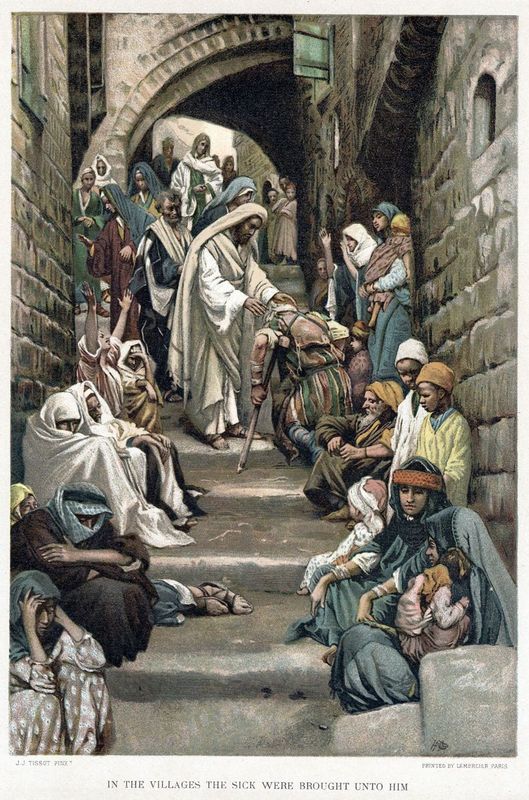
“And it came to pass, as [Yeshua] went to Jerusalem, that he passed through the midst of Samaria and Galilee. And as he entered into a certain village, there met him ten men that were lepers, which stood afar off. And they lifted up their voices, and said, ‘Yeshua, Master, have mercy on us.’ And when he saw them, he said unto them, ‘Go show yourselves unto the priests.’ And it came to pass, that, as they went, they were cleansed. And one of them, when he saw that he was healed, turned back, and with a loud voice glorified Elohim, and fell down on his face at his feet, giving him thanks. And he was a Samaritan. And Yeshua answering said, ‘Were there not ten cleansed, but where are the nine?’ There are not found that returned to give glory to Elohim, except this stranger [lit. sprung from another tribe, foreigner or alien]. And he said unto him, ‘Arise, go your way, your faith has made you whole.'”
Prophetic Points to Analyze
verse 11— the midst of Samaria and Galilee
verse 12— ten men that were lepers
verse 12— that stood afar off
verses 14–15— they were cleansed … healed
verse 16— he was a Samaritan
verse 18— stranger
Samaria and Galilee were Roman provinces comprising of the ancient territories of the Northern Kingdom of Israel, the home of the ten northern tribes. As noted earlier, Yeshua spent much of his time ministering in that region and in much of what he taught, as well as the venues where he ministered, in the meanings of the geographical names, and in the terminologies used in describing his ministry activities, we can find a deeper or allegorical prophetic meaning relating to his ministry to the lost sheep of the house of Israel. This account of the ten lepers is no exception.
These ten lepers lived in the historic region of the Northern Kingdom, house of Israel or Samaria. The number ten corresponds to the number of tribes that historically had lived in that area. These tribes were: Ephraim, Manasseh, Reuben, part of Levi, Gad, Asher, Naphtali, Dan, Zebulin and Issachar. (Judah, part of Levi and Benjamin comprised the Southern Kingdom, or house of Judah; Simeon is omitted, for it is thought that they were assimilated into Judah in accordance with the Genesis 49:5–7 prophecy, and that their land inheritance was surrounded by that of Judah.) But when the ten northern tribes were exiled from the land of Israel they became strangers or aliens in the countries of their captivity. These terms are used throughout the Scriptures in reference to the scattered tribes of Israel. These lepers, because of their disease, were likewise aliens from their fellow Israelites in the land of Judea where they currently were living.
The term “leprosy” scripturally, was a generic term for any infectious skin condition and does not necessarily relate to the modern term leprosy that is a disease involving the slow rotting away of the flesh. Samson Raphael Hirsch, the nineteenth century Jewish Torah scholar, shows that the biblical skin condition of tzaraas is unrelated to leprosy and therefore is an erroneous translation in our English Bibles.Here is a brief study on the skin disease the Torah calls tzaraas and some of the spiritual implications of this ailment. It is quoted from the author’s own Torah commentary.
Leviticus 13 discusses various skin disorders known as tzaraas. The KJV uses the word “leprosy,” but this is a mistranslation. The [Jewish sages] teach (and so does Christian biblical commentator Matthew Henry in his commentary) that these skin disorders “[were] a plague often inflicted immediately by the hand of [Elohim].”
Tzaraas is a result of sins of the mouth such as slander, gossip, murder with the mouth, false oaths and pride as well as sexual immorality, robbery, and selfishness. For proof of this the [Jewish sages] cite the similarity between the Hebrew word for “skin disorder” (m’tzora) and the word “one who spreads slander”(motzeyra). They say that these skin disorders are “divine retribution for the offender’s failure to feel the needs and share the hurt of others. YHVH rebukes this antisocial behavior by isolating him from society, so that he can experience the pain he has imposed on others—and heal himself through repentance.”They then cite the examples of Miriam’s skin turning white when she slandered Moses. We must not forget what occurred to Gehazi and to king Uzziah, as well (2 Kgs 5:27; 2 Chr 26:19, 21).
It would be well for us to pause at this moment and to consider our own behavior with respect to our tongue. Thankfully, we’re under the grace of Elohim. But in the book of Acts, Ananias and Sapphira found out what happens when one sins with one’s mouth and Elohim pulls back his hand of grace. They were instantly struck dead. As we get closer to the end of the age and the return of Messiah it is likely that Elohim will begin to require greater spiritual accountability of his people, especially of leaders, in the areas we are discussing. He wants to instill within his people the true fear of YHVH-Elohim and a repentant and contrite heart, and to turn people away from lukewarmness. It is likely that such rapid judgments as happened to Miriam, Korah et al, Gehazi, Uzziah, Ananias and Sapphira and others in the Scriptures will begin to occur soon, in our day, and may already be occurring.
The time for playing fast and loose with our mouths and other members of our bodies is over. We are all being called to account by Elohim. Be hot or cold, not in-between! Yeshua is not coming back for a Babylonian (half world and half Word-orientated lifestyle), sin-spotted bride, but one who is without spot and wrinkle.
The skin disease, tzaraas, was like a red flag which if a person had it was regarded as a judgment from Elohim for the sin of slander, gossip, murder with the mouth, false oaths and pride as well as sexual immorality, robbery, and selfishness. That person was considered to be physically and spiritually contagious and so was put outside the camp of Israel until the disease was gone. According to Samson Raphael Hirsch, quarantine was a means of shocking the victim into recognizing his moral shortcomings and driving him to repentance.
It is the skin disease of tzaraas that the ten men of Luke 17 most likely had making them ritually impure and causing them to be legally banned from social contact with the rest of Jewish society. It was these social outcasts of the region of the historic homeland of the lost sheep of the house of Israel to which Yeshua was reaching out. These men knew they were spiritually and physically unclean and they cried out to the only one who could heal and save them—Yeshua the Messiah, whose very name means “salvation.”
Similarly, in the end times, the house of Israel (or the Christian church) will begin to recognize that many of its Torahless religious traditions have been inherited lies handed down from previous generations (Jer 16:19), that she has failed to remember her Torah-based marriage covenants with YHVH (Mal 4:4–6), and that the foreign lovers to which she turned spiritually did not satisfy her like YHVH her husband once had (Hos 2:7). The house of Israel (and the house of Judah) will eventually return to YHVH (Hos 2:6–7) in covenantal relationship (Jer 31:31, 33). They will no longer be a rejected people (Hos 1:6, 9). YHVH will begin to call his people to come out of the filth of Torahlessness and spiritual Babylon (Rev 18:4) and urge them to stop forgetting his Torah (Hos 4:6; 8:1, 12). YHVH pleads with both Judah and her sister Israel (Ephraim) to return to him from their backslidden spiritual condition (Jer 3:6–14). Hosea prophesied that both the houses of Ephraim and Judah will acknowledge their sin against YHVH (the sin of breaking their covenants with him and syncretizing themselves spiritually with the customs of the heathen nations around them, Hos 5:3), and begin to seek YHVH eagerly (Hos 5:15). Hosea then prophesies that Messiah will return after three days (or in the third millennium) to “revive,” resurrect or resuscitate them spiritually and give to Israel new life (Hos 6:1–2), after which she will live in Messiah’s sight during the Messianic Age (or Millennium, verse 3).
Yeshua’s encounter with the ten lepers is an allegorical picture of this. After the Messiah healed the lepers, he instructed them to present themselves to the priests whose duty it was, according to the Torah, to declare that they were physically healed and ritually clean. This pronouncement on the part of the priests cleared the way for the former lepers to legally integrate themselves back into Jewish society without fear of retribution or ostracism.
It is interesting to note that one of the ten “lepers” was a Samaritan. These people were highly shunned and disdained by many in the Jewish culture of the first century. This mixed race people lived in the historic lands of the house of Israel. They were most likely comprised of Northern Kingdom Israelites and heathen Gentiles that the Assyrians had transplanted into northern Israel when they conquered that nation. Here Yeshua is reaching out to this people whom the Jews despised and rejected. Hosea prophesied that the house of Israel would mix herself with the nations of the world (Hos 7:8; 8:8), yet Yeshua reached out to these same type of people when he ministered to the Samaritan woman at the well (John 4), and when he commanded his disciples to take the gospel to Samaria (Acts 1:8).
This account of Yeshua’s ministry to the ten “lepers” teaches us that even though some lost and scattered Israelites may be in a state of extreme spiritual contamination and pollution brought on by sin, YHVH’s grace is open to all—even those whom society shuns and considers to be at the lowest echelon.
Ezekiel 34 paints a clear picture of YHVH’s sheep who have been lost and scattered, but who YHVH, the True Shepherd, will regather. His sheep are starving spiritually, have been pillaged by evil and covetous shepherds and ravished by spiritual diseases and predators. Yeshua is that true Shepherd whose arms of love are still open wide (as they were while he was hanging on the cross). He takes upon himself the burdens of all lost Israelites who are returning to him and promises to heal and to feed them, and to give them beauty for ashes, the oil of joy for mourning, and the garments of praise for the spirit of heaviness.
What You Can Do
We must follow the example of Yeshua and reach out to anyone regardless of their race or religious affiliation and offer them the good news of spiritual healing and salvation through Yeshua the Messiah. The disease of sin has made all humans impure and separated us all from a loving relationship with YHVH Elohim through Yeshua. Only as we as come into contact with Yeshua the Savior , place our trust in him, and receive his mercy can we be made whole.