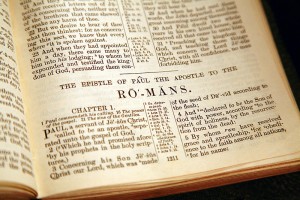
Numbers 10:11–12a, In the second year. Israel had rested at the foot of Mount Sinai for slightly more than one year. According to the Torah, newlyweds (in this case, YHVH and Israel) were to spend one year together (getting to know each other) before going to war (Deut 24:5). It was now time for Israel to go to war—to fight their way to the Promised Land. With this biblical principle in mind, how would you characterize your spiritual walk? Are you in the warfare stage of your spiritual journey yet or are you still sitting (on the sidelines) in the same place spiritually that you were at the beginning of your journey? Have you fought the spiritual Canaanites, the serpents and scorpions, the heat and cold, hunger, doubt and unbelief, or have you never ventured outside of your spiritual comfort zones to do battle, to labor hard, to minister for YHVH in attempting to reach the Promised Land of his kingdom? (Let’s not forget what Yeshua said to the unprofitable servant in the Parable of the Talents in Matt 25:14–29.)
Category Archives: Weekly Scripture Readings
Are You Like a Menorah?
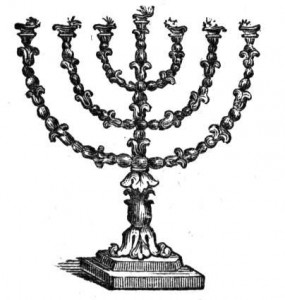
Numbers 8:2, The menorah. The phrase toward the face of the menorah is an interesting one. The Jewish sages teach that the three wicks on the right and the three on the left were all directed toward the menorah’s central stem, thus concentrating light toward the center. The menorah symbolized that YHVH is the Source of all light (The ArtScroll Stone Edition Chumash, p. 775). What are the connotations of this for a believer in Yeshua? How did Yeshua describe himself? (See John 8:12; 9:5.) Moreover, what did he mean when he said that “I am the vine and you are the branches?” (John 15:5) What does this mean and how is this pointing to a type of human menorah? Now relate this to the seven Messianic assemblies of Revelation 2 and 3 being likened to menorahs (Rev 1:13, 20). Is Yeshua the center of all that we do? Do we place all of our focus on him? Can we say, as the Apostle Paul did, that “in him we live and move and have our being” (Acts 17:28)? Does the power of his resurrected life and anointing flow through you even as oil was in the menorah and sap flows through a tree to its branches?
Redeemed Israelites Are That Menorah
The Scriptures plainly states that Yeshua and his body of followers are likened to a tree of which the seven-branched menorah that adorned the mishkan (tabernacle) in the wilderness as well as the sanctuary of Solomon’s Temple is a picture. Furthermore, remember what Yeshua said in John 15:5? “I am the vine and you are the branches …” This is a perfect picture of the menorah, which has a central trunk with six (the number representing man) branches growing out of the trunk. Remember what Yeshua said in Matthew 5:14–15, that his followers were to be lights upon a lampstand on a hill for all the world to see—a clear allusion in the mind of anyone in Yeshua’s audience to the temple’s menorah (which was upon the Temple Mount like a light on a hill).
Additionally, when a redeemed believer in and follower of Yeshua is in a sacred state of worshipping his Master and Savior, he will often lift his arms heavenward. Not only is this the universal sign of surrender (in this case to one’s Heavenly Master), but when we lift our hands our bodies are actually forming a human menorah. By doing this, in worship we are acting out what we are—a lampstand to the world radiating forth the good news of the truth and love of Yeshua.
In fact, The Scriptures shows us that the menorah, and not the cross, is the symbol of Yeshua’s spiritual body of believers. We see this in Revelation 1:12, 20 and 2:1 where the seven congregations are symbolized as a seven-branched menorah! The menorah here is the symbol of the congregation of redeemed believers.
Though the cross is representative of the redemptive work Yeshua accomplished on our behalf, it is not the symbol of the body of believers, commonly called the “church,” but the menorah is! Furthermore, in Jewish thought, the menorah is analogous to an olive tree (the ancient temple menorah was constructed of hollow tubes of solid gold filled with olive oil that burned when lit), to which the Apostle Paul makes reference in Romans 11, as representing the tree of life (which ultimately represents Yeshua) into which all must be grafted if they are to be part the spiritual body of Yeshua and have his eternal life.

Blog Scripture Readings for 6-1 through 6-7-14
Aside
THIS WEEK’S SCRIPTURE READINGS FOR STUDY AND DISCUSSION:
Parashat B’ha’alatkha — Numbers 8:1 – 12:16
Haftarah — Zechariah 2:14(10)* – 4:7
Prophets —Jeremiah 38:1 – 44:13
Writings — Lamentations 1:1 – 5:22; Ecclesiastes 1:1–18
Testimony — Romans 6:1 – 11:10
Most of this week’s blog discussion points will be on these passages. If you have general comments or questions on the weekly Scripture readings not addressed in a blog post, here’s a place for you to post those. Just use the “leave a reply” link below.
The full “Read Through The Scriptures In A Year” schedule, broken down by each day, can be found on the right sidebar under “Helpful Links.” There are 4 sections of scripture to read each day. One each from the Torah, the Prophets, the Writings, and from the Testimony of Yeshua. Each week, the Torah and haftarah readings will follow the traditional one-year reading cycle.
* Verse numbers in parenthesis refer to the verse number in Christian Bibles, which can at times differ from verse numbers in Hebrew Bibles.
Weekly Blog Scripture Readings for 6/1 through 6/7/14.
New Video: The Book of Romans Explained from a Hebraic Perspective
In this video on the book of Romans, we discuss Paul’s view of the gospel, the Torah (the law of Moses) and the reunification of the nation of Israel.The material presented here is totally fresh and is from a Hebraic perspective and is likely totally different than anything you’ve heard on this subject to this point. For a free, short study guide to this video, go to http://hoshanarabbah.org/blog/2014/05/28/the-book-of-romans/.
The Book of Romans: The Gospel, the Torah & the Israelite Nation Reunited
The Main Themes of Romans
The is perhaps the only book in the Bible that is organized systematically like a theological textbook from beginning to end with each point leading to the next. This is not how biblical books are typically arranged.

In this letter, there are several main themes.
Pre-eminently, Elohim is the Just Judge of the universe to whom all are accountable (both Jews and Gentiles). This concept alone is huge, since most humans don’t want to believe they’re accountable to anyone except their own egos.
The Torah is Elohim’s standard of righteousness by which he will judge the deeds of all men (both Jews and Gentiles) fairly. If people can accept the fact that there is a supreme God to whom they’re accountable for their actions, then it’s a short next logical step to accept that such a God has laws that man must follow if he’s not to run afoul of that God.
Next, Paul counters a religious system that purported to explain who that God was and what he required of sinful man. This was Judaism. The problem is that Judaism had perverted the truth of Elohim into a racially exclusive, legalistic, works-based salvational system. Paul attempts to correct this error, and restore this religion to its original truth.
Paul then presents the gospel message of salvation by grace through faith in Yeshua the Messiah is at the center of YHVH’s process to redeem sinful man.
Before Elohim, the God of the universe, there is no racial inequality between Jews and Gentiles. Elohim isn’t a racist. All are equal before him. All are sinners, and all need Yeshua.
Paul’s Epistle to the Romans keeps Yeshua and the gospel message front and center, yet at the same time Paul weaves together the good news of Yeshua with that of the righteous lifestyle of Torah-obedience. Together, these two messages form a beautiful tapestry-like picture encompassing the message of the entire Bible from Genesis to Revelation — a message of the salvation of man resulting in his being reconciled to Elohim his becoming elevated to the spiritual status as a child of Elohim.
Part 1 — Introduction: The Cornerstone of the Gospel Message
At the very beginning of his epistle, Paul carefully and boldly sets in place the cornerstone for what is to follow. He declares the preeminence of the gospel message and his Continue reading
Are You a Baal Worshiper?
Baal was the god of the Canaanites, the enemies of the ancient biblical Israelites. God’s people were constantly being enticed by the heathen practices associated with Baal worship. Down the through the ages, the worship of Baal has resurrected itself and taken on the trappings of each new culture. The concepts behind Baal worship are thriving and growing in our post-Christian culture. To what degree having you fallen for the enticements of Baalism? Before you write this off saying it doesn’t apply to you, please watch this video!
Blog Scriptures Readings for 5-25 through 5-31-14
Aside
THIS WEEK’S SCRIPTURE READINGS FOR STUDY AND DISCUSSION:
Parashat Nasso — Numbers 4:21 – 7:89
Haftarah — Judges 13:2–25
Prophets —Jeremiah 31:1 – 37:21
Writings — Song of Songs 6:1 – 8:14; Ruth 1:1 – 4:22
Testimony — Jude 1:1–25; Romans 1:1 – 5:21
Most of this week’s blog discussion points will be on these passages. If you have general comments or questions on the weekly Scripture readings not addressed in a blog post, here’s a place for you to post those. Just use the “leave a reply” link below.
The full “Read Through The Scriptures In A Year” schedule, broken down by each day, can be found on the right sidebar under “Helpful Links.” There are 4 sections of scripture to read each day. One each from the Torah, the Prophets, the Writings, and from the Testimony of Yeshua. Each week, the Torah and haftarah readings will follow the traditional one-year reading cycle.
Weekly Blog Scripture Readings for 5/25 through 5/31/14.