Blog Scripture Readings for 6-22 Through 6-28-14

Aside

THIS WEEK’S SCRIPTURE READINGS FOR STUDY AND DISCUSSION:

Parashat Chukat — Numbers 19:1 – 22:1 
Haftarah — Numbers 28:9–15; Isaiah 66:1–24**
Prophets —Ezekiel 6:1 – 12:28
Writings —Esther 4:1 – 10:3
Testimony — 1 Corinthians 7:25 – 11:33

Most of this week’s blog discussion points will be on these passages. If you have general comments or questions on the weekly Scripture readings not addressed in a blog post, here’s a place for you to post those. Just use the “leave a reply” link below.

The full “Read Through The Scriptures In A Year” schedule, broken down by each day, can be found on the right sidebar under “Helpful Links.” There are 4 sections of scripture to read each day. One each from the Torah, the Prophets, the Writings, and from the Testimony of Yeshua. Each week, the Torah and haftarah readings will follow the traditional one-year reading cycle.

** A different Haftarah is read when it is a special sabbath in Jewish tradition. This Shabbat is Rosh Chodesh on the traditional calendar. Usually Judges 11:1-33 is read with Parashat Chukat.

Weekly Blog Scripture Readings for 6/22 through 6/28/14.


Korah: A Character Study of a Malcontent, a Rebel and a Humanist

The Spirit of Korah

The spirit of Korah is alive and well on planet earth. The righteous must discern, identify and then oppose it. Everywhere in every way, it is attempting to destroy the work of YHVH Elohim on earth.

Fist 14522398

The spirit of Korah is the spirit of rebellion against YHVH and his divine authority. In our society, it is manifested in the philosophies of secular humanism, socialism, Marxism, evolution, which are all aspects of the Babylon the Great, New World Order political-religious system that will oppose the saints of Yeshua and Yeshua himself at this second coming. We see it at work, supported and encouraged in international politics, in our own government, in our educational systems, in the media, in the false religions of the world, and in the apostate church. Even within the spiritual body of Yeshua it is attempting to subvert and pervert the truth of Elohim as revealed in the Bible, and to undermine legitimate, YHVH-ordained authority.

The rebellion of Korah and his comrades against Moses and Aaron and Elohim’s judgment against them is a prophetic picture of what will happen in the end times. In fact, it is a picture of the judgment of Elohim that will happen to ALL sinners who choose to rebel against YHVH, his will, his Word, his plans and purposes and those on this earth who are carrying out his will.

The spirit of Korah continues to manifest itself in uprisings against godly authority both within the body of Yeshua, and globally as the New World Order, which the Book of Revelation calls Babylon the Great, takes a more strident and virulent stand against Elohim, the Bible and the saints. Continue reading →


Bitterness and Rebellion—A Deep Pit of Destruction

Numbers 16:1–3, Notice a progression (or downward spiral) of actions on the part of Korah and his rebels. They separated themselves from fellowship, rose up against Moses, gathered together others of like mind and falsely accused leadership of wrong doings. This is the world’s formula for achieving political (humanistic) power and domination. It is the opposite method of advancing in YHVH’s kingdom where the way down is the way up; that is,  when one lays one’s life down in service, spiritual reward, advancement and blessing will occur for that person (Matt 20:27; 23:10).

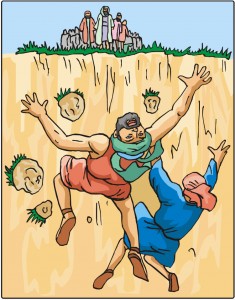
Korah falling into pit 20281294

Rebels, like Korah, tend to separate themselves from fellowship, seek out other like-minded rebels, and then rise up in defiance and accusation against godly leadership. Again, this leads to political power. The way of spiritual power is laid out in Acts 2:42–47 where the followers of Yeshua continued steadfastly in the apostles’ doctrine, in fellowship, breaking bread together, in prayer and sharing their goods with one another. The result was real spiritual power authority and anointing from heaven, and not power based on usurpation, human pride, degradation of others and self-promotion. This can only happen as people forsake not the assembling of themselves together (Heb 10:25), function according to the place and spiritual calling within the spiritual body of Yeshua submitted one to another as they walk in the spiritual light YHVH’s instructions in righteousness—the Torah.

The Jewish sages note that Korah and his band of malcontent had come under the power of resentment, which grew and festered until open rebellion broke out. Korah was a fellow Levite and cousin of Aaron who was among those “overlooked” for the priesthood and who were relegated to being “mere” assistants to the priests. He was also a firstborn of his household (Exod 6:21), and when the tabernacle sacrificial service was inaugurated Aaron’s sons replaced the firstborn Israelites in offering sacrifices. Furthermore, Dathan, Abiram and On were of the tribe of Reuben, the first-born child of Jacob. These men had their own grudge, since Reuben had lost his birthright as the firstborn son to the sons of Joseph because of sin (note 1 Chron 5:1). What do we see here? Resentment leads to bitterness, which then leads to separation, then to uprising, then to accusation, then to rebellion against YHVH-ordained authority, then to attempted usurpation of authority, and eventually it leads to judgment and death. Is this not the path Lucifer took in his rebellion against YHVH Elohim? (Read Isa 14:12–23.)

Numbers 16:31, The ground split apart. There earth splitting open and swallowing these rebels is likely a prophetic foreshadow of YHVH’s judgment against the ultimate arch-rebel and usurper authority—Satan—when YHVH judges him at the end of this age by casting him into he bottomless pit or abyss (Rev 20:1–3).


Blog Scripture Readings for 6-15 through 6-21-14

Aside

THIS WEEK’S SCRIPTURE READINGS FOR STUDY AND DISCUSSION:

Parashat Korach — Numbers 16:1 – 18:32 
Haftarah — I Samuel 11:14 – 12:22
Prophets —Jeremiah 51:36 – 52:34; Ezekiel 1:1 – 5:17
Writings —Ecclesiastes 9:1 – 12:14; Esther 1:1 – 3:15
Testimony — 1 Corinthians 1:1 – 7:24

Most of this week’s blog discussion points will be on these passages. If you have general comments or questions on the weekly Scripture readings not addressed in a blog post, here’s a place for you to post those. Just use the “leave a reply” link below.

The full “Read Through The Scriptures In A Year” schedule, broken down by each day, can be found on the right sidebar under “Helpful Links.” There are 4 sections of scripture to read each day. One each from the Torah, the Prophets, the Writings, and from the Testimony of Yeshua. Each week, the Torah and haftarah readings will follow the traditional one-year reading cycle.

Weekly Blog Scripture Readings for 6/15 through 6/21/14.


What kind of spy are you?

Numbers 13:2, Send forth men, if you please (The ArtScroll Stone Edition Chumash). The implication here is that Elohim gave Moses permission to send out the spies, but left the final decision up to him. This idea is confirmed in Deuteronomy 1:22 where Moses states that the idea to spy out the land came from the Israelites, not from YHVH. By allowing them to do this, it appears that YHVH was deliberately putting them to the test to see if they would trust him when he had already told them that Canaan was a good land and theirs for the taking with his help. Would they walk by faith in his word and promises or would they have to see the actual land before believing YHVH’s word?

When YHVH gives you a promise, do you have to see it come to pass before believing it, or are you able to simply begin taking steps of faith toward the fulfillment of the promises without actually seeing any tangible evidence of the end goal? What has YHVH promised you and what steps of faith have you taken toward possessing your spiritual “promised inheritance?” (Read the scriptural definition of faith in Heb 11:1.)

YHVH did not choose the twelve spies, the people did; hence, the name of this parashah, “Send for Yourselves.” When people choose their own leaders the failure rate is high­—in this case ten of twelve leaders were faithless duds. Man-inspired and initiated efforts seldom produce lasting spiritual benefits. This effort ended in the faithless leaders shouting down those who had courage and faith. Do you act like Caleb and Joshua or one of the other ten spies in your spiritual approach to what YHVH has called you to do? Are you running upward and onward toward your spiritual inheritance, or are you holding back? Are you hearing the voice of YHVH’s Spirit so that you know what your personal spiritual marching orders are? Do you know how to hear his voice? If not, why not? Most of us sometimes act as Joshuas and Calebs and at times like the other ten spies. We tend to be inconsistent in our spiritual walk. What are you doing to become more like Joshua and Caleb?

Eighteenth-century Christian Bible commentator, Matthew Henry, in his comments on this passage, discusses the demerits of the people’s choice to search out the land of Canaan. He then compares the unbelief of the ten carnal spies with the doubt and unbelief in the walk of the believer. He notes that the motion to search out the land appears to have come from the people (see Deut 1:22). They had a better opinion of their own policy than of Elohim’s wisdom. Thus we ruin ourselves, he says, by believing the reports and representations of sense rather than of divine revelation. We walk by sight, not by faith (pp. 130–131, ­Matthew Henry Concise Commentary on the Whole Bible, Moody Press).

What is “divine revelation?” One does not hear this concept often discussed. What is it and how does a born-again believer receive it? Henry continues, Difficulties that are in the way of salvation dwindle and vanish before a lively, active faith in the power and promise of Elohim. All things are possible, if they are promised, to him that believes, but carnal sense and carnal professors are not to be trusted. Unbelief overlooks the promises and power of Elohim, magnifies every danger and difficulty, and fills the heart with discouragement. May YHVH help us to believe! We shall then find that all things are possible through him who strengthens us (Ibid.)

 

Blog Scripture Readings for 6-8 through 6-14-14

Aside

THIS WEEK’S SCRIPTURE READINGS FOR STUDY AND DISCUSSION:

Parashat Sh’lach L’cha — Numbers 13:1 – 15:41 
Haftarah — Joshua 2:1–24
Prophets —Jeremiah 45:1 – 51:35
Writings —Ecclesiastes 2:1 – 8:17
Testimony — Romans 11:11 – 16:27

Most of this week’s blog discussion points will be on these passages. If you have general comments or questions on the weekly Scripture readings not addressed in a blog post, here’s a place for you to post those. Just use the “leave a reply” link below.

The full “Read Through The Scriptures In A Year” schedule, broken down by each day, can be found on the right sidebar under “Helpful Links.” There are 4 sections of scripture to read each day. One each from the Torah, the Prophets, the Writings, and from the Testimony of Yeshua. Each week, the Torah and haftarah readings will follow the traditional one-year reading cycle.

Weekly Blog Scripture Readings for 6/8 through 6/14/14.


BEWARE: the Mouth!

Numbers 12:1–3, Miriam and Aaron spoke against Moses. This is slander! None of us are immune from this sinful proclivity of man’s fallen nature. Sadly, such activity is rife within our congregations! As long as we give in to gossip and slander we will grieve the Spirit of Elohim and will not advance spiritually. We’re all guilty of this. Confess your sin and repent now! What does YHVH say about those who sow seeds of discord among brethren? How does view it? (See Prov 6:16 and 16.) How did the apostles handle such individuals? (Note Rom 16:17; Tit 3:10; 2 Thess 3:6; 1 Tim 3:5.) What was the penalty that YHVH prescribed for Miriam because of the evil misuse of her mouth? (Read Num 12:14.) How does this penalty compare with that which Paul prescribes for those who cause division and strife with in the congregation? What does Paul teach about slandering or rebuking an elder in the congregation? (See 1 Tim 1:19.) What does he call such activity? (Read verse 20.)

Mouth 4 20837968

Seven Ways to Misuse the Mouth

(From a book entitled Stop the Runaway Conversation by Dr. Michael Sedler)

  1. The Backbiter: One who speaks against an absent individual. All criticisms and comments, as the name implies, are made without the accused being present or are behind his back. (Ps 15:2–3; Rom 1:30; Prov 25:23; 2 Cor 12:20)
  2. The Busybody: One who seeks out information on a false report and spreads it by means of gossip, slander, backbiting, etc. YHVH takes this very seriously. In fact, he equates being a busybody with being an evildoer or even a murderer. (1 Pet 4:15; 1 Tim 5:13; 2 Thess 3:11)
  3. The Complainer: One who finds fault. This type of person often uses a personal situation as a platform for his or her complaint. “I was treated unfairly.” “Do you know what this person did?” You think that’s bad, let me tell you what happened to me.” These are the types of phrases that will come from such a person. (Num 11:1; Jude 16)
  4. The Murmurer: One who grumbles. We find that this person is usually complaining but only loudly enough for those in close proximity to hear. The murmuring person is seldom happy or pleased with the outcome of situations. Like the complainer, he looks for faults and then justifies a bad attitude with his comments. (Phil 2:14; Num 16:2; Jude 16)
  5. The Slanderer: This is an individual who tries to injure someone’s reputation or character by false and defamatory statements. (Num 14:36; Jer 6:28; 9:4; 1 Tim 3:11; Prov 10:18; Ps 101:5)
  6. The Talebearer (or Gossip): This is a person who elaborates and exaggerates so as to make a story more dramatic or “juicy”). (Prov 11:13; Lev 19:16; Rom 1:28–30; see also Prov 18:8; 20:19; 26:20,22; 1 Tim 5:13)
  7. The Whisperer: This is an individual who talks about other people privately, secretly and covertly in order to hurt them. (Prov 16:28; Ps 41:7)