
How does YHVH fight for us?

Deuteronomy 1:26–28, Moving forward in the face of obstacles. Many times in our spiritual walk we are just at the point of spiritual breakthrough, but we receive an evil report about some spiritual giants that is blocking our forward movement and our resolve to advance melts. It seems sometimes that if we could just see what the future holds for us that it would be much easier for us to go forward! Yet Yeshua said, Blessed are those who haven’t seen, yet still believe in YHVH’s promises (John 20:29). Do you have what it takes to go on without being deterred by the world, the flesh and the devil? How can one go forward in faith if one cannot see where one is going? It gets down to personal and intimate relationship with your Heavenly Father, through Yeshua. He directs us through his Spirit. Can you hear his voice with your spirit when he tells you, “This is the way, walk you in it,” (Isa 30:21)?

Deuteronomy 1:29, He will fight for you.How does Elohim fight for us? Let’s look at the example of the children of Israel. We can learn a lot from them (1 Cor 10:11). How many examples are there of the Israelites sitting down and doing nothing while YHVH fought for them? Few if any. What then does YHVH require? 

We must do our part, and he will do the rest. What is the part we are to do? That depends. Sometimes it depends on what we we’re capable of doing. Often he requires us to come to the end of our resources and abilities, and then he will step in and finish the fight on our behalf to the victorious end. We also have to fight only the battles he has told us to fight. 

Sometimes we choose to fight battles he has not instructed us to fight. This was the case with the Israelites who chose to go up and take the Promised Land when YHVH had told them not to do so. As a result of their disobedience, they were defeated (Deut 1:42–45). YHVH will not support his people in a battle he has not sanctioned. 

When YHVH tells us to go to battle, we must fight how he tells us to fight, who he tells us to fight, and when he tells us to fight. For example, if the Israelites had gone up against Jericho using conventional warfare tactics, they would have been defeated because that’s not how YHVH instructed them to defeat that city. The same is true of Gideon’s unconventional method of defeating the vast Midianite army with only three hundred soldiers armed with candles in clay jars and shofars. 

YHVH will only fight for us when we submit to his battle plans and fight the enemy his way. For example, the Israelites defeated the Amalakites when Moses stood on a hill with his arms outstretched in a cross-like formation. Likewise, they overcame Jericho by marching around it blowing shofars. Gideon used lamps and shofars to defeat the enemy. David used a slingshot and a pebble. Once the Israel defeated their enemy with the help of the ark of covenant, through prayer and praise. 

The biblical list of unconventional methods of YHVH’s people defeating their enemies is a long and inspiring one! What can we learn from all of this? For YHVH to fight for us, we must first do things his way so that he’ll fight for us. This means knowing when and who to fight and how to fight. Often we have to wait on YHVH for the answers to these questions even as a military officer has to wait for headquarters to give him his marching orders. Headquarters won’t back or support the soldier who takes matters into his own hands. Conversely, headquarters won’t tolerate a solider who refuses to obey orders. The same is true of YHVH.

 

Welcome to Deuteronomy!

Over the years, on many occasions, I have posted my my introduction and outline to the book of Deuteronomy, so I won’t repost them again. Instead, I will provide links, so that those folks who are interested can go back and reread them.


Blog Scripture Readings for 8-4 Through 8-10-19

Aside

Parashat D’varim — Deuteronomy 1:1 – 3:22
Haftarah — Isaiah 1:1-27
Prophets — Ezekiel 39:1 – 45:25
Writings — Nehemiah 5:1 – 11:36
Testimony — Galatians 6; Ephesians 1:1 – 5:33

Most of this week’s blog discussion points will be on these passages. If you have general comments or questions on the weekly Scripture readings not addressed in a blog post, here’s a place for you to post those. Just use the “leave a reply” link below.

The full “Read Through The Scriptures In A Year” schedule, broken down by each day, can be found on the right sidebar under “Helpful Links.” There are 4 sections of scripture to read each day: one each from the Torah, the Prophets, the Writings, and from the Testimony of Yeshua. Each week, the Torah and haftarah readings will follow the traditional one-year reading cycle.

Weekly Blog Scripture Readings for 8/4/19 through 8/10/19.


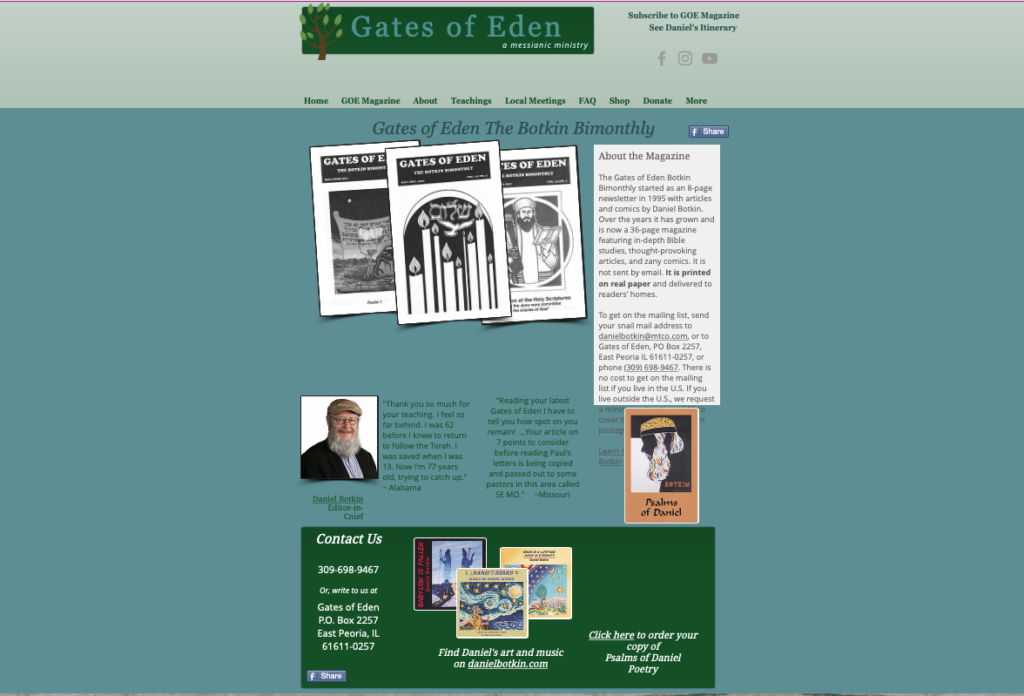
Please subscribe to the Gates of Eden magazine…

As regular readers of this blog know, I seldom promote other ministries, since this is not the purpose of the blog: it is a Bible study blog and a place to discuss Scripture. However, I want to make an exception, and encourage everyone reading this to subscribe to my friend and fellow Hebraic roots and Bible truth teacher Daniel Botkin’s Gates of Eden magazine.

I have known and worked with Daniel for many years. We have been in each other’s homes and congregations, and I have been privileged to minister with him at several conferences. At times, we have even quoted each other in our respective writings.

Daniel has been a Messianic Torah teacher for many decades and has a proven record as a mature well-respected, solid Bible teacher and scholar. He has a gentle and humorous approach, which comes through in his writings, and he is gracious and gentle toward everyone, yet at the same time his writings are hard hitting and he is a non-compromiser when it comes to Torah and the message of the gospel.

I have been receiving the Gates of Eden magazine for many years and have learned much from Daniel, who I respect greatly as a colleague.

Over the decades, we have watched many so-called leaders come and go. Many have fallen by the wayside due to moral failings, or have become promoters of heretical teachings or man-made doctrines and have even built their ministries on ear-tickling silly side issues, greed and the love of money and fame. Not Daniel Botkin. He has faithfully stuck to the meat and potatoes of the the apostolic faith and is a quiet but forceful advocate of the faith once and for all delivered. This is why I can heartily recommend that you read and subscribe to his magazine which contains his writings on a plethora of uplifting, extortive and challenging biblical subjects.

You can subscribe here: https://danielbotkin6.wixsite.com/gatesofeden/gates-of-eden-magazine.

(Please note, this is not a paid or solicited endorsement. My goal is only to see the kingdom of Elohim advanced, and to promote those who are doing so by building up the body of Messiah. I can only promote those in ministry who I know well, which is very few people.)


Dear Natan: Who are the 7,000 who haven’t bowed the knee to Baal?

The Christian tradition of kneeling before the Baal tree…

In the comments section of this blog, in reference to 1 Kings 19:18 and Elijah and the 7,000 saints who hadn’t bowed the knee to Baal, John S. writes:

7000 that haven’t bowed their knees to the Baals.
The 3 zeros are 3 covenants, so we have 7 attached to 3 covenants.
The 7 Messianic congregations of Revelation.
And those who have not bent their knees to the Baals are the overcomers.
This is my understanding of the numerology involved. It is prophetic.

Natan comments in response to John’s revelatory insight:

Very interesting insight!

The three covenants are the Abrahamic, Mosaic and Renewed Covenants. Paul mentions “covenants of promise” (plural) in Eph 2:12 of which the ex-Genitles are now a part when they come to Messiah and become the one new man (v. 15), the seed or offspring of Abraham (Gal 3:29), part of the olive tree of Israel (Rom 11:11–32) and the Israel of Elohim (Gal 6:16). The mainstream church focuses only on “the New Covenant,” while omitting and rejecting the first two covenants. Obviously, the exclusion of the first two covenants wasn’t in Paul’s thinking or else he would have said “covenant” not “covenants.” This is because the Word of Elohim never changes; his laws and standards are immutable. Therefore, each succeeding covenant is built upon the foundational truth of the previous covenant and is an expansion of the previous one (e.g. Isa 42:21).
Those who are walking in accordance with Elohim’s entire word including all three of his covenant are those that John describes as keeping the law and having the testimony or faith of Yeshua (i.e. they walk in accordance with the OT and NT covenants; Rev 12:17; 14:12).
It follows, therefore, that these saints are those who haven’t bent the knee to Baal (i.e. they’re not following the downward, gravitational pull of the carnal or evil inclination by following the world, the flesh and devil as does the world around them, and, for the those in churchianity, this includes all forms of Torahlessness, following Christo-pagan traditions, and whitewashed church doctrines of men by which the word of Elohim has been made of none effect). Hence, 7,000 who haven’t bowed the knee to Baal has the following metaphorical or drash-level biblical meaning: seven is the biblical number of perfection, and the three zeros are the three covenants YHVH Elohim made with Israel to bring them into a relationship with them potentially ultimately leading to them becoming his glorified sons and daughters in his everlasting heavenly kingdom.

Prophetic indeed… You got me going there John and triggered me in a good way!


“Under the law”?

Galatians 5:18, But if you be led of the Spirit, you are not under the law. To understand this passage, let’s back up to verse 16 where Paul instructs the Galatians to walk in the Spirit of Elohim, and not to fulfill the lust of the flesh. What are the lusts of the flesh? Doing that which comes naturally to the carnal, sinful man such as lust, adultery, lying, stealing, worshipping false gods, coveting, and so on. All these things are a violation of YHVH’s Torah-commands. 

In verse 18, Paul says that if one walks in accordance with YHVH’s Holy Spirit, then one won’t be sinning or violating the Torah, and thus coming under the penalty of the law when one violates it. One, instead, will be fulfilling the Torah by loving one’s neighbor as oneself, which is the fulfillment of the Torah (vv. 14–15). Then in verses 19 through 21, Paul goes on to list the works of the flesh, all of which are violations of the Ten Commandments and the rest of YHVH’s Torah’s laws. He then lists the fruit of the Spirit (vv. 22–25), which are the summation and result of Torah-obedience (cp. Rom 13:8–10; John 14:14; 1 John 2:3–6).

So now what about verse 18? Very simply this. If we walk in accordance with the Spirit of Elohim that convicts us of sin (i.e. Torahlessness, 1 John 3:4) and leads us away from sin (John 16:8) and into the truth of Yeshua who is the Living Torah-word and truth of Elohim (John 14:6; John 1:1, 14), we will be walking in YHVH’s Torah-truth (Ps 119:142, 151), and under YHVH’s grace if and when we sin. If we either don’t place our faith in Yeshua, or try to earn our own salvation by our good works, then we have failed to receive YHVH’s grace and have placed ourselves under the penalty of the law, which is death. This is a summation and the bottom line message of Paul’s message in the Epistle to the Galatians!


Blame Shifting—Acting Defensively as a Cover-Up for Our Own Sinful Inadequacies

Galatians 5:16–25, The Works of the Flesh Vs. the Fruit of the Spirit.

How often do people have a personality and a worldview that is based on a mental and spiritual paradigm that is defensive and self-protective? Someone with such a personality often excuses and absolves themselves of responsibility for their actions by shifting the blame off of self by accusing others for the negative consequences their actions. 

The actions of such a narcissistically defensively minded person often proceed from that person’s mental and spiritual carnal nature strongholds. It is out of these strongholds (e.g. pride, selfishness, fear, greed, lust, bitterness, etc.) and an attempt to cover their sin (instead of dealing with it through admission of responsibility followed by confession and repentance) that these defensive, self-preservationist actions occur. Those on the receiving end of the person’s defensive, sinful actions will see this person as accusative, angry, contentious, lying, arrogant and fearful. These are the bad spiritual fruits of a carnally-minded person.

Moreover, our own sins often blind us from clearly seeing the sins of others. What happens, in an effort to cover up our own sins and absolve and excuse ourselves from responsibility for our own sinful actions, is that we often condemn and accuse others of that of which we ourselves are guilty. This is called blame shifting and is a merely a slight-of-hand diversionary tactic to distract the attention of those we’re trying to deceive. By resorting to this defensive strategy, we get the critical eye of others off ourselves and we effectively are able to cover and hide our own sins thus escaping responsibility for our own evil actions. This is what Adam and Eve did when Elohim called them to account for eating of the forbidden fruit: Adam blamed Eve, who then blamed the serpent (Gen 3:12–13), and we all have been following the poor example of our first parents to this day.

This is why we have to be so careful when pointing fingers at others for any reason. Perhaps we are guilty of the same sin for which we’re accusing others.

Therefore you are inexcusable, O man, whoever you are who judge, for in whatever you judge another you condemn yourself; for you who judge practice the same things. (Rom 2:1)

Judge not, that you be not judged. For with what judgment you judge, you will be judged; and with the measure you use, it will be measured back to you. And why do you look at the speck in your brother’s eye, but do not consider the plank in your own eye? Or how can you say to your brother, “Let me remove the speck from your eye’; and look, a plank is in your own eye? Hypocrite! First remove the plank from your own eye, and then you will see clearly to remove the speck from your brother’s eye.” (Matt 7:1–5)

In fact, the wise person, when he sees himself accusing someone of something, will stop for a moment of self-reflection and self-analysis to determine if he is actually reacting in a hypocritical and duplicitous manner. If so, this is an excellent opportunity for one to gain an insight into the dark areas of one’s own soul (the mind, will and emotions of a person), and to admit his own glaring sinfulness and to confess and repent of that sin. This takes great courage and spiritual maturity, but provides one with a great opportunity to overcome sin and to grow closer to Elohim by becoming more like Yeshua.

Accountability to others is vitally important to help keep us on the straight and narrow path of righteousness and truth and to even aid us in maturing spiritually. With the help of those to whom we make ourselves accountable, we will learn to act under the controlling influence of the Word and Spirit of Elohim. We will be disinclined merely to act out of carnal emotional and mental (often demonically-influenced) impulses that are based on sin-strongholds that exist deep in our soul as a result of past wounds, hurts, biases, bigotry and false beliefs. These past hurts and wrong beliefs continually jerk us around by dictating how to act and what to say when we are confronted with difficult, embarrassing situations (Gal 5:16–17). Instead of being led by the Spirit of Elohim to respond appropriately in crisis situations resulting in the fruit of the Spirit being produced (Gal 5:16, 22–25), such a person, instead, tends to react emotionally, impulsively and defensively and the outcome is the works of the flesh (Gal 5:19–21).

This is why accountability to others is important. Other people will help us to see our blind spots and, if we can get past our own pride and proclivity to react self-defensively, to overcome our fleshly, carnal, sinful tendencies, and to walk under the control of the Spirit of Elohim thus producing the fruit of the Spirit instead of the works of the flesh.

As a result, our interpersonal relationships will improve, stress will diminish and the peace of Elohim will fill our lives and will live in an atmosphere of love, joy and peace instead of strife, contention and anger.