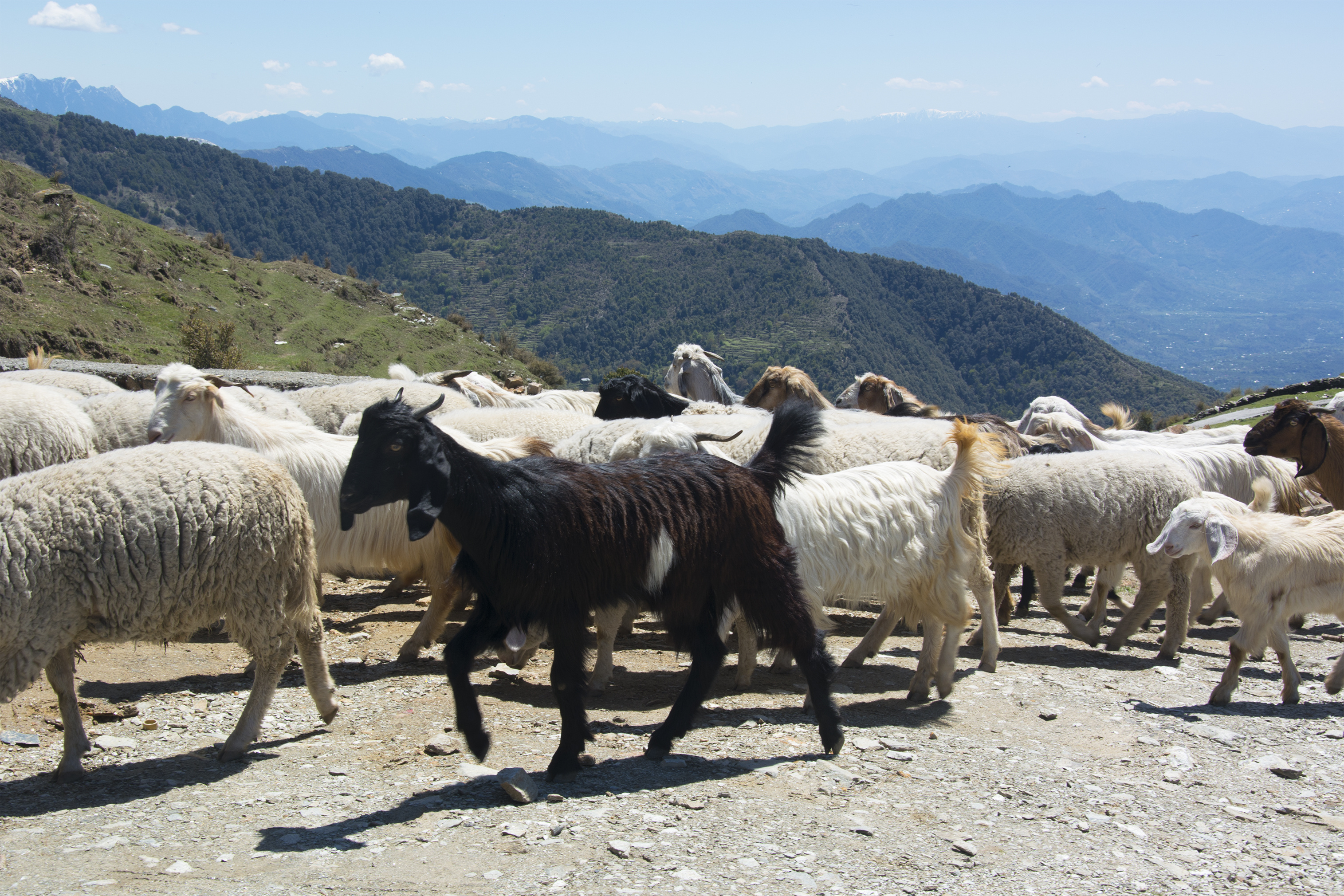
Who are the lost and scattered sheep of Israel?

But [Yeshua] answered and said, I am not sent but unto the lost sheep of the house of Israel. (Matt 15:24)

But go rather to the lost sheep of the house of Israel. (Matt 10:6)

And other sheep I have, which are not of this fold: them also I must bring, and they shall hear my voice; and there shall be one fold, and one shepherd. (John 10:16)

Deuteronomy 32:21, I will move them to jealousy with those which are not a people. I will provoke them to anger with a foolish nation. The term not a people is the Hebrew phrase lo-am. Curiously this same phrase occurs in several other references in the Hebrew Scriptures (Tanakh) in reference to the Northern Kingdom or House of Israel (Ephraim) and is repeated by several apostolic writers in reference to the “Gentiles” or “peoples of the nations” (which is the meaning of the Greek word ethnos translated as gentiles). (See Isa 7:8; Hos 1:9; 1 Pet 1:1; 2:9–10.) In Romans 9:25, Paul equates the “Gentiles” with the same people-group to which Hosea makes reference in Hosea 2:23. To whom is Hosea referring in his prophecy? (Read Hos 1:4,6; 4:15–17, chapter 5; 6:10–11; 7:1–11; chapter 8; etc.). Remember that the nation of Israel split into two groups at the time of Jeroboam and Rehoboam: the Northern Kingdom comprised of the ten northern tribes of Israel and referred to in Scripture as Ephraim, House of Israel and Samaria while the Southern Kingdom was known as Judah, the House of Judah and Jerusalem. 

Where are these Ephraimites today? The answer can be found in Genesis 48:14 and 16 where the patriarch Jacob is prophesying over the two sons of Joseph: Ephraim and Manasseh. Can you find any clues in these two verses that may point to a religious people-group in existence today on earth? What sign does Jacob make with his arms when placing them on the heads of his two grandsons? Is it coincidental that it is the sign of the cross? Then in verse 16, Jacob recounts his experiences with the Angel or literally Heavenly Messenger who “redeemed me from evil.” This is a reference to Genesis 31:1–11 where, while fleeing from Laban, Jacob’s adversary, he had a dream where the Messenger of Elohim calls himself the El of Bethel (or the El/God of the House of El/God). Who is the Messenger of Elohim who is also a Redeemer? (See Rom 3:24; Eph 1:7; Col 1:14; Heb 9:12.)

Finally, Jacob prophesies that his grandsons’ descendants would grow into a multitude in the midst of the earth. The word grow is the Hebrew word dagah/VDS from which the Hebrew word dag/DS or fish derives. This is why the ArtScroll Stone Edition Tanach translates this phrase as “may they proliferate abundantly like fish within the land.”

The question is then begged, what religious people-group on earth today can be associated with a cross, a Redeemer and a fish? Knowing this will give us a clue as to whom Paul and the other writers in the Testimony of Yeshua (NT) were referring when they equated the “Gentiles” with “a foolish nation” and “not a/my people.”

Deuteronomy 32:26, I will scatter them into the corners. How was this prophecy fulfilled to Israel? Who in Israel was scattered and forgotten? Certainly not the Jews. They were scattered, but not forgotten.

Verses 28–29 say of these people that they are void of counsel and Continue reading


Pharmakeia and Sorceries in the Last Days

Revelation 9:21, Sorceries. Gr. pharmakeia. Pharmakeia is a methodology to circumvent Elohim and to open the doorways into the supernatural. It is the mix of science along with magical arts, occultic or hidden, demonic, angelic or paranormal realm and medicine, potions, or herbs for sorcerous reasons to open the mind to put one in contact with what is beyond the gate or the boundaries YHVH has established between the natural and supernatural (including the demonic) realm.

The Satanic spirits in Revelation chapter nine inhabit the pit, and those who resort to pharmakaia are coming into contact with spiritual entities either from the pit, or from realm of darkness beyond this earth. Satan is both the angel of the bottomless pit (Rev 9:11) and the prince of the power of the air (Eph 2:2). 

There are gateways or portals down to the pit and out into the universe in either case to contact beings from other dimensions. 

There are good and evil portals. YHVH revealed to Jacob a good portal or gateway to heaven at the site of the future Temple Mount when he dreamed of the ladder to heaven. Yeshua is the gateway or doorway to the Father in heaven (John 1:51). But there are evil gateways that men an open up illicitly through pharmakeia or drug induced states. 

Biblical examples of individuals illicitly opening up gateways into the evil realm beyond man’s perception include the witch of Endor who summoned the dead (1 Sam 28:3ff). We also see this with the slave girl who was possessed with a spirit of divination and who followed Paul in Macedonia (Acts 16:16–18).

Those who come under the influence of pharmakeia put themselves into a drug-induced state to activate gateways into the supernatural realm. It’s a form of rebellion against YHVH’s established boundaries that man is not supposed to cross. Witchcraft is also taking something holy and exploiting it for personal purposes. This is what Samuel accused Saul of doing when he kept the cattle he was supposed to kill, so that he could at a later time offer up an illicit sacrifices without going through the proper Levitical protocols. Samuel equated this act of rebellion with witchcraft (1 Sam 15:23). Saul had this proclivity, for he had offered up a witchcraft sacrifice once before (1 Sam 13:9–13). Samuel rebuked him for it, yet Saul was willing knowingly to repeat the same mistake again, which was strictly forbidden.

Taking that which YHVH has ordained to be used legally one way and defiantly using it another way for one’s own selfish purposes is an act of rebellion and witchcraft.


Satan’s Last Days Wrath—A Divine Judgment Upon Rebellious Humans

Revelation 9:1,  A star fall from heaven. Likely Satan when he is cast out of heaven.

Revelation 9:1, Key to the bottomless pit. Elohim will give Satan the freedom to release evil spirits imprisoned in the abyss who will go forth to torment men as part of YHVH’s wrath against rebellious men. Perhaps this relates to the perennially enigmatic and troubling passage found in Jude 6 (cp. 1 Pet 3:18–20; 2 Pet 2:4). It seems that the evil, locust-like spirits may be the fallen angels that either rebelled with Lucifer and or were the ones who interacted with humans in the antediluvian world (Jude 6; 1 Pet 3:18–20; 2 Pet 2:4).

Revelation 9:1, Bottomless pit. This Greek term (abussos phrear) indicates a large, cavernous hole, pit or abyss with a small opening or orifice like a well and is found several other places in the book of Revelation (Rev 9:2, 11; 11:7; 17:8; 20:1, 3). The bottomless pit is analogous to the deepest sheol in the Tanakh (Deut 32:22; Ps 86:13; Isa 14:15) or tartaroo (2 Pet 2:4) and is the place where the angels who rebelled in the time of Satan are being held in chains of restraint awaiting their judgment day (see 2 Pet 2:4). It is where Satan will be cast at the beginning of the Millennium (Rev 20:1–3) and is to be distinguished from the lake of fire where Satan (and presumably his demons) will be cast at the end of the Millennium to be tormented forever (Rev 20:10).

This passage indicates that YHVH will open the bottomless pit and allow the evil spirits imprisoned therein to torment men for a period of time as part of his judgments against wicked men.

Revelation 9:2, Smoke. Wherever this pit is, it appears to be a place of fire, heat and smoke. The opening of the pit by Satan first releases so much smoke that it darkens the sun and air. This phenomenon is the first sign that the demons of the pit are about to be released. After this follows their release and their tormenting of unredeemed humans. This is the wrath of Satan against humanity that precedes the wrath of Elohim. Since Elohim is permitting these demons to torment humans, it is, in reality, an extension of his judgment or wrath against the wicked. Since unsaved humans have rejected Elohim, and more and more are becoming enamored with and turning to outright Satan worship, Elohim his turning them over to the powerful forces of darkness they are seeking over him. These humans will discover what it’s like to live in a hellish world where those they wish to serve have full reign to torment them—a world devoid of the protective grace of a merciful Creator. 

Revelation 9:3, Locusts. These locusts don’t fit the description of the Joel 1 locusts, which destroy all vegetation. These locusts do not (v. 4). Perhaps the vegetation of Joel 1 is a symbolic metaphor. If so, then is the vegetation of Rev 9:3 also symbolic? If so, how do we still reconcile these two passages, since the symbolic analogy of the one would be opposite the other?

These locusts are likely hybridized theriomorphic or animal-shaped descriptions of demonic spirits that have been released from the abyss where they have been kept imprisoned since their rebellion (see 1 Pet 3:19; 2 Pet 2:4), but who will be released to torment rebellious men as part of Elohim’s end time judgments.

Revelation 9:3, Power. (Gr. exousia) These scorpion, humanoid demons have the divine permission, physical and mental power, the authority and right, the ability and strength to torment unredeemed men.

Revelation 9:4, Those men…seal of Elohim. This is yet another proof that YHVH’s saints are on the earth during this period (the first half) of the wrath of Elohim, and that the pre-tribulation rapture theory is an unbiblical hoax. What is the seal of Elohim? If we let Scripture interpret Scripture, this seems to be a reference to the sealing of the Set-Apart Spirit of the saints (e.g. John 6:27; Rom 4:11; 2 Cor 1:22; Eph 1:13; 4:30; 2 Tim 2:19 cp. Rev 7:3).

Revelation 9:5, Not kill…tormented. Torment (Gr. basanizo) means “to test the quality of a metal; to question by applying torture; to vex with grievous pains (of body or mind), to torment; to be harassed, distressed.” The demon-locust humanoid creatures can torment and torture unsaved humans, but not kill them. Those who have the seal of Elohim on their foreheads will be untouched. It seems that this will be an amazing opportunity for the saints to evangelize the spiritually lost.

Revelation 9:5, Torment of a scorpion. The symptoms of most scorpions stings are relatively harmless, but the bark scorpion (Centruroides sculpturatus, also known as C. exilicauda), found in the American southwest, is an exception. This species of scorpion is venomous and can cause more serious injury and illness. Initial symptoms include immediate pain and sometimes numbness or tingling in the region stung. Serious symptoms, most common among children, include restlessness, muscle spasms, abnormal and random head, neck, and eye movements, anxiety and agitation, sialorrhea and diaphoresis. In some cases, a scorpion bite can prove fatal for children. In adults, tachycardia, hypertension, increased respirations, weakness, muscle spasms, and fasciculations may predominate.

Revelation 9:7, Locusts. Likely some demonic, grotesque gargoyle-like demonic creature (or chimera) that is currently inhabiting the bottomless pit, but that will be released at this time for YHVH’s intended purposes.


Let it rain on the dry ground of our lives!

Deuteronomy 32:1–2, Note the phrases: “words of my mouth,” “my doctrine,” “rain,” “my speech shall distill as the dew,” “small rain” and “showers.” Now read compare these phrases with Eph 5:26. What is Scripture talking about here?

Israel spent 40 years in a dry wilderness. By contrast, the Promised Land was a land flowing with milk and honey and was well-watered. Immediately before and after the giving of the Torah at Mount Sinai (Exod 20), there are references to human thirst and YHVH providing water for his people (Exod 15:22–27; 17:1–7 Num 20:2–1

3). During the Messianic Age (the Millennium), living waters will flow from Jerusalem (Zech 14:8) and those who refuse to come up to Jerusalem for the Feast of Tabernacles (Sukkot) will receive no rain on their land (Zech 14:16–19).

As you relate all these scriptures together, what is the bigger lesson YHVH is trying to teach us here pertaining to water and the word of YHVH?


Blog Scripture Readings for 9-16 Through 9-22-18

Aside

THIS WEEK’S SCRIPTURE READINGS FOR STUDY AND DISCUSSION:

Parashat Ha’Azinu — Deuteronomy 32:1-52
Haftarah — 2 Samuel 22:1-51
Prophets — Haggai 1, 2; Zechariah 1:1 – 8:23
Writings — 2 Chronicles 23:1 – 29:36
Testimony — Revelation 9:1 – 15:8

Our annual Scripture Reading Schedule for 2017-2018 is available to download and print.

Most of this week’s blog discussion points will be on these passages. If you have general comments or questions on the weekly Scripture readings not addressed in a blog post, here’s a place for you to post those. Just use the “leave a reply” link below.

The full “Read Through The Scriptures In A Year” schedule, broken down by each day, can be found on the right sidebar under “Helpful Links.” There are 4 sections of scripture to read each day: one each from the Torah, the Prophets, the Writings, and from the Testimony of Yeshua. Each week, the Torah and haftarah readings will follow the traditional one-year reading cycle.

Weekly Blog Scripture Readings for 9/16/18 through 9/22/18.


A Wake-Up Word to the Seven Churches of the Last Days

Will you pass the test and make it into YHVH kingdom? 

Life is a series of tests. We either pass or fail them. YHVH is the school teacher who determines whether we will pass or fail, not us. His Word is our text book that tells us how to pass. If we learn the lessons and put to practice the things we have learned, we will pass. If not, we will fail. 

The problem is that we’re not just in a regular school classroom where if we fail, it’s really not a big deal in the bigger scope of life. Our classroom is this life. Whether we pass or fail will determine not only whether we will obtain eternal life or eternal damnation, but if we pass, the grade we get will determine our level of rewards in YHVH’s eternal kingdom. There are a couple of things going on here.

When YHVH calls us with his holy calling and we respond, we have a choice. The choice we make will determine whether we will be the least or the greatest in his kingdom (Matt 5:19). If we choose to obey him only a little, we will be least in his kingdom. If we choose to obey him all the way, we will be the greatest in his kingdom. Our level of obedience to his commandments determines our level of rewards in his kingdom.

If we give YHVH our all, like Ruth did when she chose to forsake the world and follow Naomi, we can become the bride of Yeshua. Ruth is a prophetic picture of Yeshua’s bride. The heart-attitude of the bride is: your people will be my people, your Elohim will be mine, and where you go, I will go.

Yeshua refers to his bride in the book of Revelation. She is unreservedly faithful to him. Yeshua’s bride is comprised of those who are follow the Lamb of Elohim wherever he goes; they don’t just follow him only when it’s convenient!

And I looked, and, lo, a Lamb stood on the mount Sion, and with him an hundred forty and four thousand, having his Father’s name written in their foreheads. And I heard a voice from heaven, as the voice of many waters, and as the voice of a great thunder: and I heard the voice of harpers harping with their harps: and they sung as it were a new song before the throne, and before the four beasts, and the elders: and no man could learn that song but the hundred and forty and four thousand, which were redeemed from the earth. These are they which were not defiled with women; for they are virgins. These are they which follow the Lamb whithersoever he goeth. These were redeemed from among men, being the firstfruits unto God and to the Lamb. And in their mouth was found no guile: for they are without fault before the throne of God. (Rev 14:1–5)

Yeshua demands total and unreserved commitment from his disciples. He said that his followers would need to love him more than anyone else including one’s closest family Continue reading


Double-Speak and Double-Think in Christian Theology

Deuteronomy 31:10–13, You shall read this Torah before all Israel. Verses like this tend to expose the theological confusion that occurs in the minds of many Christian Bible teachers. For example, Christian commentator Matthew Henry on this verse writes about the need to read the Word of Elohim and that doing so will “help us to keep his commandments.” Yet elsewhere he says in the same commentary about the same laws that the commandments or laws of YHVH “are done away with.”

Statements like these are representative of a split and incongruous, double-speak and double-think on the part of many mainstream church teachers and people when it comes to the commandments or laws of Elohim. Some laws, they say, we are to keep (e.g. thou shalt not murder, lie, commit adultery, etc.), but other laws we can disobey (e.g. the Sabbath, dietary laws, and biblical feasts).

Is it possible to have it both ways: to believe that we need to keep his commandments, yet teach they are done away with? If so, then what is the meaning of such biblical phrases pertaining to YHVH’s Torah or Word as “forever,” “for a thousand generations,” “the same yesterday today and forever,” “till heaven and earth pass away,” “I change not,” and “think not that I came to destroy the Torah-law?” Is ­YHVH’s Word inconsistent and contradictory, or is this, instead, the case with the thinking of men? Is YHVH’s immutable character flawed with regard to keeping his Word, promises and standards or is man the one at fault?

Do we have a high enough view of YHVH Elohim and fear him and tremble at his Word (Isa 66:2), or have we, in reality, to demoted the veracity of his Word by contorting YHVH and his Word to fit the mindset of changeable and inconsistent man (which the Scriptures define as idolatry)? Have we bought into the lie that the serpent proffered at the tree of knowledge in the Garden of Eden when he told the man and the woman that YHVH really did not mean what he said and that humans can take the “have it your own way” and “pick and choose” approach when it comes to obeying the Word of YHVH (a philosophy that forms the basis for the religious movement called secular humanism, which is at the heart of all the religions of the world—including much of Christianity—except the true religion of the Bible)?

How many aspects of Christian theology are no more than a thinly veiled version of the religion of humanism in disguise? These are tough questions that we as redeemed Israelites need to ponder seriously. Let’s not forget the words of Yeshua in John 14:15, “If you love me, keep my [Torah] commandments” and the words of the apostle in 1 John 2:5–5, “He that says, ‘I know him,’ and does not keep his [Torah] commandments is a liar and the truth is not in him. But whosoever keeps his Word in him truly is the love of Elohim perfected: hereby know we that we are in him.”

The bottom line as to why man has a hard time submitting to all of YHVH’s commandments is nowhere stated more concisely in the Bible than in Romans 8:7,

[T]he carnal mind is enmity against Elohim: for it is not subject to the law of Elohim, neither indeed can be.