Called to the ministry? Here’s what to do…

Do you have a ministry call on your life? If you’re a disciple of Yeshua, then you should. Yeshua has commissioned every saint to help fulfill the great commission to spread the gospel to the world. Below are some basic guidelines on how to know that you’re in the perfect will of Elohim for the ministry to which he has called you.

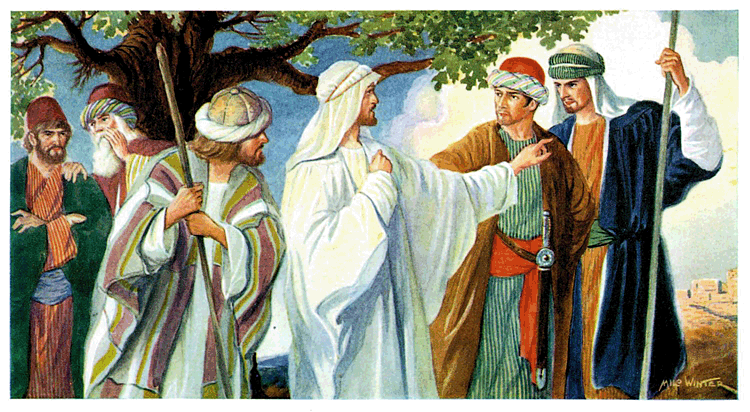
Matthew 10:5ff, Yeshua sent out. The Commissioning of the Twelve Disciples.

There are several steps one must go through when receiving a ministry commission from Yeshua. The following steps are based on Yeshua’s commissioning his disciples in Matthew 10. As modern-day disciples of Yeshua, we need to take these into consideration when assuming a ministry role. These are the requirements of his laborers who will work in his harvest field (see Matt 9:37 for context).

  • Yeshua calls one into the ministry (Matt 10:1). Some people go into the ministry as a career like any other job by their own choice. This is unbiblical. Involvement in Yeshua’s ministry is by his invitation only.
  • After calling one into the ministry, there is a time of training. This is the biblical norm. For some, it was five years (e.g. the Levites), or forty years (Moses and Joshua). David had a period of training before becoming king, as did Paul the apostle and Elisha. For Yeshua’s disciples, it was three-and-one-half years. The Matthew ten account is part of the disciples’ training program.
  • After calling them, Yeshua gives his disciples their marching orders by telling them where to go and not to go (Matt 10:5–6). They were to go to the lost sheep of the house of Israel, although, later on Yeshua instructed them to go the Gentiles. Paul even taught in several places that the lost sheep of Israel were to be found among the Gentiles, as the ancient biblical prophets predicted they would be.
  • Yeshua then instructs them what their ministry was to be (Matt 10:7–8). They were to do exactly as Yeshua himself did: preach the gospel of repentance and the kingdom of Elohim, and to heal the sick.
  • He then gives them instructions pertaining to travel arrangements — what they were to take on their journey, where they were to stay, and how to act when encountering resistance (Matt 10:9–15). This includes lodging, food and financial remuneration. On the latter point, today many itinerant evangelists flagrantly violate Yeshua’s strictures in this regard and have become nothing more than travelling salesmen and peddlers always with their hands out for financial gain. They have simply become merchandisers of the gospel, sadly.
  • Next, Yeshua warns his disciples against persecution (Matt 10:16–26). He assumes that persecution would be a natural result of preaching the gospel. Conversely, it could be assumed that something is out of spiritual order when one preaches the gospel and persecution doesn’t occur. 
  • Yeshua then instructs his disciples about fear — who to fear and not to fear. They are to fear YHVH, not men (Matt 10:27–31). This is an important point, since preaching the gospel to the lost can be intimidating, which is why so few do it. Yeshua promises divine protection for his disciples who preach the gospel as he has instructed (Matt 10:29–30).
  • The workman is worthy of his hire. Yeshua promises spiritual rewards to those who preach the gospel (Matt 10:32–33).
  • For those who are called into Yeshua’s ministry, he demands total commitment. One must put Yeshua first above all other human relationships. For this, expect rejection from family and friends (Matt 10:34–39). 
  • Again, Yeshua holds out the promise of spiritual rewards for those who heed his call to become a disciple who works in his spiritual harvest field (Matt 10:39 cp. Matt 9:37).
 

Yeshua’s Disciples—Multilingual?

Matthew 10:2–4, The names of the twelve. The disciples’ names reflect the multilingualism that had influence over Jews of the first century in the land of Israel. Likely, Yeshua and his disciples were multilingual. They spoke Hebrew and Aramaic and likely had some knowledge of Greek as well.

  • Simon Peter. Heb. Shimon (from shama) meaning “heard.” Gk. petros meaning “a rock or stone.”
  • Andrew. Gr. Andereas (from aner) meaning “manly.”
  • James. Heb. Jacob meaning “heal catcher, supplanter.”
  • John. Heb. Jochanan (Yah and chanan) meaning “YHVH has graced, shown mercy.” 
  • Philip. Gk. philoppos (philos meaning “friend” and hippos meaning “horse”) meaning “a friend or lover of horses.”
  • Bartholomaios. Aram. meaning “son of Tolmai.”
  • Thomas. Aram. meaning “coupled or joined together, twin.”
  • Matthew. Heb. Matthaios or Mattiyahu meaning “gift of YHVH.” 
  • Thaddaeus. Of uncertain origin. Could be Greek or Hebrew.
  • Judas. Heb. Yehudah meaning “praised.”
 

Abraham, a man of reluctant faith?

The story of Abraham leaving Babylon reveals the great mercy of Elohim in one man’s life. Romans 12:2 talks about finding the good, better and perfect will of Elohim for our lives. As much as we may respect and even venerate Abraham as the father of the faithful, it appears that he didn’t follow Elohim’s instructions perfectly at first. It wasn’t that Abraham was out of the will of Elohim, but that he may not have been in the perfect will of Elohim. Despite human weakness and reluctance to immediately follow the Creator’s instructions, YHVH was still merciful and gracious with the spiritual father of our faith.

Genesis 12:1, Get thee out of thy country. Did Abram immediately leave his father’s house and go directly to the country that YHVH would show him, or did he fulfill YHVH’s will for his life in incremental steps? (Compare Gen 11:31 with 12:1.) Did Abram leave his father’s house completely, or take part of his father’s house with him including his father and nephew? Haran is located in northern Mesopotamia and is nowhere near Canaan. When Abram finally made his way to Canaan minus his father, did he still have part of his kindred with him, something YHVH instructed him to leave behind (Gen 12:1)? Did his nephew Lot prove to be a help or a hindrance to Abram in fulfilling YHVH’s mission for his life in a new land?

What lessons can we learn from this account? First, YHVH is gracious to us even when we don’t obey him completely and immediately. Scripture still refers to Abraham as the father of the faithful or faithfulness (Rom 4:12, 16). Second, Abram was a man of prominence in Babylon (or Chaldea), was recognized as a mighty prince (Gen 23:6), and was 75 years old when YHVH asked him to leave the comforts of life in Babylon to trek across the desert to the backwoods region of Canaan. No doubt, this was not an easy move for Abram for the reasons stated above.

What did Yeshua tell his disciples about the sacrifices that would need to be made to be a follower of YHVH? (Matt 10:35–39). What did Yeshua say would be the eternal rewards of those, who like our father Abraham, set out in faith for a new spiritual destiny? (Matt 19:29) What physical obstacles stand in your way of fulfilling YHVH’s spiritual calling, mission and destiny for your life?

Presently, YHVH is calling his people out of the spiritual Babylon (Rev 18:4) of man-made religious systems that, to one degree or another, have supplanted the simple truths of YHVH’s word with doctrines and traditions of men. Anything that takes precedence in the hearts and minds of men that is contrary to the Bible is, by biblical definition, an idol. End times spiritual Babylon is full of idolatry. It is a confused mixture of truth and lies. YHVH called Abram out of Babylon, and he’s calling his people out of Babylon today to worship and obey him in Spirit and truth. His end time saints will be those who follow Yeshua the Messiah unconditionally wherever he goes (Rev 14:4–6). Their chief identification mark is that they follow the Torah-commandments of Elohim and have the faith of Yeshua—their lives have been transformed by the message of the gospel (Rev 14:17; 12:14).


Blog Scripture Readings for 10-14 Through 10-20-18

Aside

THIS WEEK’S SCRIPTURE READINGS FOR STUDY AND DISCUSSION:

Parashat Lekh L’kha — Genesis 12:1 – 17:27
Haftarah — Isaiah 40:27 – 41:16
Prophets — Joshua 15:1 – 21:45
Writings — Psalms 15:1 – 20:9
Testimony — Matthew 10:27 – 13:58

Our new annual Scripture Reading Schedule for 2018-2019 is available to download and print. If you are still working through 2017-2018’s Scripture Reading Schedule, the link will still be available on the right sidebar under “Helpful Links”.

Most of this week’s blog discussion points will be on these passages. If you have general comments or questions on the weekly Scripture readings not addressed in a blog post, here’s a place for you to post those. Just use the “leave a reply” link below.

The full “Read Through The Scriptures In A Year” schedule, broken down by each day, can be found on the right sidebar under “Helpful Links.” There are 4 sections of scripture to read each day: one each from the Torah, the Prophets, the Writings, and from the Testimony of Yeshua. Each week, the Torah and haftarah readings will follow the traditional one-year reading cycle.

Weekly Blog Scripture Readings for 10/14/18 through 10/20/18.


What is the spirit of man?

Paul the apostle in 1 Thessalonians 5:23 makes an interesting statement about the human makeup that appears to be more pagan Greek than biblical Hebraic in nature.

And the very Elohim of peace sanctify you wholly; and I pray Elohim your whole spirit and soul and body be preserved blameless unto the coming of our Lord Yeshua the Messiah. (emphasis added)

In the highlighted phrase above, each of the words body, soul and spirit are separated by the word  and. This same grammatical construction exists in the biblical Greek as well: “spirit and [Gr. kai] soul and [Gr. kai] body.” This shows the deliberate separateness of these three components of a person’s makeup. In Paul’s mind, the soul and spirit of man were two separate entities. While the ancient Greek philosophers had a clear understanding of this, the Hebraic Bible writers seemed to have often conflated the idea of the soul and spirit of mans; that is to say, they didn’t clearly distinguish between the two. This doesn’t, however, mean that they didn’t understand the uniqueness of man’s spirit, as opposed to his soul, as we will soon see. What are we to make of this?

If we are to believe Paul, man is a tripartite being composed of a body, a soul and a spirit. In biblical Hebraic thought as presented in the Tanakh (Old Testament), the soul and spirit are virtually indistinguishable and the terms nephesh (soul) and ruach (spirit) are sometimes even used interchangeably. Paul, however, in his letter to the saints at Thessalonica puts a finer  point on the differences between the soul (or the mind, will and emotions of a person, or their unique personality) and spirit of man (or that divine spark in each person that, when spiritually energized by the Spirit of Elohim, is what connects a person to Elohim, who is a Spirit) by differentiating between the two. Additionally, the separateness of man’s soul and spirit is specifically referred to in Hebrew 4:12 where we read,

For the word of Elohim is living and powerful, and sharper than any two-edged sword, piercing even to the division of soul and spirit, and of joints and marrow, and is a discerner of the thoughts and intents of the heart. (emphasis added)

The fact that  Paul mentions the spirit first in 1 Thess 5:23 seems to suggest that YHVH created the spirit of man first, then his soul, and then placed both of them in a physical body.

Bible Scriptures That Speak of the Personal Spirit of Man

While ostensibly the writers in the Tanakh may not have made as clear a delineation between the soul and spirit of man as the Greek philosophers or as Paul and the Continue reading


What was the first and original language?

Genesis 11:1, The whole earth…one language. That language was Hebrew. How do we know that? Because all the names of people before the confounding of the languages were Hebrew names with Hebrew meanings (e.g. Adam, Eve, Seth, Cain, Abel, Noah, etc.). The meanings of these names don’t correlate one hundred percent across the board to any other language except Hebrew.

Moreover, the linguistic science of Edenics shows evidence that all the languages of the world trace back to Hebrew (for proof, see the work of Isaac E. Mozeson in his book, The Word, The Dictionary That reveals the Hebrew Source of English).

Some scholars speculate that in ancient times there existed a language called Proto-Hebrew that was akin to but different from biblical Hebrew. This is pure speculation, since no examples of this language have ever been found. The Biblical record proves that Biblical Hebrew was the original language of creation.