What happens after the return of Yeshua to this earth — after he has put down all of his enemies in battle (Zech 14:1–3; Rev 17:14; 19:11–21)? This we know. He shall set his feet on the Mount of Olives (Zech 14:4) even as he ascended from the same place (Acts 1:9–12), and YHVH-Yeshua shall become king over the earth (Zech 14:9). He shall be King of kings (Rev 17:14; 19:16) and rule with a rod of iron over the whole earth (Rev 12:5; 19:15) for one thousand years (Rev 20:2, 3, 4, 6, 7). This is commonly referred to as the Millennium. This is the earth that Yeshua declared that the meek would inherit (Matt 5:5).
A Quick Overview of the Millennium
What will the 1000 year-long Millennium be like? The Scriptures give us some insights into life on earth during this time.
Elohim will live with his people. (Ezek 37:26–28)
David will rule as King over Israel (Ezek 37:24–25)
YHVH’s annual feast will be kept by all people (Ezek 46:3–6; cf. Col 2,16–17)
YHVH’s government will be established on Mount Zion in Jerusalem: Torah will go forth from Mount Zion and the nations will go up to Mount Zion to worship YHVH in the house (temple) of YHVH (Mic 4:1–2)
A Highway of YHVH, or a highway of holiness will lead to Zion. (Isa 35:8–10)
Whether literal or spiritual, living waters will flow from Jerusalem and Yeshua’s throne. Water was flowing from under the threshold of the temple toward the east (Ezek 47:1; Zech 14:8)
On the bank of the river there were very many trees on each side (Ezek 47:6–9)
People will live to a very old age. (Isa 65:20)
Crowds of people will flock to Jerusalem. (Zech 2:1–4; Isa 49:14)
The temple in Jerusalem will be rebuilt. (Zech 6:15; 14:20–21; Hag 2:6–9)
The Messiah will be king over the whole world. (Zech 6:9–13; Isa 11:1–5; Rev 20:6; 5:9–10)
The nations which do not want to serve and obey YHVH will be destroyed. (Isa 60:12; Zech 14:16–19; Isa 9:5–7)
What Happens After the Millennium?
After the thousand years is completed, Satan the devil who has been bound in the bottomless pit (Rev 20:1–3) will be released briefly to test those on earth as to their faithfulness to King Yeshua (verses 7–8). The devil will then be cast into the lake of fire forever (verse 10).
Next is the final judgment day — commonly called the great white throne judgment. At that time, all the dead, and any others who have died in Yeshua and have yet to receive their reward of eternal life, will be raised from the dead to stand before the Almighty. Those whose names are not written in the Book of Life will be cast into the lake of fire (Rev 20:11–15).
As discussed earlier, I believe that the New Jerusalem will come into view at Yeshua’s return where it will be hovering over the earth during the wrath of Elohim period and during the 1000 year-long Millennium. However, the Scriptures speak of a new heavens and new earth (Isa 65:17; 66:22; 2 Pet 3:13; Rev 21:1).
Before this happens, something very dramatic must first happen.
The Heavens and Earth to Pass Away; Arrival of New Heavens and Earth
There comes a time in the chronology of end times events that accompany the return of Yeshua when YHVH will pour out his wrath upon rebellious men. The Bible refers to this as “the day of YHVH” or “the day of his wrath” — a phrase which occurs more than two dozen times in prophetic writings of Isaiah, Ezekiel, Joel, Amos, Obadiah, Zephaniah, Zechariah and Malachi. What is this day?
Is the “day of YHVH’s wrath” a literal day, or a time period, since the Hebrew word for day (Heb. yom)can mean both? The prophet Isaiah may give us a clue. In several places, he mentions “the day of YHVH’s vengeance” (or words to this effect). This is the time period when YHVH will judge the nations including Babylon the Great, which is in existence at Yeshua’s second coming (see Rev 17, 18 and 19). In three places, Isaiah indicates that the day of YHVH will last for one year (Isa 34:8; 61:2 and 63:4). Interestingly, in Isaiah 63:4, the prophet couples the idea of the day of YHVH’s vengeance being a year long with the jubilee year — “the year of my redeemed has come.” This occurs as the Messiah (the subject of Isa 63:1–6) judges the enemies of Israel (notably Edom) as he is at the same time about to redeem (i.e. regather and return scattered Israel to its Promised Land inheritance.) It appears that while Yeshua is judging Israel’s enemies at his second coming, he will at the same time begin regathering the lost and scattered 12 tribes of Israel in a major way. Yeshua seems to allude to this in Matthew 24:31
What Is the Wrath of YHVH/Elohim?
In the Book of Revelation, the term wrath of God/Elohim or similar language is found ten times in reference to YHVH’s fierce judgments against unrepentant and rebellious sinners. It is my belief that these judgments are yet to occur and are connected with the end times just prior to the return of Yeshua the Messiah.
But in the context of the full counsel of YHVH’s Word, what specifically is the wrath of Elohim/YHVH?
The term “the wrath of Elohim” or similar language is used in numerous places in the Scriptures, and refers to YHVH’s bringing severe judgments against men for their wickedness. Listed below are all the instances in the Scriptures where the phrase “the wrath of Elohim” or similar language is found.
The wrath of Elohim came upon the children of Israel when they rebelled against YHVH (Ps 78:31).
All those who are ungodly will experience the wrath of Elohim eventually (John 3:36; Eph 5:6; Rom 1:18; 2:5–8; Col 3:6).
YHVH’s wrath was evidenced at various times against the ancient Israelites (2 Chron 24:18; 29:10; 2 Chron 30:8; 2 Chron 36:16; Ezra 5:12; Ezek 5:13; 7:19; 8:18).
Elohim’s wrath came against the nations at various times for their wickedness (Jer 10:10; Nah 1:2; Jer 25:15; Mic 5:15; 2 Pet 2:9).
YHVH’s wrath was expressed against Jerusalem at its fall (Isa 51:17, 20).
YHVH’s wrath was expressed against Edom (Isa 63:3, 5, 6; Ezek 36:5–6).
YHVH’s wrath was expressed against the nations for their wickedness toward Israel (Deut 32: 41,42; Mic 5:15; Zec 8:2).
YHVH’s wrath will be poured out in end times against his enemies (Isa 66:15).
The seven trumpets of the Book of Revelation are the wrath of Elohim (Rev 6:16–17).
The seven bowl judgments of the Book of Revelation are the wrath of Elohim (Rev 11:18; 14:10; 15:1, 7; 16:1,19).
As we can see from the evidence, the Bible records numerous “wrath of Elohim” events at various times throughout the long time span of biblical history. Whenever YHVH intervenes in the affairs of men and brings judgment against the wicked, this is the wrath of Elohim. In this study, we are dealing with the wrath of Elohim in the last days prior to the return of Yeshua as prophesied in the Book of Revelation.
When Does the Period of YHVH’s Wrath — the “Day” of YHVH Begin?
As noted earlier in this study, the end times wrath of Elohim occurs after the great tribulation. This we know from Matthew 24:29 where Yeshua describes events that will occur “immediately after the tribulation.” These events (the sun be darkened, the moon not giving its light, the stars falling from heaven, and the powers of heaven being shaken) occur at the sixth seal, which describes identical cosmic disturbances (Rev 6:12), and this event is described as the beginning of the day of YHVH’s wrath (verse 16).
At this time, Yeshua will be coming in the clouds of heaven (Matt 24:30) in the midsts of great heavenly signs and wonders (verse 29; Rev 6:12–14), and he will gather his elect from the four corners of the earth (verse 31; Rev 7:1–16). But the Scriptures still don’t say that he has “touched down” on earth yet. All eyes will see him in the earth’s atmosphere (Matt 24:30). They shall all see “the face of him who sits on the throne” and will know that the time of “the wrath of the Lamb” has come (Rev 6:16). Where else do we see the throne of Elohim and the Lamb together? The Book of Revelation records several instances where this occurs (Rev 5:1, 6, 13; 7:10,17; cp. 21:23; 22:3). Revelation 21:23 and 22:3 tie the throne of Elohim, the Lamb (Yeshua), the temple of Elohim with the New Jerusalem. They are together. What can we make of this? Fasten your seat belts! The answer may surprise you. It is very likely that when Yeshua appears in the clouds, he will be accompanied by the New Jerusalem, the heavenly temple and the throne of Elohim. In other words, in a certain sense, heaven will “descend” into the earth’s atmosphere, and will come into view just after the great tribulation and at the sixth seal. It seems very possible, if my analysis is correct, that the New Jerusalem may be hovering in the earth’s atmosphere (where the clouds are) for all humans to see with their natural eyes!
Not unlike treasure hunters examining a map for clues leading to a buried treasure, or an archeologist carefully scrutinizing ancient artifacts for information about lost civilizations, or an engineer diligently studying blueprints in order to construct a mechanical device or a building, we have briefly examined some of YHVH’s spiritual blueprints found in the Scriptures to give us clues about the nature and order of end-time events. Understanding the seven biblical feasts, the seven stations in the tabernacle of Moses and the various steps of the biblical wedding will help us to decode the mysteries surrounding the events pertaining to the second coming of our Master, Yeshua the Messiah.
Introducing the Olivet Prophecy
Now let us carefully investigate another set of spiritual blueprints: Yeshua’s prophecy in Matthew 24 and 25, commonly called the Olivet Prophecy.
Having a working knowledge of all these “blueprints” will help us to discover who we are as a people in the eyes of YHVH, where we have come from, where we are presently, and where we are going—that is, what the future holds for us, and what our spiritual destiny or divine inheritance is. Only then will we understand the end-time prophetic events leading up to the second coming of Yeshua, and we will learn what our role will be to play in them.
As we begin to examine Matthew 24 and 25, it is important first to note the chronological positioning of this prophecy in the context of the passages before and after this pivotal chapter. The chapters that precede Matthew 24 prophetically speak of precursory events leading up to the second coming of Yeshua, while those that follow Matthew 24 prophetically delineate events that occur after his return.
Matthew 24 sits like a diamond in the midst of a brilliant gold setting. It speaks of the order of end time events pertaining to the second coming of Yeshua the Messiah, our beloved King, Redeemer and Savior. Listed below is a chronology of events as Matthew lays them out, more or less, in the order in which they will occur prophetically. Many of these passages will be elucidated upon later in this book. It is important that we present the overall layout of end-time events here and now before studying the individual components in detail later.
Deuteronomy 32:1–2, Words of my mouth…rain. Note the phrases: “words of my mouth,” “my doctrine,” “rain,” “my speech shall distill as the dew,” “small rain” and “showers.” Now read compare these phrases with Eph 5:26. What is Scripture talking about here? Israel spent 40 years in a dry wilderness. By contrast, the Promised Land was a land flowing with milk and honey and was well-watered. Immediately before and after the giving of the Torah at Mount Sinai (Exod 20), there are references to human thirst and YHVH providing water for his people (Exod 15:22–27; 17:1–7 Num 20:2–13). During the Messianic Age (the Millennium), living waters will flow from Jerusalem (Zech 14:8) and those who refuse to come up to Jerusalem for the Feast of Tabernacles (Sukkot) will receive no rain on their land (Zech 14:16–19). As you relate all these scriptures together, what is the bigger lesson YHVH is trying to teach us here pertaining to water and the word of YHVH?
Deuteronomy32:8, Children of Israel. The Septuagint (LXX) has “angels of God,” the ESV has “sons of God,” and the Dead Sea Scrolls (DSS) has “children of God.” The LXX and ESV references could be a reference to the fallen angel, demon-nephilim or sons of Elohim reference found in Genesis 6:2 who along with their descendants founded kingdoms and empires that were opposed to Elohim. This alternate rendering possibly makes more sense, since Israel was not yet a nation when the Almighty assigned the nations to the heathens and the demon-gods or elohim that he placed over them and that they worshipped in place of the true YHVH Elohim. On the other hand, perhaps YHVH arranged the heathen in their countries around the future land of Israel, and those heathen living therein were merely squatters illegally inhabiting the Promised Land before the children of Israel were a nation.
Deuteronomy32:14, Blood of the grapes. What is Torah referring to in this interesting, rather arcane phrase? Compare this with a parallel passage found in Genesis 49:11, which is clearly Messianic in nature. Now add into the mix Leviticus 17:11; Revelation 1:5; 7:14; Matthew 26:27–28; Romans 3:25; Ephesians 1:7; Colossians 1:14; John 15:1–5 and finally John 6:53–56. In the last passage listed, is Yeshua advocating some bizarre cultic rite involving cannibalism, or is he relating back to these Torah passages that are Messianic in nature and relating them to his redemptive work at the cross, which believers commemorate when they take communion at Passover?
Deuteronomy 32:15,Yeshurun. The name Yeshurun is a poetic name for Israel and means “upright, straight or just.” YHVH ascribed this august title to Israel indicating that Israel was not to deviate from the high standards demanded by YHVH (The ArtScroll Stone Edition Chumash, p. 1103). This is a prophecy about what would happen to Israel once in the Promised Land. They forsook the one who had redeemed them and blessed them. Compare this with Yeshua’s admonition to the Laodicean believers in Revelation 3:14–21 (especially note verse 17), which is a description of the contemporary American Christian church, much of which preaches an “easy-believism,” health and wealth, pop-psychology, “come to Jesus and everything will be all right” “gospel” message. Just because you now a part of a more Hebraically oriented congregation does not mean that you have shed off this kind of thinking and its accompanying lifestyle and that this prophecy does not apply to you. Selah (ponder and reflect).
Do you sense that the world is going stark raving mad and crazy all around you? That the Antichrist demonic forces of hell and death have been unleashed and are waging a rabidly fierce battle to the death against all that is good as defined by the Bible? The natural human reaction in light of this is either flee or to fight. What should the saint do?
The Bible makes it clear. There is a time to fight and a time to flee. I don’t believe that now is the time for most of us to flee. Where would we flee to anyway? No. We must pray for boldness to preach the gospel as the early saints did in the book of Acts even in the face of life threatening circumstances (Acts 4:23–31).
Hopefully, these commentary notes, which I have just written this morning, will encourage us to do just that. This manna gleaned from the Word of Elohim has definitely encouraged me.
Be blessed and strengthened in Yeshua the Messiah who has overcome sin and death and made us partakers of his victory!
2 Timothy 1
2 Timothy 1:6,Stir up.What in us needs stirring up from time to time? Simply this: boldness to share the gospel with those around us as we discuss in the next verse.
2 Timothy 1:7, Spirit of fear [Gr. deilia]. Deilia denotes “timidity or cowardice.” The opposite of deilia is shame (v. 8), but shame of what? The context is clear here. It shame of the testimony or gospel of Yeshua and of standing up for those who are being persecuted for preaching the gospel (v. 8). For fear of what others will think, too many believers fail to share the gospel with those around them. Yeshua referred to this as putting one’s lamp under a bushel basket when, instead, he called his disciples to be like light on a hill (Matt 5:13–15) and commissioned them to take the gospel to the world (Matt 28:18–20; Mark 16:14–18). For too many saints, the great commission has become the great omission!
What have the saints to fear when Yeshua has given them the victory over sin and death (1 Cor 15:54–56)? Nay, through Yeshua the Messiah, the saint can do all things (Phil 4:13), and has become more than a conqueror (Rom 8:37), for greater is he that is in us than he that is in the world (1 John 4:4). After all, if Elohim is for us, who can be against us (Rom 8:31)? This means that YHVH will give us the boldness to share the gospel message with those around us, even as he gave the early disciples the boldness to do so when they asked him for it in the face of life threatening persecution (Acts 4:23–31).
Power [Gr. dunamis]…love [Gr. agapē]…sound mind [Gr. sōphronismos]. Dunamis refers to miraculous power or strength. Agape denotes “affection or benevolence” and, in Scripture, refers to the love of Elohim for his Son, for the human race, believers for Yeshua, the saints for one another, and is a fruit of the Spirit.
Sōphronismos denotes “a well-balanced, self-controlled or disciplined mind.” In other words, YHVH has equipped the saint with everything he needs to counteract the natural tendency toward fear in difficult situations. We have the miraculous power of the Spirit of Elohim working within us, the fruit of the Spirit of love, and a well-balanced and self disciplined mental state that will give in neither to irrational nor to naturally occurring human fear in the face of difficult situations.
What is Paul saying here in contrast to the spirit of fear or timidity and being ashamed of the testimony of Yeshua (v. 8)? He is declaring that Elohim has given his saints the means, power and ability to share the gospel with those around them and to stand up for the testimony of Yeshua in the face of persecution rather than succumbing to the natural tendency to pull away in timidity or cowardice.
Elsewhere, John declare that there is no fear in love, that perfect love casts out fear, and that the saint’s source of love is from the Father in heaven (1 John 4:18–19). If we are full of the love of Yeshua for others, then we will neither be afraid of what they think nor will we be ashamed to share the gospel with them, for our desire to see them saved will override all fear including that of criticism, mocking or rejection by others. The example of this can be illustrated by a house that is on fire and that contains sleeping occupants who are unaware of the fire that is about to kill them. Without thinking and in total boldness, a good Samaritan will break into the house, rush in yelling and screaming for the people to wake up and escape. He will do so boldly and without concern for what those in the house may think. In a sense, this should be our approach to those around us who are spiritually lost and in danger of being cast into the lake of fire.
2 Timothy 1:9, Before time began.YHVH Elohim established his plan of salvation for mankind through the redemptive life and death of Yeshua the Messiah before the world began (Rev 17:8; Acts 15:18; Rom 16:25; Tit 1:2; 1 Pet 1:20). Additionally, YHVH has chosen each saint through Yeshua before the foundation of the world (Eph 1:14; Rom 87:29–30; 11:2; Acts 18:38). That is, he knew each person by name who would accept his gift of salvation (Rev 13:8; 17:8) and, by implication, he also knew those who wouldn’t. Moreover, the kingdom of Elohim or heaven has been prepared for the saints from or before the foundation of the world (Matt 25:35).
2 Timothy 1:10, Life [Gr. zoe] and immortality [Gr. aphtharsia]. Zoe refers to life in it all of its aspects both in physical and spiritual dimensions. Aphtharsia denotes “incorruptibility or generally unending existence.” Through Yeshua, the saint has both physical and spiritual life that will extend past the final curtain of physical death and will continue unendingly into eternity. This is the message and power of the gospel in a person’s life through a relationship with Yeshua.
2 Timothy 2
2 Timothy 2:25–26, Grant them repentance.This verse indicates that sinful humans can’t even repent of sin properly on their own strength. Repentance is a gift that YHVH grants to those who have a heart for it—that they will come to their senses and turn from falling prey to the snares of the devil that have bound them in sin. Moreover, verse 25 indicates that YHVH may or may not grant people this gift.
Elsewhere we read that YHVH is not willing that anyone should perish, but desires that all men everywhere come to repentance (Acts 17:30; 2 Pet 3:9). From these scriptures, we may conclude that whether YHVH grants the gift of repentance or not depends on whether a person is sick enough of his sin to cry out to YHVH for help in desperation for deliverance.
This gift of repentance can occur at the beginning of one’s spiritual walk as they are coming to faith, or later down the road when one is repenting of reoccurring sin that, in their own strength, they feel powerless to overcome.
This gift comes as a result of trusting YHVH completely and not relying on one’s own strength to overcome sin. Faith in Elohim and humility on the part of the sinner is the key that unlocks access to the gift of repentance.
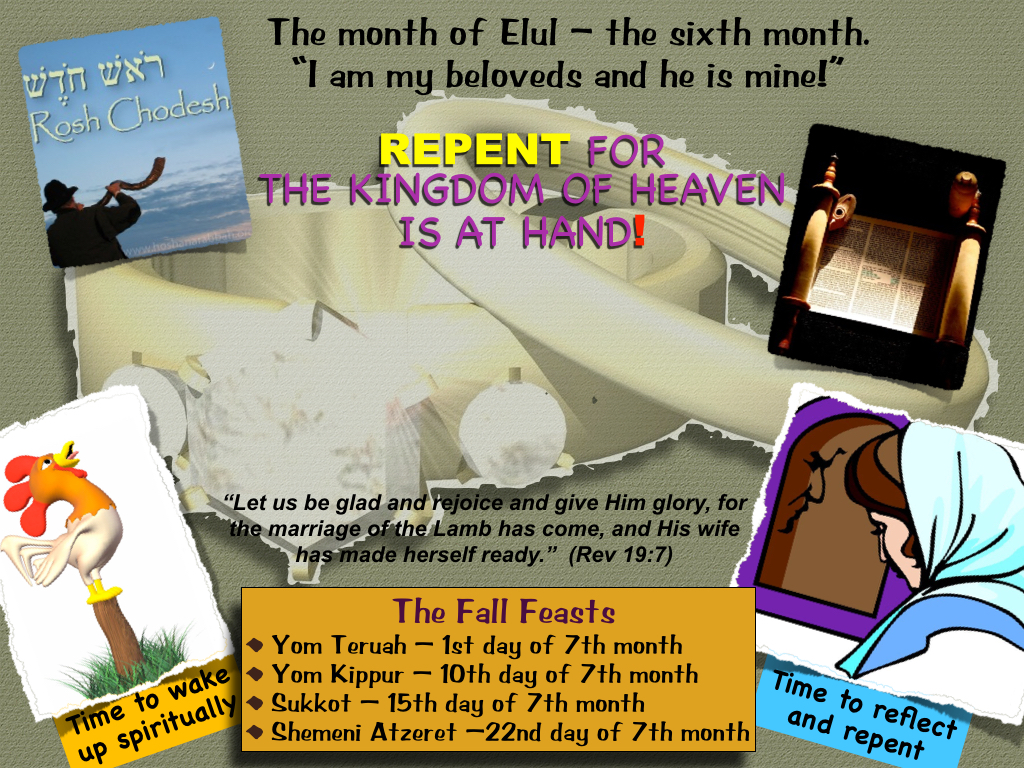
The fall biblical feasts are upon us, and now is time to prepare for them. As children of the light, we are called to NOT be ignorant of the times or seasons (1 Thess 5:1–10), and this includes understanding the biblical feasts which fall in their season (Lev 23:4) and are prophetic of and chronological in the steps YHVH’s glorious plan salvation for humankind.
The autumn feasts speak of events surround the second coming of Yeshua the Messiah. Contrary to biblical Truth, the mainstream church has lied to its people by declaring that Elohim’s Torah-law including the seven biblical feasts have been fulfilled (i.e. done away with) and are no longer relevant to the saint. This is patently absurd, especially when it comes to the fall feasts, since they obviously have not been fulfilled. This is because the prophetic events to which they point HAVE NOT yet occurred. Yeshua has not returned yet, the resurrection of the saints has not occurred, and Yeshua is not reigning with a rod of iron on this earth from his seat of power in Jerusalem.
So the biblical feasts are still important in the life of the Bible believing saint and, therefore, it is important that we not only be aware of them, but that we prepare to celebrate them. As such, the sixth month (the month of Elul) on the biblical calendar is the time to prepare for the fall feasts that occur in the seventh month. This is the time when the bride (the saints) are to prepare themselves for the coming bridegroom (Yeshua the Messiah). How do we prepare? By cleansing our lives of sin and putting on the robes of righteousness. This occurs through repentance from sin, turning from sin and getting our lives in line with the Word of Elohim. The month of Elul is the time to do this.
There is no salvation without true repentance!
What would you hear if you were to ask the average Christian to summarize the basic gospel message in one sentence? You might hear something like “Jesus loves you and has wonderful plan for your life.” Or you might hear, “Jesus died for your sins, so that you might go to heaven.” Some of the more “modern and progressive” or so-called “seeker friendly” Christians might say, “Come to Jesus and he’ll improve your self-esteem,” or “If you want good health and lots of wealth, come to Jesus.” But how does the Bible summarize the gospel message? That’s a question that almost nobody asks and no one knows or preaches about, even though the answer should be obvious to anyone who has read the Gospels. The truth is shocking and radically different from what most modern Christians think!
Matthew in his Gospel after describing the circumstances around the birth of Yeshua the Messiah, opens up by introducing the ministry of John the Baptist, the anointed prophet from heaven who came to prepare the way for the Messiah. The Gospel writers summarizes the preaching of John as “Repent, for the kingdom of heaven is at hand” (Matt 3:2). In the next chapter after his brief introduction to John’s ministry, Matthew then brings Yeshua the Messiah onto the scene. After Yeshua’s temptation in the wilderness, Matthew records, “From that time Yeshua began to preach and to say, ‘Repent, for the kingdom of heaven is at hand’” (Matt 4:17). Mark in his gospel records the same event as follows: “Now after John was put in prison, Yeshua came to Galilee, preaching the gospel of the kingdom of Elohim, and saying, ‘The time is fulfilled, and the kingdom of Elohim is at hand. Repent, and believe in the gospel’” (Mark 1:14–15). Finally, on the day of Pentecost after being pricked in their hearts byu Peter’s convicting sermon, the crowd asked the apostle what they should do next. His answer was, “Repent, and let every one of you be baptized in the name of Yeshua the Messiah for the remission of sins; and you shall receive the gift of the Holy Spirit” (Acts 2:38). A central and recurring theme in all of these passages is the idea of repentance from sin—a biblical concept that is understood by few modern Christians, and a message that is seldom preached in modern pulpits anymore. All of this is in spite of the fact that the writer of the Epistle to the Hebrews refers to “repentance from dead works” as “one of the [six] elementary principles of Messiah [or the gospel message]” (Heb 6:1-3).
So what is repentance? How does Scripture define repentance? It is a Hebraic concept, so we must go back to the Hebrew Scriptures to discover the answer.
Hebrew Word Definitions
There are two biblical Hebrew words that together present the complete picture of what true biblical-based repentance is. The first word is nacham meaning “to be sorry, console oneself, repent, regret, comfort, be comforted.” According to The Theological Dictionary of the Old Testament (The TWOT), the origin of the root of this word seems to reflect the idea of “breathing deeply,” hence the physical display of one’s feelings, usually sorrow, compassion, or comfort. The root occurs in the Ugaritic … and is found in Old Testament (OT or Tanakh) proper names such as Nehemiah, Nahum and Menehem. The Greek Septuagint (or lxx) translates the Hebrew word nacham by the two Greek words metanoeo and metamelomai. The Greek word metanoeo means “to change one’s mind, that is, to repent or to change one’s mind for better, heartily to amend with abhorrence of one’s past sins.” Wilson’s Old Testament Word Studies says this of nacham:
Multiple times, the Scriptures enjoins those who have been blessed materially to help those who are poor. In fact, YHVH even has a special place in his heart for a special class of individuals who have fallen into poverty, namely, the widows and the fatherless (Deut 14:29; 16:11, 14; 24:19; 26:12–13; 1 Tim 5:3). Let’s now discover some biblical guidelines about charitable giving.
Yeshua declared that the poor would always be among us (Matt 26:11), so there will never be a lack of opportunity for the so-called haves to help the have-nots. Furthermore, YHVH promises to bless us when we give to the poor (Ps 41:1–3) as well as to those who have dedicated their lives to serving YHVH’s people through the ministry (Deut 14:29; 16:14; 26:12–13).
In Deuteronomy 15:7, we discover that there are levels of priorities in our charitable giving. Our first responsibility is to help a poor person who is a brother, that is, who is a member of our immediate family, or someone who is like a brother to us. Second, we are to help those in need who reside in our gates, or are a member of our immediate community. Finally, and last, our charitability is to go toward those who are in need in our own land or country. The idea here is that our charitable giving is to go first to those who live the closest to us, and then go out from there geographically as we are able to do so financially. Too many churches have it backwards. They support to poor in other countries through evangelistic outreach, while neglecting the mission field or charitable giving on their own backyard.
In the Torah, there is a social welfare system in place to help the needy, but it comes with strict guidelines. For example, YHVH instructed the Israelites to set aside a certain portion of their income to help the poor. (Deut 14:28–29). For the ancient Israelites, this was a sort of social welfare system whereby those who had been blessed materially were commanded to help those who weren’t and were in need.
Moreover, the Torah had other social mechanisms whereby those who had fallen into poverty had the means to work themselves out of that economic state. There was no such thing as sitting idly and expecting a handout from society! For example, a poor person could sell themselves into servitude for a period of time until they worked themselves out of debt (Exod 21:2; Lev 25:39–55). Every seven years, debts were forgiven (Deut 15:1–2). Those who had an abundance financially and were in position to loan money to a poor person were forbidden from charging the lender any interest (Lev 25:35–38). Moreover, a poor person who had land could also sell their land to raise money; however, at the end of the 50 year jubilee cycle, that land would be given back to them (Lev 25:8–17).