Blog Scripture Readings for 3/18–3/24/12 Midrash

Aside

Exodus 29–35; Isaiah 11–24 and John 10–16

Most of this week’s blog discussion points will be on these passages. The full year’s Bible Reading Schedule can be found on the right sidebar under “Helpful Links.”

If you have general comments or questions on the weekly Scripture readings not addressed in a blog post, here’s a place for you to post those. Just use the “leave a reply” link below.


Back to the Future with Moses at Mount Sinai

Moses’s bringing the children of Israel into a covenantal (marriage) agreement with YHVH at the foot of Mount Sinai contains powerful prophetic symbolism that applies to us now. Point-by-point, it foretold the steps that Yeshua would take through his death on the cross as he brought the spiritually lost (you and me) into a covenantal (marital) relationship with him.

Exodus 24:6, Moses sprinkled half the blood of a sacrificed animal on the altar, which prophetically pointed to Yeshua shedding his blood on the cross, so that we might enter into a covenantal relationship with YHVH. The wine Yeshua drank at the last supper that ratified the Renewed Covenant signified the blood he was about to shed at the cross (Matt 26:26–28). When we as redeemed believers drink the third cup (i.e., communion) of the Passover Seder and eat the bread, we are signifying our marital commitment to YHVH-Yeshua. We are accepting the terms (our marriage agreement or ketubah) of the covenant—the Renewed Covenant, which includes the Torah being written on our hearts by the Spirit of Elohim (Jer 33:31–33; Heb 8:8–10).

Exodus 24:7, Israel agreed to the terms of the ketubah the third time (see also Exod 19:8 and 24:3). As Israel pledged loyalty and obedience to YHVH, even so, we also must confess with our mouths and believe in our hearts that Yeshua was raised from the dead, and then walk in righteousness, which is obedience to the Torah (Rom 10:9–13; Ps 119:172).

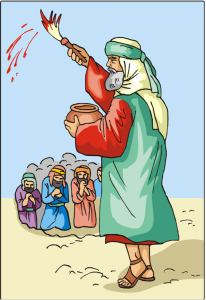
Exodus 24:8, Moses sprinkled the blood of an innocent animal over the people, which is a prophetic picture of Yeshua shedding his blood at the cross for the redemption of sinners from the penalty of sin, so that they might enter in a sinless state into a covenantal relationship with YHVH (Heb 9:18–22).

Exodus 24:9–12, Only after the blood of the sacrificed animal was shed and sprinkled over the people were the elders permitted access into the Presence of Elohim. Only through the shed blood of Yeshua and through the veil of his flesh are we able to come boldly to Elohim’s throne of grace (Heb 10:19–20; 4:16).


Did Yeshua Break the Sabbath?

John 5:18, [Yeshua] … broke the Sabbath. Listen to an interesting and sad, but true story. About ten years ago, I was in a meeting where a Bible teacher was giving a message on the end times. In the middle of his teaching and totally out of context, he quoted this passage from John and claimed that Yeshua broke the Sabbath. There was a rustle in the audience of about 300 people. A little later, he made the same statement again and began to deride the Sabbath. This time there was an audible moan from some in the audience—many of whom were Sabbath keepers. I felt like he had hit me in the gut. A little later, he made the same statement again, and continued to bash Sabbath observance. This time, I could hold my peace no longer. I stood up and challenged him in the middle of the meeting. To say that Yeshua had broken the Sabbath was to call Yeshua a sinner, and that Yeshua had not broken the Sabbath, but some Jewish legal traditions (or halakhah) pertaining to the Sabbath. The speaker was flustered and had no response, and the host of the meeting decided to take an intermission.

A year later, this Bible teacher had suddenly and unexpectedly dropped dead in the pulpit while preaching. I can’t help but wonder…. Had this false teacher simply pulled down a concordance from his bookshelf and looked up the word broke in the Greek, and had read John’s statement in verse 12 in the context of verses 8–10, he wouldn’t have been teaching this blasphemous heresy about our Master and Redeemer!

Here is the explanation of this passage:

The word broke is the Greek word luo meaning “to loose, untie someone or something bound, to dissolve, destroy.” According to The Theological Dictionary of the NT, luo means “to free from prison, open something closed; destroy fetters, foundations, walls; to release.”

What Yeshua was breaking was the Jews’ extra-Torah legal traditions that made the Sabbath a burden by prohibiting the alleviation of human suffering and need on this day (John 5:8–10). He was in no way violating the Torah, since there is no Torah prohibition from healing on the Sabbath or carrying one’s bed roll.

In attempting to follow the Torah through men’s traditions, many of the Jews of Yeshua’s day had actually omitted the weightier matters of the Torah (justice, mercy and faith, Matt 23:23), and had forgotten that YHVH is more concerned with heart issues rather than religious legalism, since he desires mercy over sacrifice, and the knowledge of Elohim over burnt offerings (Hos 6:6).


Blog Scripture Readings for 3/11–3/17/12 Midrash

Aside

Exodus 22–8; 2 Kings 21–25; Isaiah 1–10 and John 3–9

Most of this week’s blog discussion points will be on these passages. The full year’s Bible Reading Schedule can be found on the right sidebar under “Helpful Links.”

If you have general comments or questions on the weekly Scripture readings not addressed in a blog post, here’s a place for you to post those. Just use the “leave a reply” link below.


Doctrines of Men Built on Weak Foundations

Parashah Mishpatim: Exodus 21–23

Exodus 21:1, These are the judgments [mishpatim]. Most of the Torah-laws listed in Exodus chapters 21 through 23 are civil in nature and relate to our relationship with our fellow man (as summarized by the phrase, “you shall love your neighbor as yourself,” Lev 19:18).

These laws would correspond to the second half (the fifth through tenth) of the Ten Words or Commandments of Exodus 20.

These civil laws are an expansion or elucidation of those foundational principles given in chapter 20. For example, death by someone’s animal is an expansion of the “thou shalt not murder” command. The charging of usury on loaned money is an expansion of the commands not to covet or steal. The land sabbath and annual sabbaths (appointed times or moedim) are an expansion of the weekly Sabbath.

It should be possible to see how all of YHVH’s Torah commands spring from the original ten, which form the foundation for the rest of the Torah.

Additionally, the approximately 1056 imperative commands found in the Testimony of Yeshua (NT) all spring from the 613 found in the Torah. Think about it. YHVH’s Word would be in opposition to itself if any of the 1056 were to contradict or nullify any of the 613. If they did, that would make YHVH into a liar and his word inconsistent with itself (Mal 3:6; Heb 13:8; John 10:35).

Yet have you ever heard this taught in the church? If it were, how many doctrines of men would come crashing down?


The Passover of the Jews???

John 2:13, Passover of the Jews. (See also John 5:5; 6:4; 11:55; 12:1; 13:1.) Have you ever wondered why John often uses this phrase? What other Passovers were there that necessitated specifying which Passover he was referring to?

This “Passover of the Jews” is in opposition to the Passover feasts held by competing religious sects of the time (e.g., the Essenes at Qumran and the Samaritans). The modern Samaritans following ancient calendric traditions, for example, will hold their Passover on May 4 in 2012 as opposed to April 6, which is this year’s likely date on the biblical calendar.

The ancient Qumran community embraced an “unorthodox liturgical calendar that [set] them apart from the rest of Jewry” (The Complete Dead Sea Scrolls in English, by Geza Vermes, p. 41). For example, on the Qumran community’s solar-based calendar that is based on a 364-day year, the Passover always fell on a Wednesday (Ibid. p. 79).

As you can see, determining on what days the biblical feasts fall was as controversial then as it is now!

(For additional enlightening studies on the biblical calendar, check out my articles at http://www.hoshanarabbah.org/pdfs/cal_demyst.pdf and http://www.hoshanarabbah.org/pdfs/new_moons.pdf and http://www.hoshanarabbah.org/pdfs/vis_moon.pdf.)


Who Is the God of the Old Testament: Yeshua or the Father?

John 1:1, The Word was God [Elohim]. Is Yeshua or the Father the God (Elohim) of the Old Testament (Tanakh)?

For many believers in Yeshua, there is confusion as to who it was in the Godhead who interacted with the Israelites in the Tankah. Was it the Father or the Son?

In the minds of the apostolic writers, there was no confusion about this. Yeshua, in his preincarnate state, was the One that YHVH Elohim the Father used to both create and then to interact with mankind. He was the Word of YHVH Elohim, the Father, who become flesh and dwelt among men (verse 14). This truth is easily confirmed in several passages in the Testimony of Yeshua (New Testament).

First, Yeshua himself claims to be YHVH or the I Am of the burning bush (see John 8:58 cp. Exod 3:14). The Jews viewed Yeshua’s claim as blasphemous, which is why they picked up stones to kill him (John 8:59).

Next, Yeshua in declaring to the Jewish religious leaders that “I send you prophets, wise men and scribes: some you will kill…” (Matt 23:34), he is claiming the rights and prerogatives of YHVH—a right and role that solely belonged to YHVH in the Tanakh.

Yeshua also declared that no man has seen the face of Elohim the Father (John 5:37). Yet in the Torah, we have several instances of men seeing YHVH (e.g., Gen 17:1; 18:1; 26:2; 48:3). If we are to take what these scriptures say as literal, then it could not have been YHVH the Father these individuals saw, but YHVH the Son who later become Yeshua.

Not only that, Yeshua even goes so far as to say that the Israelites of old not only didn’t see the Father’s face, but neither at anytime even saw his form nor heard his voice (John 5:37). Therefore, it becomes evident that while on Mount Sinai, Moses didn’t see the backside of the Father, but of the pre-incarnate Yeshua (Exod 33:18–23).

What’s more, in John 14:15, Yeshua, speaking to his disciples, declares, “If you love me, keep my commandments.” When Yeshua says commandments here, we know from Luke 18:20 that he has the Torah in mind. In this statement, Yeshua is actually quoting himself when he made the same statement to the children of Israel while he was delivering to them the Oracles or Torah of Elohim (Exod 20:6; Deut 11:1).

Stephen, in agreement with John, clearly demonstrates that Yeshua was the prophesied “prophet like Moses” who was to come (see Deut 18:15), and who was the Angel, or more correctly, the Divine Messenger from Elohim, who gave the Torah to the Israelites (Acts 7:37–38).

Paul goes on to say in enigmatic terms that Yeshua was the spiritual rock from which the Israelites drank and that followed them (1 Cor 10:4). And finally, Paul equates Yeshua, “the Word of Elohim made flesh and that dwelt among us” (John 1:14) with the Written Torah that YHVH gave through Moses to the Israelites. This he does when he quotes Deuteronomy 30:11–14 and substitutes the word Torah for Yeshua (see Rom 10:5–13). In Paul’s mind, Yeshua was not only synonymous with the Torah, but he was very much present with the children of Israel.

Do you have some additional proofs from the Testimony of Yeshua to share with this blog family that show how Yeshua is the God of the Old Testament?