What Is it to “Abide in Yeshua”?

John 15:1–10, Abide in me.
The term abide is found nine times in this passage. Seven of the those nine times are in reference to abiding in Yeshua or his Father. Seven is the biblical number of completion or perfection. When we abide in Yeshua and his Father, then we’re made perfect or complete in all areas of our life: spiritually, physically, mentally, and emotionally.

Let’s explore what it means to abide in Yeshua so that we produce good spiritual fruit for our Master and Savior.
  • We are made clean/katharos [to be made pure, blameless, innocent; free of corrupt desire, sin, guilt and from that which is false] through the Word of Elohim (John 15:3, 7).
  • We must continue/abide in the love of Yeshua by keeping his/the Father’s commandments (John 15:10).
  • We must love one another (John 15:12–17).

We must practice the key elements Yeshua taught in the Sermon on the Mount.

  • We must do the beattitudes (Matt 5:3–12)
  • We must love the Torah (Matt 5:17–19)
  • We must love our enemies (Matt 5:21–26, 38–42).
  • We must keep our word (Matt 5:33–37).
  • We must be a charitable giver (Matt 6:1–4).
  • We must pray without ceasing (Matt 6:5–15; 1 Thess 5:17).
  • We must fast regularly (Matt 6:16–18).
  • We must flee materialism and greediness (Matt 6:19–21).
  • We must set our life’s priorities spiritually straight — seek first the kingdom of Elohim in all that you do (Matt 6:24–34).
  • We must seek Elohim’s help/trust in him in every way in all that you do, say and think (Matt 7:7–11).
  • We must live by the golden rule (Matt 7:12).

What are the results of abiding in Yeshua?

  • Being made clean, pure, free of sin, corruption, defilement and guilt (John 15:3).
  • Bearing much fruit (John 15:5). What fruit? The fruit of the Spirit (Gal 5:22–25).
  • Avoiding the (lake of) fire (John 15:6).
  • We can ask whatever we want of the Father and he will give it to us (John 15:7, 16).
  • Glory comes to the Father as a result of our bearing much fruit (John 15:8).
  • We are filled with joy (John 15:11).
  • We become the friends of Yeshua (John 15:14).
 

Spirit to Spirit: How the Holy Spirit Helps Us

John 14:16, Another helper/Comforter.

The Spirit of Elohim Energizes our Spirit to Keep the Torah
At the end of his ministry, Yeshua promised his disciples to send them his Holy (Set-Apart) Spirit or Comforter after he had left earth (John 14:16). He declares that his Set-Apart Spirit:

  • Would dwell in them (John 14:17)
  • Would testify of him (John 15:26)
  • Would convict the world of sin (or Torahlessess, John 16:8)
  • Would guide them into all truth (i.e., Torah, see Ps 119:142, 151)
  • Would tell them things to come (John 16:13)
  • Would glorify the Son and speak to them on behalf of the Son (John 16:14).

How, therefore, does the Spirit of Elohim interact with man?

Continue reading →


Isaiah’s Prophecy on America?!

Isaiah 18:1–3, In the chapter heading in some Christian Bibles, Isaiah chapter 18 is titled “Ethiopia.” Is this an accurate chapter heading?

Isaiah 18:1 refers to “the land … which is beyond [on the other side of] the rivers of Ethiopia.” The traditional view among many biblical commentators (both from Christian and Jewish sources) is that this prophecy is referring to the area of modern Ethiopia, which is just south of Egypt. It is believed that the river mentioned in this passage is the Nile with its tributaries, while the ships are a reference to boats that regularly ply those waters, and the whirring wings refer to either locusts or to tsetse flies, which are abundant in that region. These same commentators offer various views on how this prophecy of Isaiah was fulfilled in ancient times. In these commentaries, no explanation was given of the meaning of the word sea in verse two and how that relates to Ethiopia, or how Ethiopia was a nation that was feared far and wide (verse 2). Perhaps another interpretation could be offered that would better fit the descriptions of the land and its people given in this prophecy.

It would be presumptuous to base our entire premise that America is in Bible prophecy on this passage alone, but united with other similar passages that speak clearly of end-time Ephraim, perhaps Isaiah 18:1–3 should be considered in this context. This is all the more plausible when we consider the fact that the scholarly views that this prophecy pertains only to ancient Ethiopia are from before the twentieth century when America was not yet a world power, and airplanes were yet to be invented. Also consider the fact that as rabbinic Jewish scholars do not know who end-time Ephraim is, so Christian scholars do not know who Ephraim is either. Neither group relates Ephraim to “Gentile” Christianity.

Now with some of these things in mind, let us take another look at Isaiah 18:1–3 and see how several well-known Bible translations render these passages.

Verse 1, This verse literally refers to “a land buzzing/whirring with wings” beyond Cush (Ethiopia, Africa), or to “clamorous wings” (ASET), or to “whirring wings” (NAS). Could this be a reference to the modern airplane and the role of aircraft in end-times America? Which nation on earth has more aircraft than America? Where was the airplane invented? What nation is the world’s leader in the aero-space industry and technology? Where can one not go in America without hearing aircraft overhead? What nation of people fly more than any other people?

Verse 2, This country sends ambassadors by sea, is a nation which has been feared from its beginning, is feared far and wide (KJV and NAS), is a powerful and oppressive nation (NAS) whose land is full of rivers meaning there are many mountains and lakes as well—it’s a well-watered land, and it is a land where people speak a strange language. English is a very recently developed language! Additionally, America has been a mighty nation from its founding. It twice defeated the mighty British empire in the Revolutionary War and the War of 1812. America is also a land of many large and small rivers flowing out of numerous mountain ranges.

(This article is excerpted from a much larger teaching I have published entitled, “Is America In End-Times Bible Prophecy?” You can read this article at http://www.hoshanarabbah.org/pdfs/america.pdf.)


The Sabbath—A Rest Area Sign

Exodus 31:13–17, My Sabbaths you shall keep. Note that Sabbaths is plural—a reference to not only the weekly Sabbath, but to the feast day Sabbaths as well. However, the seventh day Sabbath remains central to YHVH’s spiritual economy for his people. Why did YHVH designate it as a sign (“signal, distinguishing mark, banner,” Exod 31:12) between him and Israel? By keeping the Sabbath, from whom was Israel distinguishing itself? As YHVH’s set-apart people, Israel was distinguishing itself from the surrounding nations who did not keep the Sabbath.

What distinguishes us as YHVH’s set-apart people from the non-believing heathen around us?

Certainly our love for one another is a distinguishing mark, according to Yeshua (John 13:35). Yeshua also said that if we love him we will keep his Torah commandments (of which the Sabbath is the fourth of the ten commandments, John 14:15; Exod 20:8).

John was inspired to write that those who say they know Elohim and don’t keep his Torah-commandments (of which the Sabbath is a foundation stone) are liars and the truth is not in them (1 John 2:3–6). And finally, Yeshua told those who were Torahless (i.e., workers of iniquity or lawlessness) to depart from him, that he didn’t know them even though they claimed to be his followers and had done many religious works in his name (Matt 7:21–23). Although the Sabbath may not be the sign of the Renewed Covenant, it is a foundation stone of the Torah, and the keeping of it remains to this day for the saints of Elohim (Heb 4:9).

The ArtScroll Stone Edition Tanach translates verse 15 as follows:

For six days work may be done and the seventh day is a day of complete rest, it is sacred to [YHVH] … (emphasis added)

What is complete rest? What is the connection between “complete rest” and the idea of sacredness or being set-apart or kadosh? The people of YHVH are called to separate the kodesh from the common or profane:

Her priests have violated my Torah, and have profaned my set-apart/kodesh things: they have put no difference between the kodesh and profane [common, polluted] neither have they showed difference between the unclean and the clean, and have hid their eyes from my Sabbaths, and I am profaned among them. (Ezek 22:26)


And [the priests] shall teach my people the difference between the kodesh and profane, and cause them to discern between the unclean and the clean. (Ezek 44:23)

What is common or profane? It is that which is commonly done on the other six days of the week. Have you made this complete separation in your life so that you can completely rest on the Sabbath? If not, what are the excuses you use? What does YHVH think about your reasons for not obeying him in light of his clear commands?


Paleo-Hebrew: the Writing of Elohim?


Exodus 32:16, The writing of Elohim.
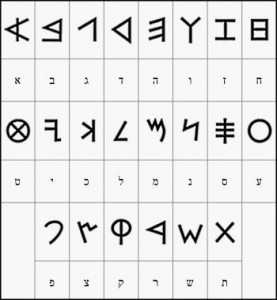
The contemporary square script letters of the Hebrew alphabet were likely introduced into Israel by Ezra the scribe after the Babylonian exile. Prior to this, Israelite writers used the Paleo-Hebrew pictographic script, which is of ancient origination and is likely the script that YHVH used when engraving the stones on Mount Sinai.

Most modern linguistic scholars trace the alphabet of the European languages, including English, back to the pictographically-based Phoenician alphabet of the tenth century B.C., which shows striking similarities with the Proto-Sinaitic or Paleo-Hebrew script of nearly one thousand years earlier indicating that our own alphabet likely originates from the ancient Hebrew script of Mount Sinai!

The Scriptures record that the time the Phoenician script came into prominence on the world scene coincides with the Israelite alliance with King Hiram of Tyre, who was the king of the Phoenicians. Theirs was a commercial and military alliance that dominated much of the known world, and Israel was the senior partner in this confederation, since the empire of Israel (under kings David and Solomon) controlled a large area of land from Egypt to the Euphrates River (in modern Iraq). In the eyes of some ancient nations (e.g., the Greeks), the Phoenicians and Israelites were regarded as the same people, and both were known by the label of Phoenicians (see The Origins and Empire of Ancient Israel, pp. 148–151, 229–231 by Steve Collins quoting George Rawlinson, nineteenth century biblical scholar and history professor at Oxford University).

From this evidence, we can see that it is likely that the script known as “the writing of Elohim” (in Exod 32:16) is the root of many of the world’s alphabets including Japanese! (See http://jamesjpn.net/index.php/2010/06/10/japanese-script-compared-with-hebrew/.)

(Paleo-Hebrew graphic used as per Creative License with thanks to mdewey60; a member of AboveTopSecret.com in his message thread, “Is the Rune Alphabet Related To Paleo-Hebrew?” at http://www.abovetopsecret.com/forum/thread794112/pg1)


Nuggets in Isaiah

Here are some precious pearls and gold nuggets from the first several chapters of Isaiah. Bon appetite!

Isaiah 6:3, Holy, holy, holy. (Also Rev 4:8.) Since these are the words of worship being proclaimed to Elohim in his throne room continually, then holiness must be his chief attribute—not love, mercy, grace, etc. as many in the church teach and believe.

Isaiah 6:8, Us. Here is another proof of the plurality of the Godhead. Compare this with Gen 1:26; 3:22; 11:7 and Matt 28:19.

Isaiah 7:11 and 14, Here is a scripture proving the virgin birth of Yeshua. (See http://www.hoshanarabbah.org/pdfs/vbirth.pdf .)

Isaiah 8:14, A stone of stumbling. This an obvious reference to Yeshua who is a stone of stumbling to both houses of Israel (i.e., the non-believing Jews and the Christians.) The Christians stumble over or reject (at least, in part) Yeshua who is the Written Torah-Word of Elohim (John 1:1). The non-believing Jews, on the other hand, reject Yeshua, the Living Torah-Word of Elohim who came in flesh form (John 1:14).

Isaiah 8:16, Bind up the testimony. Here Isaiah is prophesying the canonization of the NT by the disciples of Yeshua (who is mentioned in verse 13). Did you know that the NT’s name for the NT isn’t the NT, but the Testimony of Yeshua—a name that John who finalized the NT canon gave it when he was writing the Book of Revelation? There, he calls the OT/Tanakh  the “Word of God/Elohim” and the NT “the Testimony of Yeshua” (see Rev 1:2, 9; 6:9; 12:17; 14:12; 20:4). If you didn’t know that John canonized the NT before his death, read my article on the subject (http://www.hoshanarabbah.org/pdfs/nt_canon_full.pdf .)

Isaiah 9:7, Increase. Here is another proof of the virgin birth of Yeshua. How you say? You have to dig into the Hebrew on this one. (See my article http://www.hoshanarabbah.org/pdfs/closed_mem.pdf .)

Isaiah 11:11–16, The second exodus. This is one of the main Tanakh passages on this subject. It’s too detailed to discussed in this blog. Stay tuned to a full-scale teaching that I have written on the second exodus, which is about to be published on the hoshanarabbah.org website.

Isaiah 12:2 literally says, “God/Elohim is my salvation/Yeshua…He [YHVH Elohim] has become my salvation/Yeshua.” Then verse 3 says, “Therefore with joy you will draw waters from the wells of salvation/Yeshua.” This verse was quoted on Hoshana Rabbah (the last or seventh day of Sukkot) during the water pouring ceremony. Yeshua referenced this in John 7:37–38. Can anyone shout HALLELUYAH (!) for this Tanakh passage that not only proves the deity of Yeshua, but shows how Yeshua fulfilled the OT prophecies like no one else ever did!


Seven Steps to Consecrating the Priests/Saints

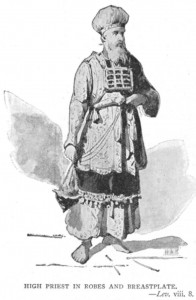
Exodus 28:1–29:46, Note the seven steps required to consecrate the priests for service in the tabernacle. Let’s compare them with the steps a believer goes through to become a “chosen generation, a royal priesthood, a set-apart nation, a peculiar people that you should show forth the praises of him who has called you out of darkness into [Yeshua’s] marvelous light” (1 Pet 2:9). These steps relate to the process a believer goes through from initial salvation to his ultimate glorification.

  1. The priests were taken from among the children of Israel (Exod 28:1). This prefigures divine election. YHVH calls or chooses each person. Yeshua called his disciples (John 15:16–19). They did not call or choose him, but they had to respond to that call.
  2. They were then brought into the door of the tabernacle (Exod 29:4). The door of the tabernacle is Messiah Yeshua who is the door to the sheepfold. No man comes to the Father except through Yeshua (John 10:1–18 and 14:6). The door is comprised of four colors, which speak of the person and work of Yeshua: blue, scarlet, white and purple. It also speaks of the four Gospels, which are the door to understanding the Person and work of Yeshua.
  3. They were washed (Exod 29:4). Upon accepting the work and Person of Yeshua, one must be immersed for the remission of sins (Acts 2:38) to identify spiritually with the death, burial and resurrection of Yeshua (Rom 6:3–14), and the washing of the water of the Word (Eph 5:26).
  4. They were clothed in their official garments (Exod 29:4–9). The redeemed believer is to put on the robes of righteousness. (Gal 3:27, “For as many of you as have been baptized into Messiah have put on ­Messiah.”) Paul talks about fruits of righteousness through Yeshua in Philippians 1:11. Righteousness is Torah obedience (Ps 119:172) and is a mark of the end-time believers/saints (Rev 12:17 and 14:12) and of the bride of Messiah (Rev 19:8).
  5. They laid their hands on the head of the animals that were sacrificed, blood was shed and sprinkled on Aaron and his sons, matzoh (unleavened bread) was waved and burnt, and they ate the flesh of the ram and the matzoh (Exod 29:10–26, 32–33). Each believer has to take personal responsibility for his own sins. The sacrifice of Yeshua, the Lamb of Elohim, at the cross must become personal to each person each must have his own personal relationship with Yeshua. Each must “eat” the flesh and “drink” the blood of Yeshua individually (John 6:35–58). Communion pictures this and is a personal and individual matter.
  6. They were anointed with oil (Exod 29:21). Each person must receive the Set-Apart Spirit (Ruach) of Elohim
  7. They are sanctified or set-apart for a special, divine purpose (Exod 29:44). Only after going through these steps is one set apart unto YHVH as a set-apart priesthood doing the set-apart work of YHVH.

Only on the basis of following YHVH’s steps, as outlined above in a spiritual manner, can one have fellowship with the Father. And what was the result? Relationship with the Father! Read Exodus 29:44–46 below,

And I will sanctify the tabernacle of the congregation, and the altar. I will sanctify also both Aaron and his sons, to minister to me in the priest’s office. And I will dwell among the children of Israel, and will be their Elohim. And they shall know that I am YHVH their Elohim, that brought them forth out of the land of Egypt, that I may dwell among them: I am YHVH their Elohim. (emphasis added)

This is all accomplished through Yeshua living in us spiritually. Yeshua is the Chief Cornerstone of the spiritual building of which the saints are a part (Eph 2:20). He is the end result or goal of the Torah (Rom 10:4). He is the Author and the Finisher of our Faith (Heb 12:2), the Beginning and the End, the Aleph and Tav (Alpha and Omega, Rev 21:6; 22:13) of everything. He is calling us to be  his “royal priesthood.”

 But you are a chosen generation, a royal priesthood, a holy nation, a peculiar people; that ye should shew forth the praises of him who has called you out of darkness into his marvelous light, which in time past were not a people, but are now the people of Elohim, which had not obtained mercy, but now have obtained mercy. (1 Pet 2:4–10, emphasis added)

Our faith in Yeshua stays alive and vibrant because of the sacrifices of devotion and praise we offer up daily—morning and night as did the priests of old.