Jacob’s Prophecy to the Christians (pt 3)

48:18, Multitude of nations. What do the Jewish sages say about this prophetic verse pertaining to the descendants of Ephraim and Manasseh?
Ibn Ezra: Many nations will descend from him (i.e., the word TKN/mem-lamed-aleph [melo], fullness, connotes abundance, the phrase meaning: And his seed will become the abundance of the nation [Neter; Karnei Or].) (The ArtScroll Bereishis/Genesis Commentary p. 2121)

R[abbi] Avraham b. HaRambam somewhat similarly: The expression denotes abundant profligacy to a point that they will have to inhabit lands of other nations it is an allusion to Ephraim’s expansive territory (Ibid.).

Radak: This refers to the Exile when the lands of others will be filled with his scattered descendants … See also Hos 7:8: “Ephraim shall be mingled among the nations. (Ibid.)

What kind of blessing was this prediction that one day his descendants—the Ten Tribes—would be scattered among the nations?

R. Munk explains: while it is true that the dispersion was caused by the unfaithfulness and sinfulness of Ephraim’s descendants (Hos 7:8ff), Jacob’s blessing was not in vain for “they will return to God” and will have their share in the world to come (Sanhedrin 110b). And R. Eliezer adds: “Even the darkness in which the Ten Tribes were lost will one day become as radiant as the day’ (according to the version of Avos d’Rabbi Nosson 36). And in the perspective of history, did not these exiled children of the Patriarchs enlighten the nations among whom they were scattered? They did so by teaching their conquerors the fundamental ideas of the knowledge and love of God, ideals they had never forsaken. Hence they too have a messianic vocation and their Messiah the. … Messiah son of Joseph (Succah 52a), also called Messiah son of Ephraim (Targum Yonasan on Exod 40:11), will play an essential role in humanity’s redemption, for he will be the precursor of the … Messiah Son of David …” (Ibid., pp. 2121–2122).

Can you better see in Jacob’s prophecies over the sons of Joseph and the resulting rabbinic interpretations of those prophecies foretelling the Messianic/Hebrew roots movement (within the Christian church) of the final days? Can you see how this movement would (will) be instrumental in bringing the Christians (many of whom are descendants of Joseph’s sons) back to their Hebrew and Jewish (Book of Acts) roots as part of the restitution/restoration of all things before Messiah Yeshua, the Son of David, returns (Acts 3:21)?

Does not the Book of Revelation prophesy the last days Hebrew roots movement? Read Revelation 12:17 and 14:12 that states that the end-time saints will be those who have the message of the gospel or the faith and testimony of Yeshua the Messiah and who keep YHVH’s Torah-commandments (the Torah or instructions of YHVH given to Moses and Israel at Mount Sinai).

 

Jacob’s Prophecy to the Christians (pt 2)

48:16, Multitude in the midst of the earth. The ArtsScroll Stone Edition Tanakh translates this verse as follows:

“‘May the angel who redeems me from all evil bless the lads, and may my name be declared upon them, and the names of my forefathers Abraham and Isaac, and may they [Ephraim and Manasseh] proliferate abundantly like fish within the land.’

Onkelos renders this verse as follows:

‘And like the fish of the sea may they multiply among the children of men on earth’ … The literal translation of VDS/dalet-gimel-hey [dagah] refers to procreation … [and] the word essentially denotes fish (The ArtScroll Bereishis/Genesis Commentary p. 2117, emphasis added).

What religious group on earth today has spread out across the face of the earth into all nations and has proliferated a message of Redemption pertaining to a Messenger of YHVH involving a cross-symbol resembling the ancient paleo-Hebrew letter tav and a fish symbol?


Jacob’s Prophecy to the Christians (pt 1)

Genesis 46:14 and 16, Jacob’s Prophecy Over Ephraim and Manasseh

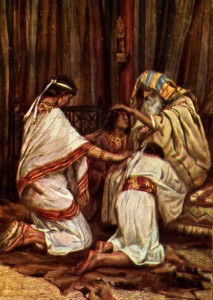
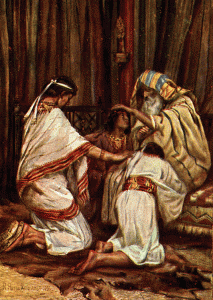
While prophesying over Joseph’s sons, Ephraim and Manasseh, Jacob crossed his hands over their heads making the symbol of the paleo-Hebrew letter tav  (like the letter t or x in the alphabet), which resembles a cross and in that ancient Hebraic script and pictographically means “sign of the covenant.” Jacob then spoke of the Heavenly Messenger (the Hebrew word malak mistranslated as “angel” in most Bibles) of YHVH (i.e., the preincarnate Yeshua) who had redeemed him from all evil (see Gen 31:11–13). Jacob then prophesied that the descendants of Ephraim and Manasseh would become like “fish in the midst of the land” (literal translation of Gen 48:14–16; see The ArtScroll Stone Edition Tanach).

In light of this prophetic symbolism, which present day religious group would qualify as having fulfilled Jacob’s prophecy as to who the descendents of Ephraim and Manasseh would be? Which religion on earth uses the fish as their symbol, speaks of a Messenger from YHVH as their Redeemer, and has the sign of the paleo-Hebrew letter tav, which looks like a cross? The Buddhists? The Moslems? The Hindus? Even the Jews? No! Only Christianity fits this enigmatic criteria.

Many Christians are without a doubt the literal descendants of Ephraim and Manasseh. Those who are not, according to the Apostle Paul, once they come to saving faith in Yeshua in some unique sense become the descendants of Abraham (e.g., Gal 3:7,29). Many of these unsaved descendants of Abraham will recognize Yeshua their Messiah on the day that he returns to Jerusalem (e.g., Zech 12:10).


The “Two” Messiahs of the Old Testament

The Scriptures Reveal Two Messiahs Are to Come:
One Who Will Be Like Joseph and One Who Will Be Like David

Let’s note a startling statement from Orthodox Jewish sources: Mesorah Publications The ArtScroll Bereishis, vol. 1(b) states in its commentary on Genesis 48:19 regarding Ephraim:

“R. Munk explains: ‘while it is true that the dispersion [of the descendants of Ephraim and Manasseh] was caused by the unfaithfulness and sinfulness of Ephraim’s descendants (Hos 7:8ff), Jacob’s blessing was not in vain for “they will return to God” and will have their share in the world to come (Sanhedrin 110b).’ And R. Eliezer adds: ‘Even the darkness in which the Ten Tribes were lost will one day become as radiant as the day’ (according to the version of Avos d’Rabbi Nosson 36). And in the perspective of history, did not these exiled children of the Patriarchs enlighten the nations among whom they were scattered? They did so by teaching their conquerors the fundamental ideas of the knowledge and love of God, ideals they had never forsaken. Hence they too have a messianic vocation and their Messiah, the Mashiach ben Yosef, Messiah son of Joseph (Succah 52a), also called Messiah son of Ephraim (Targum Yonasan on Exodus 40:11), will play an essential role in humanity’s redemption, for he will be the precursor of the Mashiach ben David, Messiah Son of David. It is therefore not surprising to find that the prophet Jeremiah (3:12) speaks affectionately of Ephraim. In this light, Jacob’s words, ‘his offspring’s fame will fill the nations nation,’ assume the significance of a blessing” (pp. 2121–2122). (emphasis added)

What the Jewish sages are saying here is that Messiah the Son of Yosef/Joseph—the Messiah whose coming precedes that of Messiah the Son of David—is the Messiah that causes the house of Ephraim (that is the ten northern tribes of Israel, many of whose descendants are currently found within the Christian church) to return to YHVH. Yeshua (Jesus), the son of Joseph, of whom the life and ministry of Joseph, the son of Jacob, was an antetype or prophetic shadow picture, is the very Messiah, unbeknownst to them, of whom they speak.

In Jewish literature, the Messiah whose life would resemble Joseph was referred to as the suffering servant or “Messiah Son of Joseph” (Mashiach Ben Joseph), while the Messiah whose life and ministry would resemble David was referred to as warrior king or “Messiah Son of David” (Mashiach Ben David). The Jewish sages came to this conclusion because when reading the messianic prophecies in the Tanakh (OT) they saw two different, even conflicting Messiahs whose roles were very different from each other. What was not known by the ancient Jewish sages, and was a subject of much debate, was which Messiah would come first, when he would come, would he be the same person or two different individuals, and how much time would separate the two comings.

For believers in Yeshua, this does not seem like a dilemma, for we look back in time and can see clearly that Yeshua fulfilled the Suffering Servant role at his first coming, and will fulfill the Conquering King role at this second coming. But two thousand years ago, without the benefit of historical perspective, this was not so easy a matter to figure out. Even the disciples were at times in a quandary as to which mission Yeshua was to fulfill as evidenced by their last question to him before his final ascension, “Will you at this time restore again the kingdom to Israel?” (Acts 2:6).

Let’s review some of the passages in the Tanakh that point to the two different Messiahs:

Messiah Son of Joseph

  • The Suffering Servant will die a martyrs death for the sins of his people (Isa 52:13–53:12).
  • In the end of times, the Jews will look upon him whom they pierced and mourn for him as one mourns for his only son (Zech 12:9–10).
  • Verse one of Psalm 22 are some of the last words to come out of Yeshua’s mouth while he hung dying on the cross. This psalm predicts certain aspects of the Suffering Servant Messiah’s ministry.
  • John 1:45 may be a double entendre allusion to Yeshua as being not only the (adopted) son of Joseph, the husband of Mary, but to his being Messiah Son of Joseph as well.

Messiah Son of David

  • He will restore righteous government in Jerusalem (Isa 1:26)
  • He shall judge the nations (Isa 2:4)
  • All on earth shall worship him (Isa 2:17).
  • He shall rule the earth and destroy the wicked (Isa 11:4).
  • Under his rulership, all Israelites will be restored to their homeland (Isa 11:12).
  • Matthew 9:27; 12:23; 15:22; 20:30, 31; 21:9,15; 22:42 are references to the expectations of the Jewish followers of Yeshua that he was Messiah Son of David.
 

Joseph—An Inspiring Example

Genesis 45:5,7,8, Elohim sent me. Joseph was sold into slavery at age 17, was freed from prison and made ruler of Egypt at age 30, then seven years of plenty followed, and two years of famine had passed by the time he was reunited with is brothers.

Only after 22 years in Egypt did Joseph finally figure out Elohim’s grand and wonderful plan for his life, and how it involved the saving of his family. Had Joseph lost faith along the way, become embittered over his misfortunes, and turned from Elohim, the nation of Israel may have never been preserved.

Keeping one’s eyes on Elohim, and refusing to lose faith during the dark times can yield some amazingly triumphant outcomes, as we learn from the life of Joseph.


Weekly Blog Scripture Readings for 8/12 through 8/18/2012

Aside

Genesis 42–48; Esther 7–10; Daniel 1–10; and Psalms 129–130

Most of this week’s blog discussion points will be on these passages. The full year’s Bible Reading Schedule can be found on the right sidebar under “Helpful Links.”

If you have general comments or questions on the weekly Scripture readings not addressed in a blog post, here’s a place for you to post those. Just use the “leave a reply” link below.

Weekly Blog Scripture Readings for 8/12 through 8/18/2012


Edom’s Hatred for Jacob: The Roots of the Islam’s Hatred for the People of the Book

Edom Has a Perpetual Hatred for Jacob (Judah and Ephraim)

As we saw in the previous blog post, Esau’s other name was Edom and he hated and tried to kill his brother Jacob (Israel). The Jewish sages over the millennia have viewed Edom as the archenemy of Israel. The biblical prophets speak of a great showdown in the end times between the literal and spiritual descendants of Jacob (the Jews and the Christians)  and those of Esau (the Moslems).

Let’s explore a little further the nature of the hatred Edom has for the people of Israel.

As we have noted, Edom’s hatred for Israel has its roots in the antagonism between Ishmael and Issac, and then afterwards between Esau and Jacob. The hatred that Esau had for Israel has been passed on down to successive generations of Edomites. The biblical prophets discusses this murderous antagonism on Edom’s part as being carried down generation to generation to the very end times. Let’s review some of these biblical prophecies.

Ezekiel 36 speaks about the conflict between end-time Edom and end-time Israel. In verse two, we see that the enemies of Israel have regarded the “ancient high [or declared, promised] places” of Israel as “ours in possession.” This is a clear reference to the holy places in Israel (e.g., the Temple Mount for the Jews and Bethlehem for the Christians—only in recent years have the Palestinians taken Bethlehem and forced—out of persecution and intimidation—the majority of the large Christian population of that city to leave). “High places” can also refer to the militarily strategic high places such as the Golan Heights and the ridges surrounding the eastern shores of the Sea of Galilee.

Next, let’s look at Ezekiel 35, which is a prophecy against Edom. In verses four through five, we see that end-time Edom will be devastated because of its perpetual hatred for the Children of Israel. They have killed their enemies by the power of the sword. This is how Islam has traditionally spread—by the curved scimitar sword. Advancing Moslem armies force its captives to leave, covert or die. According to verse five, this is to be occurring at the time of the punishment (of the children of Israel?) at the time of the end (NAS) or the end of time (lit. Hebrew). This is another example of YHVH’s using Edom (Esau) to bring Ephraim and Judah to its knees in the time of the end.

In verses six through nine of the same chapter, we see that YHVH will punish Edom for its blood-thirstiness against Israel and will devastate its cities and slay large numbers of its people. Other biblical prophecies indicate that the militaries of Judah and Ephraim will be the means by which YHVH accomplishes this.

Finally, in verse 10, Edom (Islam) wants to take over or possess the two countries/nations/lands (Heb. eretz) of Israel: Judah and Ephraim even though YHVH was there (in the lands of his people). Their anger and hatred against Israel is based on envy or jealousy (verse 11) of Israel.

The Koran, the unholy book of Islam, has taken the historic and prophesied hatred of Edom and formed a religion around it. The Koran was written by Mohammed, a Jew and Christian hater, more than one thousand years after the prophecies of Ezekiel and Obadiah. Here are some quotes from the Koran that confirm the prophecies of the Bible with regard to Edom.

Make war upon those to whom the Scriptures have been given as believe not in God [Allah] … and who forbid not that which God and His Apostle [Mohammed] have forbidden, and who profess not the profession of the truth, until they pay tribute out of hand, and they be humbled.  The Jews say, “Ezra in a son of God”; and the Christians say, “The Messiah is a son of God.” Such sayings in their mouths. They resemble the sayings of the infidels of old! God do battle with them! How they are misguided! (Sura 9:29–30)

When thy Lord spake unto the angels, “I will be with you: therefore stablish ye the faithful I will cast a dread into the heart of the infidels.” Strike off their heads then, and strike off from them every finger-tip. (Sura 8:12)

“O people of the Book! … Can I announce to you any retribution worse than that which awaiteth them with God? They whom God hath cursed and with whom He hath been angry—some of them hath he changed into apes and swine; and they who worship Thagout are in evil plight, and have gone far astray from the right path. (Sura 5:64–65)

Only recompense of those who war against God and His Apostle, and go about to commit disorders on the earth, shall be that they shall be  slain and crucified, or have their alternate hands and feet cut off, or be banished from the land …(Sura 5:37)