Natan on Top of 12,276 Foot High Mt. Adams

Get “High” on Mountains!

On the “About Natan” page of this blog (http://hoshanarabbah.org/blog/about/), it is listed that I am a high alpine mountain climber. As evidence of the veracity of this statement, on Monday, August 13, 2012, my 17 year old son, Aaron, snapped this photo of me standing on the summit of 12,276 foot high Mt. Adams in SW Washington state. It is the second tallest mountain in the Pacific Northwest of the United States. The tallest mountain is visible in the background, and is the 14,410 foot tall Mt. Rainier.

This was my 19th climb on glaciated peak and my 17th climb to the summit of a mountain. My first climb was to the top of the famous Mt. St. Helens volcano in 1972 when I was 12 years old. This was eight years before it blew its top. I have since climbed it twice.

Here is a picture of Mt. Adams from a distance.

May YHVH Elohim be praised for creating such spectacular beauty and allowing us the privilege and good health to be able to enjoy it!

Shabbat shalom!


Prophesied Long Ago: The Conflict Between Moslems, Jews and Christians

(This post is an excerpt from a larger article Natan has written entitled, “Is America in End-Time Bible Prophecy,” which is available at http://www.hoshanarabbah.org/pdfs/america.pdf.)

Who Are the Ancestors of the Modern Arabs? Bible Prophecy Will Repeat Itself in the End Times.

Genesis 36. Esau and his army stood in the way preventing Jacob from returning to his homeland. This event is prophetic of what will happen in the end times.

We have already identified who the sons of Jacob are, how they were divided into two camps, or two houses, and two kingdoms (the northern kingdom of Israel and the southern kingdom of Israel). But who are the descendants of Esau?

Many, if not most of the modern Moslems (especially the Arabs) trace their lineage back if not biologically then spiritually to Ishmael, the son of Abraham by Hagar. Islam in its holy book, the Koran, claims that it was Abraham and Ishmael who founded the religion of Islam and built the Kaaba, which is the small building containing a stone that supposedly fell from heaven. This shrine is located in the midst of great mosque in Mecca, Saudi Arabia. Of Ishmael and his descendents, the Bible prophesies in Genesis 16:11–12,

The angel of YHVH said to her further, “Behold, you are with child, And you shall bear a son; and you shall call his name Ishmael, because YHVH has given heed to your affliction. And he will be a wild donkey of a man, his hand will be against everyone, and everyone’s hand will be against him; and he will live to the east of all his brothers.”

The Koran has further twisted the biblical account to teach declare that the patriarchs were Mulims and that Abraham gave the birthright blessing to Ishamael instead Isaac. Both Israelites and Arabs, therefore, believe that they have a right to the Promised Land of Canaan, and, hence, this disagreement roots of the modern Arab-Israeli conflict.

The Scriptures further record that Esau (Edom), the disinherited son of Isaac, also had ought against his brother Jacob, who, in a sense, stole the birthright promise from him. Furthermore, Esau married the daughter of Ishmael (Gen 28:9). Thus, some of Ishmael’s and Esau’s descendants merged becoming a people-group who had a jealous feud with the sons of Jacob or Israel.

The Bible has more to say prophetically about the descendants of Esau, who scripturally are referred to as Edom (Esau’s alternate name) than about those of Ishmael. Edom is portrayed as an aggressive and bloodthirsty people who are opposed to Israel at every step. We will discover what the Scripture have to say about this below.

In the mean time, let’s take a closer look at Edom.

  • Esau and Edom (meaning “red”) are synonymous (see Gen 25:25, 30; 36:1, 8–9, 19, 43).
  • Esau intermarried with the descendants of Ishmael (Gen 28:9).
  • Seir is another name for the land of Edom (Gen 32:3; 33:16; 36:8).
  • Esau intermarried with the people of Canaan (Gen 36:2). He intermarried with the Hittites, the Hivites, as well as the Ishmaelites.
  • His descendants included the Amalekites (Gen 36:12, 16) who fought against the Children of Israel upon leaving Egypt and as soon as they had entered the wilderness en route to the Promised Land (Exod 17:1).
  • Esau’s sons were dukes or chieftains (leaders of clans) and kings (Gen 36:15–16, 40–43).
  • Although Esau’s direct lineage was confined to the area of the traditional land of Edom, it is clear from the biblical record that he and his descendants intermarried with many of the neighboring nations, so that his descendants were scattered far and wide over the region that later became known as the Holy Land.

The entire one-chapter Book of Obadiah is a prophecy against Edom. Let’s note several key points in this prophecy that might help us to understand some things about Edom in light of end-time Bible prophecy. This will in turn help us to understand end-time world politics and give us a further clue in identifying America in prophecy. Let’s analyze some key verses in Obadiah in light of end-time events.

Verse 2, The descendants of Edom are greatly despised (scorned, held in contempt, disdained).

Verse 3, They dwell in the clefts (places of concealment, retreats) of the rocks, they are proud and view themselves as invincible.

Verse 4, YHVH promises to bring Edom down.

Verse 7, Edom has a confederacy (league, alliance) of nations, which include many of the modern Moslem and Arab nations.

Verse 11, Edom’s eyes are on Jerusalem. Edom along with his foreign allies will cast lots for Jerusalem (seek to divide it among the nations/religions of the world as an international city under the control of the United Nations?).

Verse 13, Edom has entered into the gates of the land of Israel in the day of her calamity/disaster.

Verse 14, Edom will kill Jewish refugees trying to escape the land of Israel in her time of distress.

Verse 15, The time frame of the fulfillment of these prophecies is “near” the day of YHVH, when he will judge Edom and the other heathen nations.

Verse 16, Edom will be drinking (celebrating?) on the Temple Mount/YHVH’s “holy mountain,” and as a result, they shall drink the cup of YHVH’s wrath.

Verse 17, The house of Jacob will get the Temple Mount back!

How many descriptions of the modern Palestinian and other Islamo-terrorists do we see in Obadiah? What other people-group fits this description? Is Edom a picture of many modern-day Palestinians and their Moslem backers who hate the Jews, the state of Israel and America?

We have learned who Jacob represents in end-time prophecy. Now we learn who Jacob’s descendants’ arch-enemy will be and who will attempt to prevent them from returning to the land of Israel. This will happen in the end times before the coming of the Messiah. We will learn more about this later.

 

Men Wearing Earrings

Genesis 35:4, Strange gods …earrings. Strange in Hebrew is “foreign/alien gods/mighty ones.” Before going up to Bethel to worship before Elohim, Jacob instructed the men to put away their idols and remove their earrings, which this passage links to idol worship. It was acceptable for women to wear earrings (Ezek 16:12), but here, strange gods and earrings are linked.

These rings were not worn as mere ornaments, but for superstitious purposes; perhaps as amulets or charms, first consecrated to some false god, or formed under some constellation, and stamped with magical characters. Maimonides mentions rings and jewels of this kind, with the image of the sun, moon, etc., impressed upon them; and Augustine describes them (Epist. 73,) as used for this execrable purpose.

In the Scriptures, men wearing earrings is often connected to paganism. Note the following Bible passages:

And Aaron said unto them, “Break off the golden earrings, which are in the ears of your wives, of your sons, and of your daughters, and bring them unto me.” And all the people brake off the golden earrings which were in their ears, and brought them unto Aaron. And he received them at their hand, and fashioned it with a graving tool, after he had made it a molten calf: and they said, “These be thy gods, O Israel, which brought thee up out of the land of Egypt.” (Exod 32:2)


And Gideon said unto them, “I would desire a request of you, that ye would give me every man the earrings of his prey.” (For they had golden earrings, because they were Ishmaelites.) And they answered, “We will willingly give them.” And they spread a garment, and did cast therein every man the earrings of his prey. And the weight of the golden earrings that he requested was a thousand and seven hundred shekels of gold; beside ornaments, and collars, and purple raiment that was on the kings of Midian, and beside the chains that were about their camels’ necks. And Gideon made an ephod thereof, and put it in his city, even in Ophrah: and all Israel went thither a whoring after it: which thing became a snare unto Gideon, and to his house. (Judg 8:24–27)


Weekly Blog Scripture Readings for 8/5 through 8/11/2012

Aside

Genesis 35–41; Ecclesiastes 5–12; Esther 1–6; and Psalms 122–128

Most of this week’s blog discussion points will be on these passages. The full year’s Bible Reading Schedule can be found on the right sidebar under “Helpful Links.”

If you have general comments or questions on the weekly Scripture readings not addressed in a blog post, here’s a place for you to post those. Just use the “leave a reply” link below.


Coming Before Elohim

Genesis 35:2, Foreign gods. Heb. teraphim. (See notes at Gen 31:19.) The necessary prerequisites to coming up to Bethel (Heb. the house of El/God) included: the putting away of the pagan idols that were among Jacob’s family members, purifying or cleansing oneself (physically and ceremonially), and changing into clean clothing (v. 2), removing jewelry with any pagan connotations (v. 4).

Bethel, according to the Jewish sages, was where the Temple of Solomon was eventually built (i.e., the Temple Mount).

Because of this act of consecration, “the terror/fear of Elohim” came upon the Canaanite inhabitants of surrounding region (v. 5).

What is the lesson here? There are two. When coming into the presence of Elohim, we would be prudent to consecrate ourselves, for Elohim is in heaven, and we are on earth; therefore, let us be careful not to offer up the sacrifice of fools (see Eccl 5:1–2). And then, let us walk righteously and cleanly before Elohim, devoid of all pagan appearances and practices, and uncleanliness of all kind, including coming before him unbathed and wearing dirty clothing.


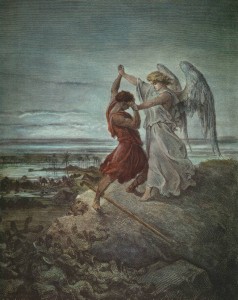
Did Jacob Wrestle with the Pre-incarnate Yeshua?

Genesis 32:24–32, Jacob Wrestling With the Messenger of YHVH. In verse 24 we read,

And Jacob was left alone; and there wrestled with a man [Heb iysh, Strong’s H376] or heavenly messenger [i.e. Heb malak]. (KJV, see Hosea 12:4)

In the following passages, we see that this man was Elohim.

You have power with Elohim and with men, and have prevailed. (verse 28, based on the KJV)

… for you have striven with the Divine [Elohim] and with man and have overcome. (verse  28, The ArtScroll Stone Edition Tanach and Chumash)

Then Jacob says that he has “seen [Elohim] face to face” (KJV, CJB and The Soncino Edition Pentateuch, Second Edition). The two standard Orthodox Jewish versions of the Torah, The ArtScroll Stone Edition Tanach and The ArtScroll Stone Edition Chumash, and Samson Raphael Hirsch’s Torah commentary The Pentateuch (by Judaica Press) all read, “For I have seen the Divine face to face.” Here they have translated the Hebrew word Elohim as the Divine (OHBP OHVKT/Elohim panim).

Which translation of the word Elohim is the correct one? Before resorting to human sources to solve this dilemma, does the Word of Elohim itself interpret this passage for us giving it clear light? Most assuredly so. In Hosea 12:2-5 we read,

[YHVH] hath also a controversy with Judah, and will punish Jacob according to his ways; according to his doings will he reward him. He took his brother by the heel in the womb, and by his strength he had strove with [Elohim]. He strove with an angel [Heb malak or heavenly messenger in many instances referring to YHVH himself, as noted elsewhere in this work] and prevailed: he wept, and made supplication to him; he found him in Beth-El, and there he spoke with us; and [YHVH Elohim] of hosts; [YHVH] is his name. (based on the KJV)

The Stone Edition Tanach renders this passage as follows (starting in verse four):

In the womb he seized his brother’s heal, and with his strength he struggled with [an angel of] God; he struggled with an angel and prevailed; [the angel] wept and beseeched him: ‘In Beth-el He will find us and there He will speak with us.’ HASHEM is the God of Legions; HASHEM is His remembrance. (bracketed supplied word are in the original)

So which translation is correct? The first one indicates Jacob was wrestling with a Heavenly Messenger who was none other than YHVH Elohim, while the second translation is cast in such a light as to imply that Jacob was wrestling with merely an angel.

Does the word Elohim mean the Divine? It is interesting to note that in the Authorised Version the word Elohim appears 2606 times in the Tanakh. It is translated as God 2346 times, god 244 times and several other words less than five times each (e.g. judge, goddess, great, mighty, angels). As in all cases with a word which can have several meanings, the context of the Scripture passage will determine its meaning and its subsequent translation from the original language into English. The word divine was not employed in the 1611 Authorized Version (KJV) in reference to Elohim anywhere in the Tanakh, since the word had a pejorative connotation (as in divination or one who divines the future). This is not the case in our modern parlance as the modern Webster’s New Collegiate Dictionary defines divine in its primary definition as “relating to, or proceeding directly from God, being a deity, directed to deity.” All standard English (Christian )versions (NKJV, NAS, NIV, NRSV) translate this passage as “God face to face” and none use the term “the Divine face.” The New Brown-Driver-Briggs-Gesinius Hebrew-English Lexicon defines Elohim (in those Scripture passages where it is a clear reference to deity, as opposed to a goddess or a human judge) as the true God, Yahweh is (the) God. Never does this Hebrew lexicon define Elohim as the Divine. Similarly, nowhere does the TWOT in defining the word Elohim suggest that the Divine could be an appropriate substitute for the title of YHVH, Elohim. So we must ask, why do the two Jewish translations of this passage (noted above) seem to run cross grain to a plethora of other translations, both Jewish and Christian, as well as noted lexicographers to translate it as they do? Is this a case of translation bias? Could translating Elohim panim as Elohim face to face as so many other translators do be a tacit admission that Elohim can appear as a man, hence giving credence to the Christian assertion that Yeshua was Elohim in the flesh? It is interesting to consider this. But before jumping to conclusions, let us examine other passages in the Tanakh where Elohim and man seem to come face to face. How do the Jerwish sages treat these passages? How do their commentaries explain these difficult passages?

What do some leading rabbinic commentaries say on these passages? Continue reading →


Hidden Message in the Names of the 12 Tribes

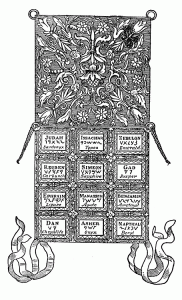
Genesis 29:32–30:24, The Scriptures record that the gospel was preached not only to the first century believers, but to ancient Israel (Heb 4:2), as well the Patriarchs (Gal 3:8). Here is another example of this in the meanings of the names of the twelve sons of Jacob. They are: Reuben, Simeon, Levi, Judah, Dan, Naphtali, Gad, Asher, Issachar, Zebulun, Joseph and Benjamin (who was not born until Gen 35:18). Translated their names mean:

  • Reuben/“See, a Son,” (this points to Yeshua).
  • Simeon/“Hearing” (hear the Son or gospel/good news).
  • Levi/“Joined” (referring to the union by which the Set-Apart Spirit makes us one with the Son through the hearing of the gospel).
  • Judah/“Praise” (the response of the redeemed upon being joined to Yeshua and becoming regenerated spiritually or born from above).
  • Dan/“Judgment” (the believer, though worthy of judgment for his sin, has passed from judgment to life through the atoning blood of Yeshua.
  • Naphtali/“Wrestling” (this speaks of the believer’s life as he struggles against the world, flesh and the devil endeavoring to walk righteously).
  • Gad/“Troop, Company” (this speaks of the fellowship of believers in the household of faith), the result of fellowship is Asher/“Happiness.”
  • Issachar/“Hire” (once a part of the spiritual body of believers, one is equipped for works of service in advancing the kingdom of Elohim as a bondservant).
  • Zebulun/“Dwelling, Exalt, Honor” (we are to occupy until Yeshua comes again while we honor and exalt him before the Gentiles.
  • Joseph/“Adding” (can refer to adding to the body of believers in Yeshua through outreach or to rewards in YHVH’s eternal kingdom for a job well done laboring in YHVH’s spiritual field).
  • Benjamin/“Son of My Right Hand” (a reference to Yeshua who sits at the right hand of YHVH and to believers who are seated with Yeshua in heavenly places, by faith).

Or another way to look at it is this:

  • Judah means “Now I will praise YHVH.” (Gen 29:35)
  • Reuben means “Surely YHVH has looked upon my affliction.” (Gen 29:32)
  • Gad means “What good fortune.” (Gen 30:11)
  • Asher means “Happy am I.” (Gen 30:13)
  • Naphtali means With great wrestlings have I wrestled.” (Gen 30:8)
  • Manasseh means “For Elohim [said he], ‘has made me foreget all my toil.’” (Gen 41:51)
  • Simeon means “ Because YHVH has heard that I was hated.” (Gen 29:33)
  • Levi means “ Now this time will my husband be joined to me.” (Gen 29:34)
  • Issachar means “Elohim has given me my wages.” (Gen 30:18)
  • Zebulon means “Elohim has endowed me with a good gift, now my husband will dwell with me.” (Gen 30:20)
  • Joseph means “YHVH shall add to me.” (Gen 30:24)
  • Benjamin means “You shall have this son. (Gen 35:17–18)

Combined the names tell the following story: Now will I praise YHVH. Surely YHVH has looked upon my affliction. What good fortune. Happy am I. With great wrestlings have I wrestled and I have prevailed. For Elohim has made me forget all my toil because YHVH has heard that I was hated. Now this time will my husband be joined unto me. Elohim has given me my wages. Elohim has endowed me with a good gift. Now my husband will dwell with me. YHVH shall add to me. You shall have this son.

It starts with Yeshua and ends with him. He is the Aleph and the Tav (or the Alpha and Omega), the Beginning and the End, the Author and Finisher of our faith! Give him glory! Pause and reflect on these names. Is it possible that the mind of man could have cleverly contrived these names and their order about 1800 years before the birth of Yeshua?

Where are you in this prophetic scenario? In your spiritual walk have you passed through the reality of each of the twelve steps? Perhaps this is the world’s original “twelve-step program”!