Think Globally; Act Locally

Genesis 48:19, Multitude of nations. What do the Jewish sages say about this prophetic verse pertaining to the descendants of Ephraim and Manasseh?

20391530

Ibn Ezra declares that many nations will descend from him, since the word many is the Hebrew word melo meaning “fullness,” and connotes abundance. The phrase literally means “and his seed will become the abundance of the nation” ([Neter; Karnei Or]; The ArtScroll Bereishis/Genesis Commentary, p. 2121)

R. Avraham b. HaRambam somewhat similarly states that the expression denotes abundant profligacy to a point that they will have to inhabit lands of other nations it is an allusion to Ephraim’s expansive territory (Ibid.).

The Radak says that this refers to the exile when the lands of others will be filled with his scattered descendants … See also Hos 7:8: “Ephraim shall be mingled among the nations. (Ibid.)

What kind of blessing was this prediction that one day his descendants—the ten tribes—would be scattered among the nations? R. Munk explains: while it is true that the dispersion was caused by the unfaithfulness and sinfulness of Ephraim’s descendants (Hos 7:8ff), Jacob’s blessing was not in vain for “they will return to God” and will have their share in the world to come (Sanhedrin 110b). And R. Eliezer adds: “Even the darkness in which the Ten Tribes were lost will one day become as radiant as the day’ (according to the version of Avos d’Rabbi Nosson 36). And in the perspective of history, did not these exiled children of the Patriarchs enlighten the nations among whom they were scattered? They did so by teaching their conquerors the fundamental ideas of the knowledge and love of God, ideals they had never forsaken. Hence they too have a messianic vocation and their Messiah the … Messiah son of Joseph (Succah 52a), also called Messiah son of Ephraim (Targum Yonasan on Exod 40:11), will play an essential role in humanity’s redemption, for he will be the precursor of the … Messiah Son of David …” (Ibid., pp. 2121–2122).

Can you better see in Jacob’s prophecies over the sons of Joseph and the resulting rabbinic interpretations of those prophecies foretelling the Messianic or Hebrew roots movement (within the Christian church) of the final days?

This movement will be instrumental in bringing the Christians (many of whom are descendants of Joseph’s sons) back to their spiritual Hebrew (or Book of Acts) roots as part of the restoration of all things before Messiah Yeshua, the Son of David, returns (Acts 3:21).

The Book of Revelation prophesies the last days Hebrew roots movement when it declares that the end-time saints will be those who have the message of the gospel or the faith and testimony of Yeshua the Messiah and who keep YHVH’s Torah-commandments (the Torah or instructions of YHVH given to Moses and Israel at Mount Sinai, Rev 12:17 and Rev 14:12).

Yeshua sent his disciples out to gather in the lost sheep of the house of Israel (Matt 10:6; Acts 1:6–8). If you’re a disciple of Yeshua, what can you be doing to help bring in the lost scattered  sheep of Israel to Yeshua?

Perhaps you’ve seen the bumper sticker which says, “Think globally; act locally.” I don’t know what folks who place this on their cars mean by this, but maybe we could co-opt this phrase with regards to helping to gather in the lost sheep of Israel. (By the way, it is one of the goals of this blog and the ministry behind it to help to do just that.)

Please pray and ask YHVH through his Spirit to lead and guide you to be his profitable servant in helping to gather in the lost sheep of Israel.


 

Blog Scripture Readings for 12/23 through 12/29/12

Aside

Parashat Vayechi — Genesis 47:28 – 50:26
Haftarah — I Kings 2:1 – 2:12
Prophets — 2 Samuel 13:1 – 20:26
Writings — Psalms 78:1 – 84:12
Testimony — Luke 1:46 – 1:80 

Most of this week’s blog discussion points will be on these passages. If you have general comments or questions on the weekly Scripture readings not addressed in a blog post, here’s a place for you to post those. Just use the “leave a reply” link below.

The full “Read Through The Scriptures In A Year” schedule, broken down by each day, can be found on the right sidebar under “Helpful Links.” There are 4 sections of scripture to read each day. One each from the Torah, the Prophets, the Writings, and from the Testimony of Yeshua. Each week, the Torah and haftarah readings will follow the traditional one-year reading cycle.

Weekly Blog Scripture Readings for 12/23 through 12/29/2012


Nuggets in the Torah Scroll: Nine Spaces Missing

Genesis 47:28, The Jewish sages recognize that this final parashah (Torah portion) of Genesis chronicles Jacob’s wish to reveal to his sons prophetic understandings pertaining to Israel’s long and numerous exiles, culminating in the Final Redemption (return of Israel from her exile in “Babylon” at the end of the age prior to the return of Messiah at which time the two houses of Israel will be reunited under Messiah Son of David).

Torah Scroll-open 1

Jacob states this in Genesis 49:1 when he speaks of his prophecies relating to what will befall his sons “in the last days.” Prior to the establishment of the Messianic Age (Millennium) all Israel would go into a time of darkness, gloom and exile.

The Jewish sages teach that this idea is implicated in the fact that the Torah scroll fails to place the customary nine spaces between the last word of the previous parashah and the first word of the present one. There is only a one space gap in Hebrew letters which predicts the “closing in” of Israel as they go into exile and captivity in Egypt.


Naked and Ashamed Vs. Preparedness

Mark 14:51, A certain young man…naked. The reason for the inclusion of this detail in the Gospel record has puzzled many commentators. For example, Matthew Henry suggests that it was added to show the barbarous nature of the Jewish gang that arrested Yeshua, and how narrow was the disciples’ escape from their hands.

Naked and ashamed

Naked and Ashamed

There seems, however, to be a greater spiritual lesson to be learned from this story.

Previous to this, Yeshua, as he and his disciples were coming into the Garden of Gethsemane, admonished them to sit and pray with him (v. 32), to stay and watch (v. 34), to watch and pray so as not to fall into temptation because of the weakness of the flesh (v. 38). Instead, the disciples slept (vv. 37, 40).

Elsewhere, Yeshua instructs the elect saints of the last days to endure tribulation and spiritual apostasy to the end (Matt 24:13), and to watch vigilantly and be ready for his second coming (Matt 24:42, 44; 25:13). These warnings are in the context of his Parable of the Ten Virgins. All slept while awaiting the bridegroom’s arrival. While five were spiritually prepared, five were not. Those who were unprepared were dubbed as foolish and weren’t allowed into the wedding.

Likewise, in the end times, there will be believers who YHVH views as wretched, miserable, poor, blind, and naked because they have grown lukewarm spiritually (Rev 3:14–17).

The point of this discussion is this: If the disciples of Yeshua (that’s you and me) fail to maintain a state of spiritual preparedness (by watching, praying, keeping oil in their spiritual lamps, enduring to the end) while awaiting his return, they, like the young man in Gethsemane and the Laodiceans in the Book of Revelation, will be found to be spiritually naked lacking robes of righteousness on the day of his return and thus unprepared to meet him (Rev 19:7–9 cp. Matt 22:2, 11–12).


Let’s All Go to the Movies!

With excitement, I am happy to announce the placement of my first biblical teaching video on YouTube. The subject is “Redeemed Israel — The One New Man.”

Here’s the promo on it:

Who is the “one new man” that the Apostle Paul mentions in Ephesians 2:15? As a believer in Yeshua/Jesus, do you view yourself as a Gentile, Jew, Israelite or something else? Understanding the answers to these questions will effect your spiritual destiny and your level of rewards in the Elohim’s eternal kingdom.

Okay, my first movie isn’t going to win any Academy Awards — probably won’t even get nominated 😉 — but oh well, we’re shooting for a higher prize — right? But considering that it’s my first effort, I hope you’ll indulge me a wee bit and find the blessing in this video production despite its homespun, novice qualities.

I’m teaching myself the iMovie 11 video editing program, and still have a long ways to go in mastering the fine art of video production and editing, but I’ve at least got an opening and ending with music and graphics. Throughout the video, scripture references are listed over the top of the video, along with scripture quotations inset as needed as well as other graphics. So it’s not just me talking for 45 minutes. Yikes! The video contains graphic elements to hopefully keep the subject a little more lively and interesting to the viewer and take the pressure off of my, some might say, non-photogenic mug.

The sound quality came out really nice, and considering that the video camera is my trusty iPhone 4S, the video quality is nice too.

Take a look and let me know what you think. I’m already thinking of a number of improvements to make down the road, but be patient — Rome wasn’t built… well, you know the rest of it.

The most important thing about the video is the Word of Elohim is going out. I want lives to be touched for the glory of Yeshua and the kingdom of YHVH. I have this burning passion to reach lives for Yeshua. It’s like an addiction! It’s like I was placed on this earth for this purpose and can’t help myself. (Is there a 12-step program called “Evangelists Anonymous”? Well, I wouldn’t go!) Can anyone else relate to this, or am I just one of those incurable “Bible-thumping Jesus freaks”? The thing is this: I have tasted and seen that YHVH Elohim is good and I can’t get over it. Besides, what are the alternatives to serving Elohim? Becoming a fly and cow worshipping Hindu? Or a Hare Krishna or Moslem, Satanist or witch? How about a New Age tree-hugging mother earth worshipper? I can just see myself on my face before a tree just before I pick up my chainsaw to cut it down! (For those of you who don’t know, I own a tree service!) You get the point.

Bottom line, I love YHVH with all my heart and want to help make the world a better place for him. Thank for joining me in this wonderful journey into eternity!

Another video teaching is in progress and will be uploaded soon to our channel at http://www.youtube.com/hoshanarabbah. So stay tuned!


Prophetic Shadows in Joseph’s Life (pt 4)

This final post in this series on the life of Joseph is a little longer than the others, but stay with it to the end.  It’ll be worth the time to read it in that your understanding of end-times prophecy with regard to the Jewish and Christian people will be greatly expanded. Enjoy!

Joseph’s Brothers Didn’t Recognize Him as Their Brother (Gen 42:6, 8)

Joseph’s brothers did not recognize him, though he recognized them. This is prophetic of what would happen between the brothers in the future—they again wouldn’t recognize each other.

To understand how this scenario would play out prophetically,  we have to know who Joseph’s descendants would become. Ephraim and Manasseh, Joseph’s sons (Gen 41:50–52) would not only become whole nations or people-groups, but would become the leaders of other nations as well (see Ezek 37:16; Hos 6:10; 11:12; 2 Chr  30:1, 10–11).

Prophetically speaking, as Judah (the leader and spokesman of the brothers and whose descendants are the modern-day Jews didn’t recognize Joseph, so the Jews have not recognized Joseph’s descendants—the house of Ephraim—who constitute a major portion of the lost sheep of the house of Israel today (Matt 10:6; 15:24). The Jewish sages have long recognized that their Ephraimite brothers (along with those from the other tribes who had forgotten their identity) are scattered and will someday return by the divine hand of the Almighty and in fulfillment of numerous biblical prophecies. For example, Jewish teacher Jacob Immanual Schochet acknowledges that through the efforts of the Messiah, the ingathering of the exiles, including the ten tribes of the Northern Kingdom, will occur, and they will be reunited with Judah and together the whole house of Israel will serve YHVH as stated in Ezekiel 20:32–37, 40–42. The Talmud (the Jewish oral law) confirms this view position and states that the ten lost tribes will return to the land of Israel at the end of the age in conjunction with the coming of the Messiah to be reunited with their Jewish brothers.

Joseph’s Brothers Didn’t Recognize Him as Their Savior (Gen 42–44)

Joseph’s brothers didn’t recognize that Joseph was their savior (from famine). Prophetically, and in our time, most Jews neither recognize Christians (the descendants of Ephraim and Manasseh) as their brothers, nor that the Jesus of Christianity is their Savior who will supply spiritual food for which their hearts are longing (but not finding in rabbinical Judaism), but that he died to redeem them from their sins.

The Scriptures prophecy that this spiritual blindness would occur to many of the children of Israel, including the Jews. We read about this in Isaiah 8:14 and Romans 11:25.

The Concept of Deliverance Through Substitution (Gen 42:17–19, 24)

Joseph made known to his brothers a way of deliverance through substitution in that they would all be saved if Simeon were held back for ransom.

Continuing our comparison between Joseph and Yeshua, Continue reading →


Prophetic Shadows in the Life of Joseph (pt 3)

Joseph: Antitype of Yeshua the Savior (Gen 42)

Joseph acted as a savior to his brothers and family to save them from death in a time of famine. Prophetically, Christians (who are, at least in part, descendants of Joseph) present Yeshua son of Joseph as the Savior to the world (including to the Jews) to save people from spiritual death.

Viewing Joseph’s role as a savior to the Israelite people in their time of need as a prophetic picture of ­Yeshua’s similar role as Savior should not seem strange to the reader. In pre-Christian Jewish literature, the Jewish sages identified two Messiahs that were to come: one whose life would resemble Joseph and was referred to as the suffering servant or “Messiah Son of Joseph” (Mashiach ben Yoseph), and a second Messiah whose life and ministry would resemble that of David, and who they referred to as the warrior king or “Messiah Son of David” (Mashiach ben David). This messianic title was prevalent even in Yeshua’s day, for on several occasions, he was asked if he was the [Messiah] Son of David (e.g., Matt 9:27; 12:23; 15:22; 20:30–31; 21:9, 15; 22:42). The Jewish sages came to the conclusion that there were two Messiahs because while reading the messianic prophecies in the Tanakh (OT) they saw two different, even conflicting Messiahs whose roles were very different from each other. What was not known by the ancient Jewish sages, which was a subject of much debate, was which Messiah would come first, when he would come, would he be the same person or two different individuals, and how much time would separate their two comings.

For believers in Yeshua, this is not a dilemma, because we can look back in time and clearly see that Yeshua fulfilled the Suffering Servant role at his first coming, and will fulfill the Conquering King role at his second coming. But two thousand years ago, without the benefit of historical perspective, this was not an easy matter to figure out. Even the disciples were at times in a quandary as to which mission Yeshua was to fulfill as evidenced by their last question to him before his final ascension, “Will you at this time restore again the kingdom to Israel?” (Acts 1:6).

Allusions to Yeshua the Messiah’s role as the Son of Joseph can be found in the following biblical passages:

  • The Suffering Servant will die a martyrs death for the sins of his people (Isa 52:13–53:12).
  • In the end of times, the Jews will look upon him whom they pierced and mourn for him as one mourns for his only son (Zech 12:9–10).
  • In verse one of Psalm 22 are some of the last words to come out of Yeshua’s mouth while he hung dying on the cross. This psalm predicts certain aspects of the Suffering Servant Messiah’s ministry.
  • John 1:45 may be a double entendre allusion to Yeshua as being not only the (adopted) son of Joseph, the husband of Mary, but to his being Messiah Son of Joseph, as well.

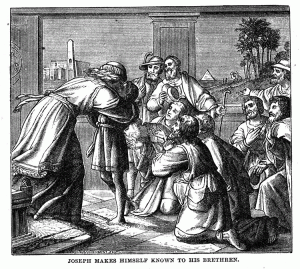
In Genesis 45:1–15 when Joseph finally reveals himself to his brothers, we see that Joseph, as an antitype of ­Yeshua, had mercy on his brothers who were now penitent for their sins against him. Joseph wept for joy and embraced his brothers (verse 14) when being reconciled to them. Past hurts and wrongs were forgiven. Prophetically, this points to Yeshua, our Savior and Redeemer, who lovingly accepts the repentant sinner and warmly embraces and welcomes him into Elohim’s spiritual family and kingdom (Ezek 18:27–32 and Ps 103:10–18).

Continuing with our comparison between Joseph and Yeshua, we see that during the remaining years of the famine, all of the Egyptians became indebted to Joseph as he judiciously doled out the stored wheat to those in need. In order to save their lives, the inhabitants of the famine-ravished land gave their lives and land to be servants of Joseph (who was a type of Yeshua) in exchange for food (Gen 45:13–26, 47:23). Yeshua, likewise, has bought us with the price of his blood (1 Cor 6:20; 1 Pet 1:18–19; Rev 5:9). Similarly, in the Apostolic Scriptures, the disciples of Yeshua are called to be his bondservants—a term the apostles apply to themselves numerous times.