How the First Passover Perfectly Pictured Yeshua the Messiah

For I am not ashamed of the gospel of Messiah, for it is the power of Elohim to salvation for everyone who believes, for the Jew first and also for the Greek. (Rom 1:16)

For the preaching of the cross is to them that perish foolishness; but unto us which are saved it is the power of God. (1 Cor 1:18)

Neither is there salvation in any other: for there is none other name under heaven given among men, whereby we must be saved [except the name of Yeshua the Messiah]. (Acts 4:12)

According to the laws of statistical probability, what are the chances of an event happening and then fifteen hundred years later another event occurring bearing an uncanny resemblance to the first one? Now suppose that not only did fifteen hundred years separate the two events, but that they occurred in two different countries several hundred miles apart, which in the ancient world considering the difficulties of travel and communications may as well have been halfway around the globe. Now suppose that the second event involved the death of a person, and that the events leading up to their death including the manner and timing of that death was beyond the control of the individual dying so that in no way could the person dying stage his death to mirror the first event. In fact, those killing the individual possessed no foreknowledge of the event that had occurred fifteen hundred years earlier. What are the chances of this occurring? Well beyond the laws of possibility!
Lamb sacrifice

This is not a fictional story! Truth is sometimes stranger than fiction. The details of these two events are chronicled in the pages of the Bible. The first event occurred in ancient Egypt and is recorded in the Book of Exodus chapters eleven and twelve. There we find recorded the details of the children of Israel’s first Passover while they were yet slaves in the land of Egypt. A whole series of events led up to this first Passover, which culminated with each family’s ritual killing of a lamb, smearing its blood on the frame of their doors, roasting the lamb, and then eating it. Doing this insured that YHVH would pass over their homes leaving those inside alive. The firstborn of those whose homes did not have the blood on them were killed.

The second event involved a descendant of those ancient people who was born in a different land fifteen hundred years later. His name was Yeshua of Nazareth, a Jew, and viewed by many of his day as the long-awaited Messiah of Israel. One of the proofs of his Messiahship would be whether he would fulfill the many prophecies that had been foretold Continue reading →


Yeshua in the Passover Lamb

A miraculous occurrence and a physical impossibility, 1500 years, two continents, and several hundred miles separated the Israelites’ first Passover in Egypt and Yeshua’s (Jesus’) death on the cross, yet the first Passover lamb perfectly foreshadowed Yeshua’s sacrificial death to take away our sins.
This video will either help you to find faith in Yeshua the Messiah, who has come to save you from your sins and to grant you eternal life, or it will substantially strengthen your existing faith.
 

Blog Scripture Readings for 3/3 through 3/9/13

Aside

Parashat Vayakhel-Pekudei — Exodus 35:1 – 40:38
Haftarah — Ezekiel 45:16 – 46:18 **
Prophets — Isaiah 22:1 – 29:24
Writings — Psalms 147:1 – 150:6; Proverbs 1:1 – 4:27
Testimony — John 14:1 – 18:40

Most of this week’s blog discussion points will be on these passages. If you have general comments or questions on the weekly Scripture readings not addressed in a blog post, here’s a place for you to post those. Just use the “leave a reply” link below.

The full “Read Through The Scriptures In A Year” schedule, broken down by each day, can be found on the right sidebar under “Helpful Links.” There are 4 sections of scripture to read each day. One each from the Torah, the Prophets, the Writings, and from the Testimony of Yeshua. Each week, the Torah and haftarah readings will follow the traditional one-year reading cycle.

Weekly Blog Scripture Readings for 3/3 through 3/9/13.

** A different Haftarah is read when it is a special sabbath in Jewish tradition. On 3/9 is the traditional “Shabbat HaChodesh” (Sabbath of the month), which is the Sabbath that precedes the beginning of the first month of the year. This haftarah as well as Exodus 12:1–12:20 are read as a reminder we are approaching the rosh chodesh (the new moon) that is the “beginning of months” or the new year. To declare the new year, the barley also must be examined to determine how ripe and near harvest it is (a stage called aviv). When living in the land, the barley was easily accessible and one could see how ripe it is. Today several groups of people from around the world search the land of Israel to determine the ripeness of the Barley harvest and report their findings via the internet.


Is America in End-Time Bible Prophecy?

Isaiah 18:1–3, In the chapter heading in some Christian Bibles, Isaiah chapter 18 is titled “Ethiopia.” Is this an accurate chapter heading? Isaiah 18:1 refers to “the land … which is beyond [on the other side of] the rivers of Ethiopia.”

21632842

The traditional view among many biblical commentators (both from Christian and Jewish sources) is that this prophecy is referring to the area of modern Ethiopia, which is just south of Egypt. It is believed that the river mentioned in this passage is the Nile with its tributaries, while the ships are a reference to boats that regularly ply those waters, and the whirring wings refer to either locusts or to tsetse flies, which are abundant in that region.

These same commentators offer various views on how this prophecy of Isaiah was fulfilled in ancient times. In these commentaries, no explanation was given of the meaning of the word sea in verse two and how that relates to Ethiopia, or how Ethiopia was a nation that was feared far and wide (verse 2). Perhaps another interpretation could be offered that would better fit the descriptions of the land and its people given in this prophecy. Continue reading →


Moses Prophesies His Own Resurrection and Glorification—and Ours Too

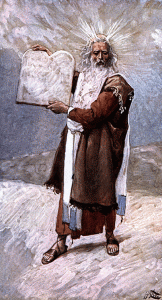
Exodus 34:1–35, Moses’ second ascension of Mount Sinai is a prophetic picture of the saints’ resurrection and glorification at the second coming of Yeshua the Messiah.

According to Jewish tradition, Moses ascended Mount Sinai to receive the second set of stone tablets containing the Ten Commandments on the first day of the sixth month or 30 days before Yom Teruah, which occurs on the first day of the seventh month. Forty days later on Yom Kippur he descended from the mountain carrying with him the second set of tablets as a sign of YHVH’s forgiveness of the children of Israel after the golden calf incident. This signaled YHVH’s renewed relationship with Israel after they had repented of golden calf worship.

Moses' shining face

We know that a biblical Israelite bride, while waiting for her betrothed to arrive from his father’s house, would hear the sound of the shofar in the distance as her bridegroom approached. If she were alert and not asleep (as were the ten virgins in Matt 25), she would have had time to put on her wedding robes, trim her lamp’s wick, and have it filled with oil and ready to light as soon as he arrived.

Prophetically, the Scriptures tells us that the saints of Yeshua are to be resurrected and to  Continue reading →


Grace—Not Just a New Testament Commodity

Exodus 33:12–13, Grace. (Heb. chen meaning “favor, grace, charm, acceptance”). The Hebrew word chen (found 69 times in the Tanakh), which is translated as grace, in this verse is equivalent to the Greek word charis, which is found 156 times in the Testimony of Yeshua and is translated as grace 130 times in the KJV.

Love of Father 9784387

The equivalency of these two words is confirmed by the translators of the Septuagint (the Greek Tanakh) who used charis in place of chen when translating the Hebrew Tanakh into Greek beginning in the third century B.C. According to The Theological Workbook of the OT, in the vast majority of occurrences of chen in the Tanakh, the focus of attention is not on the giver, but on the recipient. The emphasis is on the relationship of the superior to an inferior (e.g., a king to his subjects). What this teaches us is that despite sin and rebellion against him, YHVH (the king) is gracious (to humans, his subjects).

Contrary to what many in the church have been led to believe, the grace of Elohim is a very prominent theme in the Tanakh. Examples of this include Noah who found grace in YHVH’s eyes (Gen 6:8), or the children of Israel although dead in their sins in Egypt and deserving of YHVH’s wrath, they were saved by the blood of the lamb. There are a number of other references to the grace of Elohim in the Tanakh as well (Gen 18:3; Exod 3:21; 33:16,17; 34:9; Ps 84:11; Zech 12:10).


How Much Do You Love Yeshua? A Year’s Wages Worth?

John 12:5, Three hundred denarii. This large sum is equal to 300 days’ wages for a common laborer.

Devotion for El-19158646 3To the natural mind, Judas’ objection to the use of this expensive spice (worth between $30,000 and $50,000 in today’s money) to anoint someone’s feet seems logical. It seems like a total waste of something very valuable. By contrast, from our perspective, we can look backwards historically with perfect 20–20 hindsight and realize that for Yeshua, the Messiah and Savior of the world, he was worth every penny of the spikenard and much more. Yet, from the perspective of Yeshua’s followers, Yeshua’s true identity and mission still weren’t clear. This confusion wouldn’t clear up until after his resurrection and glorification (v. 16). So for some of them, Mary’s act of faith in anointing Yeshua’s feet with a year’s wages of spice seemed to be illogical folly.

This spice, most likely was originally intended for use on Lazarus’ body, whom Yeshua had just resurrected and so was no longer needed for that purpose, at least. It is likely that it was out of gratefulness for resurrecting her brother that Mary performed this act of love and devotion to Yeshua, not realizing that her actions were prophetic in that she was pre-anointing Yeshua’s body for his own burial ten days from that night (v. 7).

Now let us consider the following. We know that YHVH Elohim the Father gave us his greatest love gift by sending Yeshua, his Son, to this earth to live, die and resurrect for our redemption and ultimate glorification (John 3:16). How much do we love Yeshua, and what is the greatest gift we could ever give him, even if those around us thought we were crazy to do so? Have you given him all your heart? Does all that you own belong to him including your life? Would you give away all of your possessions in devotion to him if he asked it of you? Would you literally lay your life down for him as he did for you? How much do you love Yeshua?