The Ancient Sages Taught: Two Messiahs to Come— The Same or Different Persons?

The Scriptures Reveal Two Messiahs Are to Come —
One Who Will Be Like Joseph and One Who Will Be Like David

In Jewish literature, the Messiah whose life would resemble Joseph was referred to as the suffering servant or “Messiah Son of Joseph” (Mashiach Ben Joseph), while the Messiah whose life and ministry would resemble David was referred to as warrior king or “Messiah Son of David” (Mashiach Ben David). The Jewish sages came to this conclusion because when reading the messianic prophecies in the Tanakh they saw two different, even conflicting Messiahs whose roles were very different from each other. What was not known by the ancient Jewish sages, and was a subject of much debate, was which Messiah would come first, when he would come, would he be the same person or two different individuals, and how much time would separate the two comings.

For believers in Yeshua, this does not seem like a dilemma, for we look back in time and can see clearly that Yeshua fulfilled the Suffering Servant role at his first coming, and will fulfill the Conquering King role at this second coming. But two thousand years ago, without the benefit of historical perspective, this was not so easy a matter to figure out. Even the disciples were at times in a quandary as to which mission Yeshua was to fulfill as evidenced by their last question to him before his final ascension, “Will you at this time restore again the kingdom to Israel?” (Acts 2:6).

Let’s review some of the passages in the Tanakh that point to the two different Messiahs.
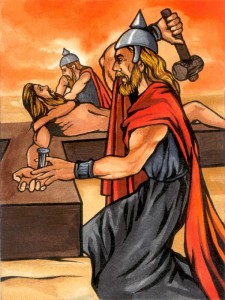
Yeshua nailed to cross16957864

Messiah Son of Joseph

  • The Suffering Servant will die a martyrs death for the sins of his people (Isa 52:13–53:12).
  • In the end of times, the Jews will look upon him whom they pierced and mourn for him as one mourns for his only son (Zech 12:9–10).
  • Verse one of Psalm 22 are some of the last words to come out of Yeshua’s mouth while he hung dying on the cross. This psalm predicts certain aspects of the Suffering Servant Messiah’s ministry.
  • John 1:45 may be a double entendre allusion to Yeshua as being not only the (adopted) son of Joseph, the husband of Mary, but to his being Messiah Son of Joseph as well.

Throne 9842706


Messiah Son of David

  • He will restore righteous government in Jerusalem (Isa 1:26)
  • He shall judge the nations (Isa 2:4)
  • All on earth shall worship him (Isa 2:17).
  • He shall rule the earth and destroy the wicked (Isa 11:4).
  • Under his rulership, all Israelites will be restored to their homeland (Isa 11:12).
  • Matthew 9:27; 12:23; 15:22; 20:30, 31; 21:9,15; 22:42 are references to the expectations of the Jewish followers of Yeshua that he was Messiah Son of David.
 

What Are Some Symptoms That a Person Is Tormented by Demons?

Mark 5:1–20, The Gadarene demoniac. This encounter between Yeshua and this demon-possessed individual teaches us about the characteristics of one who is tormented or even possessed by an evil spirit.

21446002

  • One with an unclean spirit is “unclean in thought and life” (Mark 5:2).
  • Such an individual may have a pre-occupation with things relating to death and dying (Mark 5:3).
  • They may possess superhuman strength (thanks to the aid of the demon in him, Mark 5:4).
  • They may act wild, and unable to be restrained (Mark 5:4).
  • They may be given to fits of shouting loudly (Mark 5:5), shrieking or making a shrill cry (Mark 9:18).
  • They may cut themselves, or resort to other acts of self-mutilation (Mark 5:5) or self destruction (e.g., burning oneself by fire, Matt 17:15; Mark 9:22), drowning (Mark 9:22).
  • The demoniac may possess supernatural knowledge (Mark 5:7).
  • The demon can speak through the demonized person (Mark 5:7), or cry out (Mark 9:26).
  • A demonic spirit wants to possess or inhabit something; if not a human, then an animal (Mark 5:12), or a house, an objects like idols or books (Acts 19:19).
  • They may be clothed improperly or scantily (Mark 5:15).
  • They will not a possess a “right [sound, self-controlled, sober]” mind (Mark 5:15).
  • A demonic or an unclean spirit may cause convulsions or spasmodic contractions, bodily contortions within a person, or cause a person to be hurled to the ground (Mark 1:25; 9:18, 20), wallowing or rolling around on the ground (Mark 9:20).
  • Epileptic-type seizures or madness can be some symptoms of demon possession (Matt 17:15).
  • A demoniac may foam at the mouth (Mark 9:18, 20).
  • A demoniac may grind or gnash of the teeth (Mark 9:18)
  • A demonic spirit can cause one’s body to waste away, dry up or become rigid (Mark 9:18).
  • Demonic spirits can accompany people as they come into the congregation of YHVH (Mark 1:23; Luke 4:33).
  • A demonic spirit can make one to be mute or unable to speak (Mark 9:17).
 

The Moral Integrity of Spiritual Leadership or a Moral Morass?

1 Samuel 12:3, Whose ass have I taken? The moral integrity of spiritual leadership is essential.

Most leaders in Christian or Messianic circles would strongly assert their probity (honesty and decency), and at the same time would deny that they are building their ministry kingdoms for personal benefit, but what is the real truth?

Greedy dogs!

Greedy dogs!

  • How do they treat their children and wives behind the scenes?
  • What is their response toward their detractors? How do they treat other “competing” ministries?
  • Do they live off of YHVH’s sheep, or do they use tithes and offerings for the care and feeding of YHVH’s sheep?
  • If they do receive income from their flocks, how dependent are they on that income?
  • To what degree do they make decisions affecting the congregation in order to solicit a response that will ensure the security of their position as chief leader and beneficiary of the congregation’s largesse?
  • To what degree do they angle their teaching and preaching to curry the favor of their constituents thus keeping the funds flowing toward them?

These are questions that spiritual leaders all need to ask of themselves from time to time.


The Life of Joseph—A Foreshadow of Messiah Ben (Son of) Yosef

The spirit of Antimessiah (Antichrist) is on a dramatic rise in this day and age. It is even alive in the Hebrew Roots or Messianic Israel Movement where some are losing their faith in Yeshua. A few are even converting to Rabbinic Judaism, which denies the messiahship and deity of Yeshua and the divine inspiration of the Testimony of Yeshua. Some of the blame for this can be laid at the feet of a few of the modern-day descendants of the non-believing Pharisees (i.e., the Rabbinic Jews) who use clever arguments to beguile unstable and unlearned souls into humanistic reasoning devoid of a living faith in Yeshua the Savior and Redeemer of man. Because of a spiritual blindness that Scripture prophesied would come upon the Jews producing hardness of heart toward Yeshua the Messiah, unbelieving Jews ignore the numerous prophetic shadow-pictures pointing to Yeshua the Messiah contained in their own Tanakh.

Joseph's coat 2-33397808May the following study strengthen your faith in Yeshua, in his divine origination in the very heart, mind and essence of Elohim, and in the fact that he was foreordained to come to this earth to reconcile sinful man to his Heavenly Father through his self-sacrifice on the cross. All this was prophesied long ago in the Hebrew Scriptures. The ancient Jewish rabbis speak of a messianic figure coming called Messiah ben Yosef, the Suffering Servant, whose life and ministry would parallel that of Joseph, yet these same rabbis fail to see the connection between Joseph’s life and that of Yeshua. Let’s now chronicle the striking and uncanny parallels between Joseph and Messiah, the son of Joseph, the Suffering Servant (Many of these comparisons come from the book, Gleanings in Genesis, by Arthur W. Pink):

  • Joseph had two names: Yoseph (meaning “to add, increase, do again”) and Zaphnath-panaaneah (41:45) (meaning “revealer of secrets”). How do these names point to Yeshua’s mission? Continue reading →
 

Samuel —A Boy Who Changed a Nation

Elohim used the boy Samuel to change a nation’s destiny and to bring spiritual revival. Maybe he can use you to do the same. Watch this video, and let it inspire you to do so.


Addressing the “Gay” Rights Agenda

The “Gay” rights agenda is pushing itself into all aspects of society and is on a collision course with Bible believers everywhere. What should be our biblical response? How do we help those with gender identity issues and same sex attractions? What should be a biblical and loving response? This video explorers these controversial issues from a loving, biblical, but firm perspective.


Blog Scripture Readings for 11/17 through 11/23/13

Aside

Parashat Vayeshev — Genesis 37:1 – 40:23
Haftarah — Amos 2:6 – 3:8
Prophets — 1 Samuel 11:1 – 17:58
Writings — Psalms 55:1 – 61:8
Testimony — Mark 3:20 – 6:55

Most of this week’s blog discussion points will be on these passages. If you have general comments or questions on the weekly Scripture readings not addressed in a blog post, here’s a place for you to post those. Just use the “leave a reply” link below.

The full “Read Through The Scriptures In A Year” schedule, broken down by each day, can be found on the right sidebar under “Helpful Links.” There are 4 sections of scripture to read each day. One each from the Torah, the Prophets, the Writings, and from the Testimony of Yeshua. Each week, the Torah and haftarah readings will follow the traditional one-year reading cycle.

Weekly Blog Scripture Readings for 11/17 through 11/23/13.