Franklin Graham Sticks to His Guns and Calls Sin a Sin

Franklin Graham Defends Comments on Gay Activists and Islam, Compares Himself to Father Speaking Out for MLK

BY MORGAN LEE , CHRISTIAN POST REPORTER
March 27, 2014|12:05 pm

“You talk about controversy – my father (Billy Graham) stood with Martin Luther King in the early 1960s,” Graham told The Charlotte Observer. “My father never worried about polls. I don’t care about them, either. And with the issues we are facing today – if my father were a younger man, he would be addressing and speaking out in the exact same way I’m speaking out on them.”

Late last month, Graham suggested that Putin was “right” on how the Russian government had dealt with its LGBT activists.

“Obviously, he may be wrong about many things, but he has taken a stand to protect his nation’s children from the damaging effects of any gay and lesbian agenda,” he wrote for Decision magazine.

In 2011, the head of the humanitarian organization Samaritan’s Purse suggested that American Muslims do not genuinely practice their faith, because those who do are violent.

To read the rest of the article, go to http://www.christianpost.com/news/franklin-graham-defends-comments-on-gay-activists-and-islam-compares-himself-to-father-speaking-out-for-mlk-116910/

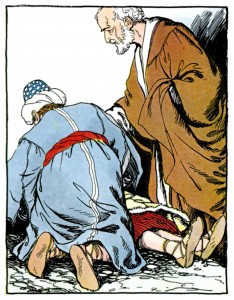
 

Still a Death Penalty for Sin in the “Dispensation of Grace” Era?

Acts 5:1–11, The deaths of Ananias and Sapphira. Why did YHVH kill them? It is because they violated the Torah laws regarding the handling of devoted things. (See notes at Lev 27:28–29.)

58972

It’s interesting to note that YHVH struck Ananias and Sapphira dead after the cross in, what many Christians call, the dispensation of grace era when, in their minds, sin doesn’t carry the same severe penalty us under “old covenant,” law of  Moses era.

What we learn from this is that YHVH still views sin as sin, and the wages of sin is still death. This has never changed before or after the cross of Yeshua. Just because one isn’t struck dead immediately upon having sinned doesn’t mean one hasn’t incurred the death penalty. That death penalty is only waived when one repents of their sin and asks for YHVH’s forgiveness through faith in Yeshua whose death paid the death penalty price for our sins.

Now let’s see what the Torah has to say about the sin Ananias and Sapphira committed.

Leviticus 27:28–29, devote … devoted thing. Heb. charam and cherem meaning “a Continue reading →


What’s the Big Deal with the Contamination of Sin?

Leviticus 12–13
Some Hebrew Terms Relating to This Passage:

  • tzaraas: a skin disease (improperly translated as “leprosy” in some Bibles). This Hebrew word means “to be struck with leprosy (BDB)” or “to smite heavily, to strike, or scourged of Elohim” since the leprosy was viewed as a special divine infliction (Wilson’s Old Testament Word Studies, pp. 248–249) against such sins as jealousy (cf. Miriam, anger, lack of full compliance with Elohim’s commands (cf. King Uzziah), and covetousness (cf. Gehazi, TWOT, p. 777).
  • niddah: someone who is separated or menstruous
  • tumah: spiritual impurity
  • metzora: one with a skin disease; a contraction of the Hebrew word motzi and ra meaning “one who speaks slander”

Leviticus 12 and 13 deal with the subject of human contamination and delineates what could seem to be a lot of irrelevant and archaic, if not arcane, regulations relating to childbirth and skin diseases.

Why is YHVH so concerned about “human contamination”? What is the larger picture here to help us gain understanding into the Father’s intent and heart behind these Torah-laws? Continue reading →


New Video: The Unpardonable Sin Explained

What is the unpardonable sin? Have you committed it? This brief video gives a quick explanation to a difficult and troubling questions.


New Video: Daily Devotionals and the Olah Tamid Offerings

The spiritual pattern for twice daily prayer and devotional times for saints is found in the ancient olah tamid offerings in the Old Testament Levitical sacrificial system. This is something that is pleasing to YHVH Elohim. Learn about offering up the sacrifice of praise in this video.


Blog Scripture Readings for 3/23 through 3/29/14

Aside

THIS WEEK’S SCRIPTURE READINGS FOR STUDY AND DISCUSSION:

Parashat Tazria — Leviticus 12:1 – 13:59
Haftarah — Exodus 12:1– 20; Ezekiel 45:16 – 18**
Prophets —Isaiah 34:1 – 40:31
Writings — Proverbs 16:1 – 22:29
Testimony — Acts 2:40 – 6:15

Most of this week’s blog discussion points will be on these passages. If you have general comments or questions on the weekly Scripture readings not addressed in a blog post, here’s a place for you to post those. Just use the “leave a reply” link below.

The full “Read Through The Scriptures In A Year” schedule, broken down by each day, can be found on the right sidebar under “Helpful Links.” There are 4 sections of scripture to read each day. One each from the Torah, the Prophets, the Writings, and from the Testimony of Yeshua. Each week, the Torah and haftarah readings will follow the traditional one-year reading cycle.

**A different Haftarah is read when it is a special sabbath in Jewish tradition. This Shabbat is traditionally known as Shabbat HaChodesh and Exodus 12:1-20 is read.

Weekly Blog Scripture Readings for 3/23 through 3/29/14.


An Analysis of NT Scriptures that Purport to Invalidate the Biblical Dietary Laws

Fasten your seat belts … here we go!

Matthew 15:11 and Mark 7:18-19

And he saith unto them, Are ye so without understanding also? Do ye not perceive, that whatsoever thing from without entereth into the man, it cannot defile him; because it entereth not into his heart, but into the belly, and goeth out into the draught, purging all meats? (Matt 15:11, KJV)

And He said to them, “Are you so lacking in understanding also? Do you not understand that whatever goes into the man from outside cannot defile him; because it does not go into his heart, but into his stomach, and is eliminated?” (Thus He declared all foods clean.) (Matt 15:11, NASV, emphasis added)

19238426

These are parallel passages in that they record the same events. Mark’s account reads, “And he saith unto them, Are ye so without understanding also? Do ye not perceive, that whatsoever thing from without entereth into the man, it cannot defile him; because it entereth not into his heart, but into the belly, and goeth out into the draught, purging all meats?” (KJV) The Hebrew Roots Version, which is a translation from the Aramaic, confirms the KJV rendering of this verse. However, some of the modern texts (e.g., the NIV and NAS) add the phrase to the end of this verse, “In saying this [Yeshua] declared all foods clean.” This variant phrase in the newer English translations is the source of the confusion in the minds of many who read this.

The KJV is translated from the Greek family of manuscripts called the Textus Receptus or Received Text, which until the end of the nineteenth century was accepted as the most authoritative and purest manuscripts by the Protestant church. On the other hand, the newer translations derive from another family of Greek manuscripts that were rejected by early Protestant scholars as being inferior to the Textus Receptus, but Continue reading →