Aurora Regino, a concerned mother from California’s Chico Unified School District, weighs in after the school board votes to uphold a ‘parental secrecy policy.’
A California mom is outraged after her daughter’s school district upheld a “parental secrecy policy” allowing school officials to offer gender counseling without informing parents.
Aurora Regino said her 11-year-old daughter’s elementary school in the Chico Unified School District helped her transition from female to male during the last school year, but a guidance counselor kept her in the dark during the entire process.
“During one of the meetings, my daughter told the counselor she wanted to tell me about her new identity. They ignored her request and did nothing to support her in letting me know what was going on at school,” she told board members at a meeting last Wednesday.
The board weighed a measure that would allow for “more parental inclusion” but ultimately voted to keep the existing so-called “parental secrecy policy” in place with a 3-2 vote.
“It was a really sad decision that they made, but unfortunately I wasn’t extremely surprised,” Regino told “Fox & Friends First” host Todd Piro on Tuesday.
“This policy that they have in place, to keep these situations a secret from the family, is incredibly damaging. It was extremely damaging in my case with my daughter. She was bullied and she didn’t have the support that she needed from her family and, also, she was outed within the school with other people within the office knowing her new gender and pronouns that she didn’t even tell them, and she had to go through those feelings of wondering how they even knew all on her own.”
California mom Aurora Regino speaks to her daughter’s school board ahead of a vote offering more transparency for parents. (Chico Unified School Board of Education)
Regino, who is suing the district for keeping her in the dark about her daughter’s identity and transition, lambasted the policy as “incredibly dangerous” and said the struggle to advance parental rights in the area had been hard-fought.
She told Piro her daughter is doing well, but she is determined to speak out on behalf of her family and others with similar experiences, so everyone knows what is taking place in public schools.
“When this originally happened to our family, nobody could’ve ever told me that this was going on, especially at the young age of elementary school,” she said.
The policy that board members voted to uphold, according to Regino, extends to children as young as pre-kindergarten who are approximately five years old and reaches through the 12th grade.
“It’s incredibly damaging that they’re upholding such a crazy policy for such young children,” she continued after a moment, arguing that such a tumultuous time in children and adolescents’ lives is when they need parental guidance the most.
Have you ever heard someone say, “I’ll believe it when I see it”? Is seeing really believing? Many people saw Yeshua when he was on this earth, but most didn’t believe him.
It has been 2000 years since Yeshua walked this earth, and since we’ve never seen him, nor even talked to those who saw him, what is the basis of our faith? Is faith in Yeshua blind? Or are there logical reasons to believe in him?
For those of us who have had a faith in Yeshua for a while, for us there are a myriad reasons that have come together to form the basis of our faith. However, for those who are new in their faith walk and don’t have a lifetime of “spiritual experiences” that corroborate that faith, initially finding a basis for that faith can be difficult.
Some people come to Yeshua because that’s their last hope. They’ve hit rock bottom in their lives and there’s no where else to go. They hear and believe the gospel message of hope and end up experiencing the power of the Yeshua and his Holy Spirit in their lives.
Others take a more reasoned approach to establishing a faith in Yeshua. Perhaps their lives haven’t hit rock bottom, but they know they’re missing something — there’s still a void in their life. They sense that there must be more to life — a higher purpose — than simply existing and then dying.
Others come to faith in Yeshua because they look around and see intelligent design behind everything in existence, which speaks of a Creator, which leads them to want to know more about him.
Some people come to Yeshua as a way of dealing with their on mortality. In their quest to answer the question of whether there’s life after death, they come to faith in Yeshua.
Perhaps some come to faith in Yeshua due to the pang of a guilty conscience because of their sin and the need for redemption.
Some people have studied the world’s religions and find that only the gospel message as presented in the Bible addresses the deeper issues of life.
These are all valid and logical reasons for coming to faith in Yeshua.
Whatever the reason for believing what the Bible says about Yeshua, there are good reasons to believe in him based on both the claims of the Bible and logic.
Yeshua — A Historical Figure
Whatever we think about Yeshua pro or con, he was a historical figure. More has been written about him than anyone else, and he has impacted the world more than anyone. There must be something to all this, and thus we have to deal with this reality. Twenty-seven different first-century New Testament documents attest to the reality of his existence and to his impact on humanity. Additionally, numerous Christian, Jewish and Roman historians from the first and second centuries attest to his existence and his positive impact on the lives of thousands, if not millions of people.
In recent years, as many Christians have been rediscovering the Hebrew roots of their faith, some Bible teachers are casting a shadow of doubt and skepticism on some of the most fundamental aspects of the Christian faith.
Such cornerstone Christian doctrines as the deity of Yeshua, his incarnation, his virgin birth, his blood atonement and his bodily resurrection are now being called into question by some skeptics. They claim that these concepts were not components of the original apostolic faith, but were added later, and that the Apostolic Scriptures were redacted by the early church fathers to reflect a diluted Hebraic-based faith melded with some popular pagan concepts of the day.
Indeed, a cursory study of the writings of the Anti-nicene church fathers reveals that there occurred much syncretizing between Christianity and Greek or Hellenistic (pagan) thought and a rejection of much of what was considered to be Jewish, such as the Torah (law of Moses). But what aspects of the apostolic faith did they indeed keep without replacing it with a paganized counterfeit? What aspects of Christian orthodoxy are original to the apostles? How can we know whether what we have learned in the Christian church is the truth or not? These are serious questions that need answers. If one comes to the wrong conclusion on these issues, the eternal consequences could be devastating!
Sadly, some Believers have bought into the line of reasoning without studying the issues carefully that the deity of Yeshua, his virgin birth and incarnation, the blood atonement and his bodily resurrection are pagan concepts. Some make these bold assertions based on the belief that these concepts are foreign to the Hebrew Scriptures (Old Testament). Is this true? This author has proven in other works posted on our ministry web site (www.hoshanarabbah.org) that the deity and incarnation of Yeshua, the virgin birth, and the blood atonement are Hebrew, not pagan concepts, and are rooted firmly in and prophesied about in the Hebrew Scriptures.
In this teaching article, we will discuss the issue of the bodily resurrection of Yeshua. It must be acknowledged that if Yeshua did not resurrect from the grave after his crucifixion then he failed to defeat sin, death and the grave, and it therefore follows that he is not the Savior and Redeemer of man, man has no hope of a bodily resurrection or afterlife himself, and as Paul said, let us eat and drink, for tomorrow we die (1 Cor. 15:32).
There were those who questioned the fundamentals of the faith in Paul’s day, for he spoke of those who had left the faith and had become spiritually shipwrecked (1 Tim. 1:19). Furthermore, he was not so self-assured to think that even he could defect from the very faith he preached and become himself a spiritual castaway or reprobate (1 Cor. 9:27). This should be a word of warning to us all to diligently search out the Scriptures, and to prove whether what we have been taught to believe squares with the Hebrew Scriptures or not. That is the basis for determining the truth of what is written in the Apostolic Scriptures—nothing more and nothing less.
Scriptures and Analysis
In this brief study, we will present to you a series of texts from the Hebrew Scriptures (or Old Testament) with commentary that foretell of a Messianic Redeemer dying and then bodily resurrecting.
Psalms 16:10, For thou wilt not leave my soul [nephesh] in hell [sheol]; neither wilt thou suffer thine Holy [chaseed or faithful, kind, pious, devout, saint, godly] One to see corruption [shakhath or decay of the grave, according to The Theological Wordbook of the Old Testament].
COMMENT: To whom is this verse referring? Who is YHVH’s Holy One? This is obviously not a reference normal humans whose bodies and souls go into the grave at the time of death (so says this verse) to await the resurrection, and where they decay into dust. Who in Scripture, but Messiah Yeshua resurrected after three days before his body could corrupt (start to decay)? According to Jewish thought, bodily decay starts after three days.
Psalms 49:15, But Elohim will redeem my soul from the power of the grave: for he shall receive me. Selah.
COMMENT: This is a generic reference to the resurrection of the righteous. Using a kal v’khomer or light and heavy (a fortiori) rule of logic (or Rabbi Hillel’s first law of Biblical hermeneutics/interpretation) we can reason that if the righteous dead are resurrected how much more so YHVH’s righteous Messiah?
Psalms 22:26, The meek shall eat and be satisfied: they shall praise YHVH that seek him: your heart shall live for ever.
The Feast of Unleavened Bread Is a Commemorative Ritual
Passover going into the first day of the Feast of Unleavened Bread is the birthday of the nation of Israel. In ancient times, universal Israel came together in Jerusalem to celebrate this event. Today, redeemed Israelites or the Israel of Elohim (Gal 6:16) come together to celebrate these divine appointment sacred convocations (1 Cor 5:6–8) cp. 11:17–29).
Abstaining from leavened bread for seven days is symbolic of Elohim’s people separating themselves from sin and entering into a holy or set-apart relationship with him. Without holiness, no one ever see Elohim (Heb 12:14). Set-apart from what? The world, the flesh and the devil (Rev 18:4; 2 Cor 6:14–18; John 17:11, 14; Jas 4:4)
Removing leavening from our homes is a symbolic activity just like taking communion, being baptized for the remission of sins, or building a sukkah during the Feast of Tabernacles. As humans, we need symbolic commemorative occasions for several reasons. They give us a sense of history by helping us to understand the past, so that we can move forward into the future knowing who we are and where we’ve come from. They give us guidance so that we’ll learn from the lessons of history, both the good and bad ones. Our American culture is full of symbolic rituals and commemorative acts and markers (Christmas, Easter, birthdays, anniversaries, Independence Day, Memorial Day, Veterans Day, Thanksgiving Day, statues, historical markers, monuments, museums, heritage sites, etc.). Likewise, Biblical commemorative rituals help us in several ways.
They help us to both recall and commemorate past and future events.
They help us to understand who we are by recalling where we’ve come from which in turn helps us to understand where we’re going.
They can be something physical that helps us to wrap our minds around difficult-to-understand spiritual principle.
They are something physical that help to point us toward a spiritual reality. They help to raise our hopes and our eyes above our mundane existence and strengthen our faith as we move toward the higher goal or reality to which the ritual or commemorative event points.
They help us to teach and to pass on to each new generation not only about our past history, but our future hope.
Leavening Is a Picture of Sin
The observance of the Feast of Unleavened Bread is a symbol of our commitment to turn towards righteousness and turn away from sin. How serious we are about removing physical leaven from our homes in compliance with YHVH’s commands is an indicator of how serious we are about removing sin from our lives.
While leavening makes bread rise and is therefore a symbol for pride, leavening is also a symbol of decay. The rising of the dough is only possible by the natural process of fermentation or decay through fungal activity. In ancient times, a pinch of fermented or sour dough was placed into a batch of unleavened dough to make it sour and cause it to rise. Yeast is a living micro organism that is classified as a fungi. Fungi feed on both living and dead and decaying organic matter. Yeast turns food sour through the process of fermentation and this begins the process by which something dies. Yeast is an apt metaphor for the corrupting influences of sin, which invades our lives and turns our souls from sweet to sour leading to spiritual death. Were it not for the curse of death because of Adam and Eve’s sin, it’s quite possible that fungi would not exist.
When YHVH commands us to remove the leavening from our homes during the Feast of Unleavened Bread, he’s teaching us an important lesson: We must remove the contagion of sin from our lives if we’re to be sweet, pure, sinless and holy (or set-apart unto YHVH). Sin, like yeast fungi, causes decay and death, and to remove yeast from our homes is like removing sin from our lives, which brings about a reverse of the curse of death resulting in eternal life.
In ancient times, unleavened bread was made to rise by the injection of sour dough or leavened dough into the pure and undefiled unleavened lump of dough. Unleavened dough has nothing old from the past that is added to it. It’s a totally new lump. That’s what were to be in Messiah — a new creation, or a new lump.
Purge out therefore the old leaven, that ye may be a new lump, as ye are unleavened. For even Christ our passover is sacrificed for us. Therefore let us keep the feast, not with old leaven, neither with the leaven of malice and wickedness; but with the unleavened bread of sincerity and truth. (1 Cor 5:7–8)
Through Messiah, our past sins—our past sour history is broken off (the sour dough yeast from the past, Rom 3:25) and has been forgiven and we get to start out totally new! What’s more, every time we sin, if we confess our sin and repent of it, he forgives and cleanses us and make us new yet again (1 John 1:9).
Unleavened bread is a picture of the life of Yeshua unspoiled by the taint of sin and death. Even his body, after his death, resurrected to life before decay could set in. He truly was the Lamb of Elohim who was without blemish in every possible way. When we eat unleavened bread, it’s symbolic of putting on or into ourselves the righteousness of Yeshua.
Paul mentions the unleavened bread of sincerity and truth (1 Cor 5:7–8). Sincerity and truth is in contradistinction to the concept of the leaven of the Pharisees, which is hypocrisy (Luke 12:1). Hypocrisy is a form of self-inflated ego or pride where one thinks that he is better than he really is or better than someone else based on outward show, but in reality, it’s a sham. The Greek word for hypocrisy (hupokrisis) literally means “to play act like an actor, to pretend, to simulate, to feign.” This kind of sinful behavior doesn’t belong in one who is a new, unleavened lump in Yeshua.
This feast helps us to focus on putting sin out of our lives and replacing it with righteousness or the righteous works of obedience to Elohim the opposite of which is sin. This can only be done through a relationship with Yeshua the Messiah and with the help of the resurrection power of Yeshua living in us through his Holy Spirit. This is why the next feast to occur after Unleavened Bread is the Feast of Pentecost, which celebrates the receipt of the Holy Spirit who came to empower us to keep the laws of Elohim (the opposite of sin) by writing them on our hearts—that is, giving us the internal desire and fortitude to obey them.
Unleavened Bread Is the Bread of Affliction
Scripture calls unleavened bread “the bread of affliction [poverty, misery, to be humbled, to put down, to stoop, to be depressed, to come low].”
Thou shalt eat no leavened bread with it; seven days shalt thou eat unleavened bread therewith, even the bread of affliction; for thou camest forth out of the land of Egypt in haste: that thou mayest remember the day when thou camest forth out of the land of Egypt all the days of thy life. (Deut 16:3)
Unleavened bread pictures the Israelites coming out of Egypt where they were afflicted in bondage under the cruel slavemaster’s whip. But even as each of us has been set free from spiritual enslavement to Satan and this world, we still have to endure the wilderness of this life en route to the Promised Land of our spiritual inheritance in the kingdom of Elohim. As Yeshua suffered for us that we might have life through him, we must follow in his footsteps as we endure suffering and persecution to be victorious over the world, the flesh and the devil even as he was.
The Resurrection Life of Yeshua
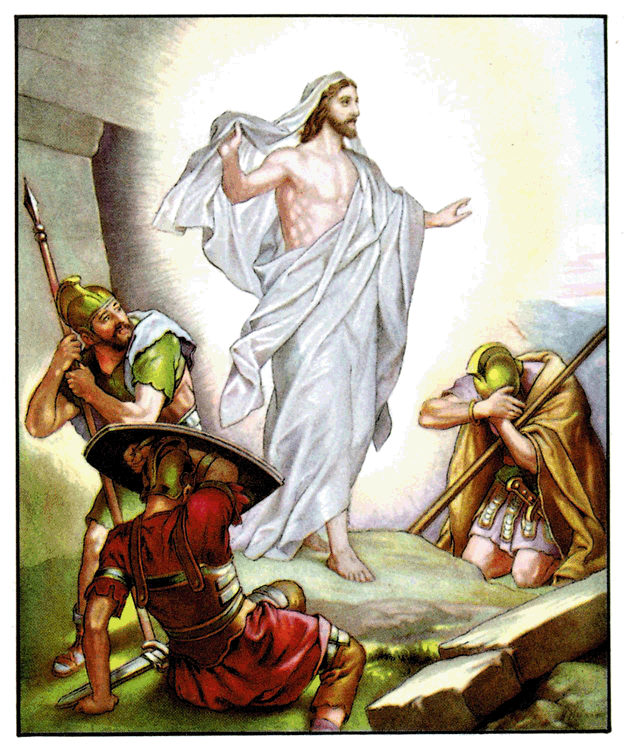
Yeshua resurrected during the Feast of Unleavened Bread. The importance of this event can’t be overemphasized. Now through the power of his resurrected life, believers have the ability to overcome the power of death as represented by yeast and leaven, which is a picture of sin, and to live in an unleavened or sin-free state.
Unleavened Bread Versus Manna
During the Feast of Unleavened Bread, YHVH commands us to eat matzah, which is a picture of the sin-free Yeshua. The Scriptures call it the bread of affliction, since it memorializes the end of the Israelites’ enslavement in Egypt. The unleavened bread also marked the beginning of Israel’s freedom, for it was on the first day of this festival that they came out of Egypt. It was the unleavened bread that they made while exiting Egypt that empowered them physically for their trek out of the land of their affliction. After that, YHVH fed them manna, which was the bread of life that empowered them to press onward to the Promised Land. The unleavened bread symbolizes taking into ourselves the sinless life of Yeshua who empowers us to leave the Egypt of the old self behind with its life of bondage to sin, the devil and the rudiments of this world.
The unleavened bread of the Feast of Unleavened Bread, the bread of communion and that bread that was offered at the daily sacrifices is different than the manna YHVH fed the Israelites each day. The manna is the bread of life to which Yeshua speaks about in John 6:33, 50, 51. Though different, the unleavened bread and manna each point to something different about Yeshua. The unleavened bread commemorates leaving the sin of Egypt behind and identifying with the broken and sinless body of Yeshua on the cross. The manna, on the other hand, fed and nourished Israel on a daily basis during their journey through the wilderness en route to the Promised Land. The manna is a prophetic metaphor speaking of how the Word of Elohim (both through the Written Word and the leading of the Holy Spirit) sustains the redeemed believer through the wilderness of life. The manna is about living in and through the power of YHVH’s Word, while the unleavened bread of the Passover communion, the Feast of Unleavened Bread and the daily sacrifices is about dying to old lifestyles and deliverance from and forsaking the leavening of sin through Yeshua’s death on the cross. The manna is all about receiving Elohim’s spiritual provision, whereas the unleavened bread is all about dying to self, and leaving sin and the world behind.
Conclusion
Paul instructed believers to celebrate the Feast of Unleavened Bread (1 Cor 5:8). So why doesn’t the whole Christian church worldwide do so?
With so much evil attempting to force its way into every aspect of our culture as well as into our very thoughts and hearts, how do we stand up against this tide of satanic evil?
Evil comes in many forms: abortion, sexual perversions, destruction of marriage, the drug culture, tyrannical government, euthanasia, confusion about male and female genders, transgenderism, bodily mutilations of all kinds, the rise of the occult and satanism, the culture war against Christian and biblical values, leftism, the rise of globalism and the new world order, the worship of the god of scientism, technocratic mind control, the new age movement, new forms of racism and discrimination against white people, and the list goes on and on.
So what can you do to stop, thwart or avert this tide of evil? Is it useless to attempt to stand against it? What would Yeshua have us to do? What is our biblical model to follow? In this video, we give you some practical suggestions on what YOU can do.
Isn’t your life already busy enough? Who has time for a six-hour Passover Seder commemorating something that happened thousands of years ago? What could this possibly have to do with my life here and now, you may ask? How can a 3500-year-old Biblical ritual in any way relate to those living in the age of the laser, satellites, the worldwide web, computers, genetic engineering, nanotechnology and artificial intelligence? Well, let’s find out!
The Preacher said in Ecclesiastes 3:15, “That which is has been already and that which will be has already been.…” Life is full of paradoxes. Do advancements in technology, science, economics, medicine, religion, and the spread of global government that all promise a man-made utopia of sorts really fulfill the promise to give man the rest for his weary soul and a deeper meaning to life that he longs for, as well as the answer to the age-old question: What happens when I die? Can I live forever? If so, how?
How about we take a different approach to the questions and problems facing modern man? Is it possible to go forward it time by going backwards in time? This is a thesis that Jeremiah, the ancient biblical prophet, proffered in his day, and which is still relevant to us. He declared, “Thus says YHVH, ‘Stand by the ways and see and ask for the ancient paths, where the good way is, and walk in it; and you will find rest for your souls. But they said, we will not walk in it,’” (Jer 6:16). What were those ancient paths to which this white-haired Israelite prophet referred? This question is answered three verses later: “Because they have not listened to My words, and as for My Torah, they have rejected it also,” (verse 19). YHVH through his prophets has been showing men the way of rest for their weary souls for thousands of years, yet men consistently refuse to listen. They always have a better way, or so it seems!
The festival of Passover is one of the most ancient paths to be found in the Scriptures. In the Passover celebration are clues that will help us to understand our past, present and the future.
Switching gears, a God-hater, Karl Marx, the father of modern communism, said that religion is the opiate of the masses. Yes, this can be said of dead, truthless and Spiritless religion. But how about that religion which gives definition, purpose, meaning, hope and destiny to a man’s life? How could anything that comes directly from the Loving Father who created you and me in his own image be detrimental to us?
Moreover, it has been said that the religion of the Bible tells a person where he has come from, where he is at and where he is going. Could it not be said that a man who knows the answers to these questions possesses true wisdom and wealth, and has indeed found rest for his troubled soul and possible, even, the answer to the life-after-death question?
Moving along as we attempt to find rest for our weary souls and answers to the deep questions of life, let’s now consider another aspect. One of the most important scriptures in the Jewish faith is the famous shema passage of Deuteronomy 6:4–9. This passage, which is like a “pledge of allegiance” for the Jews, starts out by saying, “Hear [shema], O Israel …” The word shema literally means “to hear and to do.” Later, in verse five, the shema continues, “And you shall love YHVH your Elohim with all your heart, and with all your soul and with all your might.” Loving our Heavenly Creator is not just a mind-thing, but also an action and a doing thing. It is something we act out and participate in. This is the Hebrew way…the ancient paths! As a path is for the purpose of walking down, even so, Passover is meant to be celebrated. This is how YHVH’s people showed their love and devotion to him. Yeshua, the Jewish Messiah, reiterated this when he said, “If you love me, keep my commandments [or Torah mitzvot]” (John 14:15). In so doing, one begins to discover rest for the weary soul and answers to life. The walk is the answer!
This is what the Passover Seder is all about. We, as humans, learn by doing. We learn obedience by obeying. We learn to love by loving. We learn about heavenly and spiritual mysteries by walking out the types and shadows found in Scripture (of which Passover is but one) that point to the heavenly and spiritual domain or dimension of YHVH himself. The French have a saying: L’appétit vient en mangeant. Translated this means: Appetite comes while eating. Or we could say that the more one eats (delicious food), the more one wants. David said in Psalm 34:8, “O taste and see that YHVH is good: blessed is the man that trusts in him.” The more we walk out the commandments of our Heavenly Father, the more of his goodness we behold, the more of his blessings we receive, the more our soul finds rest, the more we want to walk out his commandments, the more we behold his goodness, and so on goes this wonderful spiritual growth-cycle. Again, in the walk, we find rest and answers.
So why do we go to the trouble, expense and time to celebrate a Passover Seder? First, it helps us to fulfill the commands YHVH gave to us to do at Passover, such as eating lamb, unleavened bread and bitter herbs; telling our children the story of the Passover; holding a “set apart convocation” and so on (Exod 12:14–20, 43–49; Lev 23:4–5; Num 9:2–3; 28:16; Deut 16:1–3). But again we ask, what is the significance and relevance to us of this celebration? What can we gain from involving ourselves in this curious, ancient ritual? What mysteries has the Creator hidden therein that yield a treasure trove of answers to the deeper questions of life?
Passover is but the first piece of a panoramic puzzle, or the first thread in a rich tapestry of YHVH’s plan of redemption of mankind. Though the children of Israel kept the first Passover 3500 years ago in the land of Egypt, this ancient celebration is not only a memorial of what occurred then, but is of utmost significance to the spiritual life of the disciple of Yeshua today. It has future or prophetic implications as well. Passover is the first step of a spiritual journey that, if one continues in it faithfully to the end, will lead one into the very presence of YHVH Elohim, our Heavenly Father, himself. What a journey! Let’s take a closer look at it this step.
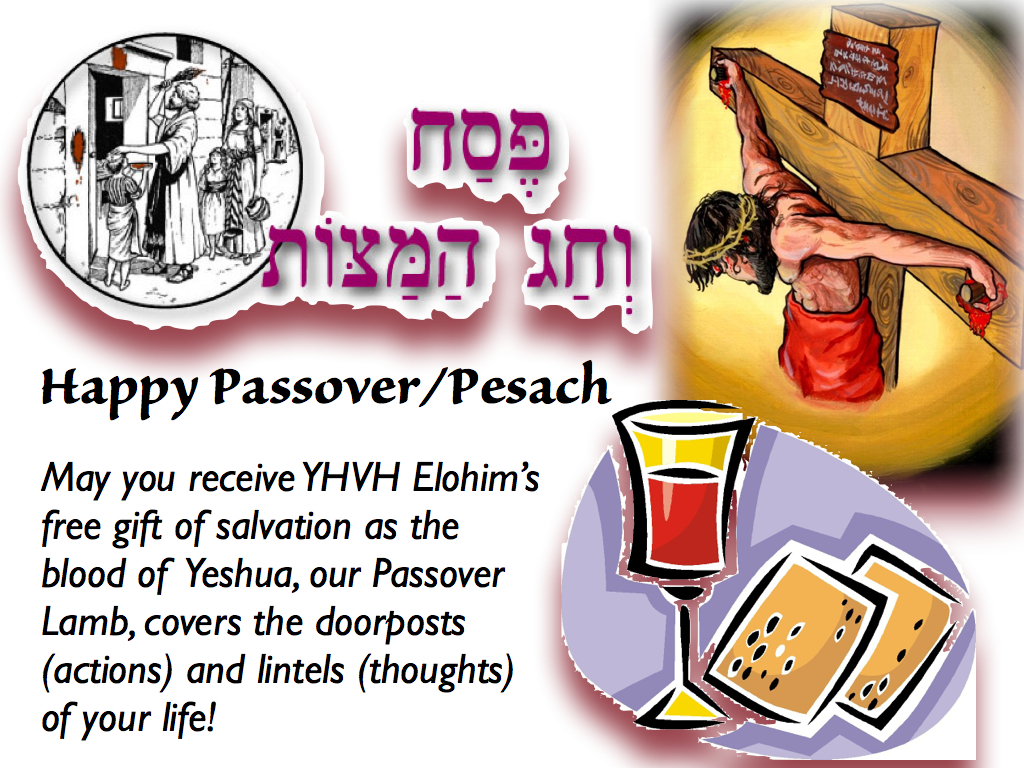
Ancient Israel, the covenant people through whom YHVH had chosen to reconcile all nations of the earth to himself, was in slavery in Egypt. YHVH heard their desperate cries, and remembering his promises to Abraham, with a mighty hand he brought down proud and powerful Egypt by his judgments and set his captive children free. Israel was in bondage to Egypt—a biblical metaphor for the world, the flesh and devil. And even as you and I were in bondage to our past sinful lives and under helpless control of the world, flesh and the devil. As the Israelites slew a perfect lamb and smeared its blood on the sides and top of the door posts of their homes, they were spared YHVH’s judgment on Egypt (again, a symbolic picture of unsaved sinners) and all those who were not under the blood. Likewise, there is deliverance for us if we simply recognize our state of sin and being spiritually lost, and if we but come repentantly to the cross of Golgotha upon which Yeshua, the bleeding Lamb of YHVH, slain from the foundation of the earth, hung. If we too will put our faith and trust in him and apply his sin-atoning blood to the door posts (thoughts and actions) of our lives, we, like our ancient forefathers, can escape YHVH’s terrifying judgment, for sin, the wages of which is death, will have no claim on our lives if we are under the blood of the Lamb.
Passover is but the first step in a parade of seven prophetic dress rehearsals or convocations (in Hebrew each is called a miqra or a command assembly) represented by the seven glorious festivals of YHVH (called moedim or appointed times) all of which point to the redemptive work of Messiah Yeshua in the life of the redeemed believer. There are three set-apart festivals (or moedim) in the spring of the year that are prophetic shadow-pictures of Messiah’s first coming to earth, and there are four set-apart festivals in autumn which are prophetic shadow-pictures of his second coming at the end of the age.
Passover represents the redeemed believer coming out of the spiritual Egypt of this world. Interestingly, Passover falls at the beginning of YHVH’s sacred biblical year. Not only is it at the beginning of the new year, but it is the first festival of the year and represents the first step in a new believer’s life—all falling in the spring season of the year, which is the time of rebirth and new beginnings both in the physical creation and in YHVH’s spiritual creation in the life of the individual!
Chag haMatzot (the Feast of Unleavened Bread), which immediately follows Passover and which is often considered to be a continuation of Passover, represents the believer putting Egypt out of his life, which is symbolized by putting leavening out of our homes and living in a leaven-free environment for seven days.
After that comes Shavuot (The Feast of Weeks or Pentecost). Since it is impossible for one to live sin-free for very long without help from above, man needs a guidebook on righteous living, and one needs divine enablement to follow the instructions within the guidebook. YHVH’s Torah (i.e., the first five books of the Bible) is that guidebook and was given to Ancient Israel at Mount Sinai. On the day of Pentecost in Acts 2, the first-century believers had not only been given Yeshua, the Living Torah (the Word of YHVH made flesh), but they were promised that the Ruach haKodesh (the Set-Apart or Holy Spirit) power of Yeshua, the Living Torah, would live inside of them empowering them to walk faithfully in the light and truth of YHVH’s Written Torah instructions in righteousness which are a river of life telling us how to love our Creator and our fellow man.
After the spring biblical festivals we come to the fall festivals, which speak of a great harvest of believers at the end of the age corresponding to the second coming of Yeshua. Those festivals are Yom Teruah (the Day of Blowing Trumpets or Shofars), Yom Kippur (the Day of Atonement), and Sukkot (the Feast of Tabernacles) immediately followed by SheminiAtzeret (the Eighth Day). Each of these contains a whole world of spiritual and prophetic meaning of tremendous significance to the believer pertaining to the regathering of Israel, the resurrection of the righteous dead, the return of Yeshua the Messiah, the marriage of Yeshua the Lamb of Elohim to his spiritual bride (the believing saints) and the establishment of YHVH’s millennial kingdom on earth. Learn about them. You will be blessed!
The central theme of the Passover Seder celebration was the lamb, along with the matzah (unleavened bread) and the bitter herbs. The Lamb is a picture of Messiah Yeshua who was crucified for you and me at the exact moment when each family of the children of Israel was killing its own lamb, and later on when the high priest was killing the Passover lamb up on the temple mount in Jerusalem.
In the Gospels we find recorded how Yeshua celebrated Passover or the Lord’s Supper memorial celebration with his talmidim (disciples). At that supper, he instructed them how he would perfectly fulfill the role of the Passover lamb and that they were to continue that memorial meal to which Paul makes reference in 1 Corinthians 11:17–34.
In the Seder are four cups of wine around which the Passover celebration revolves. They are called the Cup of Sanctification, the Cup of Deliverance, the Cup of Redemption, and the Cup of Praise or Completion. The four cups are based on Exodus 6:6–8, in which YHVH makes seven promises (called the Seven Steps of Redemption) to Israel where he elaborated how he would start by delivering Israel from Egypt and end up bringing them into the Promised Land that he would give them.
We believe that Messiah will drink of the Fourth Cup with his spiritual bride in his kingdom, for it is recorded in the Gospels that Yeshua drank of at least two of the four cups with his disciples during the Last Supper. But the last, or Fourth Cup of Praise or Completion, he said he would not partake of “until that day when I drink it new with you in my Father’s kingdom” (Matt 26:29). In this we see a reference to the long-awaited marriage supper of the Lamb to occur after his second coming.
And this, my beloved friends, is only the tip of the proverbial iceberg in the explanations of these wonderful events that Bible believers celebrate during the Passover Seder. It is a journey, if you stay faithful to him, that will never end, for the more you grow and learn, the more you will realize how little you know and how vast the ocean of YHVH Elohim’s unsearchableness really is!
Now all these things happened unto them for examples and they are written for our admonition, upon whom the ends of the world are come. (1 Cor 10:11)
But as it is written, Eye has not seen, nor ear heard, neither have entered into the heart of man, the things which Elohim has prepared for them that love him. But Elohim has revealed them unto us by his Spirit, for the Spirit searches all things, yes, the deep things of Elohim. (1 Cor 2:9–10)
Overview of Key Elements Pertaining to the Passover