Yeshua’s Model for Evangelism Revealed

Mark 10:17–22, Yeshua’s model for one-on-one evangelism is here revealed. In his encounter with the rich, young ruler, Yeshua reveals a method of evangelizing in a one-on-one scenario. He uses the following five-step approach:

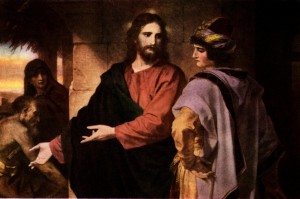
Yeshua & Rich Young Ruler 580440

  • Yeshua first establishes the character of YHVH Elohim and how man falls short of this in comparison. Namely, YHVH is good, and man is not.
  • Next, Yeshua presents the Torah as Elohim’s standard that determines the definition of good.
  • Yeshua then shows the young man that he was violated that standard of goodness by breaking the Torah.
  • He advises the young man then to repent of his Torahlessness (or of breaking YHVH’s laws, which is the biblical definition of sin in 1 John 3:4).
  • Finally, Yeshua invites the young to make the total commitment to being a good person and to follow him.

We see this evangelistic model again in Acts 17:24 when Paul addresses the Greeks on Mars Hill.


Eating a biblically kosher diet isn’t as hard as you think

The other day, someone commented on this blog about the difficulty of eating a kosher diet without having a Jewish kosher food store nearby. I want to discuss this issue a bit and dispel this notion.

Kosher Certified-stamp

First off, there are two types of “kosher.” They are rabbinic kosher, and biblical kosher. One who doesn’t know better would probably think these two are the same, but they’re not. The biblical standards for clean and unclean meats (or eating kosher) are very minimal and are found primarily in Leviticus chapter eleven of the Torah (the first five books of the Bible). There we learn what animal meat is clean (and permissible to eat), and what meat is unclean (and not permissible to eat). Elsewhere in the Torah, we learn that YHVH’s also forbids his people from eating blood (Gen 9:4; 17:12, 14; Deut 12:23), organ fat (Lev 3:17; 7:23), and animals that die of themselves (e.g., because of disease or old age) or that have been killed by other animals ( Exod 22:31; Lev 7:24; 17:15; 22:8; Deut 14:21). Basically, these are the biblical dietary standards regarding clean and unclean meats.

What types of animals does the Bible permit us to eat? Simply stated, only land animals that have cloven hooves and chews their cud, only fish that have fins and scales, only fowl-type birds, and only insects that are in the grasshopper or locust family are permitted for human consumption

Some might wonder about the Jewish rabbinic tradition of not eating meat and dairy. This is based on the Torah-law that forbids the eating a kid (or young goat) that has been boiled in its mother’s milk (Exod 23:19; 34:26; Deut 14:21). This law has been understood to refer to any young kosher animal in addition to goats. The problem with this passage is that it has several possible interpretations. They are as follows:

  • It’s unlawful to eat a kid that hasn’t been weaned.
  • It’s unlawful to boil meat in milk from its mother.
  • It’s unlawful to eat any milk and meat products together.

The rabbinic Jews have primarily taken the third explanation for their interpretation of this law. However, this is a faulty interpretation in light of the fact that Abraham fed the three heavenly messenger (one of whom was YHVH — or the preincarnate Yeshua the Messiah) meat and dairy together (Gen 18:6-8). It’s highly improbable that Abraham who was Continue reading →


More Details That Confirm the Divine Origination of the Bible

Genesis 38:29, Pharez [Heb. Peretz]. This name means “breach” or breaking through by pressing forward.” It is from the root word meaning “breach, gap, bursting forth, outburst; broken wall.” Yeshua is from this branch of Judah. Peretz received his name because of the violent nature of his birth. He was born before his twin brother, Zerah. The Peretz family line was the more prominent of the Peretz-Zerah family lines.

Matthew Henry in his commentary notes that it’s a wonder that off all the tribes Yeshua should proceed from this one considering its incestuous origins and YHVH’s displeasure over such sin. Yet Henry goes on to say that YHVH chooses human instruments not because of their merits, but out of grace, and that Yeshua came into the world to save sinners, even the chief of sinners, including those of his own family. Moreover, the worthiness of the Messiah wasn’t to be found in any meritorious moral qualities of his ancestors, but in himself alone. It is a wonder that the Jews boast at all about their lineage in light of its incestuous origins. As Jeremiah warns, a man should not glory in anything they are or have done but only that “he understands and knows me, that I am YHVH which exercise lovingkindness, judgment, and righteousness, in the earth, for in these things I delight” (Jer 9:23–24).

The inclusion of the accounts of Judah, Tamar, Pharez and Zerah further confirm the divine origin of the Scriptures. It is the generally accepted tradition in both Jewish and Christian circles and the opinion of conservative biblical scholars that Moses wrote the Torah (the first five books of the Bible). Genesis 38 gives important background information about the founding of the tribe of Judah and, more importantly, about the origins of the Messiah who was born out of this tribe. Other than a couple of oblique prophecies, there is no overt indication in the Torah that the Messiah, the Redeemer of Israel, would could come from the tribe of Judah, yet Moses included the inglorious details of the founding of this tribal family therein for no apparent reason. Those of us looking back in history at the Messiah’s birth can see how Genesis 38 fits perfectly into the overall biblical redemption story, but those in times past looking forward to the Messiah would have likely been hard pressed to see this. From our vantage point, this is yet another proof of the hand of the Divine Providence in the writing of the Scriptures.

Genesis 38:30, Zerah [Heb. Zerach]. This name means “rising” and is from the word meaning “shining, dawning.”The root of this word means “to rise, to come out or appear.” His hand first exited the womb and a scarlet cord was placed on it, although he pulled his hand back in and his brother was the first to be born.

The tying of the scarlet cord onto the hand signifies the seriousness the ancient patriarchal communities placed upon the position of firstborn or primogeniture. The firstborn was the head elder of the family and it was his duty to care for his younger sibling. Hence, he was given a double portion of the father’s inheritance, so he would have the extra resources to help the others should the need arise. Although the hand of Zerah was the first to exit the womb, Pharez’s head crowned first and so he is considered to be the firstborn and he is listed first in the several instances in the Scriptures where their names are mentioned together.

 

Are you salty?

Mark 9:49, Seasoned with salt. Salt was used on sacrifices (Lev 2:13 [ref. to the grain offering]; Ezek 43:24 [ref. to the burnt offering]). Salt was used for both preservation and seasoning of foods. Because of its ability to last and to preserve food, salt in ancient times was a symbol of permanence and thus of a binding covenant (Num 18:19; 2 Chr 13:5, see Beale and Carson in Commentary on the NT Use of the OT).

20378702Have salt in yourselves. In the larger context of passage where Yeshua warns against sectarianism and causing offense, it seems as if he is telling us to be salty toward (i.e. purify, season, preserve) ourselves rather than others. In so doing, we’ll be more successful at being at peace with those around us, since we won’t be attempting to straighten them out thereby causing offense. Also, through the process of self-seasoning and self-purification, we’re more likely to be the salt and light to those around us that Yeshua commanded us to be (Matt 5:13–14). Our lives instead of being insipid and a dark will be tasteful and light-emanating, thus attracting others to Yeshua and to his spiritual kingdom. We’ll thus be the living sacrifices we’re commanded to be (Rom 12:1), who are seasoned with the salt of a covenantal relationship with YHVH Elohim as we give our lives in service to others for the glory of Yeshua even as our Lord, the Lamb of Elohim, gave himself as a sacrifice for us.


What are YOU waiting for? Choose life NOW!

What are you waiting for? A flashing neon sign in the heavens with your name on it? For the Atlantic Ocean to part? For a death bed repentence? For your life to go to hell first? The God of the Bible is lovingly calling to you and he wants to give you salvation from sin and eternal life through Yeshua (Jesus) the Messiah. What are you waiting for? Today is your day!


New Video: Want healing? Stop eating garbage!

People eat junk food and put carcinogenic chemical in and on their bodies and expect Elohim to heal them. Is this logical and biblical? This video discusses this issue.


Blog Scripture Readings for 12-7 Through 12-13-14

Aside

THIS WEEK’S SCRIPTURE READINGS FOR STUDY AND DISCUSSION:

Parashat Vayeshev — Genesis 37:1 – 40:23
Haftarah — Amos 2:6 – 3:8
Prophets — 1 Samuel 11:1 – 17:58
Writings — Psalms 63:1 – 69:36
Testimony — Mark 8:1 – 11:18

Most of this week’s blog discussion points will be on these passages. If you have general comments or questions on the weekly Scripture readings not addressed in a blog post, here’s a place for you to post those. Just use the “leave a reply” link below.

The full “Read Through The Scriptures In A Year” schedule, broken down by each day, can be found on the right sidebar under “Helpful Links.” There are 4 sections of scripture to read each day. One each from the Torah, the Prophets, the Writings, and from the Testimony of Yeshua. Each week, the Torah and haftarah readings will follow the traditional one-year reading cycle.

Weekly Blog Scripture Readings for 12/7 through 12/13/14.