What was the sin of the golden calf, and how has that sin come down to the modern mainstream church? “Come out her my people” is Elohim’s plea to his end time saints. This video explores these issues.


What was the sin of the golden calf, and how has that sin come down to the modern mainstream church? “Come out her my people” is Elohim’s plea to his end time saints. This video explores these issues.
The Tabernacle of Moses from its front to back represents one’s progression in one’s spiritual journey starting with initial salvation leading to eternal life in YHVH’s eternal spiritual kingdom. This view is from man’s perspective.
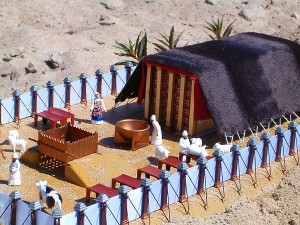
From YHVH’s view inside the holy of holies above the ark of the covenant in the glory cloud, looking outward, the perspective is different. We’ll discus this in a moment.
In the outer court of the tabernacle, all the rituals and furnishings pointed to death, judgment, washing or cleansing. These prophetically foreshadowed salvation through Yeshua’s atoning death on the cross, with Yeshua being the door to salvation, acceptance of his death on the cross for one’s sins followed by and baptism for the remission of sins. In the set-apart (kadosh or holy) place inside the tabernacle, everything pointed to life, light, food, fragrant incense, the fruits and gifts of the Holy Spirit — or life in a spiritual relationship with Elohim subsequent to one’s taking the initial and beginning steps of salvation. The outer court speaks of basic salvation for the redeemed believer in Yeshua, while the holy place speaks of spiritual growth and maturity, of moving from spiritual babyhood and growing into spiritual adulthood or maturity.
Paul speaks of man being subdivided into three parts — body, soul and spirit (1 Thess 5:23). The tabernacle’s outer court seems to relate more to the physical or body realm of the person, while the holy place speaks more of the soul or psychological, volitional and emotional aspects of man’s inner realm or psychological realm. Finally, the holy of holies portrays man approaching YHVH through the realm of his spirit man.
As one progresses into the tabernacle, it is as if YHVH is drawing man into an ever deeper relational walk with him starting at the most basic level progressing upward until man is finally communing with YHVH on a Spirit to spirit level (in the most holy place). It is the Father’s desire that men progressively grow until they are communing with him at the highest spiritual level (see John 4:23–24).
As noted earlier, this forward progression from the tabernacle’s entrance Continue reading
This short, powerful video pulls no punches. Why should you avoid money-grubbing, gospel peddlers and market and merchandize of the word of Elohim for a profit? Watch it and learn.
Learn what it is to profane or pollute the seventh day Sabbath, why does the Bible forbid it, and what is the penalty for this sin?
Parashat Vayakhel-Pekudei — Exodus 35:1 – 40:38
Haftarah — 1 Kings 7:40 – 50 | Numbers 19:1-22, Ezekiel 36:16-38**
Prophets — Isaiah 1:1 – 8:22
Writings — Proverbs 8:1 – 14:35
Testimony — John 10:1 – 13:16
Most of this week’s blog discussion points will be on these passages. If you have general comments or questions on the weekly Scripture readings not addressed in a blog post, here’s a place for you to post those. Just use the “leave a reply” link below.
The full “Read Through The Scriptures In A Year” schedule, broken down by each day, can be found on the right sidebar under “Helpful Links.” There are 4 sections of scripture to read each day. One each from the Torah, the Prophets, the Writings, and from the Testimony of Yeshua. Each week, the Torah and haftarah readings will follow the traditional one-year reading cycle.
** A different Haftarah is read when it is a special sabbath in Jewish tradition. This week is Shabbat Parah.
Weekly Blog Scripture Readings for 3/8 through 3/14/15.
Exodus 32
On Shavuot (the Feast of Weeks or Pentecost), at Mount Sinai, YHVH entered into a marriage covenant with the children of Israel, but they were not ready to live up to the terms of that covenant. Those terms, simply stated, involved the Israelites being faithful and obedient only to YHVH, Israel’s Elohim (God) and spiritual husband, and to follow his instruction in righteousness, the Torah. This Israel quickly demonstrated they were not willing to do, for they had hardly said “I do” to their marriage vows (Exod 24:3, 7) when they turned their hearts away from YHVH and began worshipping the golden calf—a pagan deity from Egypt. After the golden calf incident and up until Yom Teruah (the Day of Trumpets or Shofar Blasts) when Moses received the second tablets of stone from YHVH containing the Ten Commandments, the children of Israel, the bride of YHVH, prepared herself not only to receive YHVH’s instructions again, but this time to be faithful to her marriage vows. This Israel did. She remained faithful to YHVH for approximately 38 years while trekking through the wilderness of Sinai, after which she entered the Promised Land and “stayed the course” until after the death of Joshua.
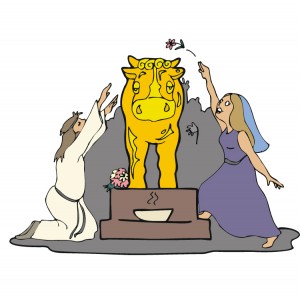 Sadly, the cycles of history often repeat themselves. This time, it involved the descendants of the children of Israel who were at Mount Sinai. In the early first century a.d., the redeemed Israelite followers of Yeshua received the Torah written on the fleshly tablets of their hearts by the finger of the Spirit of Elohim on the Day of Pentecost (Shavuot) as recorded in Acts 2. But starting at about a.d. 70 with the destruction of the temple in Jerusalem and continuing up through the Second Jewish Revolt of a.d. 135 until the time of Emperor Constantine (in the fourth century), the first-century spiritual bride of Messiah had, to a large extent, abandoned YHVH’s Torah-commandments and turned, to one degree or another, to a mixed form of worship (of which ancient Israel’s worship at the golden calif was a prophetic foreshadow) where some pagan practices were assimilated into the early churches’ belief system (most notably, Sunday replaced the Sabbath, and Christmas, Easter and other paganistic holidays replaced the biblical feasts).
Moses’ descent of Mount Sinai on Yom Teruah with the second set of tablets containing Continue reading
Sometimes you just have to get away!
Friday (yesterday) was one of those days for me. I went to work as usual, and after I got done with my first job, I was finished for the day. I was done! I couldn’t go back to work. (This is one of the benefits of being self-employed — you don’t have to work when you don’t want to!) It was a beautiful day. The sun was shining, the birds were singing, the flowers blooming and I had to get out of the city and away from it all. If I stayed there any longer, I think I would have been physically sick…literally. The wilderness of Yehovah’s creation was calling me!
Thankfully, within in an hour’s drive (or a little longer sometimes) of my town, I can be in some of the most scenic spots on planet earth whether it’s the coast of the Pacific Ocean, the Cascade Mountains with their glaciated volcanic peaks or the mighty Columbia River Gorge.
Yesterday, I grabbed my day pack, my Bible and jumped into my truck and headed out. I wasn’t sure where I was going, but Yehovah led me to Eagle Creek in the Columbia River Gorge just east of Portland, Oregon. I hiked up a little over two miles and came to the famous Punch Bowl falls in the photos below. I hope you enjoy them. Continue reading