What Is leprosy and what were its causes?

Leviticus 14:3, Plague of leprosy. Some of the English translations of this scripture verse use the word leprosy for the skin disease described in these passages. This is a mistranslation. A better translation would be infectious skin disease.

21486272

The Jewish sages teach that the skin disease described here is a supernaturally caused ailment that falls only on Israelites who are actually living in the land of Israel. They also teach that this is YHVH’s way of identifying the evil sins of gossip and slander (along with haughtiness, selfishness and jealousy) before this sin spreads throughout the land engulfing it like a forest fire from hell. (Read James 3:5–6!) This may explain why Miriam while wandering in the wilderness outside of Israel contracted this skin disease.

The disease would cause the sinner’s face to resemble a red flag for all to see. An afflicted person would be forced to live outside the camp until repentance along with atonement and purification rituals had occurred, and all this occurred under the watchful eye of a priest.

As you read this, you may be wiping your brow with a sigh of relief thankful that Continue reading →


Taking the Lid Off the Garbage Can

Let me  be honest and transparent with you, dear reader. I hope you would expect nothing less from me.

This morning I posted a picture that, I admitted, was crass. It made light of the perversities of the homosexual lifestyle. A couple of people were kind enough to register their surprise over my post. Because of this, I took the post down. In retrospect, I crossed over the line, and I apologize for offending anyone.

22076046

This blog is primarily a Bible study blog, but from time to time I deal with social issues, which are of moral or spiritual concern. The biblical prophets of old did this. John the Baptist lost his head for doing the same.

Now let me say this. I am well beyond frustrated and to the point of righteous anger over those in our society who are aggressively pushing their perverse, anti-biblical and Antichrist agendas upon us. I either want to leave and flee to an island in the South Pacific, or, if I have no option but to stay, I feel compelled to oppose the evil vigorously!

As I mentioned earlier, the purveyors of perversity are using Gestapo-like tactics to marginalize, vilify, destroy, bully, put out of business, defame, imprison and sometimes kill their opponants — namely Bible followers. This is getting to be more than I can take!!!

Let’s be honest. I believe in spiritual warfare and prayer. I do it all the time. But Continue reading →


Dealing With the Fungus Among Us

Overview of Parshiot Tazria-Metzora (Lev 12–13 and 14–15)

Often these two parshiot are combined in the yearly Torah reading cycle depending on how the biblical calendar falls for the year. Their combining is likely due to the fact that each is relatively short and deals with related subjects: namely, the ritual purity laws. As we shall see, the causes of ritual impurity involve sin issues. The Torah prescribes procedures that the afflicted person had to follow in order to be deemed cleansed and thus be readmitted into the camp of Israel after having been temporarily expelled. All the rituals prophetically pointed to Yeshua’s atoning death on the cross.

Sin is like a disease.

Sin is like a disease.

These two parshiot dealing with diseased and unclean persons immediately come after the laws concerning clean and unclean meats (Lev 11). What the Israelites ate as well as the state of their physical bodies was an important aspect of holiness in the eyes of YHVH.

From these two parshiot, we learn that an unclean person could only become clean through the atoning blood of a sacrificed animal or through ritual cleansing of water by which he was reconciled to Elohim and brought back into the camp of Israel. What can we learn from the juxtapositioning of these subjects (i.e., the laws pertaining to unclean meats and unclean people) in the Torah? Simply this. Man can easily become impure and defiled because of his innately depraved, crooked, and wicked heart that is at enmity with the laws of Elohim (Jer 17:9; Rom 8:7). Since the fall of Adam, man has been in a state of impurity from Elohim. Thus, sin separates him from the presence of Elohim and from his fellow Israelites. Only the sin-atoning blood of Yeshua can bring him to a place of purity where he can be reconciled to the Kadosh (Holy) One of Israel, and become part of the camp (i.e., the congregation of the saints or kadosh ones) of YHVH.

Leviticus 12:1–8 deals with the purification of women after childbirth. Adam Clarke in his commentary states that when a woman has to bring a sacrifice after the birth of her child, Elohim keeps up the remembrance of the fact that through woman, sin entered the world. He also keeps up the memorial of sacrifice to show that the state of a sinner, howsoever deplorable, is not hopeless. In every ceremony, we may see both the justice and the mercy of Elohim. Hence, while we have the knowledge of our spiritual impurity, we have also the knowledge of our cure—the sacrifice of an innocent animal, which always points to Yeshua who once and for all, in his sacrificial death, cleansed us from sin’s impurity.

Leviticus 13–14 deals with the disease of tzara. The noun tzaarath means Continue reading →


New Video: The Feast of Unleavened Bread 2015 Insights

Learn about this biblical feast, which Paul the apostle in the New Testament commands followers of Yeshua/Jesus to celebrate in 1 Cor 5:8.


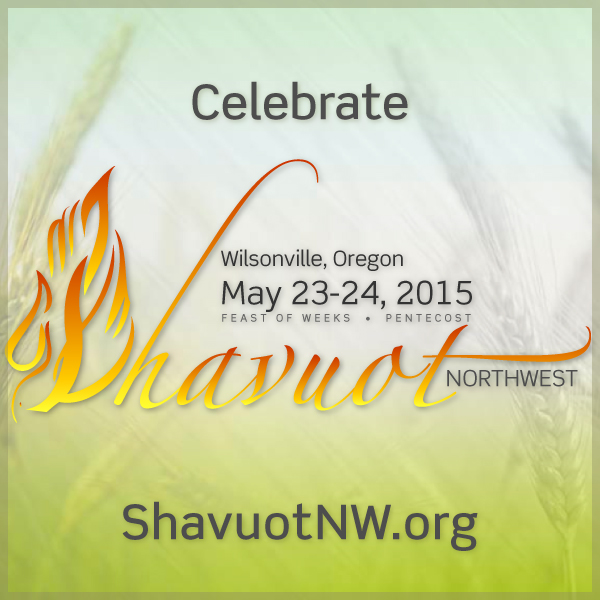
You’re invited to Shavuot NW 2015

You are invited to join us in Wilsonville, Oregon for Shavuot NW 2015!

For information, please go to http://shavuotnw.org

shavuot-nw-600x600


Can you trust Greek?

I just received this question from one of this blog’s readers. Since I’ve never been asked this before, and found it to be an interesting one, I thought I’d answer it on the blog.

Shalom,

My husband has been questioning why you have been using Greek explanations when he thought we were doing everything Hebrew.

Or can you give him an explanation as to why sometimes you use the greek meanings to words in the NT and sometimes you also give a hebrew meaning to words in the NT?

First, I’d like to address a common misconception among some folks who are new to the Hebrew roots movement. Some thing there is something wrong or evil with the Greek language. If so, then why did YHVH allow the Testimony of Yeshua (New Testament) to come down to us in the Greek language? Obviously, he didn’t think it was evil.

Second, why do I use definitions to Greek words when teaching from the Testimony? Simply this, all we have is Greek. We don’t have the Testimony in Hebrew. I can’t give a definition in Hebrew when all we have is the Greek.

Some Bible teachers will go back into the Septuagint (LXX) translation of the Hebrew language Tanakh (Old Testament) translated into Greek more than a couple hundred before the birth of Yeshua to try to figure out what words in the Greek Testimony of Yeshua might be the same as the Greek words in the LXX, and then go from there back to Hebrew. The problem with this is that it’s usually a guess as to a Greek word’s potential meaning. The problem is that the LXX translators lived hundreds of years before the Testimony of Yeshua writers, and languages evolve and some word meanings change over the centuries, so one has to be careful when doing this. Colloquial expressions and figures of speech also change with time. Many times we don’t know what Hebrew word is behind the Greek word in the Testimony even with the LXX available to us.

For these reasons, I primarily stick with the Greek language and word definitions when teaching from the Testimony because that’s all I can do. I have no other choices.

I can go to the Aramaic language New Testament Peshitta, but most of us don’t know how to read Aramaic, and I’m not aware of any Aramaic lexicons or word dictionaries. So we’re still stuck with the Greek.

Having said all this, it is my belief that some if not much of the Testimony of Yeshua was written originally either in Hebrew or Aramaic. This, however, is hard to prove since we don’t have any autographs in Hebrew, and the there’s a debate raging alone scholars about the age and the origin of the Aramaic texts, so their reliability has been called into question. Nonetheless, the Testimony writers were probably all Jewish, knew Hebrew and/or Aramaic and thought and wrote using Hebraic thought patterns (as opposed to Greek) and Hebraic terms and idioms. Knowing this is essential when reading and trying to understand the Testimony.

In summary,we do our best to understand the Testimony of Yeshua from a Hebraic perspective, even though we only have the Greek language to work from. This isn’t always easy to do, and it’s sometimes easy to add two and two and get five. This is why we have to be so careful when handling the Word of Elohim, so that we don’t make it say something that it didn’t mean.

Thankfully, Yeshua sent us his Holy Spirit who he promised would guide us, convict us of sin and lead us into all truth (John 16:5–15). I believe that if a person is Spirit-filled and Spirit-led, and wants to serve and obey YHVH unconditionally, that the true meaning and intent of a scriptural passage will be revealed to the person regardless of the language it was written in.

 

Blog Scripture Readings for 4-19 Through 4-25-2015

Aside

THIS WEEK’S SCRIPTURE READINGS FOR STUDY AND DISCUSSION:

Parashat Tazria-Metzora — Leviticus 12:1 – 15:33 
Haftarah — 2 Kings 7:3-20
Prophets — Isaiah 51:1 – 59:21
Writings — Job 19:1 – 25:6
Testimony — Acts 15:22 – 19:41

Most of this week’s blog discussion points will be on these passages. If you have general comments or questions on the weekly Scripture readings not addressed in a blog post, here’s a place for you to post those. Just use the “leave a reply” link below.

The full “Read Through The Scriptures In A Year” schedule, broken down by each day, can be found on the right sidebar under “Helpful Links.” There are 4 sections of scripture to read each day. One each from the Torah, the Prophets, the Writings, and from the Testimony of Yeshua. Each week, the Torah and haftarah readings will follow the traditional one-year reading cycle.

Weekly Blog Scripture Readings for 4/19 through 4/25/15.