Shavuot (Pentecost) NW 2015 Invite

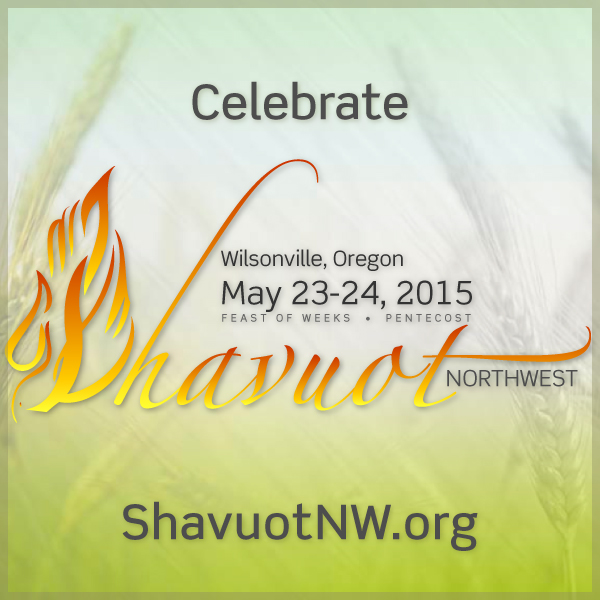
Hoshana Rabbah Biblical Discipleship Resources and Congregation Elim of Portland, Oregon invite you to join us for Shavuot NW in Wilsonville, Oregon (located just 20 miles south of Portland).

Shavuot is a biblical feast and a high holy day that YHVH commands his people in the Torah to celebrate by meeting with him and like-minded believers (Lev 23:1–2, 15–22). For more info on the festival of Shavuot, please go to http://hoshanarabbah.org/pdfs/shavuot.pdf.

Please visit our website (ShavuotNW.org) for full details and registration info.

We will be gathering “in the barn” for live praise and worship, preaching and interactive (audience participation) teaching from four Hebrew roots teachers from Oregon and California, Hebraic dance, food and fellowship, a full Hebraic Shavuot service including “the bread waving ceremony,” a Holy Spirit encounter walk through the wedding chuppah (canopy), covenantal vow renewals with YHVH Elohim, and spiritual gifts empowerment service.

Register today — if the Holy Spirit is telling to come to a higher level in your spiritual walk. If not, then stay home.

shavuot-nw-600x600


The Office of Bishop

Acts 20:28, Overseers [or bishops].

The word bishop 1985 is the Greek word  episkopos and means “an overseer, patron, one who watches or protects, one who cares for others, a man charged with the duty of seeing that things to be done by others are done rightly, any curator, guardian or superintendent;  the superintendent, elder, or overseer of a Christian church” (TDNT, vol. 2, p. 608). This word or related cognates occur only several times in the NT (Luke 19:44; Acts 1:20; 1 Tim 3:1, 2; 2 Tim 4:22; Tit 1:7; 3:15; 1 Pet 2:12, 25).

Once again, Yeshua is the Chief Shepherd and Bishop over his people (1 Pet 2:25), with those holding those earthly offices under his authority.

The TDNT notes that the role of the episkopos is to strengthen that of the pastor in watching over the flock (e.g., Acts 20:28; 1 Pet 5:2). The NT with regard to the congregation in Ephesus seems to equates the episkopos with the presbuteros (or elders-leaders of a congregation, see Acts 20:28) indicating that there is more than one leader or overseer over a congregation—literally, a group of leader-elders. Elders (presbuteros), pastors (poimen) and bishops (episkopos) are again viewed as equivalent in regards to local leadership in 1 Peter 5:1 and 2. In this passage, the leadership terms are in the plural, thus not indicating a central lead figure per se although it is the scriptural norm from the time of the patriarchs, through the priesthood, judges and kings of Israel to have a human who exercises ultimate authority. Such leaders can be elected (Acts 1:21ff; 6:3ff) or be appointed by an apostle (Acts 14:23; Ibid., p. 615f)


The Story of Two Goats

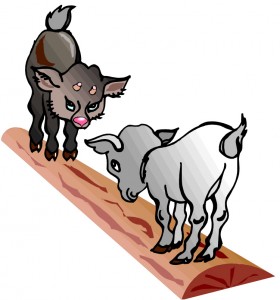
Leviticus 16:8, The scapegoat. The Soncino Pentateuch says of the azazel goat of Leviticus 16:10 that the word scapegoat, as used in the KJV, is a poor translation and should be rendered as dismissal. In the Septuagint it is translated as the one to be sent away which agrees with the term used in the Mishnah. Azazel is not a proper name, but a rare Hebrew noun (kZtZG from ZG meaning goat and kZt meaning to go away) meaning dismissal, or entire removal. It is the technical term for the entire removal of sin  and guilt of the community, that was symbolized by the sending away of the goat into the wilderness.
21692629

There is some difference of opinion as to the symbolic meaning of the azazel goat. Some say it is a picture of Satan who initially tempted man to sin or to rebel against Elohim, and has been doing so ever since. Since he is the source of sin and since he is responsible for man sinning, he must consequently bear the responsibility for his actions which he will do when he is bound and thrown into the bottomless pit at the beginning of the millennium. The azazel goat being dismissed into the wilderness is a picture of this. On the other side, there are those who teach that the azazel goat is a picture of Yeshua who bore our sins upon himself and died alone in our place. Which view is correct? Well, both. Sort of…

The most important key to determining who this goat represents is found in Lev 16:10,

 But the goat, on which the lot fell for Azazel, shall be set alive before YHVH, to make atonement over him, to send him away for azazel into the wilderness. 

Note the highlighted portion. Who made atonement for our sins? Satan or Yeshua? Scripture does not reveal the devil as the redeemer of mankind. Of Yeshua being our atonement the Scripture say:

And not only so, but we also joy in Elohim through our Master Yeshua the Messiah, by whom we have now received the atonement. (Rom 5:11)

Who being the brightness of his glory, and the express image of his person, and upholding all things by the word of his power, when he had by himself purged our sins, sat down on the right hand of the Majesty on high. (Heb 1:3)

Who needeth not daily, as those high priests, to offer up sacrifice, first for his own sins, and then for the people’s: for this he did once, when he offered up himself. (Heb 7:27)

For then must he often have suffered since the foundation of the world: but now once in the end of the world hath he appeared to put away sin by the sacrifice of himself. (Heb 9:26)

Furthermore, the act of laying on of hands (Lev 16:21) onto the azazel goat symbolizes the transference of sins from the guilty party (the children of Israel) to the innocent azazel goat. The innocent becomes the sin-bearer. Of course, who can deny that this is a perfect picture of Yeshua, and not Satan!

Spiritually, the azazel goat represents the entire removal of sin’s defilement from the camp of Israel into the wilderness. In Psalms 103:12 Elohim removes our sins from us as far as the east  is from the west. YHVH does this, not Satan!

In Lev 16:22 we read, “And the goat shall bear upon him all their iniquities unto a land not inhabited: and he shall let go the goat in the wilderness.” Throughout the Scriptures there are numerous references to Yeshua bearing our sins.

All we like sheep have gone astray; we have turned every one to his own way; and YHVH hath laid on him the iniquity of us all. (Isa 53:6)

Therefore will I divide him a portion with the great, and he shall divide the spoil with the strong; because he hath poured out his soul unto death: and he was numbered with the transgressors; and he bare the sin of many, and made intercession for the transgressors. (Isa 53:12)

So Messiah was once offered to bear the sins of many; and unto them that look for him shall he appear the second time without sin unto salvation. (Heb 9:28)

Who his own self bare our sins in his own body on the tree, that we, being dead to sins, should live unto righteousness: by whose stripes ye were healed. (1 Pet 2:24)

I believe that the azazel goat has a secondary meaning, as well. Though it doesn’t outrightly represent Satan, but Yeshua, we will see that our Savior, blessed be him, while hanging on the cross represented sin in its totality and in its extreme, and so for a brief moment took on the image of the serpent himself. Yeshua said of himself in John 3:14: “And as Moses lifted up the serpent in the wilderness, even so must the Son of man be lifted up.” In Scripture, the serpent is a picture of the Satan, the adversary (Gen 3:1, 2, 4, 13, 14, 15: Rev 12:9; 20:2).

In Lev 16:8 we see that as the two goats stood before the high priest, one on his right hand and one on his left, the lots would be cast and one would become the azazel goat and  one would be the goat that would be sacrificed in the tabernacle sanctuary itself. An interesting note that may have a bearing here: Hebraically, the right hand is the hand of strength, power and judgment, while the left land is the hand of mercy and grace.

Both Adam Clarke and Matthew Henry in their commentaries say that both goats refer to a different aspect of Yeshua’s atonement. Henry says, “Thus [Yeshua] was prefigured by the two goats, which both made one offering: the slain goat was a type of [Messiah] dying for our sins, the scapegoat a type of [Messiah] rising again for our justification…[after which] the entrance into heaven which [Messiah] made for us is here typified by the high priest’s entrance into the most holy place (Heb 9:7)” (Matthew Henry’s Commentary On the Whole Bible, vol. 1, p. 509). Henry doesn’t explain just how the goat going into the wilderness typifies Yeshua’s redeeming us, but I should like to offer an alternative idea in this regard. Perhaps, the azazel goat represented Yeshua’s soul descending into hell and there taking the keys of death (1 Pet 3:18–20; Rev 1:18). Some fun speculation to contemplate!

 

Blog Scripture Readings for 4-26 Through 5-2-15

Aside

THIS WEEK’S SCRIPTURE READINGS FOR STUDY AND DISCUSSION:

Parashat Achrei Mot – Kedoshim — Leviticus 16:1 – 20:27 
Haftarah — Amos 9:7-15
Prophets — Isaiah 60:1 – 66:24; Jeremiah 1:1 – 2:37
Writings — Job 26:1 – 32:22
Testimony — Acts 20:1 – 24:27

Most of this week’s blog discussion points will be on these passages. If you have general comments or questions on the weekly Scripture readings not addressed in a blog post, here’s a place for you to post those. Just use the “leave a reply” link below.

The full “Read Through The Scriptures In A Year” schedule, broken down by each day, can be found on the right sidebar under “Helpful Links.” There are 4 sections of scripture to read each day. One each from the Torah, the Prophets, the Writings, and from the Testimony of Yeshua. Each week, the Torah and haftarah readings will follow the traditional one-year reading cycle.

Weekly Blog Scripture Readings for 4/26 through 5/2/15.


What is the significance of the omer count?

Today is day 21 of the counting of the omer between First Fruits Day, which occurs during the Feast of Unleavened Bread and Shavuot, the Feast of Weeks or Pentecost. What is the spiritual significance of counting the omer? It is something that YHVH commands his people to do in Lev 23:15–16.

Here’s an article I wrote that answers the questions.

omer_count


From the Depths of Slavery to a Kingdom of Priests

Every detail in Scripture is for our learning and edification. All the examples of the past are for our learning upon whom the ends of the world are come (1 Cor 10:11; Rom 15:4). Everyday, YHVH is uncovering the prophetic mysteries hidden in the Scriptures that are being revealed to those who diligently seek him by diligently studying to show themselves approved as a workman rightly dividing YHVH’s Word (2 Tim 2:15).

YHVH’s command for us to count the omer as a countdown to the Feast of Weeks (Heb. Shavuot; Gr. Pentecoste, Lev 23:15–16) memorializes the Israelites’ journey from spiritual babyhood to adulthood. During this 49-day count, Israel ascended from out of the depths of slavery and suffering in Egypt, was baptized in the Red Sea, and then arrived at Mount Sinai—a place of a spiritual standing before YHVH as a kingdom of priests (Exod 19:6). It was there that YHVH gave them his instructions in righteousness—the Torah on Shavuot. This period represents Israel’s passage from slavery to freedom. They came out of slavery permeated with the leaven—the sins, values, and pagan concepts—of Egypt leaving it all behind as pictured by the Feast of Unleavened Bread. YHVH gave Israel 49 days to overcome and to get rid of the impurities of Egypt, and to become the nation Israel—a holy priesthood and the bride of YHVH. There, at the foot of Mount Sinai, YHVH wanted them to become his ambassadors to this world of his heavenly kingdom and truths.

The counting of the omer is the story of our lives also. It pictures our going from bondage to the world, the flesh and the devil and coming to a place of spiritual standing before YHVH, so that we can be used of him to advance his kingdom.

It’s a process ordained of YHVH and it’s his pattern that we must follow. There is Continue reading →


New Video: Paul on the Feast of Unleavened Bread

If there’s one biblical feast the church should be keeping, it’s the Feast of Unleavened Bread. This is because Paul commands NT believers to do so! Paul gives us some deep spiritual insights into this wonderful celebaton and we explore these in this video.


Was Paul inconsistent regarding physical circumcision?

Acts 16:3, Circumcised him. Evidently circumcision or uncircumcision wasn’t an issue for Paul. He had Timothy who was Jewish circumcised, but not Titus who was non-Jewish (Gal 2:3). Both men were elders and teachers in the assembly of believers. Both men as Torah-obedient individuals would have kept the biblical feasts including the Passover, which in the law of Moses required men to be circumcised.

Circumcision 20195387

Let’s discuss the Torah requirement that all males keeping Passover must be circumcised (Exod 12:48). Is physical circumcision now irrelevant, or was Paul rejecting the Torah on this issue?

First, in Ezekiel’s descriptions of the assumed millennial temple, all those entering in that temple will be circumcised both in flesh and heart (Ezek 44:9).In YHVH’s eyes, those entering it who are uncircumcised are defiling it (v. 7). Obviously, to YHVH, physical circumcision is a holiness issue, though not a salvational issue (as the Jerusalem counsel ruled in Acts 15). So there is still a place in YHVH’s spiritual economy for physical circumcision. Physical circumcision (in addition to heart circumcision) shows a higher level of obedience and holiness, not a lower level.

Second, the law of Moses stipulates that all men be circumcised in order to be part of the Passover (Exod 12:48).

What I’m about to say is beyond the scope of this brief discussion, but the law of Moses (as opposed to the greater or Torah or the eternal principles thereof), it seems to me, was the administrative arm of the greater Torah that pre-existed the law of Moses. The latter contained rules and guidelines needed for a nation to function properly as such. It contained a complete legal code with penalties, a judicial system, an educational system, a taxation system, and government comprised of priests and tribal elders. For the nation of Israel to protect its spiritual integrity, Moses had to protect it from foreign or pagan defilement (spiritual pathogens), which could potentially lead to Israel’s apostasy. The circumcision requirement, to my thinking, was part of the law of Moses’ legal code for Israel regarding Passover observance, but wasn’t necessarily a requirement of the greater Torah, which applies generally to all men. My sense is that Paul in not making a big issue out of physical circumcision was appealing to the greater or higher requirements of the Torah (involving more spiritual and heart issues. At this point, please recall Yeshua’s Sermon on the Mount teaching where he brings the letter and spirit of the Torah together. Paul’s seeming inconsistency with regard to whether men should be circumcised or not may be due to the fact that he was focusing less on the legal requirements of the law of Moses,which was the administrative subdivision of the Torah, which was enacted for the proper legal functioning of the nation of Israel. He was focusing more on the greater Torah or the eternal principles of the Torah that pre-existed Moses. Moreover, when Paul came along, Israel was no longer a sovereign nation that ruled itself. Timothy was half Jewish and Titus was non-Jewish, and both were from Greek nations within the Roman Empire, and so some of the strict legal aspects of the law of Moses (e.g., circumcision for Passover) couldn’t or didn’t have to be applied as long as the greater principles of Torah (i.e., circumcision of the heart) were being kept.