I invite you to watch this video where Dr. Ron Paul very simply and articulately explains America’s current economic plight and the impending consequences of it. His 30 or so minute talk is a real bucket of cold water in the face!
The later part of his talk becomes an infomercial. I’m not posting this video to promote that. I’m only interested in Dr. Paul’s analysis of America’s current economic condition up to the point where his talk turns into an infomercial.
As a watchman on the wall, I’ve seen what Dr. Paul talks about coming for nearly 40 years. It as at age 18 that I began to take steps to protect myself financially from the crisis Dr. Paul is predicting. Too many people have the idea that nothing bad can happen to America, and that the good times will continue to keep rolling on. This is blind and ignorant optimism. Such a mentality flies in the face of the past history of nations and economies who have faced similar situations.
In the past on this blog, I have shared about the judgments I see coming on America and the rest of the Western so-called Christian nations because they have turned their back of Elohim and the Bible. I’ve even shared scriptures that I believe prophesy this. Economic collapse is just one — albeit a large one —aspect of YHVH’s judgment against his people to bring them back to him.
To help you get ready for the biblical feast of Shavuot or Pentecost, I invite you to read my teaching article on the subject.
From Mount Sinai to Acts 2; From Faithlessness to Miraculous Empowerment
Ya’acov Natan Lawrence
Waters in the Wilderness, A Teaching Ministry of Hoshana Rabbah Biblical Discipleship Resources
What is Shavuot All About?
In the roughly 49 days between Passover (Pesach) and the Feast of Pentecost (Chag haShavuot), a momentous spiritual dynamic occurs. This period of time is comprised of forty-nine days or seven days of seven weeks, which is seven times seven—the biblical number for complete or full perfection. Add one day and you arrive at Pentecost. Fifty is the biblical picture of jubilee picturing redemption from the enslavement to this world.
Historically, the children of Israel were redeemed from their sins by the blood of the lamb on the first Passover in Egypt. At this time, YHVH betrothed himself to Israel (Exod 6:7). YHVH then led them out of Egypt into the wilderness, and on Shavuot he married them at Sinai (Exod 24 cp. Ezek 16:8; Jer 2:2; 31:32). At the same time, YHVH gave them his Torah, which was their ketubah or marriage vows.
Shavuot is a picture of the bride of Yeshua the Messiah coming into full maturity spiritually and coming to marriageable age. She has gone from being a spiritual child and slave in Egypt to becoming the fully mature spiritual bride and queen of the King of the universe.
At the time of Yeshua, he betrothed himself to both houses of Israel on Passover. Then, on Pentecost, he then sent his Spirit, the Comforter, as a seal of this covenant. He hasn’t married this bride (that’s you and me) yet — something that occurs at his second coming. In the mean time, he has placed her in a 2000-years-long wilderness to get ready for him — to fall in love with him (to love him by keeping his Torah commands; John 14:15) by receiving his Torah into their hearts.
In the end times, he’s going to bring his bride (the saints) out of the wilderness of Babylon (called the Second Exodus), and they will repent of their Torahless ways. We are now getting ready for this day.
Understanding the prophecies of the Bible that speak of these end-time events, and understanding who the principal players are (the two houses of Israel) is the key to insure that we’re ready for our Messiah — that we’ll be wise and not foolish virgins who have our lamps full of oil (the Torah and Spirit of Elohim).
Shavuot, along with Passover (Pesach) and the Feast of Tabernacles (Sukkot) are three times each year when YHVH commands his people to gather together to celebrate before him (Exod 23:14–17).
To fully comprehend Shavuot, we must step back and view this feast in its context with the other six biblical feasts that YHVH gave to Israel.
YHVH’s Seven Biblical Feasts
The seven annual biblical festivals of YHVH Elohim (or, in our English Bibles, the LORD God), of which Shavuot (Pentecost) is the third of seven, Continue reading →
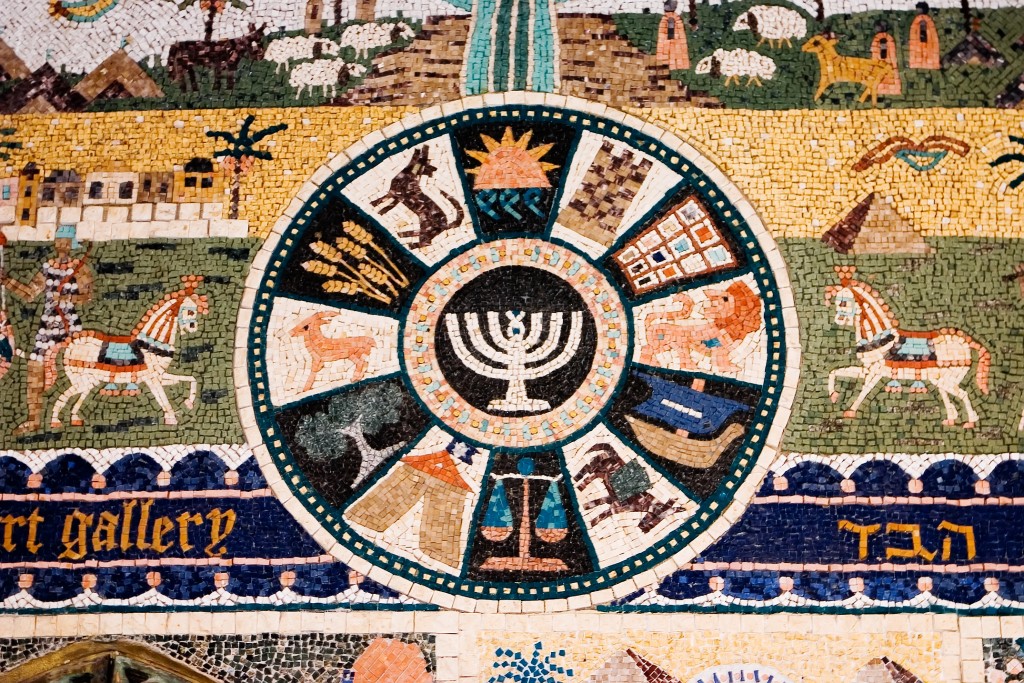
Numbers 1:52, Standard [or banner]. Each tribe had its own flag or banner. Although the Torah doesn’t tell us what these flags looked like, Jewish oral tradition records this information. According to Numbers Midrash Rabbah, the flag of each tribe was the color of its stone in the high priests breastplate and is described as follows:
Reuben’s stone was ruby and the color of the flag was red with embroidered mandrakes.
Simeon was topaz and his flag was green with the town of Shechem embroidered thereon.
Levi was smaragd (like an emerald) and the color of his flag was one third each of white, black and red and was embroidered with the urim and thummim.
Judah’s was carbuncle and the color of his flag was like the heavens and was embroidered with a lion.
Issachar’s was a sapphire and the color of his flag was black and embroidered on it was the sun and moon, which is an allusion to the text in 1 Chronicles 12:33 that the sons of Issachar understood times.
Zebulun’s was an emerald and the color of his flag was white with a ship embroidered on it in allusion to the text that Zebulun shall dwell at the shore of the sea (Gen 49:13).
Dan’s stone was the jacinth and the color of his flag was similar to sapphire, and embroidered on it was a serpent in allusion to the text that Dan shall be a serpent in the way (Gen 49:17).
Gad’s was an agate and the color of his flag was a blend of black and white, and on it was embroidered a camp in allusion to text that says Gad shall be a troop (Gen 49:19).
Naphtali was an amethyst and the color of his flag was like clarified wine of not a very deep red, and on it was embroidered a dear in allusion to the text which says that Naphtali will be like a dear let loose (Gen 49:21).
Asher was beryl and the color of his flag was like the precious stone with which women adorn themselves, and embroidered with an olive tree in allusion to the text that says that Asher’s bread shall be fat (Gen 49:20).
Joseph was an onyx and the color of his flag was jet black and embroidered thereon for both princes, Ephraim and Manasseh, was Egypt because they were born in Egypt.
On Ephraim’s flag was embroidered a bullock in allusion to the text that says his firstling would be a bullock (Deut 33:17).
On Manasseh’s flag was embroidered a wild ox in allusion to the text which says his horns are that of a wild ox (Deut 33:13), which alludes to Gideon, the Joash, who came from that tribe.
Benjamin’s stone was jasper and the color of his flag was combination of all the twelve colors, and embroidered thereon was a wolf in allusion to the text that says that Benjamin is ravenous like a wolf (Gen 49:27).
Now compare this list of precious and semiprecious stones with the list of stones that will comprise the twelve foundations of the New Jerusalem (Rev 21:19–21). There are a lot of similarities.
A young woman asks her Bible college professor a question that changed his life. This question should challenge everyone. (Flickr | RevXanatos)
A number of years ago, I had the privilege of teaching at a school of ministry. My students were hungry for God, and I was constantly searching for ways to challenge them to fall more in love with Jesus and to become voices for revival in the Church. I came across a quote attributed most often to Rev. Sam Pascoe. It is a short version of the history of Christianity, and it goes like this: Christianity started in Palestine as a fellowship; it moved to Greece and became a philosophy; it moved to Italy and became an institution; it moved to Europe and became a culture; it came to America and became an enterprise.
Some of the students were only 18 or 19 years old—barely out of diapers—and I wanted them to understand and appreciate the import of the last line, so I clarified it by adding, “An enterprise. That’s a business.” After a few moments Martha, the youngest student in the class, raised her hand. I could not imagine what her question might be. I thought the little vignette was self-explanatory, and that I had performed it brilliantly. Nevertheless, I acknowledged Martha’s raised hand, “Yes, Martha.” She asked such a simple question, “A business? But isn’t it supposed to be a body?” I could not envision where this line of questioning was going, and the only response I could think of was, “Yes.” She continued, “But when a body becomes a business, isn’t that a prostitute?”
The room went dead silent. For several seconds no one moved or spoke. We were stunned, afraid to make a sound because the presence of God had flooded into the room, and we knew we were on holy ground. All I could think in those sacred moments was, “Wow, I wish I’d thought of that.” I didn’t dare express that thought aloud. God had taken over the class.
Martha’s question changed my life. For six months, I thought about her question at least once every day. “When a body becomes a business, isn’t that a prostitute?” There is only one answer to her question. The answer is “Yes.” The American Church, tragically, is heavily populated by people who do not love God. How can we love Him? We don’t even know Him; and I mean really know Him.
What do I mean when I say “really know Him?” Our understanding of knowing and knowledge stems from our Western culture (which is based in ancient Greek philosophical thought). We believe we have knowledge (and, by extension, wisdom) when we have collected information. A collection of information is not the same thing as knowledge, especially in the culture of the Bible (which is an eastern, non-Greek, culture). In the eastern culture, all knowledge is experiential. In western/Greek culture, we argue from premise to conclusion without regard for experience—or so we think.
An example might be helpful here. Let us suppose a question based upon the following two premises: First, that wheat does not grow in a cold climate and second, that England has a cold climate. The question: Does wheat grow in England? The vast majority of people from the Western/Greek culture would answer, “No. If wheat does not grow in a cold climate and if England has a cold climate, then it follows that wheat does not grow in England.” In the eastern culture, the answer to the same question, based on the same premises, most likely would be, “I don’t know. I’ve never been to England.” We laugh at this thinking, but when I posed the same question to my friends from England, their answer was, “Yes, of course wheat grows in England. We’re from there, and we know wheat grows there.” They overcame their cultural way of thinking because of their life experience. Experience trumps information when it comes to knowledge.
A similar problem exists with our concept of belief. We say we believe something (or someone) apart from personal experience. This definition of belief is not extended to our stockbroker, however. Again, allow me to explain. Suppose my stockbroker phones me and says, “I have a hot tip on a stock that is going to triple in price within the next week. I want your permission to transfer $10,000 from your cash account and buy this stock.” That’s a lot of money for me, so I ask, “Do you really believe this stock will triple in price, and so quickly?” He/she answers, I sure do.” I say, “That sounds great! How exciting! So how much of your own money have you invested in this stock?” He/she answers, “None.”
Does my stockbroker believe? Truly believe? I don’t think so, and suddenly I don’t believe, either. How can we be so discerning in the things of this world, especially when they involve money, and so indiscriminate when it comes to spiritual things? The fact is, we do not know or believe apart from experience. The Bible was written to people who would not understand the concepts of knowledge, belief, and faith apart from experience. I suspect God thinks this way also.
The English name Numbers derives from the fact that in this book the Israelites are counted or numbered on several occasions (see chapters 1, 2, 3, 4, 26). Leviticus ends with YHVH instructing his people to count their flocks for tithe purposes, while Numbers begins with YHVH, as the ultimate Good Shepherd (or in Hebrews, YHVH Rohee), counting the Israelites themselves, who are the sheep of his pasture (Pss 74:1; 79:13; 95:7; 100:3). The fact that this counting took place in the wilderness proves that it was not for political or national economic reasons, but was in fulfillment of YHVH’s Torah instructions. Each Israelite was to give a half-shekel of silver toward the maintenance of the tabernacle. The shekels then counted would give the exact number of Israelites (Exod 30:12–16).
The Hebrew name B’midbar meaning “in the wilderness” originates from the fact that this book chronicles Israel’s wandering in the wilderness. The Book of Exodus, on the other hand, records the deliverance of Israel from Egypt, its establishment as a nation, its covenantal relationship with YHVH and the construction of the tabernacle (mishkan), which was the symbol of YHVH dwelling or tabernacling in the midst of his chosen people. The Book of Leviticus deals with the inner workings of that tabernacle and the mechanics of how sinful man could maintain a right spiritual relationship with a righteous Elohim. This was accomplished through the agency of the Levitical priesthood that would function within the tabernacle as a human intermediary between man and his Creator.
The Book of Numbers covers much of Israel’s forty years wandering in the wilderness and recounts the early years of this nation under YHVH’s theocratic rule. Recorded are Israel’s triumphs and defeats, its obedience and disobedience to YHVH’s rule of law and the resulting consequences whether blessing or cursings.
In this book, we see several main subdivisions. Chapters 1:1–10:10 cover instructions from YHVH to Israel while still at Mount Sinai. Chapters 10:11–36:13 cover the Israelite’s actual wilderness journey. The second section dealing with the wilderness journey has two main parts: the perishing in the wilderness of the older generation (10:11–25:18), and the preparation of the second generation of Israelites to enter the Promised Land (chapters 26–36).
Reoccurring themes in the Book of Numbers include the continual murmuring of Israelites and the divine punishment on them as a result. YHVH made promises to care for them and lead them into the Promised Land. Instead of having faith and trust in him, with few exceptions, the Israelites exhibited doubt and unbelief in YHVH. As a result, the entire older generation, with the exception of faithful Joshua and Caleb, perished in the wilderness never to realize the promises YHVH had made to them concerning the Promised Land. This is a poignant lesson for all believers in their faith walk. The spiritual application of this lesson is not missed by the writer of the Epistle to the Hebrews in chapter four of that book. When YHVH makes promises, his people need to embrace those promises with enthusiastic and optimistic faith and never let them go. After all, if we cannot trust our Creator, then who or what can we trust?
In this book, we see revealed the grace of YHVH, that he is longsuffering and slow to anger (14:20–38), but that he is also just, and as a father, he disciplines those he loves. His judgments are measured and progressive. The more his children refuse to obey him and resist him, the stronger the judgments. Eventually, the older generation of Israelites died off in the wilderness. This teaches us that death is the final judgment against the sin of rebellion and unbelief. There are no eternal rewards or spiritual inheritance for those who refuse to take hold of YHVH’s promises and to go forward in faith and faithful obedience to him.
We see the work and person of the future Yeshua the Messiah in the Book of Numbers as well. As Provider, he meets all of Israel’s needs both physical and spiritual. Paul reveals that Yeshua was the spiritual Rock that gave them water in the wilderness (1 Cor 10:4). Twice, Israel received water from the rock (Exod 17:1–7 and Num 20:1–13). Additionally, the secular prophet, Balaam, prophesied about the Messiah who was to rise out of Israel like a star (Num 24:17). Leading rabbinic Jews sages, such as Akiva ben Joseph of the early modern era, mistakenly applied this verse to the Jewish zealot, Bar Kokhba, when he endeavored to throw off the yoke of Roman rule over the Jewish people during the Second Jewish Revolt of A.D. 133–135.
THIS WEEK’S SCRIPTURE READINGS FOR STUDY AND DISCUSSION:
Parashat B’midbar — Numbers 1:1 – 4:20 Haftarah — Hosea 2:1 (1:10) – 2:22 (20)* Prophets — Jeremiah 17:1 – 23:40 Writings — Song of Solomon 5:1 – 8:14; Ruth 1:1 – 3:18 Testimony — 1 Peter 5:1-14; 2 Peter 1:1 – 3:18; 1 John 1:1 – 3:24
Most of this week’s blog discussion points will be on these passages. If you have general comments or questions on the weekly Scripture readings not addressed in a blog post, here’s a place for you to post those. Just use the “leave a reply” link below.
The full “Read Through The Scriptures In A Year” schedule, broken down by each day, can be found on the right sidebar under “Helpful Links.” There are 4 sections of scripture to read each day. One each from the Torah, the Prophets, the Writings, and from the Testimony of Yeshua. Each week, the Torah and haftarah readings will follow the traditional one-year reading cycle.
* Verse numbers in parenthesis refer to the verse number in Christian Bibles when it differs from the Hebrew Bible or Tanakh.
Weekly Blog Scripture Readings for 5/17 through 5/23/15.
The dictionary definition of judgment: “a decision of a court or judge; a misfortune or calamity viewed as a divine punishment.”
The Bible speaks a lot about judgment. When we read about the subject of judgment in the Bible, it’s always about the other guy: someone in the past, or someone in the future, or someone that we consider to be more wicked than we are. The problem is that our pride prevents us from thinking that it is something that could happen to us.
Judgment is nothing more than suffering the consequences of our actions. It’s simply a function of the law of cause and effect. If you jump off of a building, you’ll suffer the consequences of your actions when you hit the ground. Similarly, when we break YHVH’s commandments, we will suffer the consequences. It’s a matter of degrees. To the degree that we obey his commandments, we’ll reap the blessings of obedience. To the degree we disobey them, we’ll reap the negative consequences (Lev 26:3ff cp. 14ff). For most of us, our actions with regard to obedience to YHVH’s laws are a mixture of both good and evil, so we’re reaping both blessings and curses at the same time.
Coming out the mainstream church, most of us have been so indoctrinated with the doctrine of YHVH’s love and grace, that we have a skewed view of his judgments. No one ever talks about judgment. Add to this the idea of the pre-tribulation raptures, and the idea of divine judgment is shoved further into the back of many believer’s minds. If a preacher does talk about divine judgment, they’re often accused of being judgmental, and that shuts down the conversation. No one wants to talk about it since it messes with people’s false view of a totally loving and gracious Elohim, and it also forces people to face the facts of their own sinfulness and wickedness and the fact that they deserve his judgments for their disobedience.
Beyond this, most of us have developed a theology of our own making whereby we excuse and justify ourselves in the comfort zones of our sin. Our hearts become hardened at that level and we often justify ourselves by comparing ourselves to someone who, in our mind, is a worse sinner than we are, thus making ourselves feel Continue reading →