Hoshana Rabbah Blog

Midrash with Natan Lawrence

Hoshana Rabbah Blog

What America Would Look Like Under Sanders’ Socialism

From http://www.investors.com/politics/capital-hill/what-america-would-look-like-under-sanders-socialism/

We would be seeing more of these in Bernie Sanders' socialist America. (iStock)

We would be seeing more of these in Bernie Sanders’ socialist America. (iStock)

To celebrate the Monthly Labor Review’s centennial, the Bureau of Labor Statistics is taking a look back at the last 100 years. One of the articles in this series — “The life of American workers in 1915” — is eminently fascinating and shows in stark relief just how far we have come in America since then.

Life in the U.S. certainly was not nasty, brutish and short a century ago. But it was almost primitive relative to what we have in front of us today. And it’s the sort of crushing existence that socialism — yes, even Bernie Sanders’ “democratic” version of that poisonous system of government — would take us back to.

Don’t think so? Below is a glimpse of how things looked back then, according the article. Consider the contrasts with today’s life in America, and then rejoin us at the bottom of this post.

• “If you were alive in 1915, chances are you rented your house or apartment; the ratio of renters to homeowners was about 4-1 in 1920.”

• “The typical home of a working-class family was crowded, somewhat disorderly, and without modern conveniences.”

• A “family of nine has a boarder to help pay the rent. He is a night worker, and in the daytime can always be seen asleep in one of the beds. … There is a bath tub, but the clothes wringer and last winter’s sleds are always kept in it. This is not the home of a very poor family.”

• “Apparently, several children in the described family shared a bed, and the family members may have all shared the same bedroom. Few of the homes of working-class families had running water, and almost none had running hot water.”

• “Whether or not your abode was a single-family home or a crowded tenement, it probably was heated by a potbelly stove or by a coal furnace in the basement.”

• “Your home probably wasn’t yet wired for electricity; less than a third of homes had electric lights rather than gas or kerosene lamps.”

• “If your home had an indoor toilet, the toilet likely was located in a closet or a storage area. It would be a few more years until it was common for toilets, sinks, and bathtubs to share a room.”

• “If you didn’t work at home, you also may have traveled to your job by foot, or you may have gotten there on horseback or by mule.”

• “The predominant occupation group was that of craftsmen, laborers, and operatives, and professional and technical workers — today’s largest group — made up less than 5% of all workers.”

Things are quite different now, and none of the advances we enjoy — take for granted, even — has been brought to us by socialism, not even today’s better working conditions, for which the socialist labor movement takes credit. All have been the products of free-market capitalism. It is the lone system that has the structural incentive — the profit motive — that drives people to produce the advances we’ve seen.

Socialism has the exact opposite effect. It motivates people to live off of others, and requires coercion and force. That’s a plan for disaster, as any reading of the history of the last 100 years will show. It’s not coincidental that the Cubas, North Koreas, Venezuelas, Greeces of 2016 look a lot like the America of 1915.


Blog Scripture Readings for 2-21 Through 2-27-16

Aside

THIS WEEK’S SCRIPTURE READINGS FOR STUDY AND DISCUSSION:

Parashat Ki Tisa — Exodus 30:11 – 34:35
Haftarah — 1 Kings 18:1-39
Prophets — 2 Kings 17:1 – 23:37
Writings — Psalms 124:1 – 130:8
Testimony — John 1:1 – 4:54

Most of this week’s blog discussion points will be on these passages. If you have general comments or questions on the weekly Scripture readings not addressed in a blog post, here’s a place for you to post those. Just use the “leave a reply” link below.

The full “Read Through The Scriptures In A Year” schedule, broken down by each day, can be found on the right sidebar under “Helpful Links.” There are 4 sections of scripture to read each day. One each from the Torah, the Prophets, the Writings, and from the Testimony of Yeshua. Each week, the Torah and haftarah readings will follow the traditional one-year reading cycle.

Weekly Blog Scripture Readings for 2/21 through 2/27/16.


Rantings: Scalia’s Death, Bernie Sanders, Apathetic Christian Voters

109241938

Rant #1

The sword of Elohim’s judgment is hanging by a hair over the United States at this moment. With the recent death of Supreme Court Judge Antonin Scalia, the next court appointment will determine whether the court leans toward a more traditional view of the US Constitution or not. This will have a profound impact on America—whether it moves toward a more socialistic, Leninisque orientation or holds truer to its more conservative, Judeo-Christian values. Only repentance and spiritual revival can save this nation. If Sanders or Clinton become president of the US, and I suspect one of them will (because YHVH Elohim continues to lift his hand of mercy off this nation because it has largely rejected him), if sufficient numbers of Americans don’t return to YHVHJ Elohim, and because of the apathy of Christians who refuse to vote, we are headed for severe judgment. This judgment will effect our daily lifestyles in negative ways never before imagined. This judgment from heaven will be necessary to wake up the secular humanistic and apathetic American people to their sad spiritual state. Spiritual revival doesn’t start with the other guy. It starts with you and me!

Rant #2

Bernie Sanders, the Leninist-Socialist, could become the next president of the US. Make no mistake about it, this would be a severe judgment of Elohim against America—and a well deserved one because this nation has forsaken him! Sadly, many naive individuals are being sucked in by Sanders’ rhetoric. Yes, he is correctly Continue reading →


Is your table an altar?

Luke 24:30, He sat at the table. (See also vv. 41–43; John 21:12–13). In Bible times, when a covenant of friendship had been broken, as had occurred when the disciples forsook Yeshua prior to his apprehension, the broken relationship would be restored by eating together. After his resurrection, Yeshua had at least three meals with his disciples in order to renew loving covenantal relationship with them (Manners and Customs, pp. 78–79).

Young Hispanic Family Saying Prayers Before Meal At Home

In Hebraic thought, one’s table is a sort of sacred altar where familial and spiritual communion occurs. You don’t just break bread with anyone—only your close friends. Additionally, when a prayer of thanksgiving is made over a meal, YHVH’s Presence is invoked making the meal a sort of spiritual act where heaven and earth commune together.

This is one reason why the Passover seder meal is of such serious significance. Only those of one’s spiritual family are to gather together at the seder where together they meet with Elohim. Furthermore, this is why Paul states in 1 Cor 5:9–11,

I wrote to you in my epistle not to keep company with sexually immoral people. Yet I certainly did not mean with the sexually immoral people of this world, or with the covetous, or extortioners, or idolaters, since then you would need to go out of the world. But now I have written to you not to keep company with anyone named a brother, who is sexually immoral, or covetous, or an idolater, or a reviler, or a drunkard, or an extortioner—not even to eat with such a person.  (emphasis added)


Is your life an altar of incense before YHVH?

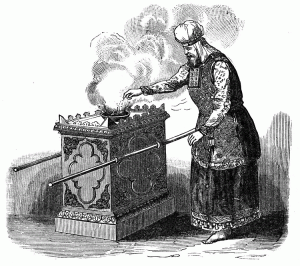
Exodus 30:1–10, Altar to burn incense. The golden incense altar was constructed of acacia wood covered in gold and was situated in front of the veil leading into the holy of holies (the most set-apart place) halfway between the menorah and the table of showbread.

Altar of Incense 25590039

Like the table of showbread, it had a golden crown around the top of it, which points to Yeshua being the head of the body of believers.

The priest burned incense on the altar twice daily, in the morning and the evening.

Scripture reveals that incense represents the prayers of the saints rising up to heaven before the throne of Elohim (Ps 141:2; Rev 5:8), which in the tabernacle is pictured by the mercy seat in the most set-apart place or oracle (d’veer). The altar of incense was a place of deep prayer, praise, worship and intercession and speaks directly to the intimate twice daily prayer life and devotions of the born-again believer before the throne of the Father in heaven.

At the altar of incense, preparation was made to enter the most set-apart place (holy Continue reading →


Shabbat Shalom! Beautiful Nature Scenes from Mexico

There are still beautiful things in this world. Here are photos of a few of them Sandi and I took on our recent 25th anniversary cruise to the Mexican Riviera. I never cease being overwhelmed in awe and joy and the splendors of YHVH Elohim’s creation.

OLYMPUS DIGITAL CAMERA

IMG_1829

OLYMPUS DIGITAL CAMERA

A humpback whale spouting

A humpback whale spouting

IMG_3172

_MG_1483

Try to ignore my feet and focus on the really beauty beyond!

Try to ignore my feet and focus on the real beauty beyond!

And the best of all…Sandi, my lovely bride and gift of heaven of 25 years!

And the best of all…Sandi, my lovely bride and gift of heaven of 25 years!


The Twice Daily Sacrifices Are a Picture of Our Daily Devotions

Exodus 29:38–42, In the morning…at twilight. (See also Lev 1:1–17 and Num 28:1–15.) This twice daily offering was known as the continual burnt offering (Heb. olah tamiyd), and was offered at the door of the tabernacle (verse 42). The word continual (Heb. tamiyd) means “continually.” The Hebrew word for burnt offering is olah meaning “ascent, stairway or steps,” and derives from the basic Hebrew verb, alah, meaning “to go up, climb or ascend.”

Prayer 16958564

In this offering, the fire consumes the entire animal, and the word olah refers to the smoke of this whole burnt offering ascending to heaven, which is a “sweet aroma” to YHVH (verse 41). The olah was an offering or gift (Lev 1:2, Heb. qorban) to YHVH and could be a bull, goat, ram, turtle dove or a pigeon as long as it was a perfect specimen without defect (Lev 1).

If an Israelite sinned, he could bring this gift-offering to the door of the tabernacle where he would place his hands upon the head of the animal, after which the priests would slaughter it, and sprinkle its blood around the altar of sacrifice just inside the door of the tabernacle (Lev 1:2, 4, 5). The meat was then prepared and arranged on the altar and entirely burnt (Lev 1:6–17). When the sinner laid his hands on the animal, it was as if he were transferring his sins onto the innocent, blemish-free animal, where upon YHVH accepted it as an atonement for the person’s sin (Lev 1:4).

The writer of Hebrews clearly teaches that this offering (along with all the other offerings in the sacrificial system) pointed to Yeshua, our Great High Priest, whose atoning death on the cross fulfilled all the types and shadows of the Levitical, sacrificial system (Heb 4:14–5:7; 7:1–10:18).

Besides the obvious antetypes pointing to Yeshua’s death on the cross, what else can we learn from the olah tamiyd offering rituals? What are the spiritual implications and the lessons to be learned for the redeemed believer living in the twenty-first century? Matthew Henry in his commentary on Numbers 28:1–8 sums it up very nicely: Continue reading →