Getting a Christmas Tree? Save Some $ and Read This First!

The use of trees or wooden poles as an object of worship in the ancient world was universal as a fertility or phallic symbol. In many places, the Bible strongly condemns involvement with this pagan custom. Obviously the tree of Jeremiah 10:1–5 is not the modern “Christmas tree” as we know it, since Christmas wasn’t invented by the Christians until about the late fifth century AD. However, the decorated tree is a pagan symbol as evidenced by history, which is why it was outlawed by the Puritans and many other religious groups in America in the 1700s. It was not until the 1850s with many Germans migrating to America with their Christmas tree tradition that Christmas became popularized again in this country.

The Scriptures advise us to abstain from all appearances of evil (1 Thess 5:22). At the very least, because of its pagan connotation, a Christmas tree is an appearance of evil. Furthermore, where in the Bible do we find any examples of YHVH’s people reclaiming a pagan tradition, sanitizing it, and then practicing it? This occurred only when Israel was in a state of apostasy or was attempting to syncretize the religion of the Bible with the pagan practices of the surrounding nations.

True, many things in our daily lives have been tainted by paganism. If we were to toss out everything that fits that category, we probably wouldn’t be able to say anything, wear anything, eat anything, or do anything. Some of us would even have to change our names! What we are to throw out are those things that the Bible forbids, anything that is indigenously pagan, or anything that leads us away from YHVH and his Word.

Often our view of the Scriptures is filtered through our emotions. We all struggle with this spiritual disease. When we’re extremely partial to a belief or an idea, we have a hard time conforming our lives to those biblical scriptures that disagree with us. Thus, we have a spiritual blind spot. For many, Christmas has become a spiritual blind spot because it is so ingrained in our families and the culture  around us. It is perhaps the hardest thing for people to let go of because of family and emotional ties. Each of us has to make the choice: Do we love the praises of family or the praises of Elohim more (John 12:43)?

Jeremiah 10:1–5 is the perfect description of what has come to be known as a Christmas tree. Continue reading →


New Video: Gen 32:3–36:43 Parashat Vayishlach


This is a gospel-oriented Torah study guide. Our goal is to connect the good news of Yeshua the Messiah (the gospel message) to its Hebraic, pro-Torah roots or foundations. The information given here is more than head knowledge. Understanding and wisdom (the right application of knowledge that is based on truth) is taught thus making biblical truth practical, relevant and applicable to your daily life. The truths of the Bible not only have the power to transform your life here and now for the better, but eventually to take you past the veil of death and into eternity.

This Torah study is subdivided in sections by topic in a magazine format thus making it easy to watch at several sittings.

May you be blessed as you watch this video.

For a free, printable adult and youth Torah study guide on this Torah portion (parashah), please go to http://www.hoshanarabbah.org/parshiot.html


Blog Scripture Readings for 12-11 Through 12-17-16

Aside

THIS WEEK’S SCRIPTURE READINGS FOR STUDY AND DISCUSSION:

Parashat Vayishlach — Genesis 32:4 (3)* – 36:43
Haftarah — Obadiah 1:1–21
Prophets — 1 Samuel 5:1 – 11:15
Writings — Psalms 58:1 – 64:10
Testimony — Mark 4:20 – 7:37

Our new Scripture Reading Schedule for 2016-2017 is available to download!

Most of this week’s blog discussion points will be on these passages. If you have general comments or questions on the weekly Scripture readings not addressed in a blog post, here’s a place for you to post those. Just use the “leave a reply” link below.

The full “Read Through The Scriptures In A Year” schedule, broken down by each day, can be found on the right sidebar under “Helpful Links.” There are 4 sections of scripture to read each day. One each from the Torah, the Prophets, the Writings, and from the Testimony of Yeshua. Each week, the Torah and haftarah readings will follow the traditional one-year reading cycle.

* Verse numbers in parenthesis refer to the verse number in Christian English Bibles when they differ from Hebrew Bibles or the Tanakh.

Weekly Blog Scripture Readings for 12/11/16 through 12/17/16.


The Spirit of Laban and Balaam Is Alive and Well on Planet Earth Today!

Flee from the tree of the knowledge of good and evil!

Flee from the tree of the knowledge of good and evil!

Genesis 31:43, Laban and Balaam. It is quite possible that the false prophet Balaam, who heard from YHVH and had a sense of righteousness, though was still steeped in paganism, was a descendant of Laban.

Both Laban and Balaam were from Aram (part of greater Babylon) and only 280 years separated them. One of the Aramaic Targums (Targum Jonathan) equates Balaam with Laban, while other scholars view Balaam as Laban’s grandson.

Both were involved in a mixed-religious system—some truth and some error, some good and some evil. This is the nature of religious Babylon (meaning “mixture” or “confusion”). A mixture of what? Of good and evil.

Remember the tree by that name in the Garden of Eden? Who was the one who enticed man to indulge in that fruit in rebellion to YHVH’s commands?

Even today, Satan the serpent is at the helm of spiritual Babylon trying to lure people into his system of good and evil. Like the tree of knowledge, the religious Babylon of today, out of which YHVH is calling his people (Rev 18:4), is just that—a mixture of truth and pagan lies. How else, for example, do we account for the name of the Christian festival called Easter or Ishtar named after the Babylonian sex goddess of fertility? Or how else do we account for the Christmas tree phallus symbol that also originated from Babylonian sex worship? Or how about the Easter egg (an ancient Babylonian fertility or sex symbol) or the egg on the Jewish Passover Seder plate? All these are symbols of pagan sex worship.

As YHVH called Jacob away from Babylon back to Beth-el (the House of El), and as YHVH turned Jacob’s heart back to the ways of his fathers, is not the same YHVH likewise now calling his people to come out of religious Babylon (Rev 18:4), to separate themselves from that which is unclean or not kosher (2 Cor 6:17)?

Yes, YHVH is pleading for the modern descendants of Jacob (redeemed Israelites or the Israel of Elohim, Gal 6:16) to not succumb to the forked-tongued Labans and Balaams of today who would pull them back into their religious systems that are a mixture of truth and error. Rather, Elohim is urging his people to remember the good, ancient and blessed paths of the Torah of Moses his servant and to listen to the spirit of Elijah as the children’s hearts re turned back to the Hebraic fathers of their faith (Jer 6:16, 19; Mal 4:4–6).


Enslavement to Babylon and Its Idols

idol-20425501

Genesis 31:19, Household idols. Heb. teraphim, from rapha meaning “to heal, make healthful.” The ancient pagans viewed these idols superstitiously as good luck charm for good health and prosperity.

But there is more.

In ancient Babylon, each family had a shrine where it worshipped its household gods, which were in the shape of clay figurines. These family gods served as guardian angels of the home, and would be left to the eldest son, who, acting as the family high priest, would perpetuate the family’s idol worship after the father’s death. The theft of these household idols left Laban in a very agitated state in that he was willing to pursue Jacob to retrieve them, by force, if necessary.

The reason is that these gods conferred the right of primogeniture (to the firstborn son), and acted as a title deed to the father’s inheritance. Thus, Rachel must have stolen her brother’s inheritance thereby making Jacob the legal heir of Laban’s estate (Manners and Customs of Bible Lands, pp. 119–120, by Fred H. Wight; TWOT, p. 980). These idols were actually legal titles to the land of Laban’s household and thus were part of his will. Those who possessed these title deeds became the legal inheritor of Laban’s estate (Social World of Ancient Israel, p. 18, by Matthews and Benjamin)

Genesis 31:43, These daughters are my daughters. Laban claims that Jacob’s wives and children belonged to him. Laban was also steeped in the idolatry of Babylon having in his possession idols or images called teraphim (Gen 31:19, 34–35), which also represented his wealth and were good luck charms.

Is there a modern-day counterpart to this?

Yes. Doesn’t modern Babylon want to control and possess the wives and children of redeemed Israel, indoctrinate them in its pagan religious system and then keep Jacob’s modern descendants from returning to their spiritual and physical homeland and birthright inheritance, and from returning to the Torah-faith of their fathers?

Are governmental systems (e.g. public educational institutions and state and federal Child Protective Services, social welfare programs, various government regulations that have greatly diminished or eliminated many of our personal freedoms along with God-givern parental rights), socio-political organizations (e.g. ACLU, UN) and greedy corporate systems (banking systems that enslave people through debt, corrupters of our food supplies that destroy people’s health, pharmaceutical companies and the mainstream medical establishment that enslaves people’s minds and bodies through drugs) modern-day Labans who want to kill, steal and destroy for the benefit of money and power? Again, yes.

Revelation 18:13 says that end times Babylon the Great will traffic in the souls of men. This speaks at some level of the modern day enslavement of men—of their religious expression, freedom of thought and action.

In these end times, the saints of Elohim must  protect ourselves and their loved ones from idols and the evil machinations of idolators. Let us not forget John’s closing words in his first  epistle:

Little children, keep yourselves from idols. (1 John 5:21)

An idol is anything that gets between us and Elohim.


New Video: River of Life (Pt 1)—How to Come Out of the River of Death


Sons of Thunder…the Voice of YHVH…the Testimony of Yeshua (NT)

new-testament-65290822

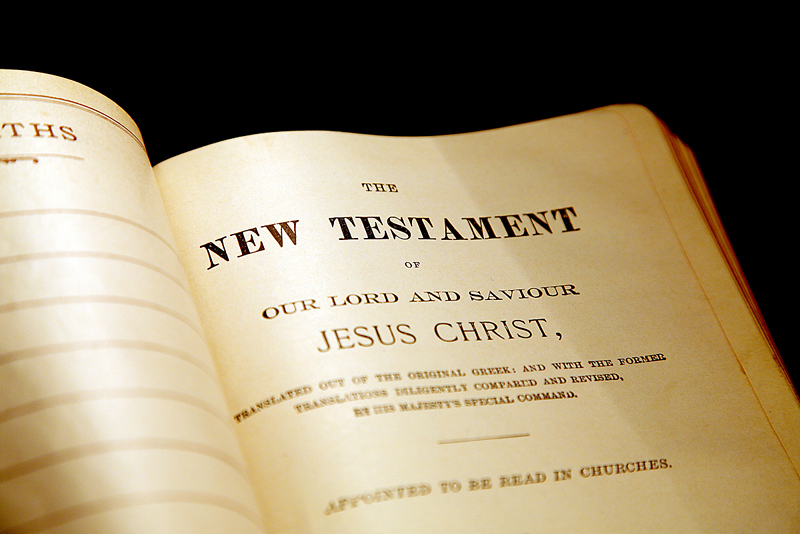
Mark 3:16–17, Surnamed Peter … sons of thunder. Yeshua chose twelve apostles, but the first three of the twelve that he chose were unique. This trio—Peter, James and John—formed the innermost circle of Yeshua’s associates, and ten times the Scriptures record their names together, as a group. Beyond that, Yeshua spoke prophetically over each one which, we can now see in retrospect, pertained to the calling he was giving them to canonize what would later become known as the New Testament. Let’s now examine the scriptural evidence for this assertion.

To Simon, Yeshua gave the nickname Peter, which means “a stone” (Gr. petros meaning “stone” as opposed to petra meaning “rock, cliff, ledge, large stone.” See Matthew 16:18 where juxtaposes these two words—the former he attributes to Peter, the latter to himself.

To James and John, the two sons of Zebedee, he gave the nickname Sons of Thunder (Aram. Boanerges). Did you ever wonder why he dubbed only these three disciples with sobriquets and not the others? Was Yeshua just having fun and playing games, or was he declaring over them, in these nicknames, what their prophetic mission was to be years later? “These are the original apostles Continue reading →