Can you buy your redemption through charitable giving?

Exodus 30:15 and 16, To make atonement for your souls. Some will read these verses and conclude that one can buy their redemption through charitable giving and therefore circumvent the need to place one’s faith in Yeshua’s atoning death on the cross. Does this passage suggest a theology where man can save himself from his sins by acts of charity? Let’s dig a little deeper to see what these verses are really teaching us.

In this passage, YHVH instructed the Israelites to pay an annual half-shekel temple tax. This money went, in part, toward, the service (verse 16) and constructing of the Tabernacle of Moses (e.g. Keil and Delitzsch Commentary on the OT, vol. 1, p. 459; Exod. 38:21–31), and later toward the purchase of the animals the priests sacrificed (The Temple and Its Service, by Alfred Edersheim, p. 48). In this way, the people were participating vicariously in the act of sacrificing an innocent animal as an offering or atonement for their sins. Again, the Scriptures reveal that this sacrificial system merely pointed prophetically toward the Greater Sacrifice that would come later in the Person of Yeshua, the Redeemer of Israel. (Read Isa 53.) On the point that the paying the half-shekel was a merely a temporary solution to the problem of man’s sin, Keil and Delitzsch say in their commentary on this passage,

As an expiation [atonement] for souls, it pointed to the unholiness of Israel’s nature, and reminded the people continually, that by nature it was alienated from God, and could only remain in covenant with the Lord and live in His kingdom on the ground of His grace, which covered its sin (ibid.)

Keil and Delitzsch’s point is further strengthened in Exodus 30:16, which says,

And you shall take the atonement money of the children of Israel, and shall appoint it for the service of the tabernacle of the congregation; that it may be a memorial unto the children of Israel before YHVH, to make an atonement for your souls. (emphasis added; ibid.)

The giving of the half-shekel was a memorial to what? The Hebrew word for memorial is zikrown (Strong’s H2146) meaning “reminder, token, record.” According to The TWOT, a zikrown is an object or act which brings something else to mind or which represents something else. It reminded them of their sinfulness and pointed prophetically to a Redeemer—Yeshua the Messiah— who would come and take away their sins once and for all (Heb 10:10). For a more detailed study of this subject, please see our teaching article entitled, “The Atonement: Bloody or Bloodless? Understanding the Concept of Atonement in the Torah” located on the Hoshana Rabbah website at http://www.hoshanarabbah.org/pdfs/atone.pdf.


 

Are Humans Created Equal?

Exodus 30:15, Rich…poor. 

This passage teaches the equality of all believers. In YHVH’s eyes, each redeemed Israelite saints are equal. To the Creator of all things and who owns everything, no one is worth more than a half-shekel, and no one is worth less than a half shekel. The rich aren’t better than the poor and vice versa. This is also the moral of Yeshua’s Parable of Lazurus and the Rich Man (Luke 16:19–21). Contrary to what many Christians have been taught, this parable isn’t a doctrinal statement about the state of the dead and the afterlife. To many people, including the rich Scribes and Pharisees of Yeshua’s day, material success denotes superiority and even divine favor. The Bible dispels this false notion. YHVH looks at the heart and character of a person and the righteous fruits of their lives, and not at the outward, physical trappings—the proverbial cover of the book. The Scriptures address this issue in several places:

Judge not according to the appearance, but judge righteous judgment. (John 7:24)

A good tree cannot bring forth evil fruit, neither can a corrupt tree bring forth good fruit.

Every tree that bringeth not forth good fruit is hewn down, and cast into the fire. Wherefore by their fruits ye shall know them. (Matt 7:19–20)

But YHVH said unto Samuel, Look not on his countenance, or on the height of his stature; because I have refused him: for YHVH seeth not as man seeth; for man looketh on the outward appearance, but YHVH looketh on the heart. (1 Sam 16:7)

Now the Torah and the rest of the Scriptures teach that all the saints are equal. But what about the rest of humanity? Are all humans created equal?

There are many ways to look at this equality issue. But let’s see what the Bible teaches.

The Bible states in several places that all humans are created in the image of Elohim. This implies equality among all humans.

The Bible also states that all humans are sinners, that all deserve death and that none are righteous of themselves. This also implies equality.

The Bible states that Elohim so loved all the world that he sent his Son to die for all humanity. This implies equality among humans.

The Bible also state that Elohim loved us while we were still sinners. This implies equality among all humans.

Elohim desires all humans to be saved. This also implies equality among humans.

The Bible furthermore states that Elohim isn’t a respecter of persons. This implies equality among humans.

The Bible teaches that there is one Torah-law standard of righteousness for all people—Israelites and non-Israelites. This implies equality.

Moreover, the Bible states that Elohim will judge all humans by that law. All humans will come before his judgment seat. Thus all are equal before the law and before the Judge of the universe.

Conversely, there is no question that the Bible teaches that Elohim favors those who love and serve him. He favors them with a special love and enters into a personal relationship with them. He blesses then in a special way (salvation, healing, answered prayers, special protection, guidance, wisdom the Set-Apart Spirit, etc.) and eventually will reward them with eternal life, glorification and inclusion into his eternal kingdom as his adopted children. So in this sense, Elohim starts out loving and treating everyone equally, but those who choose to love and obey him he favors them and extends his grace to them. In this case, not everyone is treated equally. But this is not based on favoritism on YHVH’s part, but upon the choices that humans make with regard to his initial equal treatment of all. In the end, all humans will reap what they sow. If they obey Elohim they will be blessed with immortality. If they disobey him, with eternal death.

Even though all humans are created equal by Elohim and will stand equal before him, the Bible in no way promotes the idea of economic equality among humans as socialism advocates. But this is another discussion for another time.


Blog Scripture Readings for 3-8 Through 3-14-20

Aside

Parashat Ki Tisa — Exodus 30:11 – 34:35
Haftarah — 1 Kings 18:1-39 | Ezekiel 36:16-38**
Prophets — 2 Kings 19:1 – 25:30
Writings — Proverbs 1:1 – 7:27
Testimony — John 7:1 – 9:41

Our new annual Scripture Reading Schedule for 2019-2020 with daily readings is available to download and print. If you are still working through 2018-2019’s Scripture Reading Schedule, the link will still be available on the right sidebar under “Helpful Links”. If you are using a mobile device or tablet, the link may be below, meaning you’ll need to scroll down instead.

Most of this week’s blog discussion points will be on these passages. If you have general comments or questions on the weekly Scripture readings not addressed in a blog post, here’s a place for you to post those. Just use the “leave a reply” link or the “share your thoughts” box below.

The full “Read Through The Scriptures In A Year” schedule, broken down by each day, can be found on the right sidebar under “Helpful Links.” There are 4 sections of scripture to read each day: one each from the Torah, the Prophets, the Writings, and from the Testimony of Yeshua. Each week, the Torah and haftarah readings will follow the traditional one-year reading cycle.

** A different Haftarah is read when it is a special sabbath in Jewish tradition. This week it is Shabbat Parah on the traditional calendar with a special reading. Otherwise, 1 Kings 18:1-39 would be read.

Weekly Blog Scripture Readings for 3/8 through 3/14/2020.


“Eat my flesh and drink my blood” Meaning

John 6:54, Flesh…blood. “Eats flesh and drinks my blood” is not some ribald admonition on the part of Yeshua to involve themselves in cannibalism, as I have heard some biblically naive and ignorant people claim. What did Yeshua really mean when he made this statement? 

This phrase, in fact, is merely a Hebrew idiom or metaphor meaning “the whole person” (see Matt 16:17; 1 Cor 15:50; Gal 1:6; Eph 6:12; Heb 2:14). This relates to Moses’ instructions that “man shall not live by bread alone…but by every word that proceeds from the mouth of YHVH” (Deut 8:3). This applies to Yeshua who was that Word of Elohim who “became flesh and dwelt among us” (John 1:1 and 14).

When one puts their faith in Yeshua (John 6:29 and 5:24), then one must also believe him—that is, not only accept him as the Son of Elohim and one’s Savior, but also follow and obey (or “eat”) him who is the Living Manna-Word of Elohim from heaven.

This involves believing his words by loving him and keeping his Torah-commands (John 14:15, 23 cp. Exod 20:6), which are his literal words.

This is why YHVH instructed the Israelites to eat the whole Passover lamb, and to leave nothing left over (Exod 12:10).

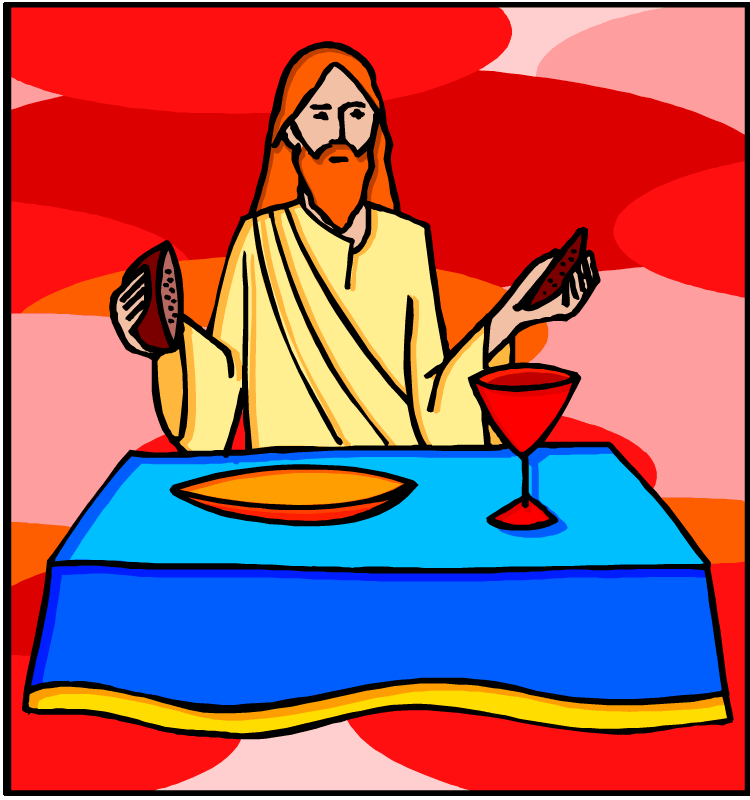
This teaches us that we are to “eat” all of Yeshua—his whole Person as represented by the bread and the wine at communion on Passover. We are to accept the totality of his Word, not just the parts that suit us, or fit with our conventional religious viewpoints as per the traditions of men.

Many believers claim “to eat” all of Yeshua’s flesh and drink all of his blood, yet through their anti-Torah theologies they rip pages out of their Bibles and toss many of YHVH’s biblical instructions and commands into the spiritual trash can claiming these were for the Jews and not for Christians.

Sadly, this is exactly what Adam and Eve did when they listened to the serpent’s lies at the tree of knowledge and rebelled against YHVH’s clear commands. The devil deceived them into take a pick-and-choose approach to the Word of Elohim. This was the first sin that humans committed.

The Bible defines sin as violating the words, commands or Torah of Elohim (1 John 3:4). It is also a sin not to believe in Yeshua (John 16:9; 3:18–19) who is the Living Torah-Word of Elohim incarnate. It is also sin to act in unrighteousness (1 John 5:17). The Bible defines unrighteousness as violating YHVH’s Torah commands (Ps 119:172), which are the words of Yeshua.

In summary, when we accept all of Yeshua by eating his flesh and drinking his blood, (i.e. partaking of the bread and wine at communion) we are confessing that we accept the totality of who he was and is. If we fail to believe and obey all of his words, then to the degree that we do so we are walking in sin, don’t love him and don’t even know him (1 John 2:3–4). 


YOU can’t believe Jesus/Yeshua without also believing Moses!

John 5:46–47, Believed Moses. These two verses at the end of chapter five can easily be overlooked, but their implications are huge. Quite simply, Yeshua is saying that those who don’t believe the writings of Moses (i.e. the Torah) won’t believe the words of Yeshua who himself upheld the Torah and taught its validity in the lives of his disciples. 

This then begs the following question: Where does this leave all those who claim to be followers of Yeshua, but who believe that the law of Moses was abrogated? It’s hard to be absolutely black and white on this matter, since only YHVH can judge the heart condition of each individual, for undoubtedly many who claim the law was “done away with” still actually adhere to many of the law’s tenets (e.g. you shall not steal, murder, lie, commit adultery, worship idols and you shall honor your parents, etc.) and are thus obedient to the law to one degree or another. 

However, we can safely say that it’s a matter of degrees. That is to say, to the degree that we don’t believe the words of Moses, we don’t believe the words of Yeshua who was a proponent (and, in reality, as the Word of Elohim, the Originator) of the Torah-law of Moses. 

John makes a similar statement in his first epistle from which we can deduce the following: To the degree we don’t keep the (Torah) commandments of Elohim, we won’t know him; that is to say, conversely, if we keep his commandments which are a reflection of his character, will and heart, we will be able to know what pleases him, which in turn will determine the depth of our spiritual relationship with him (1 John 2:4). 

In reality, these should be simple concepts to grasp and put into practice in one’s spiritual walk, yet, sadly, most religious leaders have misled Christians to believe anything and everything but the simple truth of the Bible and instead have concocted convoluted man-made doctrines and theological theories resulting in unbiblical church traditions by which they have made the word of Elohim of no effect (Mark 7:13). It’s time for Elohim’s people to come out of the Babylonian church system with its webbed mixture of truth along with half-truths and outright lies (Rev 18:4).

Moreover, Yeshua is saying here that Moses’ prophecies about the coming Messiah formed the foundation for all the subsequent biblical messianic prophecies and the eventual coming of Yeshua the Messiah. If one couldn’t believe these prophecies of Moses, how would they recognize, much less believe in, Yeshua when he did come?


The Twice Daily Sacrifices and the Saints Daily Devotions

Exodus 29:38–42, In the morning…at twilight.(See also Lev 1:1–17 and Num 28:1–15.) Heb. erev meaning “twilight or between the evenings.” According to Alfred Edersheim, the morning sacrifice was offered at 9 AM and the evening sacrifice was offered at approximately 6 PM, since Israel is closer to the equator making the day and night portions on average closer to twelve hours each (The Temple–Its Ministry and Service, p. 108, by Alfred Edersheim). He then goes on the show that by the time of Yeshua, the Jews had changed the time of the evening sacrifice, so that it commenced earlier. By this time, the lamb was killed at about 2:30 PM with the pieces being laid on the altar about 3:30 PM. The whole evening sacrifice service would last until about 4:00 PM (ibid., pp 108–109).


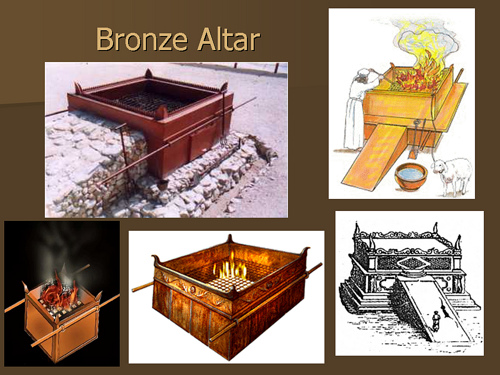
This twice daily offering was known as the continual burnt offering (Heb. olah tamiyd), and was offered at the door of the tabernacle (verse 42). This sacrificial offering has great spiritual implications for the serious disciple of Yeshua and relates to his or her daily life. The word continual (Heb. tamiyd) means “continually.” The Hebrew word for burnt offering is olah meaning “ascent, stairway or steps,” and derives from the basic Hebrew verb, alah, meaning “to go up, climb or ascend.” In this offering, the fire consumes the entire animal, and the word olah refers to the smoke of this whole burnt offering ascending to heaven, which is a “sweet aroma” to YHVH (verse 41). The olah was an offering or gift (Lev 1:2, Heb. qorban)to YHVH and could be a bull, goat, ram, turtle dove or a pigeon as long as it was a perfect specimen without defect (Lev 1). If an Israelite sinned, he could bring this gift-offering to the door of the tabernacle where he would place his hands upon the head of the animal, after which the priests would slaughter it, and sprinkle its blood around the altar of sacrifice just inside the door of the tabernacle (Lev 1:2, 4, 5). The meat was then prepared and arranged on the altar and entirely burnt (Lev 1:6–17). When the sinner laid his hands on the animal, it was as if he were transferring his sins onto the innocent, blemish-free animal, where upon YHVH accepted it as an atonement for the person’s sin (Lev 1:4).

The writer of Hebrews clearly teaches that this offering (along with all the other offerings in the sacrificial system) pointed to Yeshua, our Great High Priest, whose atoning death on the cross fulfilled all the types and shadows of the Levitical, sacrificial system (Heb 4:14–5:7; 7:1–10:18).

Continue reading
 

Davidic Dance—An Expression of Joy and Praise

Psalm 149:1, 3, In the assembly of the saints…dance. (On the dance, see Ps 150:1, 4.) Hebraic worship dance should be an aspect of praise and worship in the congregation of the saints according to the Psalms. Certainly, at the very least, dancing should be occurring on the three pilgrimage feasts or chagim: the Feast of Unleavened Bread, the Feast of Weeks and the Feast of Tabernacles. The Torah refers to each of these three appointed times (Heb. moedim) as chag meaning “festival.” The root word of chag is chagag meaning “to celebrate, keep a solemn feast or holy day, to move or go around in a circle, march in a sacred procession, to reel to and fro in a giddy manner.” Indeed Davidic dancing at joyous celebrations such as the biblical feasts has been a Hebraic tradition since time immemorial.